
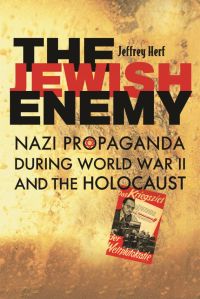
Jeffrey Herf’s The Jewish Enemy is one of the most compelling works on Nazi ideology and propaganda. Rather than treating the Holocaust as a hidden or secretive policy, Herf demonstrates that the Nazis proclaimed their genocidal intentions openly, presenting them as necessary acts of national defense. Through a careful analysis of speeches, press directives, and propaganda materials, Herf shows how Hitler and his regime cast themselves as Germany’s saviors, cleansing the nation of its supposed mortal enemy: the Jews.
Herf’s central thesis is that Nazi propaganda fused the war effort with the campaign against Jews. Hitler and Goebbels portrayed Jews as a conspiratorial force behind both communism and capitalism, responsible for Germany’s humiliation after World War I and its current suffering under Allied attack.
- The Savior Myth: Hitler was presented as the providential leader chosen to redeem Germany. Propaganda fused his personal destiny with that of the German nation — “Hitler is Germany; Germany is Hitler.”
- Cleansing as Redemption: Jews were described as parasites or disease infecting the national body. Genocide was reframed as a hygienic process, with Hitler as the physician purifying the nation.
- The Prophecy Fulfilled: Hitler’s 1939 “prophecy” that a new world war would lead to the annihilation of Jews became a recurring propaganda theme. Once extermination began, it was presented not as aggression, but as the fulfillment of his foresight.
- Propaganda as Legitimization: Newspapers, radio broadcasts, posters, and rallies all reinforced the idea that extermination was part of saving Germany. Mass murder was not concealed; it was sanctified.
Strengths of the Book
- Depth of Sources: Herf draws on an impressive range of primary documents, including Goebbels’ diaries, Reich Press Office directives, and speeches, to prove his point that propaganda was explicit and central.
- Clarity of Argument: The book dismantles the myth that Germans were kept in the dark about Nazi crimes. Instead, it shows that many accepted these crimes because they were framed as acts of salvation.
- Relevance Today: By unpacking the mechanics of propaganda, Herf provides a framework for understanding how leaders justify violence as virtue.
Lessons and Contemporary Relevance
Herf’s book is more than a history of Nazi propaganda; it is a warning for the present. When leaders project themselves as saviors and frame violence as “for the good of the people,” societies are placed on a dangerous path.
This lesson resonates beyond Europe. In the Philippines, former President Rodrigo Duterte framed his brutal war on drugs as an act of national protection — a cleansing mission to save the youth and the future. The logic mirrors Hitler’s:
- Beware of the Savior Myth
Leaders who claim to be the only one who can save the nation are often laying the groundwork for unchecked power. In Nazi Germany, Hitler’s myth silenced dissent and erased accountability. - Language Masks Violence
Euphemisms like “cleansing” or “purification” made genocide sound like hygiene. Today, whenever leaders use sanitized language to describe violence against groups, it should raise red flags. - Scapegoating is a Warning Sign
Hitler blamed Jews for Germany’s crises; modern leaders often blame minorities, migrants, or dissidents. Scapegoating a vulnerable group is a classic prelude to repression. - Violence Disguised as Protection
Hitler justified extermination as defense of the nation. Former Philippine President Rodrigo Duterte used similar language in his war on drugs, claiming extrajudicial killings were necessary “to protect the youth” and “save the nation.” In both cases, cruelty was reframed as virtue. - Propaganda Thrives in Crisis
Fear and instability make people receptive to redeemer figures. When nations face crisis, the temptation to believe in “strongmen saviors” becomes dangerous. - Ordinary People Can Accept Extraordinary Crimes
Herf’s research shows that the Holocaust was not entirely hidden — it was justified in public. Ordinary Germans accepted or ignored it because they were told it was for the greater good. The same mechanism can enable societies today to tolerate mass killings, as long as they are framed as “necessary for survival.”
Herf’s The Jewish Enemy demonstrates that Hitler’s image as savior was essential to the justification of genocide. By presenting himself as the redeemer tasked with cleansing Germany, Hitler transformed violence into virtue and genocide into salvation.
The danger is not only historical. As Philippine politics shows, the savior myth can resurface in new guises. Herf’s work reminds us that the mask of salvation can hide the hand of destruction.
The Jewish Enemy is an essential read for anyone seeking to understand how propaganda can transform mass violence into moral duty. Herf demonstrates that Hitler’s image as savior was not a side story but the very heart of Nazi justification for genocide.
Its enduring lesson is clear: whenever leaders promise redemption through elimination — whether of minorities, dissenters, or the marginalized — societies must resist. For behind the savior’s mask lies the executioner’s hand.
“The Nazis did not conceal their genocidal intentions; they proclaimed them as acts of national defense, casting Hitler as the savior who would cleanse Germany of its enemies.” – Jeffrey Herf, The Jewish Enemy
 Real LexEcon