
Real estate consulting has traditionally been siloed into distinct professional disciplines. Appraisers determine market value; environmental planners prepare land use maps; engineers design infrastructure; lawyers resolve regulatory and title issues; and financial analysts evaluate internal rates of return. Each profession performs an indispensable function within the development lifecycle.
Yet, despite the technical competence of these individual disciplines, a fundamental question often remains unanswered: What development decision creates the greatest long-term economic value?
This question cannot be answered by valuation alone, nor can it be resolved by engineering, planning, law, or finance acting independently. It requires economics.
The Missing Integrator
Economics is frequently misunderstood as merely the study of money, inflation, or macroeconomic growth indices. In reality, economics is the science of decision-making under conditions of scarcity. It examines how limited resources are allocated among competing alternatives to maximize utility and value.
In the built environment, land is perhaps the most finite and critical resource. Every parcel of land possesses multiple potential futures. It could be developed into a residential subdivision, a commercial retail center, a high-density office district, a logistics hub, a healthcare facility, or an integrated mixed-use estate. Each alternative yields vastly different economic outcomes, requires distinct capital outlays, carries varying risk profiles, and generates different levels of public and private benefits.
The consultant’s ultimate responsibility is therefore not simply to determine whether a pre-determined project is structurally or financially viable. The far greater mandate is to discover which specific asset class and strategy the property should support in the first place. That is fundamentally an economic question.
The Limitations of Traditional Consulting
Many feasibility studies suffer from a structural flaw: they begin with a predetermined conclusion. A client approaches a consultant with a specific project already in mind—a condominium tower, a shopping mall, or an office building—and asks the consultant to evaluate its financial viability. While the resulting study may be technically sound, the process implicitly assumes that the proposed project already represents the property’s optimal use.
Rarely is the more critical question asked: Is this the best possible development for this specific property?
A financially feasible project is not inherently the Highest and Best Use (HBU) of the land.
A shopping mall may generate positive returns today, while an integrated mixed-use district could produce significantly greater capital appreciation and economic resilience over a thirty-year horizon. The objective of real estate consulting should not merely be to validate a developer’s assumptions; it must be to identify the precise development strategy that the empirical evidence demands.
Economics Connects Every Discipline
Real estate development is inherently multidisciplinary, but without a central axis, these disciplines can operate at cross-purposes:
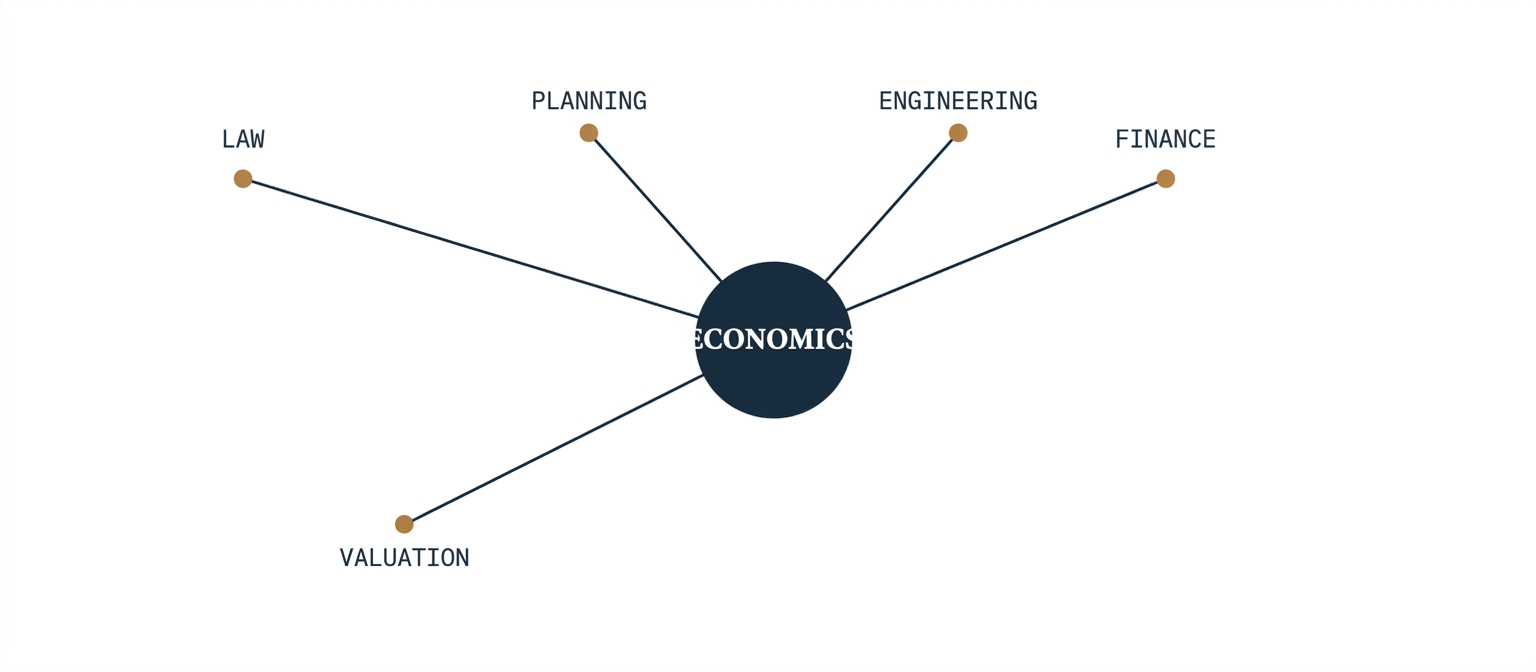
- Law defines ownership boundaries and development rights.
- Planning regulates land use zoning and density limits.
- Engineering enables physical construction and site stability.
- Finance structures the capital stack and assesses liquidity.
- Valuation measures current market value based on historical comparables.
Economics serves as the connective tissue among these fields. It explains how legal constraints shift investment decisions, evaluates how planning regulations compress or expand land values, and measures the opportunity cost of choosing one development path over another.
Economics connects them.
Furthermore, economic analysis decodes market demand and absorption cycles, determines whether expanding a building’s floor area yields diminishing returns, and evaluates how infrastructure access drives localized productivity. Most importantly, economics constantly asks whether scarce land and capital are being allocated to their most productive and resilient use.
From Evidence to Decisions: The EBDC Framework
This realization directly shapes a modern consulting philosophy. Rather than starting with a predetermined project concept, every engagement must begin with an objective audit of the property itself—analyzing its physical characteristics, legal rights, planning controls, surrounding economy, market environment, and institutional context.
Only after synthesizing this evidence should the conversation shift toward a development concept. This philosophy underpins the Evidence-Based Development Consulting (EBDC) framework.
[Traditional Feasibility] ----> Focuses on: "Can this specific project be built?"[Evidence-Based Consulting] --> Focuses on: "What development does the evidence support?"
This structural shift redefines the role of the consultant. The consultant ceases to be a mere validator of a client’s preconceived notions and instead becomes a driver of market opportunities.
Development Rights Are Not Development Capacity
One of the most pervasive misconceptions in real estate development is the belief that the maximum legally permissible development automatically equals the optimal development.
For instance, an urban zoning ordinance may permit a Floor Area Ratio (FAR) of 16, legally allowing a developer to construct over a million square meters of gross floor area. However, that figure merely represents development rights—it does not automatically translate into true development capacity.
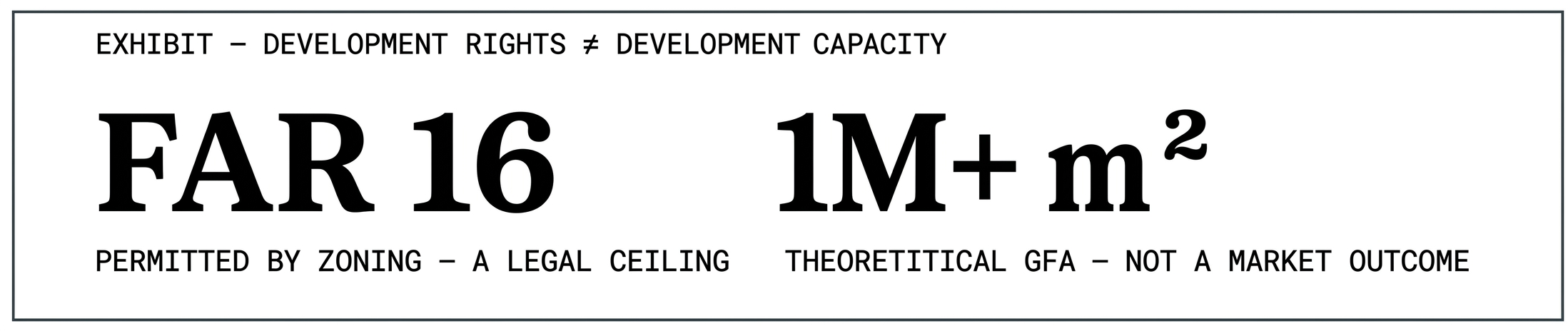
Real development capacity is bounded by a complex matrix of external factors:
- Market demand and sustainable absorption rates.
- Infrastructure availability (power, water, and waste management systems).
- Transportation capacity and localized traffic impact.
- Financial feasibility and realistic capital expenditure limits.
- Investment timing relative to macroeconomic cycles.
- Environmental sustainability and long-term urban livability.
The law establishes what you may build; economics determines what you should build. Shifting the objective away from maximizing raw floor area allows consultants to focus entirely on maximizing long-term economic value.
Beyond Traditional Consulting
Many feasibility studies suffer from a structural flaw: they begin with a predetermined project. A client approaches a consultant with a set proposal—such as a condominium, a shopping mall, or an office tower—and asks the consultant to determine whether that specific concept is financially viable.
While this approach is common, it implicitly assumes that the proposed project already represents the property’s optimal use. Rarely is the more fundamental question asked: Is this the most appropriate development for this property?
Consider a well-located urban property. A condominium may be financially feasible. An office building may also be financially feasible. A medical complex may likewise be financially feasible. The mere existence of financial feasibility does not establish that one alternative is superior to the others. Before evaluating feasibility, we must first understand the complete range of economically supportable development opportunities. That is where Highest and Best Use (HBU) becomes indispensable.
Highest and Best Use as Pre-Feasibility
Highest and Best Use is often misunderstood as a process that selects a singular final project. It does not. Its true role is to identify the development options that are legally permissible, physically possible, financially supportable, and maximally productive.
In other words, Highest and Best Use is a pre-feasibility exercise. It narrows the universe of possibilities into a refined portfolio of viable development alternatives.
                       [ THE UNIVERSE OF POSSIBILITIES ]
                                      │
                         ( Legally Permissible )
                         (  Physically Possible  )
                         ( Financially Supportable )
                         ( Maximally Productive )
                                      │
                                      ▼
                  [ PORTFOLIO OF EVIDENCE-BASED OPTIONS ]
                  (e.g., Office, Mixed-Use, Medical Campus)
For a strategically located property, these alternatives might include:
- A Grade A office district
- A mixed-use commercial center
- A residential-led development
- A medical and wellness campus
- An innovation and technology district
- An integrated metropolitan business district
Each of these alternatives may satisfy the traditional technical tests of Highest and Best Use while responding to different market opportunities and investment strategies. At this stage, the consultant is not dictating which project should ultimately be built. Instead, the consultant is presenting the property owner with evidence-based development options.
The Owner Makes the Strategic Decision
Once the alternative development options have been clearly identified, the decision shifts from technical analysis to corporate investment strategy. The property owner or investor evaluates these options based on institutional factors that extend beyond the standard scope of an HBU analysis, including:
- Capital availability and funding constraints
- Investment objectives (e.g., immediate capital gains vs. long-term yield)
- Organizational capability and execution experience
- Financing capacity and leverage limits
- Partnership opportunities or joint-venture prospects
- Risk tolerance and hurdle rates
- Portfolio diversification goals
- Long-term business strategy
Different owners may legitimately select entirely different development programs for the exact same piece of land. A family-owned corporation may prioritize stable, recurring rental income through office development to preserve multi-generational wealth. Conversely, a public developer may choose residential projects to accelerate capital recovery and velocity. Meanwhile, an institutional investor may favor a diversified mixed-use district structured for future Real Estate Investment Trust (REIT) monetization.
The consultant’s role is not to make that corporate business decision. The consultant’s role is to ensure that every option on the table is supported by objective, empirical evidence.
From Feasibility to Strategy
This perspective elevates the utility of the traditional feasibility study. Historically, these reports answered a binary question: “Is this project feasible (Yes/No or Go/No go)?”
A far more valuable, strategy-driven approach asks: “Which development strategy maximizes the property’s long-term economic potential?”
Answering this requires testing multiple alternative-use scenarios, running sensitivity analyses on market absorption, modeling diverse capital structures, assessing systemic risks, and optimizing the phased allocation of development rights. In this framework, feasibility is no longer the final deliverable; it is simply a component of a comprehensive strategic decision-making process.
The Future of Real Estate Consulting
As cities grow denser and land values rise, urban development becomes increasingly complex. Modern cities face competing, high-stakes demands for housing, employment centers, transit infrastructure, environmental protection, and public amenities. Institutional investors now prioritize long-term ESG resilience over volatile, short-term yields, while local governments increasingly require private developments to generate demonstrable public value alongside financial returns.
In this sophisticated environment, real estate consulting must evolve beyond technical specialization. It must become an economics-driven, multidisciplinary practice. This is not because economics replaces planning, law, or engineering, but because it integrates them into a single, coordinated investment decision.
Ultimately, the most valuable service a modern consultant provides is not a valuation report or a thick feasibility binder—it is the facilitation of better decisions. Every recommendation influences the allocation of finite land, capital, and public resources. Every project shapes neighborhoods, creates employment, generates wealth, and transforms cities.
That level of responsibility demands disciplined reasoning backed by objective evidence. The future of real estate consulting lies not in producing more reports, but in engineering better decisions. And better decisions begin with economics.
About the Author
Augusto B. Agosto is an economist, Environmental Planner, Licensed Real Estate Consultant, Licensed Real Estate Appraiser, and President of AA+ Appraisal & Consultancy, Inc. He is the pioneer of the Evidence-Based Development Consulting (EBDC) framework—an economics-driven methodology that integrates valuation, spatial planning, market analysis, finance, and investment strategy to guide complex real estate and urban development decisions.
AA+ Appraisal & Consultancy, Inc. — Evidence-Based Development Consulting


