
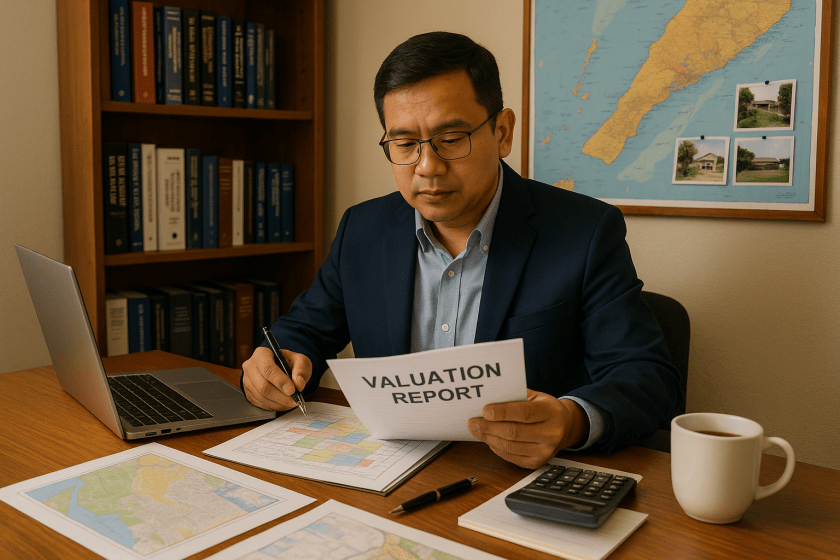
An excerpt from an interview with Appraiser Gus Agosto
In this special feature, a Bachelor of Science in Real Estate Management (BSREM) student sits down with Appraiser Gus Agosto to learn about his early journey into the world of real estate appraisal. From his first spark of interest to navigating the challenges of starting, Appraiser Agosto shares how his background in economics, passion for learning, and hands-on experience shaped his professional path. This insightful conversation offers valuable lessons and inspiration for students and aspiring appraisers alike.
Interviewer:
Welcome, Appraiser Gus Agosto. We’re excited to learn more about your journey into the world of real estate valuation. Let’s begin with your early inspiration.
1. What initially drew you to the field of real estate appraisal, and can you recall the moment you decided to pursue it as a career?
Appraiser Gus Agosto:
My journey into appraisal began during my time as a real estate salesperson and property investment specialist. More than a decade has passed since then. One vivid memory stands out: I was in a developer’s office when I met a gentleman who was reviewing for the appraiser’s licensure exam. I watched him work through a complex mathematical problem and admired the analytical skill involved. That moment sparked a deep curiosity in me, one that never left.
Later, during my broker’s review, I began to understand the nuances of the different professions within real estate. Our lecturers were very encouraging, and I gravitated toward appraisal because of its close ties to economics and mathematics—two subjects I’ve always been passionate about. Given my background as a researcher, writer, and a graduate in economics, the transition felt natural. That’s when I firmly decided to pursue a career in real estate appraisal.
2. How did your educational background or early professional experiences prepare you for the demands of property valuation work?
Appraiser Gus Agosto:
I hold a degree in economics and spent several years engaged in research before entering real estate. I conducted studies on local economies, enterprises, and development trends—work that laid the groundwork for the analytical mindset essential in valuation.
My stint as a real estate salesperson further broadened my understanding. I was exposed to different types of properties and transactions, attended seminars, and got to know the real-world workings of the industry. Steve Jobs once said, “You can only connect the dots looking backward.” In my case, those dots connected my work as a researcher, writer, lecturer, and a real estate practitioner, all of which converged toward a solid foundation in appraisal.
3. What challenges did you face when you were just starting out as an appraiser, and how did you overcome them?
Appraiser Gus Agosto:
Like many beginners in the field, I faced the usual questions: Where do I begin? How do I get clients? One piece of advice from a lecturer stuck with me—start with your “KKK”: Kamag-anak, Kliyente, at Kakilala—your natural network. That became my launching pad.
At one professional association event, I met a fellow appraiser who owned an appraisal firm. She invited me to join their Cebu branch, and I accepted without hesitation. It was a valuable opportunity. The company had a structured system, an established client base, and a culture of mentorship. We focused on the core operations—site inspections, analysis, and report writing. Each report we submitted was reviewed by seasoned appraisers, turning every assignment into a learning experience.
Later on, I had the opportunity to work with another appraisal firm in Metro Manila whose clients included major banks and large corporations. There, I learned the discipline of working in a highly coordinated team with tight turnaround times—often just three days per report. The volume of work was intense, but it sharpened my ability to deliver accurate reports under pressure, without compromising quality.
When I returned to Cebu, I reconnected with mentors who were among the pioneering appraisers in Visayas and Mindanao—back when there were only about five of them in the region. They welcomed me into their practice without formal discussions about fees. For me, the priority was learning. I was exposed to a different side of the profession: that of the individual practitioner. Besides Cebu and nearby provinces, I handled assignments even in remote areas such as Kapatagan in Lanao del Norte, Ozamis, and Clarin. I also had the opportunity to appraise properties of prominent Cebuano families and large-scale developments. That phase lasted for at least two years and deepened my understanding of valuation beyond the corporate environment.
Eventually, a batchmate invited me to serve as an appraiser for a nationwide cooperative, marking the start of my independent practice. I traveled to various locations, encountered a wide range of property types and development conditions, met people from all walks of life, and balanced time in the field with desk work in the office. Those routines became the rhythm of my early appraisal career.
In those formative years, I worked with at least three appraisal firms and three respected individual appraisers. My guiding principle was simple: “Work to learn, and earning will follow.” I was driven by a deep eagerness to grow in the profession, more than anything else.
Looking back, my journey—from economic researcher to real estate salesperson to hands-on valuation—was a kind of “gestation period.” Each phase played a vital role in sharpening my skills and shaping my professional identity as a full-fledged appraiser.
4. Looking back at your first appraisal assignment, what lessons did you learn that still guide your practice today?
Appraiser Gus Agosto:
I’ll never forget my first assignment—it was a warehouse in Pagsabungan, Mandaue. My buddy and I were eager and nervous. We did everything manually—measuring the structure, crawling into tight spaces, and sweating through the inspection. It was tough, but also rewarding.
The biggest lesson I learned was about trust. Clients allow us into their private spaces and rely on our judgment to assign value to their property. That responsibility has always stayed with me. I make sure to explain to my clients how I arrived at the valuation and why it’s fair. For me, valuation is not just about figures—it’s about credibility, integrity, and professionalism. Trust is the foundation of our practice, and I continue to uphold that principle in every report I sign.
Advice to Aspiring Appraisers:
Appraiser Gus Agosto:
To those just starting: “Work to learn first, not just to earn.” Be open to guidance, surround yourself with mentors, and never stop asking questions. This profession is built not just on numbers, but on experience, trust, and continuous growth. Stay curious, stay humble, and stay committed.
Interviewer Wrap-Up:
Thank you, Appraiser Gus Agosto, for that inspiring and grounded look into your journey. Your story is not only a blueprint for aspiring appraisers but also a testament to how passion, persistence, and purpose can shape a meaningful career.

 Real LexEcon