From Cost to Value: Where Engineering Ends and Appraisal Begins

Understanding the Roles of Engineers and Appraisers in Machinery, Equipment, and Renewable Energy Valuation

The valuation of renewable-energy assets presents an opportunity to revisit a long-standing perception in Philippine valuation practice: that machinery and equipment valuation — and even the Cost Approach in general — is primarily the domain of engineers.

There is an understandable historical basis for this view. Engineers possess the technical expertise to understand buildings, machinery, industrial plants, power-generating equipment, and other specialized assets. They can determine specifications, capacity, physical condition, useful life, construction or replacement requirements, and engineering costs.

But an important distinction must be made: knowing the asset and determining its cost are not necessarily the same as determining its value. This distinction becomes particularly clear when we consider the valuation of a renewable-energy facility such as a wind farm or other assets.

The Legal Foundations: Two Professions, Two Mandates

The Engineer Has a Legitimate Valuation Role

Any discussion of professional boundaries should begin by recognizing what the law actually provides. The Philippine Mechanical Engineering Act of 1998 (RA 8495) expressly includes within the practice of mechanical engineering:

“Consultation, valuation, investigation and management services requiring mechanical engineering knowledge.”
— RA 8495, Philippine Mechanical Engineering Act of 1998

The law also covers machinery, turbines, power plants, and plants or processes deriving power from sources that include wind.

Thus, it would be incorrect to suggest that a Professional Mechanical Engineer (PME) has no role in valuation. To the contrary, engineering expertise can be indispensable in understanding highly specialized plant and machinery. A PME examining a wind turbine can provide critical information concerning its design and specifications, rated capacity, operating efficiency, physical condition, maintenance requirements, remaining technical life, replacement requirements, technological characteristics, and engineering cost.

All of these can be essential inputs into valuation. But the question is whether engineering valuation and professional property appraisal are the same function. They are not necessarily so.

Machinery and Equipment Are Also Within the Appraiser’s Competency

The Real Estate Service Act of the Philippines (RA 9646) provides the other side of the discussion. Among the subjects prescribed for the licensure examination of real estate appraisers are:

theories and principles in appraisal; methodology of appraisal approaches; valuation procedures and research; appraisal of machinery and equipment; practical appraisal mathematics; appraisal report writing; and real estate finance and economics.
— RA 9646, Real Estate Service Act of the Philippines

The inclusion of “appraisal of machinery and equipment” is significant. Machinery and equipment valuation is therefore not something alien to the professional competency of a licensed appraiser simply because the assets themselves are highly technical. Rather, machinery valuation is one of those areas where engineering and appraisal naturally intersect — the professions bring different competencies to the same asset.

A Wind Turbine Is an Engineering Asset. A Wind Farm Is a Property.

Consider a wind turbine. From the engineering perspective, important questions include:

  • What type of turbine is it, and what is its generating capacity?
  • How efficiently is it operating, and what is its physical condition?
  • What components require replacement, and what is its remaining technical life?
  • What would it cost to reproduce or replace?

Those questions clearly require engineering knowledge. But suppose the assignment is not merely to examine the turbine — suppose the assignment is to determine the value of the wind-energy property. The valuation problem immediately becomes broader.

A wind-energy property may consist of:

Land + Site Improvements + Buildings + Wind Turbines + Electrical and Mechanical Equipment + Roads + Transmission/Interconnection Facilities + Easements and Other Property Rights

And these physical assets exist within a broader environment:

Location + Neighborhood + Wind Resource + Accessibility + Land-Use Regulation + Environmental Restrictions + Energy Market + Economic Conditions + Government Policy + Risk

The turbine is therefore only one component of a much larger valuation problem. A turbine can be analyzed as a machine. A wind farm must also be analyzed as property situated in a market. This distinction is fundamental.

A Machinery-Intensive Water Treatment Facility

The same principle becomes even clearer when considering another type of specialized property: a large water treatment facility.

Such a facility can be extraordinarily machinery- and infrastructure-intensive. It may contain treatment machinery, pumps and motors, filtration systems, intake facilities, reservoirs, tanks, chlorination systems, metering facilities, electrical installations, control systems and extensive piping. It may also include substantial civil works, buildings, roads, land and other site improvements.

In such an assignment, the engineer’s contribution can be extensive:

Plant design → Treatment technology → Capacity → Pumps and motors → Treatment machinery → Process piping → Transmission pipelines → Electrical/control systems → Condition → Performance → Technical life → Replacement requirements → Engineering cost

Indeed, much of the physical property may be understandable only with competent engineering assistance. Yet this does not transform the entire valuation assignment into an engineering exercise.

Piping Illustrates the Distinction Particularly Well

Consider the piping system. An engineer can identify the pipe material, diameter, pressure rating, length, installation method, pumping requirements, physical condition and remaining technical life. The engineer may also determine the appropriate replacement cost. Those are essential facts.

But the appraiser must consider another set of questions:

  • Where does the pipeline go, and what facilities does it connect?
  • What easements or rights-of-way permit it to occupy its route?
  • Does it have utility independently of the treatment facility?
  • What is its remaining economic, rather than merely physical, life?
  • Is the system oversized or undersized relative to current requirements?
  • Has newer technology affected its economic utility?
  • Are there external circumstances affecting the demand for the capacity it provides?
  • What contribution does the pipeline make to the value of the integrated facility?

Thus, even something as apparently engineering-specific as a pipeline illustrates the difference between technical characteristics and economic value.

The Facility Is More Than Its Machinery

A water treatment facility can be conceptualized as:

  • Land
  • Buildings and Civil Works
  • Intake and Treatment Structures
  • Pumps and Motors
  • Treatment Machinery and Equipment
  • Process Piping
  • Transmission and Distribution Pipelines
  • Reservoirs and Tanks
  • Electrical and Control Systems
  • Roads and Access
  • Easements and Rights-of-Way
  • Other Infrastructure

But even that describes only the physical property. The appraiser must additionally consider:

Property Rights + Location + Neighborhood + Market Conditions + Economic Environment + Regulation + Economic Life + Income or Service Capacity + Risk + Functional Obsolescence + External Obsolescence

This is why a specialized property should not simply be viewed as the sum of its engineering components. The components work together as an integrated economic asset.

What the Valuation Must Also Account For

Land Cannot Be Ignored

Renewable-energy facilities occupy land. That immediately raises questions that cannot be answered solely through mechanical-engineering analysis:

  • What property interest is being valued — is the site owned or leased?
  • What is the value of the underlying land?
  • What are the applicable zoning and land-use restrictions, and what easements affect the property?
  • What alternative uses are available, and what is the highest and best use of the land?
  • What are comparable properties selling for?

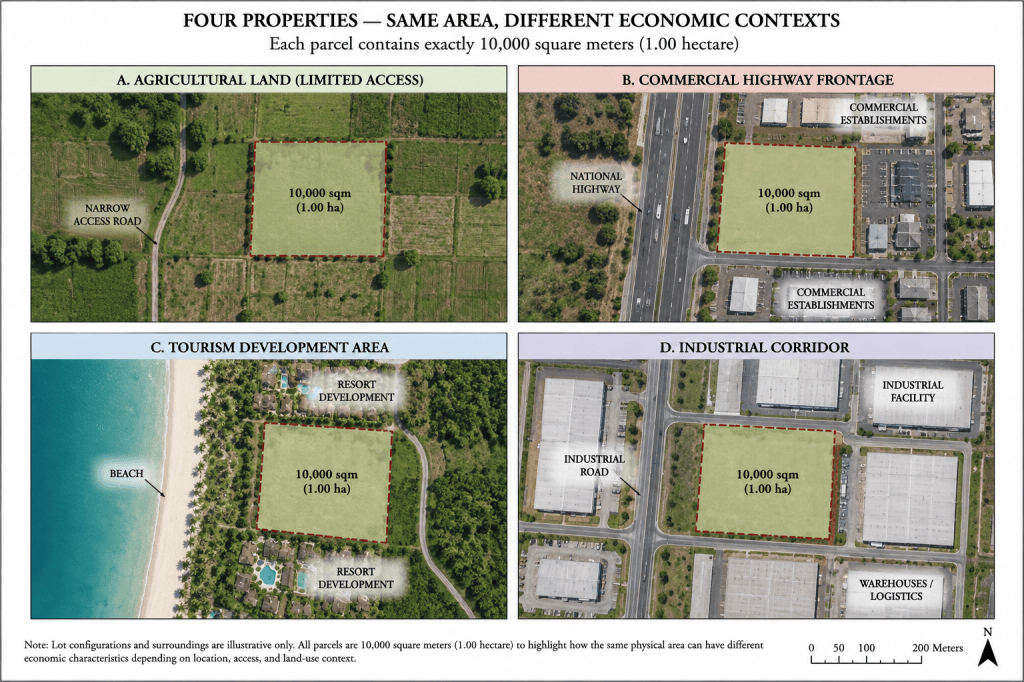
These are not incidental considerations — they can materially influence the value of the overall property. Two wind farms can contain identical turbines and still have substantially different values because their land, location, rights, accessibility, infrastructure, and market environments are different.

The Neighborhood Also Creates — or Destroys — Value

An asset does not exist independently of its surroundings. An appraiser therefore considers the neighborhood and the external forces affecting the property. For a renewable-energy facility, these may include accessibility, transmission connectivity, surrounding land uses, infrastructure, competing developments, environmental conditions, regulatory changes, electricity demand, and broader economic trends.

This is particularly important when analyzing external or economic obsolescence. A turbine may remain mechanically sound while losing economic value because of circumstances completely outside the machine. For example, a PME could correctly conclude that a turbine remains in excellent physical condition and has many years of technical life remaining. The appraiser could simultaneously conclude that its contribution to value has declined because of transmission constraints, changes in energy economics, technological competition, adverse regulatory developments, or other external factors. Both conclusions can be correct because they address different dimensions of the asset.

Cost Is Not Value

The Cost Approach has traditionally been closely associated with engineers because engineers are highly competent in estimating construction, reproduction, and replacement costs. But cost estimation should not be confused with the Cost Approach to value.

Suppose an engineer determines that replacing a wind turbine today would cost ₱500 million. That does not automatically mean:

Replacement Cost = ₱500 million, therefore Market Value = ₱500 million.

For the appraiser, the ₱500 million may only be the starting point. The valuation may require consideration of:

  • Replacement or Reproduction Cost New
  • Less: Physical Deterioration
  • Less: Functional Obsolescence
  • Less: External / Economic Obsolescence
  • = Depreciated Cost Indication

— with appropriate treatment of land, site improvements, property rights and other components according to the particular assignment. Even then, the result is an indication of value, which must be considered within the appropriate basis of value, valuation premise, market environment and, where appropriate, evidence from other valuation approaches.

Cost is evidence. Value is a conclusion.

Depreciation Is More Than Physical Deterioration

The distinction is especially important in measuring depreciation. An engineer may be particularly competent to determine physical deterioration: inspecting the turbine, identifying worn components, estimating repair requirements, analyzing efficiency, and determining remaining technical life.

But valuation depreciation extends beyond physical condition. A perfectly maintained turbine may suffer functional obsolescence because newer turbine technology generates substantially more electricity at lower operating cost. Likewise, a technologically sound turbine may suffer external or economic obsolescence because market, regulatory, environmental, locational, or economic conditions have changed.

Engineering determines what has happened to the asset technically. Valuation determines what those technical — and non-technical — conditions have done to its value. That is a critical distinction.

The Same Principle Applies to Buildings

The issue is not confined to machinery. Consider two physically identical buildings constructed at exactly the same cost. One is situated in a growing commercial district with excellent accessibility, strong demand, compatible surrounding uses, and expanding infrastructure. The other is situated in a declining neighborhood with weak demand, poor access, and adverse surrounding development.

Their replacement costs may be virtually identical. Their values may be very different. Why? Because cost is largely concerned with creating the asset; value is concerned with how the market regards that asset. This is why the Cost Approach cannot be reduced to engineering cost estimation.

The Appraiser Uses More Than One Lens

The valuation of a renewable-energy property demonstrates the integrative nature of appraisal. The appraiser may have to look at the same property through several different lenses:

  • Engineering lens — specifications, capacity, condition, efficiency, technical life and replacement cost.
  • Property lens — land, buildings, improvements, machinery, ownership, leasehold interests and easements.
  • Location and neighborhood lens — accessibility, infrastructure, surrounding uses, transmission connectivity and external influences.
  • Legal and planning lens — zoning, land-use controls, permits, environmental restrictions and highest and best use.
  • Market lens — comparable transactions, supply and demand, market participants, competition and marketability.
  • Economic lens — economic life, electricity markets, operating conditions, functional and external obsolescence.
  • Financial lens — revenues, operating expenses, capital expenditures, cash flows, capitalization, discount rates and risk.
  • Valuation lens — subject of valuation, property interest, basis of value, valuation date, approaches and methods, reconciliation and final opinion of value.

The appraiser does not necessarily personally generate every piece of information. That is neither the purpose nor the strength of professional valuation. The strength of the appraiser lies in knowing what evidence is required, obtaining it from competent sources, testing its relevance, and integrating it into the valuation process.

Appraisal Has Always Been Multidisciplinary

This becomes clearer when compared with the other valuation approaches:

  • An accountant may provide audited revenues and operating expenses — that does not make the Income Approach an accounting function.
  • An economist may provide forecasts of inflation, growth, interest rates, and industry conditions — that does not make economic valuation exclusively an economist’s function.
  • A lawyer may interpret ownership, leases, easements, restrictions, and contractual rights — that does not make property valuation a legal function.
  • An environmental planner may establish planning restrictions and development possibilities — that does not make highest and best use analysis solely a planning function.
  • An engineer may determine replacement cost and technical condition — without making the Cost Approach itself an engineering function.

Professional valuation is inherently multidisciplinary because value itself is multidimensional.

The Real Question: What Are We Valuing?

Before discussing methodologies or professional roles, perhaps the most important question should be: what exactly is the subject of valuation?

  • Are we valuing the wind turbine individually as machinery and equipment?
  • Are we valuing all machinery and equipment within the wind farm?
  • Are we valuing the land, or the land and improvements?
  • Are we valuing a leasehold interest?
  • Are we valuing the entire renewable-energy real property?
  • Or are we valuing an integrated income-producing energy project?

Each is a different valuation problem. The appropriate expertise, scope of work, valuation approaches, assumptions and data requirements depend upon the answer. That is why simply saying “wind turbine valuation” tells us surprisingly little about the actual valuation assignment.

How Engineering and Valuation Expertise Complement Each Other

The proper relationship between engineers and appraisers should therefore not be viewed as a professional turf war. For specialized machinery, the appraiser may need a PME — the PME may possess knowledge of the equipment that the appraiser could never reasonably acquire through ordinary inspection and market research. That expertise strengthens the valuation. But the appraiser performs a different, integrative function.

A useful way of seeing the relationship:

ENGINEER

Technical characteristics → condition → performance → technical life → replacement requirements → engineering cost

APPRAISER

Technical evidence + land + property rights + location + neighborhood + market + economics + income + risk + obsolescence

VALUATION APPROACHES

Cost Approach + Market Approach + Income Approach, as applicable

RECONCILIATION

PROFESSIONAL OPINION OF VALUE

The engineering analysis does not compete with the valuation — it feeds into it.

Moving Beyond an Old Tradition

Perhaps it is time to reconsider the traditional assumption that machinery and equipment valuation — or the Cost Approach generally — is principally an engineer’s territory. That tradition may have developed because cost information was historically one of the most visible components of specialized-asset appraisal. But modern valuation requires much more.

The enactment of RA 9646 itself is instructive. The law expressly includes machinery and equipment appraisal within the competency expected of professional appraisers. At the same time, RA 8495 properly preserves the PME’s authority over valuation requiring mechanical-engineering knowledge. These statutes need not be viewed as contradictory — they instead reveal the multidisciplinary character of specialized valuation. The PME brings depth of technical knowledge. The appraiser brings breadth of valuation analysis. And where the assignment involves a complex renewable-energy facility, both may be necessary.

8. Beyond the Wind Turbine

Renewable energy provides an excellent illustration because the technology is highly visible. But the underlying lesson applies to almost every specialized property:

  • A hospital is more than its medical equipment.
  • A hotel is more than its building.
  • A factory is more than its production machinery.
  • A power plant is more than its generating equipment.
  • And a wind farm is more than its turbines.

Every property exists within a legal, physical, locational, economic and market environment. Understanding the machinery is therefore indispensable. But understanding the machinery alone is not enough to understand value.

Conclusion

Specialized property valuation is necessarily multidisciplinary, but multidisciplinary input should not be confused with the professional function of valuation. Engineers provide indispensable technical evidence on the asset—its characteristics, capacity, condition, performance, physical deterioration, technical life, replacement requirements, and engineering cost. Economists, accountants, lawyers, planners, and other specialists may likewise contribute evidence within their respective fields. Yet cost is not value, physical deterioration is not total depreciation, and technical assessment is not appraisal. Value also reflects functional and external obsolescence, property rights, location and neighborhood, market conditions, economic forces, income potential, risk, and highest and best use.

The distinction is particularly important in machinery-intensive properties such as wind farms, water treatment facilities, power plants, and industrial facilities. The greater their technical complexity, the greater the need for engineering and other specialist expertise—but this does not transfer the valuation function to those specialists. The appraiser leads the valuation process, defines the valuation problem, determines the appropriate approaches and methods, evaluates specialist inputs, analyzes their effect on value, and reconciles the evidence into a supportable professional opinion.

Ultimately, the professions should complement rather than substitute for one another. The engineer helps us understand the asset; the economist helps us understand the economic forces affecting it; but the appraiser integrates these inputs and answers the ultimate valuation question: What is the property or property interest worth?

RESA Month Reflection: Economics as the Foundation of Philippine Real Estate Practice

Every August, the Philippine real estate profession celebrates the enactment of the Real Estate Service Act (RESA), a landmark law that professionalized real estate brokerage, appraisal, and consultancy.

The significance of RESA extends beyond licensure. Its Declaration of Policy recognizes that the real estate service profession plays a vital role in national development by promoting the growth of the real estate industry, protecting the public interest, and ensuring that the services rendered by real estate professionals contribute to economic progress through competent, ethical, and globally competitive practice.

That declaration reveals an important insight.

The objectives of RESA are fundamentally economic.

Efficient property markets, credible valuation, sound investment advice, orderly land development, and the protection of consumers all concern the allocation of scarce resources. Land is finite. Capital is limited. Development opportunities compete with one another. Every decision made by a real estate broker, appraiser, or consultant influences how these scarce resources are allocated throughout the economy.

Viewed from this perspective, economics is not merely one subject in the RESA curriculum. It is the analytical foundation upon which the profession operates.

Economics explains all three.

This understanding also explains why RESA integrates subjects such as valuation, finance, economics, planning, property law, taxation, and consulting within a single professional framework. These are not isolated fields of study. Together, they explain how scarce land, property rights, capital, and development opportunities are allocated to create value while protecting the public interest.

Many practitioners view economics simply as one of the subjects in the licensure examination. In reality, economics is the analytical foundation upon which every real estate decision rests. Whether a broker negotiates a sale, an appraiser estimates market value, or a consultant recommends an investment strategy, each professional is fundamentally making an economic judgment about the allocation of scarce land, capital, and development opportunities.

The broker operates in the marketplace. Every transaction reflects the interaction of demand and supply, consumer preferences, financing conditions, expectations, and competition. A successful broker does more than match buyers and sellers; the broker understands why markets behave the way they do and how economic forces influence prices, absorption, and investment decisions.

The appraiser approaches the same market from a different perspective. Rather than facilitating exchange, the appraiser measures the economic consequences of scarcity, location, utility, anticipation, and income. Market value is not an arbitrary figure. It is an economic conclusion derived from market evidence and professional analysis. Understanding why land commands different values in different locations requires an understanding of economic rent, competition, and highest and best use.

The consultant extends this analysis further by asking a different question: What should be done with the property? A feasibility study is not merely a financial computation; it is an economic evaluation of alternative uses of scarce resources. The consultant examines market demand, development regulations, investment risk, financing, and expected returns before recommending the most economically productive course of action.

Although these professions perform different functions, they are united by the same analytical discipline. Brokerage facilitates market exchange. Appraisal measures value. Consultancy guides investment and development decisions. Economics explains all three.

This perspective also changes how we understand the broader role of real estate professionals in society. Real estate is more than buying and selling land. It concerns the allocation of one of society’s scarcest resources. Decisions involving housing, commercial centers, agricultural land, infrastructure, urban redevelopment, and environmental conservation all involve economic choices. Every zoning ordinance, infrastructure project, valuation report, feasibility study, and investment recommendation ultimately reflects decisions about how limited land and capital should be allocated to maximize economic and social welfare.

This understanding has important implications for professional education. The competencies prescribed under RESA should not be viewed as isolated technical subjects. Valuation, finance, planning, property law, development, taxation, and consulting are interconnected disciplines because they all seek to answer one central question:

How should scarce land and capital be allocated to create the greatest value for individuals, communities, and the nation?

That is the question real estate economics seeks to answer.

As the profession continues to evolve, the role of economics becomes even more significant. Emerging issues such as housing affordability, urban redevelopment, renewable energy, climate resilience, public-private partnerships, digital property markets, and evidence-based valuation all require economic reasoning alongside legal and technical expertise.

Celebrating RESA Month is therefore more than commemorating a law. It is an opportunity to reflect on the intellectual foundations of the profession and to recognize that real estate professionals are not merely brokers, appraisers, or consultants. They are economic decision-makers whose work influences investment, public policy, land use, and national development.

RESA elevated real estate practice into a profession. The next challenge is to strengthen its intellectual foundation.

That foundation is Real Estate Economics.

This article forms part of the continuing work toward the forthcoming book, Economics of Real Estate in the Philippines, which proposes that economics is the common analytical foundation of Philippine real estate brokerage, appraisal, and consultancy.

Beyond the Hotel: Complex Hospitality Valuation in Rehabilitation Proceedings

Open hotel appraisal report showing property overview and financial metrics

One of the privileges of professional practice is the opportunity to work on assignments that challenge not only technical competence but also one’s understanding of economics, law, and property rights.

Our team had the opportunity to undertake two major hospitality valuation assignments in support of corporate rehabilitation proceedings. While confidentiality prevents disclosure of the parties, the engagements involved substantial hospitality assets in Zambales and Tagaytay. They required the application of appraisal principles beyond conventional real estate valuation.

One assignment involved a hospitality development consisting of two five-storey hotel buildings, together with a clubhouse, basement parking, swimming pool, landscaped amenities, function facilities, and more than one hundred individually titled accommodation and commercial units. The complexity of the property required careful analysis of both the physical assets and the legal interests represented by numerous condominium titles.

The second assignment involved another large-scale hospitality village developed on approximately four hectares of land. The property consisted of three multi-storey villa buildings with a combined gross floor area approaching 16,000 square meters, complemented by recreational facilities including a clubhouse, swimming pool, tennis court, landscaped parking areas, and other resort amenities. Unlike the first assignment, however, the underlying land was held under a long-term government lease, requiring the valuation to distinguish between the leasehold interest over the land and the ownership of the buildings and improvements.

These engagements reinforced an important realization.

In complex litigation and rehabilitation proceedings, valuation is no longer about estimating what a property could sell for. It is about understanding what legal rights exist, what economic opportunities those rights create, and how those rights influence value.

Two hotels may appear similar in terms of buildings, rooms, and operations. Yet they may have materially different market values because the underlying property rights differ.

This is precisely why our consulting practice has continued to develop what we refer to as the Evidence-Based Valuation Framework.

Rather than beginning solely with comparable sales, the framework first identifies the property rights involved before systematically examining physical, legal, planning, economic, and market evidence. The final opinion of value is therefore not simply an estimate—it is the conclusion supported by a comprehensive body of evidence.

Assignments such as these demonstrate the expanding role of modern valuation practice. Today’s appraiser is expected not only to measure value but also to explain the legal and economic foundations upon which that value rests. This is particularly important in rehabilitation proceedings, where valuation evidence assists the court, creditors, rehabilitation receivers, and other stakeholders in making informed decisions regarding financially distressed assets.

For us, every engagement is an opportunity to demonstrate that valuation is more than determining a number.

It is the disciplined application of economics, property law, planning, and market evidence to arrive at an opinion that is credible, transparent, and capable of withstanding professional and judicial scrutiny.

The future of valuation lies not merely in producing credible numbers, but in presenting credible evidence.

When One Property Has Three Possible Futures

Insights from Practice

Reflections from a Development Advisory Engagement

Every property has a story.

Some stories are about families preserving generations of ownership. Others involve investors searching for opportunities or businesses planning their next expansion. Occasionally, a property presents something more challenging — not because of what it is today, but because of what it could become.

One such engagement brought me to Batangas.

Every consulting engagement begins long before the first client meeting. Thus, whenever I receive an inquiry, I make it a point to review any available information before meeting with the client. Property titles, tax declarations, zoning certifications, planning documents, location maps, aerial imagery, and publicly available information often provide valuable context about the assignment. This preliminary review allows me to understand not only the property itself, but also the questions that are likely to shape the engagement.

Before meeting the client, I examined the available planning documents and immediately realized that this was more than a routine development study. The property was situated within an area where changing land use patterns and planning policies presented several possible development opportunities. Initial documents suggested that residential subdivision, agro-industrial development, and industrial development could each be considered viable alternatives.

At that point, I knew the first meeting should not begin with development concepts.

It should begin with understanding the client’s decision.

Three Futures, One Decision

The assignment involved a 29,445-square-meter property with considerable development potential. Located within an area experiencing gradual economic growth and changing land use patterns, the property appeared capable of supporting several types of development. At first glance, it seemed like a straightforward consulting engagement.

It wasn’t.

The property could reasonably support a residential subdivision. It also exhibited characteristics suitable for agro-industrial development. At the same time, industrial development could not be immediately dismissed given the municipality’s continuing economic expansion.

Three possible futures.

One property.

One investment decision.

The Three Questions

When we finally met, I asked three questions that I now consider essential in every development advisory engagement:

  • What decision are you trying to make?
  • What level of investment are you prepared to commit?
  • What is your desired timeframe for implementation?

The answers were revealing.

The client was not looking for someone to recommend a particular development. The client wanted an independent assessment that could provide confidence before committing significant capital to a long-term investment.

Those three questions shaped the remainder of the engagement.

Many clients initially expect questions about the property itself. Instead, I try to understand the decision they are facing. A property never exists in isolation. Every recommendation must be viewed in the context of the owner’s objectives, available resources, and implementation timeline.

Where Planning Enters the Picture

As I reviewed the available planning documents, including the Municipal Zoning Certification and the local Zoning Ordinance, it became apparent that the property’s planning environment would play a significant role in shaping its future. The documents provided important guidance on the municipality’s long-term land use vision and the regulatory framework within which future development would occur.

To many property owners, planning regulations are viewed primarily as compliance requirements.

I see them differently.

Planning establishes possibilities. It defines the framework within which opportunities can be pursued, investments can be made, and communities can evolve. Long before architects prepare building plans or contractors mobilize equipment, planning has already begun influencing the future of the property.

The engagement therefore became much more than comparing three development concepts. It became an exercise in understanding how the property’s opportunities aligned with the client’s objectives.

That, in my experience, is where consulting creates its greatest value.

Clarity Over Reports

Clients rarely engage consultants because they need another report. They engage consultants because they must make important decisions involving significant capital, uncertainty, and long-term consequences.

Our responsibility is not to make the decision for them. Our responsibility is to help them understand the choices before them, appreciate the opportunities and risks, and move forward with greater confidence.

The Lesson

Looking back on this engagement, one lesson continues to resonate.

The success of a development is rarely determined when construction begins. It is determined much earlier — when the owner decides what the property should become.

Everything that follows — planning, financing, design, implementation, marketing, and operations — builds upon that single decision.

That is why I continue to believe that development consulting is ultimately about helping people make better decisions.

Not merely about land.

Not merely about buildings.

But about the future those properties are capable of creating.

A Final Reflection

One of the greatest privileges of consulting is being invited into conversations before important decisions are made. Every engagement reminds me that behind every parcel of land is a person, a family, a business, or an institution trying to answer a fundamental question:

“What should we do next?”

Helping clients answer that question thoughtfully, independently, and with confidence remains one of the most rewarding aspects of my profession.

About Insights from Practice

This article is based on a representative consulting engagement. Certain project details have been summarized or modified to preserve client confidentiality. The purpose of this series is not to showcase individual projects, but to share the practical lessons and decision-making principles that emerge from professional consulting experience.

Evidence-Based Valuation: Reconciling Property, Planning, Economic, and Market Evidence

On June 18, 2026, I had the privilege of speaking before the members of the Philippine Real Estate Service Practitioners, Inc. (PhilRES) – Mandaue City Chapter during its 6th General Membership Meeting held at Mandani Bay, Mandaue City. My presentation focused on a subject that has occupied much of my professional work in recent years: Evidence-Based Valuation (EBV) for Litigation, Expropriation, and Just Compensation.

For decades, real estate valuation has relied heavily on the Sales Comparison Approach. Comparable sales remain an important source of market evidence and continue to be one of the most widely accepted methods of determining value. However, in many assignments—particularly expropriation cases, litigation matters, infrastructure projects, and complex property disputes—the question often arises: Is market evidence alone sufficient to explain value?

The traditional appraisal process frequently emphasizes numerical adjustments derived from comparable transactions. While mathematically sound, such an approach may not fully capture the broader factors that influence value. Infrastructure investments, zoning regulations, land use policies, economic growth, scarcity, accessibility, environmental conditions, and development potential all contribute to the creation of value long before they are reflected in actual market transactions.

This observation led to the development of a framework I refer to as Evidence-Based Valuation (EBV).

The central premise of EBV is straightforward: value conclusions should not rely solely on comparable sales but should be supported by the reconciliation of multiple forms of evidence. These include:

Property Evidence – the physical characteristics of the property such as location, area, shape, topography, accessibility, improvements, and development potential.

Planning Evidence – land use plans, zoning classifications, infrastructure projects, government policies, and regulatory controls that influence future utility and development.

Economic Evidence – demand and supply conditions, growth trends, scarcity, investment activity, income potential, and broader economic drivers.

Market Evidence – comparable sales, listings, market transactions, and investor behavior.

These forms of evidence are not independent of one another. Rather, they interact to influence the highest and best use of a property, which ultimately forms the basis of value.

The concept is equally relevant in both ordinary valuation assignments and special-purpose engagements. Evidence-Based Valuation strengthens the foundation of value conclusions by integrating multiple forms of evidence beyond comparable sales alone. Even in ordinary market valuations, appraisers are expected to provide conclusions that are not only supported by comparable sales but also grounded in a thorough understanding of the property’s characteristics, planning context, and economic environment. Courts are often asked to determine compensation that is fair not only to the government but also to the property owner. In such situations, the challenge is not merely selecting a comparable sale but reconciling all available evidence to arrive at a value conclusion that is credible, transparent, and defensible.

Evidence-Based Valuation does not seek to replace established valuation approaches. Instead, it seeks to strengthen them by expanding the evidentiary foundation upon which value conclusions are formed. Comparable sales remain important, but they should be viewed as one component of a broader evidentiary framework rather than the sole determinant of value.

As valuation professionals, we are increasingly called upon to explain not only what a property is worth, but also why it is worth that amount. This requires a deeper examination of the factors that create, sustain, and influence value.

The EBV framework remains a continuing work in progress. Future developments will explore its application to litigation valuation, water rights valuation, infrastructure projects, feasibility studies, market analysis, and just compensation determinations. The objective is not to create complexity for its own sake, but to improve transparency, strengthen professional judgment, and provide decision-makers with more defensible valuation conclusions.

Ultimately, valuation is not merely a mathematical exercise. It is the process of evaluating evidence, reconciling competing perspectives, and arriving at a reasoned conclusion. In that sense, evidence is not an alternative to valuation—it is the foundation upon which valuation rests.

Value is created before it is measured.

When Freedom of Contract Yields: Article 1306, Public Markets, and the Lessons from Baguio

The withdrawal of SM Prime Holdings from the proposed public market redevelopment in Baguio City has often been framed as a failed deal or a breakdown in negotiations. In truth, it offers a far more instructive lesson—one rooted in contract law, urban planning, and the statutory nature of public markets. It shows how freedom of contract, when confronted with planning policy and public welfare, is legally designed to yield.

At the center of this lesson is Article 1306 of the Civil Code, which enshrines freedom of contract but only within firm boundaries. Parties may stipulate as they see fit, but only so long as their agreements are not contrary to law, morals, good customs, public order, or public policy. This conditional structure matters greatly in contracts that affect public interest. Public market redevelopment is one such contract.

Public markets are not ordinary commercial properties. Under Section 17(b)(2)(viii) of the Local Government Code (RA 7160), public markets are expressly classified as basic services, on the same statutory footing as health and welfare facilities. This classification is decisive. Once an activity is defined as a basic service, it cannot be governed solely by profit logic or treated like a private mall. The law itself embeds a social function into the space.

The Local Government Code reinforces this social character through the general welfare clause in Section 16, which authorizes local governments to exercise police power to promote public welfare, social justice, and economic stability. This power includes regulating stall rentals, fees, access, and conditions of use in public markets—even when a private entity is involved through a public–private partnership. Sections 147 and 151 further authorize LGUs to impose reasonable fees and charges, a standard that is explicitly normative, not market-driven. Reasonableness is measured against livelihood capacity and public welfare, not revenue maximization.

When these statutory provisions are read together with Article 1306, the legal architecture becomes clear. Freedom of contract exists, but only within a planning and policy framework already defined by law. Contracts governing public markets are therefore not insulated private arrangements. They are subordinate to public policy as articulated in statutes, urban plans, and zoning ordinances.

In Baguio’s case, the public market has long functioned as a livelihood hub and cultural anchor. Planning objectives—affordability, protection of long-time vendors, and preservation of the market’s public character—were not incidental concerns raised late in the process. They are inherent in how the space is planned and governed. Once these planning constraints were asserted, the scope of permissible contractual discretion narrowed, exactly as Article 1306 anticipates.

From a legal standpoint, SM Prime’s withdrawal was not a failure of freedom of contract. It was a recognition of its limits. Article 1306 does not guarantee that a contract affecting public interest will remain commercially viable under all conditions. It guarantees only that parties may contract subject to existing and continuing public policy constraints. When those constraints—rooted in the Local Government Code and the city’s planning framework—made mall-type economics incompatible with the social function of the public market, withdrawal became the lawful and rational outcome.

This dynamic carries important implications for other cities contemplating similar redevelopments. In places like Cebu, where public markets are likewise embedded in CLUPs and governed by zoning ordinances, contracts cannot be used to bypass planning intent or displace intended beneficiaries through pricing and access mechanisms. Article 1306 ensures that contractual autonomy remains a tool for implementing urban policy, not a mechanism for undoing it.

Ultimately, the Baguio market episode affirms a principle that is often overlooked in infrastructure and redevelopment debates: not all urban spaces are meant to behave like malls. Public markets are planned spaces with statutory social functions. When private contracts collide with those functions, the law does not bend planning to contract. It bends contract to the plan. That is not an aberration in the legal system—it is the system working exactly as designed.

In this sense, the Baguio case demonstrates that Article 1306 does not guarantee the profitability or finality of a public-market contract. What it guarantees is a framework within which private agreement must remain aligned with law and public policy. When alignment becomes impossible—when the commercial model required by the private party cannot coexist with the social function of the public market—the legally correct outcome is not coercive enforcement, but withdrawal.

This dynamic is precisely why the Baguio withdrawal is instructive for other public market projects. It shows that contracts over public markets survive only if contractual autonomy serves, rather than defeats, livelihood, equity, and the common good. Article 1306 does not compel private parties to stay in such contracts at all costs; it simply ensures that they cannot insist on terms that override public policy. Where those terms are essential to the private party’s participation, exit becomes the lawful and rational option.

Seen this way, the Baguio market episode is not an anomaly. It is a practical manifestation of Article 1306’s deeper logic: freedom of contract exists, but in public-interest settings, it yields to social regulation—and when that yield is too great for commercial viability, withdrawal is the system working as designed, not failing.

How CLUPs and Zoning Ordinances Set the Real Limits of Freedom of Contract

Urban planning gives concrete institutional form to the limits that Article 1306 places on contractual autonomy, and this is most clearly expressed through the Comprehensive Land Use Plan (CLUP) and the Zoning Ordinance. These planning instruments are not merely technical documents; they are the local government’s formal articulation of public policy in space. When a contract concerns land or facilities governed by an approved CLUP and zoning ordinance, the contract does not operate above these instruments—it operates within them.

Under Philippine planning law and practice, the CLUP establishes the intended social, economic, and spatial function of land. Zoning then translates that intent into binding regulatory controls on use, intensity, and character of development. When a public market is designated in the CLUP as a civic, institutional, or special commercial use—particularly one oriented toward livelihood and public service—that designation carries legal consequences. It signals that the area is not meant to function as a purely market-driven commercial zone akin to a mall district. Instead, it is planned as livelihood infrastructure, embedded in the city’s social economy.

This is where Article 1306 and planning law converge. Article 1306 allows parties to stipulate freely, but only so long as those stipulations are not contrary to law or public policy. In the urban planning context, the CLUP and zoning ordinance are the most authoritative local expressions of public policy. A redevelopment contract that effectively transforms a public market—planned and zoned as a socially oriented urban facility—into a space governed by mall-type economics may comply with the text of the contract, yet still conflict with the CLUP’s planning intent. When that happens, Article 1306 ceases to protect contractual discretion and instead becomes the legal basis for regulation, recalibration, or even non-continuance of the agreement.

The Baguio public market episode illustrates this clearly. While the proposed contract with SM Prime Holdings may have been commercially sound, it ran into a planning reality grounded in Baguio City’s land-use objectives. The public market’s role in the city’s CLUP—as a livelihood hub, cultural space, and civic anchor—meant that zoning and planning policies necessarily imposed limits on rental structures, vendor displacement, and land-use intensity. Once the city asserted these planning constraints, the contract could no longer be treated as a purely private commercial arrangement. Under Article 1306, stipulations inconsistent with those planning objectives lost their normative force.

From an urban planning standpoint, this outcome is not accidental; it is structural. CLUP and zoning compliance function as ex ante filters on what kinds of contracts are viable in particular locations. They ensure that cities do not contract away their planning mandate through long-term agreements that lock in spatial outcomes contrary to adopted plans. Article 1306 provides the legal bridge that makes this possible by subordinating contractual freedom to public policy as expressed through planning instruments.

This has important implications for other cities contemplating public market redevelopment, including Cebu City. If the CLUP and zoning ordinance characterize Carbon Market as a public market, special commercial zone, or civic space with explicit livelihood and social functions, then any PPP or joint venture must be interpreted—and if necessary, regulated—through that planning lens. Contracts cannot be used to bypass zoning intent, intensify commercial use beyond what the CLUP envisions, or displace intended beneficiaries without violating public policy. When conflicts arise, Article 1306 does not protect the contract; it protects the plan.

In this sense, CLUP and zoning compliance are not secondary considerations that follow contract execution. They are preconditions that define the legal environment in which contracts operate. The Baguio withdrawal shows that when planning objectives are clear and consistently enforced, private parties make rational decisions: they either adapt their contractual expectations to the plan or withdraw. Both outcomes preserve the integrity of the planning system.

Ultimately, the lesson for urban governance is clear. Planning leads; contracts follow. Article 1306 ensures that freedom of contract remains a tool for implementing the CLUP, not a mechanism for undoing it. When cities take their planning instruments seriously, contractual autonomy aligns with urban policy—or yields to it.

How Econometric Analysis Solved a Client’s Valuation Challenge in BGC

In today’s volatile property market, even fully leased buildings can face uncertainty when interest rates rise and yields compress. One of our clients is a developer with a 30-storey, 76-unit office tower in Bonifacio Global City. They sought clarity on whether their investment was still performing as expected. Through econometric analysis, we transformed complex market data into actions. This gave them financial insight that helped them see beyond occupancy rates. They focus on true value, risk, and return.

The Client’s Challenge

A private developer approached our team with a critical question:

“Is our 30-storey, 76-unit office building in Bonifacio Global City still financially viable under current market conditions?”

The client had completed construction two years earlier. The building was fully leased. They were concerned about rising interest rates. Modest rental escalations are eroding investment returns.

The property’s leasing structure appeared competitive. It includes a mix of bare-shell and fitted office units. These units range from PhP1,500 to PhP1,800 per sqm per month. However, management wanted to know if the building’s cash flows truly reflected its economic value. They questioned whether adjustments in pricing, escalation, or capital structure were necessary.

In short, the challenge was not occupancy — it was understanding profitability in a tightening capital market.

Our Approach

Instead of relying on conventional yield assumptions, our team applied econometric modeling. This is an analytical framework that links property-level performance to measurable macroeconomic drivers.

We began by reconstructing the building’s income statement. We also reconstructed rental schedules across 76 office units and all 30 floors. We factored in current lease terms and 3% annual escalations. Additionally, we used observed market data from Pinnacle Real Estate Consulting and Arcadis Philippines.

From there, we derived two distinct discount rates using both finance-based and property-specific risk models:

MethodFormulaResult
Finance-Based (CAPM)R=Rf+β(ERP)+SRP17.40%
Real Estate Build-UpR=Rf+∑RiskPremiums13.16%

Each parameter was anchored to empirical data. This includes the risk-free rate, beta, and risk premiums. These were tied to data from the Bangko Sentral ng Pilipinas, PSA inflation series, and Damodaran’s country risk tables.

By integrating these variables, we aligned the building’s valuation with economic reality rather than static, one-size-fits-all assumptions.

Findings: Translating Data into Decision

Our projection model covered a 10-year period, reflecting the economic life of the building’s interior improvements.

Discount RatePresent Value of Cash Flows (PhP)Fit-out & Equipment Cost (PhP)NPV (PhP)Interpretation
13.16%11,801,35812,472,358–671,000Breakeven (stabilized scenario)
17.40%10,655,64612,472,358–1,816,000Slightly negative (equity scenario)

Despite the modest NPV results, the cash inflows were sufficient to recover the capital outlay within the project’s economic life. This indicated a financially balanced asset — not speculative, but self-sustaining and capital-preserving.

The key insight for the client was that profitability was not being lost. It was simply redefined by changing macroeconomic conditions. In other words, the property’s yield had adjusted to reflect a maturing market.

We extended the analysis to examine how the project would perform under various economic shocks:

  • A 1% increase in the discount rate (e.g., due to rising interest rates) would reduce the property’s value by approximately PhP700,000.
  • A 1% increase in rental escalation would improve valuation by about PhP500,000.

This confirmed that interest-rate and capital-market movements have a greater effect on value than marginal rental adjustments.

The adopted PhP1,800 per sqm rate for fitted offices is advantageous. It places the property squarely within the prime BGC rental range of PhP1,400–PhP1,900. The effective yield is 7–8% per annum. This is a level consistent with institutional benchmarks in Metro Manila’s investment-grade office sector.

The results of the econometric analysis allowed the client to make well-informed and financially sound decisions. Our findings confirmed the current rental rate structure of PHP 1,500 to PHP 1,800 per square meter per month. This rate was aligned with prevailing market conditions. These rates match the conditions in Bonifacio Global City. Attempting to increase the rates further would risk higher tenant turnover without producing a proportional increase in building value. Hence, the most strategic course was to maintain existing rents, ensuring consistent occupancy and stable revenue streams.

Second, the study validated the client’s 3% annual escalation policy. It demonstrated that this policy accurately reflected the average inflation rate. It also matched the standard lease renewal adjustments in the area. This approach ensured that income growth would remain sustainable and competitive, balancing tenant affordability with long-term asset performance.

Finally, we advised the client to reclassify the building’s investment profile—from a short-term growth-driven asset to a core income property. This repositioning recognized that the building had already reached stabilization, with 100% occupancy and predictable cash inflows. The property could now serve as a capital preservation anchor within the client’s portfolio. It would provide reliable income to offset higher-risk, higher-yield developments elsewhere.

What initially seemed like a modest or even negative Net Present Value (NPV) was reinterpreted. It became a measure of financial efficiency. The building’s inflows matched its cost of capital. This indicated that it was performing exactly as expected in a mature market like BGC. Through this shift in perspective, the client gained a clearer understanding of the property’s value. The client also gained a more strategic framework for portfolio management, anchored in data, discipline, and economic logic.

This case highlights how econometric reasoning transforms real estate valuation from a static appraisal into a dynamic decision-making tool. We treated rents, yields, and escalation rates as variables linked to broader economic conditions. This approach helped us uncover not just the property’s value but also the logic behind it. The client learned that a neutral or breakeven NPV is not necessarily a weakness. It can signify equilibrium and maturity in a market. In this market, stability is the new form of strength.

For investors, the key takeaway is that macro-driven valuation brings clarity in times of uncertainty. Understanding how discount rates move with monetary policy provides a sharper sense of timing. Recognizing how escalation aligns with inflation sharpens your understanding of risk and opportunity. For developers, the lesson is strategic. Once a building reaches full occupancy and stable returns, it should be viewed as a core income asset. This asset anchors the portfolio and preserves capital rather than being seen as a speculative venture.

Ultimately, the study demonstrates that data and discipline lead to confidence. In Bonifacio Global City, every percentage point of yield and risk can mean millions in value. Econometric analysis offers a distinct advantage. It gives clients the ability to move beyond intuition. Consultants can also ground their investment strategies on measurable, defensible evidence.

By: AB Agosto, JD, REA, REB, REC, MA Economics (University of San Carlos)
Paralegal – Real Estate, Environmental & Corporate Law

The Impact of the WorldRisk Report on Philippine Real Estate

The Philippines, a nation of islands situated in the typhoon belt, remains one of the world’s most disaster-prone countries. The WorldRisk Report 2025 is a publication of Bündnis Entwicklung Hilft. It is also published by the Institute for International Law of Peace and Armed Conflict (IFHV) of Ruhr-University Bochum. It places the country among those with the highest global risk exposure. This conclusion is once again highlighted. The report has a special focus on floods. Floods are the most frequent and destructive natural hazard worldwide. Between 2000 and 2009, floods accounted for 44 percent of all global catastrophes, affecting more than 1.6 billion people and causing losses exceeding USD 650 billion. In the Philippines, flood vulnerability continues to rise because of climate-related rainfall intensification. Unregulated urbanization contributes to the risk. The degradation of natural buffers such as wetlands and mangroves exacerbates the situation.

These recurring flood events are no longer isolated environmental phenomena. They are now central to understanding how real estate functions. They are also central to understanding how real estate is valued. Climate risk directly influences property demand, development feasibility, and investment decisions. What once defined value purely in economic terms—location, accessibility, and market trends—now includes resilience, adaptability, and sustainability. Floods not only damage structures and displace communities but also recalibrate the long-term performance and desirability of land.

The Real Property Valuation and Assessment Reform Act (RA 12001), enacted in 2024, reflects this changing reality. It establishes a uniform national valuation framework, standardizes market-based approaches, and introduces mechanisms for adaptive reassessment. Among its provisions, Section 18 explicitly recognizes that disasters and calamities can alter property market values. It authorizes local government units to revise their Schedules of Market Values. This occurs whenever “significant changes” happen due to calamities or disasters. These changes can be man-made or natural. This provision marks a significant legal milestone. It integrates disaster risk into valuation governance. It acknowledges that climate events are legitimate economic variables. These variables can affect land and building worth.

This legal recognition aligns with the 2025 WorldRisk Report findings. The report calls for an integrated response. It combines four key perspectives: political, technological, social, and ecological. Political measures emphasize decentralized governance and the inclusion of risk management in land-use planning. Technological innovation encourages the use of satellite data, LiDAR mapping, and AI-based flood forecasting to inform planning and decision-making. Social resilience underscores community preparedness and traditional knowledge systems that reduce vulnerability. Ecological solutions advocate for mangrove reforestation, wetland restoration, and nature-based flood control, which simultaneously protect biodiversity and buffer human settlements.

In real estate valuation, these four dimensions translate into practical implications. Under the cost approach, flood exposure accelerates physical deterioration. It shortens the remaining economic life of improvements. Appraisers must apply higher depreciation rates. They also need to use more conservative estimates of useful life. The income approach must consider flood-induced operating expenses. It should also factor in reduced rentability and risk-based capitalization rates. These considerations help to account for uncertainty in income streams. Meanwhile, the market approach must segregate comparable sales based on hazard exposure. This is important since properties within flood-prone zones typically transact at discounted prices. These properties also exhibit longer marketing periods.

Beyond appraisal technique, the relationship between flood risk and property value also reflects broader behavioral and institutional adjustments. Developers now prioritize elevation, drainage systems, and green design. Lenders are requiring flood-risk assessments before approving mortgages. Insurers have introduced differentiated premiums based on hazard classification. These market adjustments demonstrate that resilience has become a form of economic capital—one that safeguards value and attracts investment.

Yet the transformation brought by the WorldRisk Report and RA 12001 extends far beyond valuation methodology. It is reshaping the Philippine real estate sector as a whole. Urban planning now integrates flood risk into Comprehensive Land Use Plans (CLUPs). Developers incorporate retention ponds and elevated designs as standard practice. Financial institutions are embedding environmental risk into credit assessments. The convergence of scientific data, legal frameworks, and market adaptation signals a new era in property governance. In this era, resilience is not peripheral but central to defining and protecting value.

In this evolving landscape, real estate valuation has likewise been methodologically reshaped. It is no longer a static appraisal of economic worth but a dynamic assessment of risk, sustainability, and adaptive capacity. Properties are now judged by their performance under pressure. This includes how they resist, how they recover, and how they remain useful during climate events. The very meaning of “value” has expanded: it now includes the ability to endure.

Ultimately, the 2025 WorldRisk Report and RA 12001 together redefine the fundamentals of real estate in the Philippines. The former provides the global scientific context for understanding hazard exposure. The latter establishes the national legal mechanism to respond to this exposure. Together, they transform how property is developed, managed, financed, and valued. In the age of climate uncertainty, the true measure of real estate is no longer limited to its square meters. It is also not defined by its location. Instead, it lies in its resilience per square meter.

In this century of rising tides and shifting ground, resilience is not just protection—it is value itself.


References

Bündnis Entwicklung Hilft & IFHV Ruhr-University Bochum. WorldRiskReport 2025. Available at: https://weltrisikobericht.de/worldriskreport/
Republic Act No. 12001. Real Property Valuation and Assessment Reform Act of 2024. Official Gazette of the Republic of the Philippines.
Department of Finance – Bureau of Local Government Finance. Philippine Valuation Standards (PVS 2023).

Why Title Annotations and Encumbrances Matter in Property Appraisal

In valuation, the fine print on the title can be as valuable—or as dangerous—as the land itself.

In real estate appraisal, numbers alone do not tell the whole story. A property’s legal status—particularly the annotations and encumbrances appearing on its title or tax declaration—can drastically alter its worth. While some may view these legal markings as mere notarial footnotes, a seasoned property appraiser understands that such entries are crucial to determining the property’s true value, marketability, and risk profile.  One of the most important but sometimes overlooked aspects of valuation is the presence of annotations and encumbrances on the property’s Transfer Certificate of Title (TCT), Original Certificate of Title (OCT), or Tax Declaration. These annotations—whether involving tax delinquency, pending litigation, or other restrictions—can drastically alter a property’s value, marketability, and highest and best use (HBU). For the professional appraiser, understanding and correctly interpreting these legal markings is essential, not optional.

Why Appraisers Must Pay Attention

There are several compelling reasons why a diligent appraiser must care about annotations and encumbrances.

First, these legal burdens directly affect market value—the core product of any appraisal. Buyers in the open market are generally unwilling to pay full price for a property encumbered by unresolved claims, legal disputes, or forfeiture risks. Appraisers must therefore consider how each annotation may cause potential buyers to either walk away or demand a discount.

Second, legal risk translates to value risk. Annotations such as a lis pendens, adverse claim, or a writ of attachment signal potential issues with ownership, possession, or future usability. Even if a property looks physically sound, a legal cloud on its title will make it less attractive and inherently riskier. Prudent appraisers account for this by adjusting their valuation assumptions, often applying a discount or issuing a qualified opinion.

Third, these annotations frequently affect the property’s highest and best use (HBU)—a foundational concept in valuation. If a property is subject to restrictive covenants, reversionary clauses, or foreshore lease limitations, its legal permissibility for development or other productive use may be severely constrained. The appraiser must therefore revise the HBU analysis and its associated value estimate accordingly.

Fourth, annotations impair a property’s marketability. For instance, a property that has been auctioned off for tax delinquency but is still within the redemption period cannot be sold with confidence. Similarly, if a property was inherited but the title transfer is not yet perfected, there may be co-heir disputes or administrative delays. In both cases, the property may be legally transferable only in theory, but not in practice—at least not without cost or time delays.

Fifth, annotations affect the property’s loanable value or equity value. Banks and other financial institutions are wary of lending against titles that carry risks. For example, a property mortgaged beyond its current market value or encumbered with a lien from unpaid taxes may only be eligible for partial financing, or worse, may be rejected altogether as loan collateral. This has direct implications for the appraiser’s task in estimating not just market value, but the net realizable or mortgageable value.

Finally, ignoring these factors may violate the appraiser’s professional and legal responsibilities. Under the Real Estate Service Act (RA 9646), the appraiser is required to exercise due diligence and report all material conditions that affect the value of the property. International Valuation Standards (IVS) and the Uniform Standards of Professional Appraisal Practice (USPAP) similarly require full disclosure and the proper interpretation of legal burdens. Failing to do so may expose the appraiser to liability, loss of license, or reputational damage.

Understanding the Specific Impact of Common Annotations

To make these risks and responsibilities more concrete, let’s examine how common annotations and encumbrances impact valuation:

A Notice of Tax Delinquency or Forfeiture carries a negative impact on value and significantly impairs marketability due to the risk of government seizure. When a Certificate of Sale appears on the title—typically following a tax auction—the buyer only has conditional ownership until the redemption period lapses. This also warrants a discounted valuation and caution in reporting.

A Lis Pendens indicates that the property is subject to ongoing litigation. Its presence severely impairs marketability and imposes legal uncertainty, which in turn reduces value. An Adverse Claim similarly signals a third-party interest in the property that contradicts the titleholder’s claim. While not always litigated, it still creates hesitation for buyers and lenders, pulling values downward.

A Levy or Writ of Attachment represents a judicial restriction. Courts attach the property to secure a possible judgment, and while the property is not yet seized, its transferability is legally curtailed. This justifies a risk adjustment in the valuation.

If the title carries a Foreshore Lease or a Department of Environment and Natural Resources (DENR) annotation, it usually means that the property is within the public domain (such as coastal or reclaimed land). Ownership is limited to leasehold rights, not fee simple. This not only reduces the appraised value to the leasehold interest but also conditions its use based on government regulation.

An Affidavit of Loss or Reconstitution of title temporarily affects the property’s marketability, especially if the reconstitution process is incomplete. Although this may only have a neutral to slightly negative impact on value, it still warrants disclosure and may be included as a limiting condition in the report.

A Real Estate Mortgage (REM), if current and performing, generally has a neutral impact on market value, assuming the appraisal is for market purposes and not equity extraction. However, the appraiser must still distinguish between total market value and the equity portion when applicable.

An Easement or Servitude, such as a right of way or drainage restriction, slightly reduces the value and may condition the property’s utility. If the easement affects buildable area or accessibility, this becomes a material consideration.

Reversion clauses or restrictive covenants are more serious. These limit future development, prohibit certain uses, or allow the property to revert to a former owner under certain conditions. As these significantly constrain HBU and market flexibility, they usually result in a negative value adjustment.

Lastly, annotations involving Deeds of Donation, Inheritance, or Partition may suggest that the property was recently transferred or is part of a co-ownership arrangement. If the legal transfer is incomplete or the estate is unsettled, the title remains in flux. This affects both value and marketability, particularly if there is a risk of future claims or if the sale requires consent from multiple parties.

In real estate valuation, legal clarity is just as important as physical condition. Title annotations and encumbrances represent real risks, limitations, and burdens that influence the value of a property. Whether through discounted sales, delayed transactions, restricted use, or diminished loanability, these legal notations affect how market participants perceive and engage with real estate assets.

The professional appraiser must go beyond mere physical inspection and apply legal awareness, risk sensitivity, and valuation expertise to provide credible, well-supported opinions of value. Every annotation tells a story—of ownership, encumbrance, or uncertainty—and the appraiser must read, interpret, and reflect that story in the appraisal report.

Property Identification: The Sacred Foundation of Real Estate Appraisal

In the meticulous world of real estate appraisal, one principle stands above all others: you cannot value what you cannot identify correctly. Whether working on a condominium in Makati, a farmland in Bukidnon, or a contested estate in Cebu, the first and most sacred duty of any appraiser is to accurately and defensibly identify the subject property. This is not just a technical requirement—it is the foundation of credibility, legality, and fairness in valuation. A mistake in property identification is not a small error. It invalidates every step that follows: the market comparison, highest and best use analysis, risk assessment, and final value estimate. Simply put, wrong property means wrong valuation.

Property identification involves several components. It means correctly determining the legal identity of the land—via Transfer Certificate of Title (TCT), technical description, and lot number. It also means identifying the actual physical location and ensuring it matches the documents, zoning classification, and any physical improvements or encumbrances. Every valuation method—whether it’s the market approach, cost approach, or income approach—relies on this first step. If you appraise the wrong lot, all your calculations, assumptions, and conclusions become legally and factually meaningless.

This is why misidentification carries not only technical consequences but also legal and ethical ones. A wrong appraisal can lead to court rejection of the report, denial of loans by banks, and even legal liability for misleading courts or clients. Under Article 19 of the Civil Code of the Philippines, professionals have a duty to act with justice, give everyone their due, and observe honesty and good faith. The Philippine Valuation Standards likewise emphasize that appraisers must exercise due diligence and care—beginning with accurate property identification.

Some of the most common pitfalls in this process include relying solely on the owner’s verbal claim without matching it against documentary evidence, misplotting technical descriptions, failing to check for easements or encroachments, and confusing adjacent lots with similar features. These errors are preventable with a disciplined and documented approach. A responsible appraiser will cross-check TCT data with the tax map and zoning ordinance, conduct field validation through site visits, use geotagged photos or drones, and even consult barangay officials or boundary markers when in doubt.

The risks of inaccuracy are very real. Imagine an appraiser tasked to value Lot 6 but instead inspects and reports on Lot 5. If Lot 5 is under threat of expropriation or prone to flooding, while Lot 6 is not, the valuation will be drastically wrong. In judicial proceedings, such a mistake may result in an unjust award of compensation or legal challenge. In lending, it may lead to defective collateralization. The appraiser’s name—and the integrity of the profession—are on the line.

I always emphasize that property identification is not just a preliminary step—it is the moral compass of professional practice. It sets the tone for the accuracy, fairness, and trustworthiness of the entire report. Real estate is a high-stakes industry. The margin for error is slim, and the cost of error is great. That is why we say: Property identification is sacred. Wrong property is wrong valuation. Always.