
Expropriation is often discussed as a procedural mechanism through which the government acquires private property for roads, bridges, transmission lines, airports, flood control systems, and other public infrastructure. Yet beneath its procedural framework lies one of the deepest constitutional tensions in democratic governance — the tension between the rights of the individual and the demands of the collective.
At the center of every expropriation case is a constitutional balancing process. On one side stands the individual property owner invoking the protection of the Bill of Rights. On the other side stands the State acting in the name of public welfare, infrastructure development, and societal necessity. Eminent domain exists precisely because constitutional democracy recognizes both interests as legitimate.
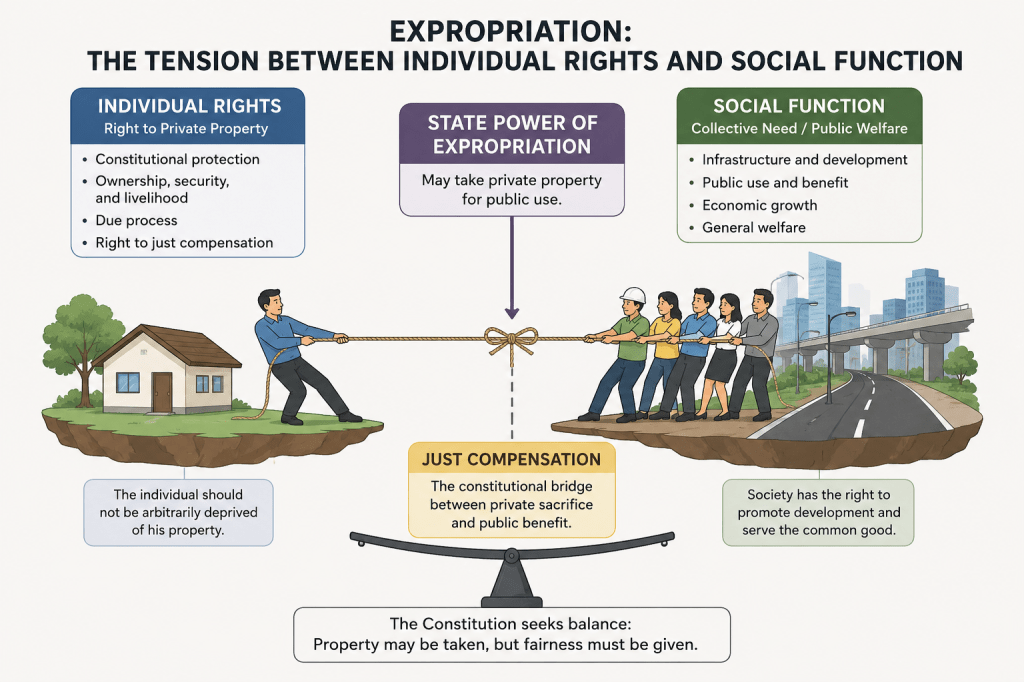
The Constitution protects private property because ownership is deeply tied to liberty, security, livelihood, and human dignity. Land is not merely a commodity or economic asset. For many families, property represents inheritance, identity, social stability, and intergenerational survival. The taking of property therefore affects more than physical land; it interferes with constitutionally protected expectations and rights.
This is why Article III, Section 9 of the Constitution declares that private property shall not be taken for public use without just compensation. The provision reflects the recognition that while the State may possess sovereign authority to compel the transfer of property for public purposes, such power is never absolute. The Constitution restrains governmental authority by imposing safeguards grounded on fairness and due process.
At the same time, society itself possesses collective needs that cannot be ignored. Modern civilization depends upon infrastructure and public systems that require land. Roads, railways, ports, schools, hospitals, power lines, flood control projects, water systems, and transportation corridors cannot materialize without space. Urbanization, economic development, environmental protection, and disaster resilience increasingly require coordinated public intervention over land use and spatial development.
Without the power of eminent domain, public infrastructure could easily become hostage to fragmented ownership or strategic refusal to sell. Collective welfare would become difficult, if not impossible, to achieve.
Thus, expropriation emerges as a constitutional compromise between private ownership and public necessity. The State may compel the taking of private property for public use, but society cannot impose the burden of public development upon a single owner without compensation. Just compensation therefore becomes the constitutional bridge between collective benefit and private sacrifice.
In many ways, just compensation reflects a principle of distributive justice. If society benefits collectively from a public project, then society — acting through the State — must fairly compensate the individual whose property was sacrificed for that collective benefit. The owner may not necessarily prevent a lawful taking for public use, but the owner possesses the constitutional right to receive the full and fair equivalent of the property taken.
This explains why the Supreme Court consistently emphasizes that the determination of just compensation is a judicial function. Courts serve as constitutional arbiters between governmental power and individual rights. The judiciary ensures that compensation is not dictated solely by political convenience, administrative valuation schedules, or institutional interests. Judicial review prevents the possibility that the coercive power of the State overwhelms constitutional fairness.
The valuation process itself therefore acquires constitutional significance. In expropriation, appraisal is no longer merely technical or commercial. Market value becomes part of constitutional justice. An undervalued appraisal effectively forces the landowner to subsidize public infrastructure unfairly. Conversely, an excessive valuation burdens public resources and ultimately affects society as a whole. The objective is constitutional equilibrium — fairness both to the owner and to the public.
This constitutional balancing also explains the critical role of commissioners under Rule 67 of the Rules of Court. Commissioners are not representatives of the expropriating agency nor advocates for the landowner. They are auxiliaries of the court tasked to assist in the fair and impartial determination of just compensation. Their role carries constitutional implications because they participate directly in balancing individual rights against collective societal interests.
For this reason, the Rules require commissioners to be competent and disinterested. Independence is essential because once valuation becomes driven by institutional loyalty, political pressure, or predetermined outcomes, the constitutional integrity of the expropriation process begins to erode.
The tension between individual rights and collective welfare has become even more complex in contemporary society. Today, expropriation increasingly intersects with climate adaptation, environmental protection, renewable energy, urban redevelopment, mass transportation, disaster mitigation, and sustainability planning. Governments now justify takings not only for traditional infrastructure, but also for broader societal objectives involving environmental resilience and long-term public survival.
As collective interests expand, however, constitutional protections remain indispensable. The challenge of modern governance is not simply to accelerate development, but to ensure that development remains constitutionally just.
This evolving landscape also transforms the nature of property law itself. Expropriation can no longer be understood solely as a procedural remedy or land acquisition mechanism. It now exists at the intersection of constitutional law, valuation, urban planning, economics, environmental governance, and infrastructure policy.
The future property lawyer, appraiser, and land governance specialist must therefore understand not only ownership doctrines and legal procedures, but also how land functions within broader economic, environmental, and societal systems. Questions involving just compensation increasingly require appreciation of market behavior, zoning, infrastructure externalities, environmental regulation, and public policy.
Ultimately, expropriation reflects one of the most profound realities of constitutional democracy: ownership is protected, but ownership is not absolute. Property carries both private rights and social obligations. The State may compel individual sacrifice for the collective good, but the Constitution insists that such sacrifice must never occur without fairness, due process, and just compensation.
That enduring balance between individual rights and collective welfare remains the true constitutional essence of eminent domain.
Brief History of Individual and Collective Rights
The history of political and constitutional philosophy reveals a continuing tension between collective authority and individual liberty. In the ancient and medieval world, collective order, political community, and social hierarchy largely dominated over individual autonomy. The individual was viewed primarily as part of the larger social or political body.
From this collective order eventually emerged the philosophy of individual rights during the Enlightenment. Thinkers such as Locke and other liberal philosophers asserted that human beings possess inherent natural rights — life, liberty, and property — which the State must respect rather than create. This intellectual movement eventually gave rise to liberal constitutionalism and the modern Bill of Rights, where the protection of the individual against arbitrary governmental power became central.
However, the rise of industrialization, economic inequality, labor exploitation, and other societal problems exposed the limitations of purely individualistic systems. As a result, constitutional thought gradually evolved once again toward social rights and collective welfare. Modern constitutions increasingly recognized labor rights, social justice, environmental protection, public welfare, and the social function of property.
Today, modern constitutionalism attempts to balance both traditions. Contemporary constitutions protect individual rights and liberties while simultaneously recognizing legitimate collective interests necessary for social order, development, and public welfare. Thus, modern constitutional law is ultimately an ongoing effort to reconcile individual freedom with the demands of society as a whole.


