Ten Questions to Ask Before Accepting an Expropriation Assignment

By Augusto B. Agosto, REA, REC, REB, EnP, JD

This morning, a newly licensed appraiser asked me a question:

“How do I start an expropriation appraisal assignment?”

Many appraisers immediately think about comparable sales, market data, or valuation methodology. While these are important, I believe the first steps occur long before the valuation process begins.

Expropriation is not a simple and ordinary appraisal assignment. It is a judicial proceeding involving property rights, public interest, legal procedures, and the constitutional requirement of just compensation. An appraiser appointed by the court, whether as Commissioner or member of a Board of Commissioners, carries a responsibility that extends beyond determining market value.

Over the years, I have developed a series of questions that I ask myself before accepting an expropriation assignment.

1. Am I a Disinterested Person?

The first document I request from the client is a copy of the Complaint.

Before discussing value, I want to know:

  • Who are the parties?
  • What property is involved?
  • What is the nature of the taking?
  • Do I have any relationship with the parties?

This allows me to determine whether there is any actual or perceived conflict of interest.

The Rules of Court require a Commissioner to be a disinterested and competent person. Independence is therefore not merely an ethical consideration—it is a legal requirement.

2. Am I Competent to Accept This Assignment?

The next question is equally important.

Do I possess the competence required by the Court for this particular case?

Expropriation requires more than valuation knowledge. An appraiser must understand the legal framework governing the proceeding.

Among the important laws and rules that should be familiar to an expropriation appraiser are:

  • Rule 67 of the Rules of Court (Expropriation)
  • Rule 32 of the Rules of Court (Commissioners)
  • RA No. 8974 and its amendments
  • RA No. 12001 RPVARA
  • The ARROW Act and its Implementing Rules
  • Comprehensive Agrarian Reform Law
  • Local Government Code
  • Relevant jurisprudence on just compensation and property rights

Understanding these laws allows the appraiser to appreciate the broader litigation process, the role of the parties, the duties of the commissioners, and the standards by which the court evaluates evidence.

3. Who Is the Expropriating Authority?

Another important question is:

Who is exercising the power of eminent domain?

Is it:

  • A national government agency?
  • A government-owned or controlled corporation?
  • A local government unit?
  • A utility company exercising delegated eminent domain powers?
  • Another entity authorized by law?

The answer helps determine the applicable legal framework, the procedures involved, the source of funding, and the nature of the project.

For example, national government infrastructure projects may involve RA No. 8974, RA No. 12001, the ARROW Act, and related regulations. Local government expropriations may involve different statutory requirements under the Local Government Code. Utility companies and government corporations may likewise operate under special laws.

Before determining value, the appraiser must first understand who is taking the property and under what authority such taking is being exercised.

4. What Property Right Is Being Taken?

One of the most common mistakes is assuming that every expropriation involves the acquisition of full ownership.

Not all takings are the same.

The government may acquire:

  • Fee simple ownership
  • Right-of-way
  • Easement
  • Transmission line corridor
  • Temporary construction easement
  • Access rights
  • Portions of improvements

Before value can be determined, the property right being acquired must first be identified.

You cannot value what you have not properly defined.

5. What is the Time of Taking?

One of the most important questions in any expropriation assignment is:

What is the legally recognized date of taking?

Many appraisers mistakenly assume that valuation is always based on the current value of the property or that the date of taking is uniform across all compulsory acquisitions. In reality, the applicable valuation date often depends on the governing law, the nature of the acquisition, and the circumstances of the case.

For example, infrastructure right-of-way acquisitions, traditional expropriation proceedings under Rule 67, and agrarian reform acquisitions may involve different legal frameworks and different approaches in determining the relevant date for valuation.

In agrarian reform cases, the issuance of a Notice of Coverage does not automatically constitute the date of taking. While it marks the commencement of the acquisition process, jurisprudence has recognized that the determination of the date of taking requires an examination of when the landowner was effectively deprived of ownership rights, possession, use, enjoyment, or economic benefits of the property, as contemplated by the governing agrarian laws.

Similarly, in infrastructure and right-of-way acquisitions, the legally relevant date may be influenced by statutory provisions governing possession, entry, deposits, negotiated acquisition, and expropriation proceedings.

The valuation date is not merely a procedural matter. It is often one of the most significant legal issues in the determination of just compensation. A difference of several years between the date of taking and the date of appraisal can substantially affect the value conclusion and the amount ultimately awarded by the court.

Before determining value, the appraiser must first determine the applicable law, identify the legally relevant date of taking, and understand the jurisprudence governing that acquisition.

The question is not:

“What is the property worth today?”

The more important question is:

“What was the property worth on the date recognized by law for purposes of determining just compensation?”

6. What Standard of Value Is Required?

Many appraisers immediately think in terms of market value.

However, the court is often concerned with just compensation.

The two concepts are related but not always identical.

An appraiser must understand:

  • Market value
  • Just compensation
  • Consequential damages
  • Consequential benefits
  • Compensation for improvements
  • Compensation for crops and other affected interests

Understanding the applicable legal standard is essential.

7. What Evidence Supports My Opinion?

The first question should not be:

“What comparables are available?”

The better question is:

“What evidence is available?”

Comparable sales are important, but they are only one form of evidence.

The appraiser must also examine:

  • Property characteristics
  • Property rights
  • Legal conditions
  • Planning evidence
  • Economic evidence
  • Market evidence

A valuation that relies solely on comparable sales may fail to capture the broader realities affecting value.

8. How will I personally inspect the Property?

No amount of documentation can replace actual inspection.

Titles, plans, and tax declarations provide information.

Site inspection provides understanding.

Actual inspection often reveals:

  • Existing access
  • Physical conditions
  • Occupation
  • Improvements
  • Constraints
  • Opportunities

Many critical valuation issues are discovered only in the field.

9. Can the Judge Understand My Report?

One of the purposes of a Commissioner’s Report is to assist the court.

A technically correct report that cannot be understood by the judge has failed in one of its essential functions.

The appraiser must be able to explain:

  • The facts
  • The evidence
  • The reasoning
  • The conclusions

in a clear and understandable manner.

10. Can I Defend My Opinion Under Oath?

Every valuation submitted to the court will be examined, questioned, and challenged.

Ask yourself:

  • Are my comparables defensible?
  • Are my adjustments supported?
  • Is the highest and best use justified?
  • Have I verified the title?
  • Have I disclosed limitations and assumptions?

A report should be prepared with the expectation that it will be scrutinized by lawyers, judges, and other experts.

Before submitting any report, I ask myself one final question: If I am placed on the witness stand tomorrow, can I confidently explain every assumption, adjustment, conclusion, and recommendation contained in this report?

If the answer is no, more work is required.

The report is not yet ready.

Conclusion

Expropriation appraisal is not merely an exercise in determining value.

It is the process of assisting the court in determining just compensation for the taking of private property.

The appraiser’s role therefore extends beyond market analysis. It requires competence in property rights, valuation, evidence, legal procedure, and professional judgment.

In my experience, the most important question is not:

“Can I determine value?”

The more important question is:

“Can my valuation withstand the scrutiny of the court?”

That is where expropriation appraisal truly begins.

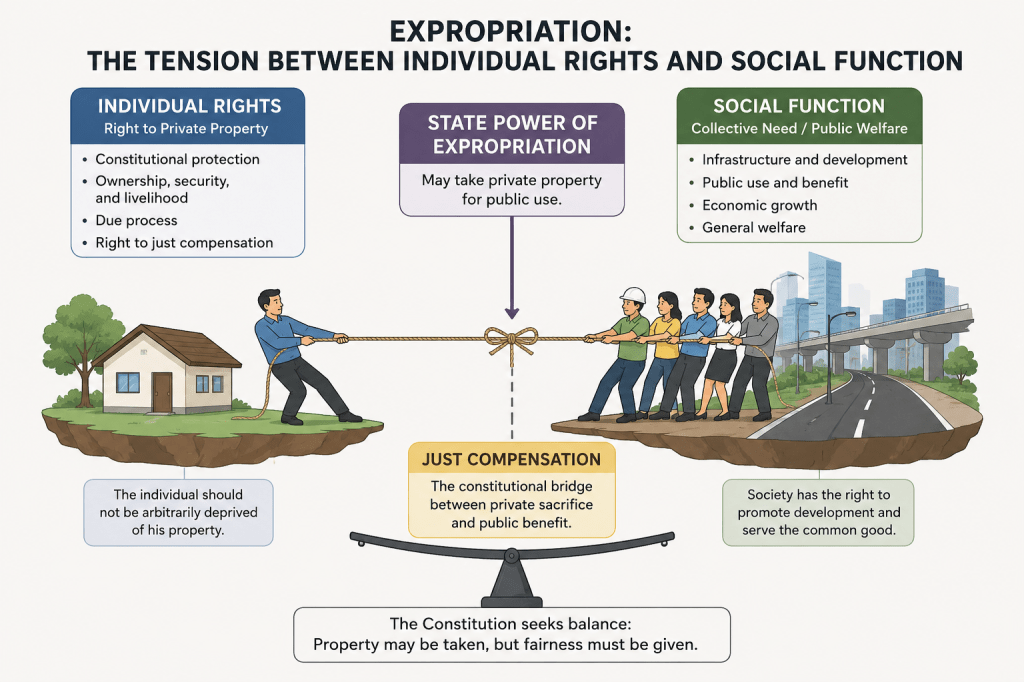
Expropriation and Just Compensation: Between Individual Rights and Social Function

Expropriation is often discussed as a procedural mechanism through which the government acquires private property for roads, bridges, transmission lines, airports, flood control systems, and other public infrastructure. Yet beneath its procedural framework lies one of the deepest constitutional tensions in democratic governance — the tension between the rights of the individual and the demands of the collective.

At the center of every expropriation case is a constitutional balancing process. On one side stands the individual property owner invoking the protection of the Bill of Rights. On the other side stands the State acting in the name of public welfare, infrastructure development, and societal necessity. Eminent domain exists precisely because constitutional democracy recognizes both interests as legitimate.

The Constitution protects private property because ownership is deeply tied to liberty, security, livelihood, and human dignity. Land is not merely a commodity or economic asset. For many families, property represents inheritance, identity, social stability, and intergenerational survival. The taking of property therefore affects more than physical land; it interferes with constitutionally protected expectations and rights.

This is why Article III, Section 9 of the Constitution declares that private property shall not be taken for public use without just compensation. The provision reflects the recognition that while the State may possess sovereign authority to compel the transfer of property for public purposes, such power is never absolute. The Constitution restrains governmental authority by imposing safeguards grounded on fairness and due process.

At the same time, society itself possesses collective needs that cannot be ignored. Modern civilization depends upon infrastructure and public systems that require land. Roads, railways, ports, schools, hospitals, power lines, flood control projects, water systems, and transportation corridors cannot materialize without space. Urbanization, economic development, environmental protection, and disaster resilience increasingly require coordinated public intervention over land use and spatial development.

Without the power of eminent domain, public infrastructure could easily become hostage to fragmented ownership or strategic refusal to sell. Collective welfare would become difficult, if not impossible, to achieve.

Thus, expropriation emerges as a constitutional compromise between private ownership and public necessity. The State may compel the taking of private property for public use, but society cannot impose the burden of public development upon a single owner without compensation. Just compensation therefore becomes the constitutional bridge between collective benefit and private sacrifice.

In many ways, just compensation reflects a principle of distributive justice. If society benefits collectively from a public project, then society — acting through the State — must fairly compensate the individual whose property was sacrificed for that collective benefit. The owner may not necessarily prevent a lawful taking for public use, but the owner possesses the constitutional right to receive the full and fair equivalent of the property taken.

This explains why the Supreme Court consistently emphasizes that the determination of just compensation is a judicial function. Courts serve as constitutional arbiters between governmental power and individual rights. The judiciary ensures that compensation is not dictated solely by political convenience, administrative valuation schedules, or institutional interests. Judicial review prevents the possibility that the coercive power of the State overwhelms constitutional fairness.

The valuation process itself therefore acquires constitutional significance. In expropriation, appraisal is no longer merely technical or commercial. Market value becomes part of constitutional justice. An undervalued appraisal effectively forces the landowner to subsidize public infrastructure unfairly. Conversely, an excessive valuation burdens public resources and ultimately affects society as a whole. The objective is constitutional equilibrium — fairness both to the owner and to the public.

This constitutional balancing also explains the critical role of commissioners under Rule 67 of the Rules of Court. Commissioners are not representatives of the expropriating agency nor advocates for the landowner. They are auxiliaries of the court tasked to assist in the fair and impartial determination of just compensation. Their role carries constitutional implications because they participate directly in balancing individual rights against collective societal interests.

For this reason, the Rules require commissioners to be competent and disinterested. Independence is essential because once valuation becomes driven by institutional loyalty, political pressure, or predetermined outcomes, the constitutional integrity of the expropriation process begins to erode.

The tension between individual rights and collective welfare has become even more complex in contemporary society. Today, expropriation increasingly intersects with climate adaptation, environmental protection, renewable energy, urban redevelopment, mass transportation, disaster mitigation, and sustainability planning. Governments now justify takings not only for traditional infrastructure, but also for broader societal objectives involving environmental resilience and long-term public survival.

As collective interests expand, however, constitutional protections remain indispensable. The challenge of modern governance is not simply to accelerate development, but to ensure that development remains constitutionally just.

This evolving landscape also transforms the nature of property law itself. Expropriation can no longer be understood solely as a procedural remedy or land acquisition mechanism. It now exists at the intersection of constitutional law, valuation, urban planning, economics, environmental governance, and infrastructure policy.

The future property lawyer, appraiser, and land governance specialist must therefore understand not only ownership doctrines and legal procedures, but also how land functions within broader economic, environmental, and societal systems. Questions involving just compensation increasingly require appreciation of market behavior, zoning, infrastructure externalities, environmental regulation, and public policy.

Ultimately, expropriation reflects one of the most profound realities of constitutional democracy: ownership is protected, but ownership is not absolute. Property carries both private rights and social obligations. The State may compel individual sacrifice for the collective good, but the Constitution insists that such sacrifice must never occur without fairness, due process, and just compensation.

That enduring balance between individual rights and collective welfare remains the true constitutional essence of eminent domain.

Brief History of Individual and Collective Rights

The history of political and constitutional philosophy reveals a continuing tension between collective authority and individual liberty. In the ancient and medieval world, collective order, political community, and social hierarchy largely dominated over individual autonomy. The individual was viewed primarily as part of the larger social or political body.

From this collective order eventually emerged the philosophy of individual rights during the Enlightenment. Thinkers such as Locke and other liberal philosophers asserted that human beings possess inherent natural rights — life, liberty, and property — which the State must respect rather than create. This intellectual movement eventually gave rise to liberal constitutionalism and the modern Bill of Rights, where the protection of the individual against arbitrary governmental power became central.

However, the rise of industrialization, economic inequality, labor exploitation, and other societal problems exposed the limitations of purely individualistic systems. As a result, constitutional thought gradually evolved once again toward social rights and collective welfare. Modern constitutions increasingly recognized labor rights, social justice, environmental protection, public welfare, and the social function of property.

Today, modern constitutionalism attempts to balance both traditions. Contemporary constitutions protect individual rights and liberties while simultaneously recognizing legitimate collective interests necessary for social order, development, and public welfare. Thus, modern constitutional law is ultimately an ongoing effort to reconcile individual freedom with the demands of society as a whole.

Police Power or Eminent Domain? Lessons from Banco de Oro v. South Rich Acres

One of the recurring constitutional tensions in land use regulation and infrastructure development is the blurred line between police power and eminent domain. Government agencies and local government units often invoke public welfare, regulation, or urban necessity to justify interference with private property rights. Yet the Constitution draws a critical distinction: regulation may be allowed without compensation, but taking requires the payment of just compensation.

This distinction was strongly reaffirmed by the Supreme Court in Banco de Oro v. South Rich Acres, G.R. Nos. 202384 and 202397, decided on May 4, 2021.

The case arose from a dispute involving Marcos Alvarez Avenue in Las Piñas City. South Rich Acres, Inc. (SRA) and Top Service, Inc. owned several parcels of land comprising the road. Over time, the road became heavily used by motorists and residents, eventually functioning as an important access route within the area.

Invoking public welfare and long public use, the City Government of Las Piñas enacted City Ordinance No. 343-97 declaring Marcos Alvarez Avenue a public road. The City essentially argued that the ordinance was merely a regulatory measure under the State’s police power, especially considering the public character the road had already assumed through years of use.

SRA and Top Service challenged the ordinance, arguing that the City had effectively deprived them of ownership and control of their property without payment of just compensation. Meanwhile, Equitable PCI Bank — now Banco de Oro Unibank, Inc. — intervened and supported the City’s position, arguing that subdivision roads had already become public under laws such as.

The Supreme Court rejected these arguments and declared the ordinance unconstitutional.

The Court ruled that the City’s action was not a mere regulation under police power, but an actual taking of private property for public use. Although the road had long been used by the public, the property remained privately titled. Declaring it public through ordinance effectively transferred the beneficial use and control of the property to the public without payment of compensation.

The decision is significant because it sharply clarifies the constitutional distinction between police power and eminent domain.

Police power allows the State to regulate property to promote public welfare, safety, health, and order. Regulation may impose restrictions on how property is used, but ownership remains with the private owner. Since the government merely regulates rather than appropriates the property, compensation is generally unnecessary.

Eminent domain, however, is fundamentally different. It involves the actual taking or appropriation of private property for public use. Once government action effectively deprives the owner of dominion, beneficial use, control, or economic value of the property, the Constitution requires payment of just compensation.

In Banco de Oro v. South Rich Acres, the Court concluded that the ordinance crossed the line from regulation into appropriation. The ordinance did not simply regulate traffic or impose land use restrictions. It effectively converted privately owned property into public property without compensation. The Court viewed the measure as a classic example of eminent domain disguised as police power.

The ruling sends an important warning to local government units and public agencies. Government cannot avoid the constitutional requirements of eminent domain by simply labeling an act as regulation or public welfare legislation. The nature of governmental action is determined not by its title, but by its actual effect on property rights.

This issue is not merely theoretical. It frequently surfaces in actual governance and land use discussions. In one discussion involving an LGU, a public official advocated the use of police power as a basis for utilizing private property for public purposes without compensation. The conversation highlighted how easily the distinction between police power and eminent domain can become blurred in practice, particularly when public infrastructure, access roads, easements, open spaces, or urban development objectives are involved.

This is precisely why the Banco de Oro ruling is highly instructive for LGU executives, planners, assessors, engineers, lawyers, and real estate practitioners alike.

The danger arises when governmental bodies attempt to justify what is effectively a taking under the language of regulation or public welfare. In practice, LGUs may invoke police power to justify road access, public use corridors, environmental restrictions, or land use controls without fully appreciating that certain measures may already constitute compensable taking under the Constitution.

The Supreme Court reminds us that courts will always look beyond labels and examine the actual effect of governmental action on property rights. A measure framed as zoning regulation, traffic management, environmental control, or public welfare legislation may still amount to eminent domain if it effectively converts private property into public use or substantially deprives the owner of beneficial ownership and economic utility.

For LGU executives, the case serves as a constitutional governance guidepost. Public purpose alone does not automatically validate uncompensated intrusion into private property rights. Constitutional safeguards remain applicable even when the intended objective is beneficial to the public.

For real estate practitioners, appraisers, consultants, and lawyers, the distinction is equally important in advising clients, evaluating government actions, assessing damages, and determining whether a governmental measure has crossed the line from regulation into compensable taking.

The case is especially relevant today as infrastructure expansion, urban redevelopment, environmental regulation, and public utility projects increasingly intersect with private property rights. The pressure to accelerate public projects often creates institutional temptation to blur constitutional boundaries in the name of efficiency or public necessity.

But the Constitution imposes limits.

The power of eminent domain remains one of the most intrusive powers of the State because it authorizes the compulsory taking of private property. For this reason, the constitutional guarantee of just compensation serves not merely as a procedural requirement, but as a safeguard against arbitrary deprivation of property.

Banco de Oro v. South Rich Acres reinforces a fundamental constitutional principle: police power cannot be used as a shortcut to acquire private property without compensation. Once regulation crosses the line into appropriation, the State must comply with the constitutional safeguards governing eminent domain.

For further reading, here is the link of the case.

Banco de Oro v. South Rich Acres

RTC Cannot Decide Contractual Condo Disputes Reserved for HLURB/HSAC

Case Alert | Cadungog v. Jung

In the recent case of, the Supreme Court clarified an important jurisdictional distinction involving condominium disputes and criminal violations under.

The case stemmed from a condominium transaction where the buyer filed a criminal complaint for violation of P.D. 957 against the developer. During the proceedings, the RTC not only resolved the criminal aspect of the case but also ruled on contractual matters arising from the parties’ Contract to Sell, including reimbursement and delivery of the condominium unit.

The Supreme Court ruled that while the RTC properly exercised jurisdiction over the criminal prosecution, it had no jurisdiction over the contractual disputes between the buyer and the developer.

According to the Court, the civil liability imposed by the RTC was not civil liability arising from the crime (ex delicto), but civil liability arising from contract (ex contractu). Since the source of the obligation was contractual, jurisdiction belonged exclusively to the HLURB — now the (HSAC) — under P.D. No. 1344.

The Court emphasized that disputes involving:

  • refund,
  • reimbursement,
  • delivery of condominium units,
  • specific performance, and
  • other buyer-developer contractual obligations

fall within the exclusive jurisdiction of the HLURB/HSAC and must be filed separately from the criminal case.

As a result, the RTC’s ruling on the contractual civil aspect was declared void for lack of subject matter jurisdiction.

The ruling is significant because it reinforces the distinction between civil liability ex delicto and civil liability ex contractu. While civil liability arising from a crime may generally be impliedly instituted with the criminal action, this rule does not apply when the obligation arises from contract. In such cases, jurisdiction is determined not by the criminal charge, but by the nature of the contractual dispute and the special law granting exclusive jurisdiction to the HLURB/HSAC.

The decision serves as an important reminder for lawyers, real estate practitioners, and condominium buyers that criminal proceedings under P.D. 957 do not automatically authorize regular courts to resolve contractual disputes reserved by law to specialized housing adjudication bodies.

For further reading, here is the link of the case:

Cadungog v. Jung, GR. 254543

The Courtroom as the Ultimate Test of Appraisal Practice

A recent court hearing involving an expropriation case provided an important and revealing glimpse into the realities of litigation appraisal and the role of commissioners under Rule 67 of the Rules of Court. The proceeding highlighted not only the technical demands of valuation in expropriation cases, but also the constitutional importance of independence and competence among commissioners appointed to assist the court.

In the hearing, one of the commissioners nominated by the plaintiff, the National Grid Corporation of the Philippines (NGCP), was placed on the witness stand and subjected to cross-examination. The commissioner testified that she had served for around thirty years with Napocor and NGCP and had appeared in more than 300 expropriation proceedings as commissioner. On the surface, the credentials appeared extensive and impressive.

However, as the testimony progressed, serious questions emerged regarding the valuation approach and the commissioner’s understanding of her role under Rule 67.

Under Sections 6 and 7 of Rule 67, commissioners occupy a unique position in expropriation proceedings. They are not ordinary witnesses, nor are they advocates for the parties who nominated them. Commissioners are auxiliaries of the court — technical aides tasked to assist the judge in determining just compensation. Because expropriation involves the constitutional taking of private property, the Rules expressly require commissioners to be “competent and disinterested.”

The hearing illustrated why these qualifications are indispensable.

Although the commissioner presented three comparable sales in her report, she ultimately anchored her conclusion on the BIR zonal value and treated it as the basis for just compensation. Defense counsel immediately challenged this methodology, correctly arguing that BIR zonal values are primarily intended for taxation purposes and are not, by themselves, determinative of market value in expropriation proceedings.

Even the trial judge appeared unconvinced and questioned why the valuation could not exceed the zonal value despite the comparable market indicators presented in the report. The commissioner’s response — “makatapal mi ana, Judge” — became a telling moment during the hearing.

At that point, the issue ceased to be merely methodological. It became a question of competence, independence, and fidelity to the commissioner’s duty under Rule 67.

The situation became even more significant when defense counsel asked whether, as an NGCP engineer, the commissioner was protecting the interests of the company. The commissioner answered in the affirmative.

That admission goes directly to the heart of the Rules of Court. A commissioner is not appointed to protect the interests of either the expropriating agency or the landowner. The commissioner’s duty is owed to the court. The obligation is to provide an independent, objective, and professionally defensible opinion to assist the judge in arriving at just compensation. Once a commissioner openly identifies with the interests of one party, the requirement that the commissioner be “disinterested” is placed into serious question.

The hearing likewise provides valuable lessons for new appraisers and those planning to enter litigation appraisal practice.

Courtroom valuation is fundamentally different from ordinary appraisal assignments conducted for banks, internal corporate use, or taxation purposes. In litigation, every assumption, adjustment, methodology, comparable sale, and conclusion may be subjected to intense scrutiny through cross-examination and judicial evaluation. A report is not judged merely by how it is written, but by whether it can withstand legal and technical examination under oath.

More importantly, litigation appraisal is not simply about arriving at a value. It is about demonstrating professional independence, analytical rigor, credibility, and ethical discipline. An appraiser who enters the courtroom without a strong grasp of valuation principles, legal standards, evidentiary requirements, and the constitutional framework governing just compensation risks not only discrediting the report, but also undermining the court’s search for fairness.

The hearing also reflects a broader concern within expropriation practice. There remains a tendency among some commissioners and agency appraisers to treat zonal values as ceilings rather than mere tax benchmarks. Others become overly aligned with institutional interests. But the constitutional standard is neither convenience nor accommodation. The constitutional standard is just compensation.

At the final analysis, the courtroom remains the ultimate testing ground of appraisal practice. Reports must not only be prepared — they must be defensible. Opinions must not only be asserted — they must be supported by evidence, methodology, and independent reasoning. Above all, the appraiser must remember that the duty is not to produce a value desired by a party, but to assist the court in the fair and impartial determination of value.

36 Years Later: Why Association of Small Landowners v. Secretary of Agrarian Reform Matters?

Thirty-six years since its 1989 ruling, Association of Small Landowners v. Secretary of Agrarian Reform remains the cornerstone of Philippine expropriation law—defining “just compensation” as the full and fair equivalent of property taken, not merely its cash price, and proving that reform and fairness can coexist under the rule of law.

It has been more than three decades since the Supreme Court decided Association of Small Landowners in the Philippines, Inc. v. Secretary of Agrarian Reform (G.R. Nos. 78742, 79310, 79744, 79777, July 14, 1989). Yet, the echoes of that landmark case still resonate across today’s debates on land rights, expropriation, and social justice. The case remains a constitutional compass for expropriation and land valuation. It guides the ongoing struggle to harmonize social justice with property rights.

This 1989 decision — penned by Justice Isagani A. Cruz — did more than uphold the constitutionality of agrarian reform under President Corazon Aquino. It defined how the State must pursue justice without committing injustice.

The 1989 decision, penned by Justice Isagani A. Cruz, arose at a pivotal moment. The Philippines had just ratified the 1987 Constitution. This called for genuine agrarian reform as a cornerstone of social justice. Acting under that mandate, President Corazon Aquino issued Proclamation No. 131 and Executive Order No. 229, launching the Comprehensive Agrarian Reform Program (CARP). These measures authorized the compulsory acquisition of private agricultural lands. Payment was provided not solely in cash. It also included government bonds, shares of stock, and other financial instruments.

Many landowners objected, arguing that such payment schemes were confiscatory and unconstitutional. They contended that agrarian reform could not override the constitutional protection of private property. They insisted that compensation must be paid in full and in money. The case reached the Supreme Court. The issue was not the legitimacy of reform itself. Instead, it was about the manner by which it was to be carried out.

Justice Cruz spoke for the Court. He upheld the constitutionality of the government’s agrarian reform measures. He delivered what would become one of the most defining interpretations of the Constitution’s takings clause. He explained that agrarian reform is “police power in purpose but eminent domain in method.” It is justified by the public welfare. Yet it involves the taking of private property. Therefore, it requires the payment of just compensation.

🟩 “The measure of compensation is the full and fair equivalent of the property taken from its owner by the expropriator. The word ‘just’ is used to intensify the meaning of the word ‘compensation,’ to convey the idea that the equivalent to be rendered for the property taken shall be real, substantial, full, and ample. Such payment need not always be made in money. It may be in other things of equivalent value, as long as it is real, substantial, and just.”
Justice Isagani A. Cruz, Association of Small Landowners (1989)

The Court emphasized that the question of just compensation is judicial in nature. Courts have the final word on what is fair and just, not any administrative or legislative body. This passage marked a turning point in Philippine constitutional law. It did not abandon market value as the measure of compensation. Instead, it broadened the understanding of how justice may be delivered in its equivalent form.

Justice Isagani Cruz, writing for the Court, clarified that the measure of compensation remains the property’s market value. This is the price that a willing buyer would pay to a willing seller under normal conditions.
What the Court changed was not the measure, but the form.

The Court held that just compensation need not always be paid in cash. The owner must receive the full and fair equivalent of the property’s market value. This means that payment can be made through bonds, stocks, or other financial instruments, provided they reflect true, realizable worth.

The logic was both constitutional and practical. Implementing agrarian reform on a national scale would have been impossible. This task involves millions of hectares. It would not be feasible if the government were required to pay every landowner in full cash. The Court allowed flexibility. However, it insisted that the total value received must be real, substantial, and equivalent to what was taken.

In other words:

The market value remains the yardstick,
while equivalent value is the means of payment.

The Court recognized that the price paid must reflect the full and fair value of the property taken. It should be the true market value. However, under exceptional circumstances, the government will pay through instruments of equivalent value. These instruments can be bonds or shares, as long as their worth is real and realizable. This doctrinal shift was both pragmatic and principled. The State can pursue a massive redistribution of land. It did so without collapsing under fiscal burden. Meanwhile, it safeguarded the constitutional rights of landowners to fair recompense.

Later decisions, including Land Bank of the Philippines v. Wycoco (2004) and Land Bank v. Honeycomb Farms (2009), reaffirmed this doctrine. Courts must determine just compensation based on market indicators, which include comparable sales, income potential, and zonal valuations. This holds even if the payment is made through other equivalent means. Thus, while the form of payment may vary, the standard of fairness does not. The Small Landowners decision preserved the essence of justice. It ensures that the value taken must be replaced by the same value returned. This must be done in whatever lawful form.

Beyond its technical rulings, the case represents a moral and constitutional reconciliation. It proved that reform need not be confiscation. Social justice must operate within the boundaries of the rule of law. The State may pursue redistribution and public welfare. However, it cannot deny fairness to those from whom the property is taken. In that balance lies the very heart of constitutional democracy.

More than three decades later, the decision continues to influence modern expropriation cases, such as Republic v. Arellano University (G.R. No. 260038, 2025), where the Court reaffirmed that just compensation cannot be based merely on administrative valuations or outdated schedules of market values. It must reflect all relevant market conditions. It should consider the property’s location and potential. Other factual considerations must make compensation truly fair. These modern cases, while dealing with urban development and public infrastructure, trace their constitutional lineage directly to Small Landowners.

The ruling’s wisdom resonates today in broader contexts. These include urban redevelopment, socialized housing, and environmental expropriations. It is also present in discussions on carbon markets and the just transition. Its enduring message is that reform must be fair, and fairness must be real. The law may adapt to new social challenges, but its foundation in justice and due process remains unchanged.

Association of Small Landowners remains a testament to the idea that progress and fairness are not adversaries but partners. The decision did not merely uphold agrarian reform; it humanized it. It emphasized that while the State may right historical wrongs, it must ensure the integrity of law is preserved. Thirty-six years later, it continues to serve as a reminder to both the government and citizens. Social justice should not be pursued at the expense of constitutional justice. No taking, however noble its purpose, is truly just without just compensation.

Why It Matters Today

The decision remains a bedrock precedent in property law, agrarian reform, and expropriation. It clarified the balance between individual property rights and collective welfare. This decision shapes how courts interpret “just compensation” in modern takings. These include cases from agrarian lands to urban redevelopment, road widening, and environmental expropriations.

In contemporary jurisprudence (e.g., City Government of Pasay v. Arellano University, 2025), the same principles continue to ensure that landowners are fairly compensated, while allowing the State to pursue inclusive, socially just development.

For further reading:

  1. Association of Small Landowners in the Philippines, Inc. v. Secretary of Agrarian Reform (1989) https://lawphil.net/judjuris/juri1989/jul1989/gr_78742_1989.html

2. City Government of Pasay v. Arellano University, 2025 https://sc.judiciary.gov.ph/260038-city-government-of-pasay-vs-arellano-university/

Why the DOJ Holds the Key to the Witness Protection Program

One of the landmark reforms in the Philippine criminal justice system is Republic Act No. 6981, otherwise known as the Witness Protection, Security and Benefit Act. The law was enacted to encourage witnesses to testify in criminal cases by granting them immunity from prosecution and providing protection and benefits that ensure their safety and livelihood. At the heart of this reform is the central role of the Department of Justice (DOJ), whose authority was tested in the high-profile case of Webb v. De Leon (G.R. Nos. 121234, 121245, 121297, August 23, 1995).

Under Section 12 of R.A. 6981, the DOJ has the power to admit witnesses into the program. Once admitted, the certification issued by the DOJ must be given full faith and credit by public prosecutors. This means that prosecutors are barred from including the admitted witness in any criminal complaint or information, and if the witness has already been charged, the prosecutor is duty-bound to move for his or her discharge. Admission also grants the witness immunity from prosecution for the related offenses, together with access to rights and benefits such as security, relocation, subsistence, and employment assistance.

This provision was challenged by petitioner Hubert Webb, who argued that only the courts, under Rule 119 of the Rules of Court, have the authority to discharge an accused as a state witness. He claimed that allowing the DOJ to decide on the admission of witnesses intrudes upon judicial prerogatives and violates the separation of powers.

The Supreme Court disagreed. It held that the prosecution of crimes is fundamentally an executive function, anchored on the constitutional duty of the executive branch to “faithfully execute the laws.” The discretion to determine whether, what, and whom to charge—including who may be used as a state witness—properly belongs to the DOJ as part of its prosecutorial power. The Court clarified that while Rule 119 empowers courts to discharge an accused once jurisdiction has been acquired, this authority is jurisdictional rather than inherent. It ensures that proceedings remain orderly, but it does not strip the DOJ of its primary role in deciding witness admissions under R.A. 6981.

The decision underscores the delicate balance between the branches of government: the executive determines who to prosecute and who to use as a state witness, while the judiciary supervises proceedings once a case is filed. By upholding the DOJ’s role, the Court strengthened the Witness Protection Program as a vital tool for combating crime. As the DOJ itself pointed out, many cases in the past had been dismissed due to witnesses refusing to testify out of fear or economic dislocation. R.A. 6981 and its interpretation in Webb directly address this challenge by protecting witnesses and ensuring their cooperation.

The Webb v. De Leon ruling affirms that the DOJ’s role in the Witness Protection Program is constitutionally sound and crucial for the administration of criminal justice. By empowering the DOJ to certify and immunize state witnesses, the law tackles one of the biggest obstacles in criminal prosecutions: the silence of those who know the truth. In a justice system often hampered by fear and intimidation, the law sends a clear message—witnesses will be protected, and their courage will not be in vain.

You may download the Supreme Court case here:

https://lawphil.net/judjuris/juri1995/aug1995/gr_121234_1995.html

How an Expert Witness Prepares for Trial

“An expert witness is expected to assist the court in understanding technical evidence by providing independent, objective, and reasoned opinions based on established expertise.” — Tortona v. Gregorio, G.R. No. 202612, Jan. 17, 2018

Appearing in court as an expert witness is a serious responsibility. It demands more than just professional qualifications—it requires thorough preparation, clarity in communication, and strict adherence to both legal and ethical standards. Whether in the field of real estate appraisal, engineering, accounting, or any technical discipline, the effectiveness of an expert witness lies in how well they understand their role and how clearly they can assist the court.

The preparation begins with a full understanding of the case. The expert must study the pleadings, judicial affidavits, motions, and any relevant reports to grasp the context of the legal dispute. This understanding helps frame the opinion the expert will give. Once the scope of the engagement is clear, the expert proceeds to draft and finalize their report. The report must be factual, supported by data, and rooted in accepted professional standards—such as the Philippine Valuation Standards for appraisers or the relevant codes of ethics and methodology in other professions. This report, along with the judicial affidavit required by the Rules of Court, becomes the backbone of the expert’s courtroom presentation.

Communication with counsel is vital. The lawyer and the expert must align on what issues the expert will testify to, what documents and evidence will be referred to, and how the expert can best support the legal theory of the case without overstepping their bounds. A good lawyer will also simulate a mock direct and cross-examination to help the expert anticipate difficult or technical questions, and practice answering in a way that is truthful, clear, and calm.

On the day of the trial, the expert must come prepared. This means dressing professionally, arriving early, and bringing all necessary materials—copies of the report, affidavits, supporting documentation, and visual aids such as charts or maps. During testimony, the expert is first qualified by the court. Once recognized as an expert in their field, they proceed to give their opinion under oath, guided by the direct examination of counsel. The expert must maintain composure during cross-examination, avoid defensive behavior, and be honest if they don’t know the answer to a question. Judges value precision and honesty over attempts to impress or advocate for one party.

Ultimately, the credibility of an expert witness rests not only on credentials but on the ability to explain complex matters in a straightforward and impartial manner. A well-prepared expert supports the truth-seeking function of the court. By grounding their opinion in verifiable data and presenting it clearly, the expert becomes a bridge between technical knowledge and legal judgment. Preparation, professionalism, and integrity are the foundation of any expert testimony that truly helps the court reach a just and informed decision.

Serving as an expert witness requires more than just subject matter expertise. It demands professionalism, preparation, and precision. Whether you’re a real estate appraiser, economist, forensic analyst, or valuation consultant, the courtroom is your stage to translate complex findings into reliable, understandable truth.

With proper preparation, your testimony can become the turning point in delivering justice.

Why Expert Witnesses are Crucial in Modern Litigation

In the resolution of civil disputes in the Philippines, courts are increasingly confronted with cases involving factual and technical issues that fall outside the competence of judges or laypersons. In such instances, the assistance of expert witnesses becomes indispensable. Expert reports—submitted by persons possessing special knowledge, skill, experience, training, or education in a particular field—help the courts understand, assess, and decide on matters requiring specialized inquiry. These reports are commonly used in civil litigation involving businesses, medical negligence, engineering defects, property valuation, environmental compliance, intellectual property disputes, accounting and taxation issues, financial rehabilitation proceedings, actions to quiet title, and assessment of actual or consequential damages.

The admissibility and evidentiary value of expert reports in the Philippine legal system are governed by Rule 130 of the Revised Rules on Evidence, as amended by A.M. No. 19-08-15-SC (2020). Section 22 authorizes the reception of expert opinion on matters requiring special knowledge, skill, experience, or training, provided the witness is properly qualified. Section 23 further clarifies that an expert’s opinion is not inadmissible merely because it touches on the ultimate issue to be decided by the court. Section 24 permits experts to base their opinions on personal knowledge or on data made known to them prior to the hearing—even if such underlying facts are not independently admissible—so long as they are of a type reasonably relied upon by professionals in the field. These provisions affirm the judiciary’s recognition of expert testimony as an essential tool in the adjudication of fact-intensive and technical disputes.

In practice, expert reports are submitted through judicial affidavits pursuant to A.M. No. 12-8-8-SC. These affidavits must identify the expert’s credentials, state the matters covered by the opinion, explain the data and methodology relied upon, and present the conclusions reached. During trial, the expert must be presented for direct and cross-examination, thereby allowing the opposing party and the court to test the validity, accuracy, and credibility of the findings. The report itself may be offered as documentary evidence, provided it is properly identified, authenticated, and formally offered in accordance with the rules on evidence.

Philippine jurisprudence strongly supports the admissibility and evidentiary weight of expert testimony. In National Power Corporation v. Sps. Saludares (G.R. No. 183053, January 13, 2016), the Court held that valuation reports carry probative weight if they apply recognized standards and methodologies. In Department of Agrarian Reform v. Heirs of Deleste (G.R. No. 195838, March 12, 2014), the Court accepted the use of formula-based valuation reports, affirming the relevance of expert input. Beyond valuation, in People v. Manalansan (G.R. No. 194844, February 10, 2014), the Court acknowledged that expert testimony is vital in matters involving scientific or medical evidence that judges are not expected to understand without professional assistance.

In complex civil forfeiture cases, such as Republic v. Corona, where the state seeks to recover allegedly ill-gotten wealth, expert witnesses—specifically forensic accountants or financial analysts—are indispensable due to the voluminous and intricate financial data involved. Their crucial role encompasses reconstructing and analyzing financial transactions, aggregating diverse financial documents, calculating wealth discrepancies by comparing income with acquired assets, and explaining complex financial concepts (e.g., co-mingling funds, offshore accounts) to the court. They are vital for identifying inconsistencies, presenting findings clearly, and even rebutting defense arguments. Without their specialized expertise, it would be virtually impossible for the court to navigate the technical barriers of financial information, prove key elements like “unexplained wealth,” and bridge the knowledge gap between raw financial data and the legal framework, ultimately transforming complex financial patterns into comprehensible evidence.

Another clear example of the value of expert testimony is found in Tortona v. Gregorio (G.R. No. 202612, January 17, 2018), where the Supreme Court upheld the annulment of a notarized deed of sale based on the expert findings of an NBI fingerprint examiner. The examiner concluded that the thumbmarks on the deed did not belong to the deceased owner. While the Court of Appeals relied on the presumption of regularity in notarized documents, the Supreme Court ruled that the expert’s analysis constituted “clear and convincing evidence” sufficient to rebut such presumption. The Court emphasized that when issues involve technical matters beyond common understanding, credible expert opinion may be given controlling weight.

Expert testimony also plays a vital role in cases involving taxation, rehabilitation, and complex financial disputes. For instance, in tax litigation, an expert in tax compliance or accounting may be necessary to explain corporate records, reconcile audit findings, or assess alleged deficiencies. In petitions for corporate rehabilitation or liquidation under the Financial Rehabilitation and Insolvency Act (FRIA), expert financial analysts or restructuring professionals help the court evaluate feasibility studies, business plans, or asset schedules. In land disputes involving conflicting titles or boundary issues, land surveyors or geodetic engineers offer clarity on technical descriptions and mapping inconsistencies. In actions for damages, whether contractual or quasi-delictual, economic experts or forensic accountants may be called upon to quantify actual loss, opportunity cost, or lost profits with precision. In all these scenarios, the expert’s role is to provide clarity and credibility to otherwise complex matters, enabling the court to make an informed and just decision.

In line with this, Mr. Gus Agosto—a licensed real estate practitioner and economist—has served as an expert witness in various court proceedings, offering professional opinion on matters involving taxation, business forecasting, property valuation, and applied economics. His independent analyses have supported judicial determinations in numerous cases, including those involving corporate rehabilitation, tax assessments, and property disputes. His experience underscores the crucial role that credible and well-grounded expert opinions play in bridging technical complexity and judicial understanding.

The weight accorded to expert reports depends on the qualifications of the witness, the soundness of the methodology used, and the extent to which the conclusions are anchored in factual and reliable data. While expert opinions are not binding on the court, they may be given substantial persuasive value. Courts may disregard expert testimony if it is speculative, methodologically unsound, or tainted by bias. Nevertheless, when grounded in proper expertise and presented with clarity and integrity, expert evidence often proves pivotal in resolving factual controversies.

Expert reports serve a vital function in civil litigation. They assist courts in resolving technical matters that demand professional judgment, supplement the court’s understanding of complex factual scenarios, and contribute to the just and efficient resolution of disputes. The Philippine Rules of Court and jurisprudence recognize and regulate the role of expert witnesses with sufficient clarity and flexibility, enabling trial courts to benefit from specialized knowledge without abdicating their judicial function. For litigants and counsel, engaging a credible expert and presenting a well-structured report is not merely a procedural strategy—it is often an indispensable element in building a persuasive and well-supported case.

Expert witnesses are not merely helpful—they are often essential to proving or rebutting complex factual claims in civil litigation. Their testimony ensures that the court is not left to speculate on matters requiring specialized understanding. As jurisprudence affirms, when the facts are too complex for lay judgment, expert testimony becomes a cornerstone of a fair trial.

One Hat at a Time: Ethical and Legal Boundaries in Real Estate Practice

In Philippine real estate practice, a professional may wear multiple hats: appraiser, broker, consultant, or assessor. With these roles come distinct legal obligations and ethical expectations. Among the most critical distinctions is the contrast between the appraiser’s duty of independence and the broker’s duty of agency. Understanding this distinction—and reconciling it—is essential to preserving public trust and professional credibility in the real estate industry. This article explores how the ethical and legal foundations of real estate practice, as rooted in the Civil Code, the Revised Penal Code, and the Real Estate Service Act of the Philippines (R.A. 9646), guide practitioners in navigating these complex but complementary roles.

A real estate appraiser is a professional whose primary obligation is to render an independent, objective, and evidence-based opinion of value. The appraiser must act with impartiality, applying market data, sound valuation methodology, and professional judgment. The role demands a non-advocacy stance—the appraiser is not to promote the interests of any party, even the client. By contrast, a real estate broker functions under a legal agency relationship. As an agent, the broker owes a fiduciary duty to the client, which includes loyalty, obedience, diligence, full disclosure, confidentiality, and accountability. A broker is expected to promote and protect the client’s interests, even as they observe fairness and ethical conduct in dealings with others.

These differing roles raise a central ethical concern: how can a real estate professional reconcile the objectivity demanded of an appraiser and the loyalty expected of a broker, especially when licensed to perform both? The answer lies in the principle of professional role separation and ethical discipline. Each role must be exercised independently, with clear disclosure and without overlap that compromises impartiality or fiduciary duty. When acting as an appraiser, the practitioner must distance themselves from any client advocacy. When acting as a broker, they must zealously represent their client, but always within the bounds of the law and truthfulness. This ethical discipline—“wearing one hat at a time”—is crucial to maintaining credibility, avoiding conflict of interest, and upholding public trust.

First and foremost, the Real Estate Service Act of 2009 (R.A. 9646)  formalizes the ethical obligations of appraisers, brokers, and other real estate professionals. Section 39 mandates that all practitioners be guided by a Code of Ethics and Responsibilities as adopted by the Professional Regulatory Board of Real Estate Service. This affirms the legal requirement to observe integrity, objectivity, confidentiality, transparency, and public accountability in all aspects of professional practice. Violations of these ethical mandates can result in administrative sanctions such as license suspension or revocation, in addition to possible civil or criminal liability.

The ethical standards expected of real estate professionals are enshrined further in Philippine civil law. Chapter 2, Book I of the Civil Code, on Human Relations, provides the normative foundation for conduct in both personal and professional spheres. Article 19 mandates that “every person must, in the exercise of his rights and the performance of his duties, act with justice, give everyone his due, and observe honesty and good faith.” This provision is the cornerstone of professional ethics, requiring appraisers and brokers to act not merely within legal bounds, but with moral integrity, fairness, and honesty. Article 20 states that “every person who, contrary to law, willfully or negligently causes damage to another shall indemnify the latter for the same.” A real estate professional may thus be held civilly liable for losses caused by misrepresentation, bias, or negligence, such as inflated valuations or failure to disclose material facts. Furthermore, Article 21 provides that “any person who willfully causes loss or injury to another in a manner that is contrary to morals, good customs or public policy shall compensate the latter for the damage.” Even in the absence of a specific law or contract violation, acts against professional ethics or public trust may be actionable under this general clause on moral damages.

The Revised Penal Code supplements civil liabilities with criminal sanctions for unethical conduct that involves deceit, falsification, or breach of public trust. Article 171 on falsification of public documents and Article 172 on falsification by private individuals provide penalties for those who falsify data, signatures, or reports, particularly when such documents are submitted to government agencies for purposes such as taxation, loan application, or litigation. A real estate professional, acting dishonestly in the preparation or authentication of a report, may thus face criminal liability. Similarly, Articles 315 and 318, which address estafa and other deceits, penalize professionals who mislead clients or third parties for financial gain. This includes concealing defects, inflating values, or misrepresenting the true nature of a property transaction. These laws underscore that professional misconduct is not merely unethical—it can be criminal.

The real estate profession is grounded not only in technical competence but also in ethical clarity and legal responsibility. The roles of appraiser and broker may be different, but both demand honesty, fairness, and accountability. Whether providing an objective valuation or advocating for a client in a sale, the real estate professional must be guided by the legal duty to act with justice, good faith, and respect for others’ rights. Ultimately, the integrity of real estate transactions—and of the profession itself—depends on each practitioner’s ability to uphold their role with clear boundaries and an unwavering commitment to ethical conduct. In doing so, they not only comply with the law but also protect the public, the profession, and the value of their word.