A property dispute involving an easement of right of way may initially appear to present a simple valuation question.
A proposed six-meter-wide right of way would affect approximately 655square meters of a servient propertywhile providing access to a 15,285-square-meter dominant estate. At first glance, the assignment appears straightforward: determine the value of the 655 square meters affected by the proposed easement.
But the area to be valued is itself based on assumptions that may materially affect the valuation result. Why this route? Why six meters? Would three or four meters adequately provide the required access? Are other feasible routes available? How would each alternative affect the servient and dominant estates?
The valuation problem therefore extends beyond assigning a unit value to the affected land. It requires determining the economic consequences of the proposed easement and its feasible alternatives.
THE AA+ CONSULTING APPROACH
AA+ does not begin by simply multiplying 655 square meters by a unit value. We first examine whether the assumptions defining the valuation problem should themselves be tested.
Alternative routes and widths are identified and evaluated as separate property scenarios. For each feasible configuration, the analysis considers the area burdened, the resulting effect on the use and development potential of the servient estate, and any corresponding diminution in its market value.
The analysis also examines the other side of the transaction. Access created over a relatively small portion of one property may materially affect the utility, development potential, highest and best use, marketability, and value of a much larger dominant estate. The economic effect of access must therefore be distinguished from the value of the land physically occupied by the easement.
AA+ does not determine which route or width the law ultimately requires. That determination belongs to the appropriate legal decision-maker. Our role is to transform the property and economic issues embedded in the dispute into independently supportable valuation evidence.
In Litigation Valuation & Consulting, sometimes the difficult valuation question is not “What is the value?” but “What exactly should be valued, and why?”
Consulting identifies the valuation problem. Valuation measures its economic consequences. Expert evidence brings that analysis into the adjudicative process.
AA+ APPRAISAL & CONSULTANCY, INC. Litigation Valuation & Consulting When Property Value Becomes the Dispute
The real estate profession is seeing a growing number of seminars, workshops, mentoring programs, “advanced appraisal” courses, and “masterclasses.” That’s generally a positive development — a profession can’t stay static. Markets change, laws evolve, valuation techniques develop, technology advances, and artificial intelligence is starting to change how information is gathered and analyzed.
But the proliferation of terms like “Advanced Appraisal,” “Masterclass,” “Expert Training,” and “Become an Appraisal Expert” raises a fair question: how advanced is “advanced,” and what should professional appraisal education actually produce?
The issue isn’t whether these seminars are useful — many practical programs are genuinely valuable, particularly for newly licensed appraisers bridging the gap between classroom knowledge and actual practice. The more important issue is whether advanced, masterclass, and expert have become marketing labels detached from any real standard of competence.
That question becomes sharper when viewed against the framework of the Real Estate Service Act of the Philippines (RESA), Republic Act No. 9646. RESA didn’t conceive of real estate appraisal as simply learning how to calculate property values. It established real estate service as a regulated profession requiring technical competence, professional responsibility, ethical standards, education, licensure, and continuing development — and the PRC framework has since moved further toward structured career progression and specialization, with a growing emphasis on learning outcomes and professional competencies.
That gives us a useful foundation for asking what basic, intermediate, and advanced appraisal education should really mean.
Appraisal Is More Than Valuation Technique
The common impression of appraisal education centers, understandably, on valuation methodology: learn the Sales Comparison Approach, the Cost Approach, the Income Approach, depreciation, capitalization, adjustments, reconciliation, and report writing. All of that is necessary. But RESA itself points toward a broader conception of professional competence — real estate-service regulation covers not just technical valuation but professional standards, ethics, education, and continuing development. The PRC’s current real estate-service framework includes accreditation of lecturers for training and CPD, and Career Progression and Specialization programs, part of a broader PRC initiative toward structured pathways aligned with professional competency levels.
For an appraiser, this matters because property value can’t be separated from property rights. Before asking “how much is the property worth,” the appraiser must first ask: what property, property interest, rights, restrictions, and obligations are actually being valued? That necessarily pulls real estate law into appraisal education. And once professional judgment enters the picture, ethics becomes inseparable from both law and valuation.
Appraisal education, then, should develop three interconnected dimensions:
Technical — how should the property be valued?
Legal — what property rights and restrictions are being valued?
Ethical — how should the professional exercise that judgment?
These should build progressively from basic to advanced education.
Basic: Know and Understand
Basic appraisal education establishes the professional foundation. At this level, the learner should understand market value, highest and best use, property rights, the three approaches to value, comparable properties, depreciation, capitalization, adjustments, and reconciliation — the essential what is questions.
But RESA-oriented education can’t stop at valuation concepts. The beginning appraiser also needs fundamental real estate law: ownership and other property rights, titles and land registration, co-ownership, easements, leases, mortgages, contracts, land-use controls, taxation, and other legal conditions affecting real property. The point isn’t to turn the appraiser into a lawyer — it’s to build enough legal literacy to recognize that the physical property and the legal interest are not the same thing.
A person may physically possess land without holding full ownership rights. A titled property may carry an easement. A 10,000-square-meter parcel may have restrictions on what can actually be developed. A property may be subject to a lease, a mortgage, a co-ownership arrangement, a zoning restriction, or some other encumbrance. One of the first lessons of professional appraisal education, then, should be:
The physical property tells us what exists. The law helps determine what rights exist. The market tells us what those rights are worth.
Basic education must also introduce professional ethics — independence, objectivity, impartiality, confidentiality, competence, disclosure, and avoiding misleading representations. Most importantly: the appraiser’s assignment is to develop an independent opinion of value, not to produce the value the client wants. So basic education, in the end, asks three things: what are the appraisal principles, what are the relevant legal principles, and what are my professional obligations?
Intermediate: Apply Competently and Ethically
Intermediate education moves from knowing to doing. This is where practical training becomes especially valuable — the appraiser learns to inspect property, gather and verify market information, conduct market analysis, determine highest and best use, select comparables, derive adjustments, estimate costs and depreciation, analyze income, derive capitalization rates, reconcile value indications, and prepare the appraisal report. “What is the Sales Comparison Approach?” becomes “how do I actually apply it?”
Legal education has to make the same shift, from memorizing rules to recognizing their valuation consequences. Knowing what an easement is, in the abstract, is one thing. Inspecting a property and discovering its only access appears to pass through another person’s land is another. Now the questions get concrete: Is the access legally established? What property right should the appraisal assume? Does the access condition affect marketability or highest and best use? Are properties with established road access truly comparable? Should legal advice or additional documentation be obtained? The appraiser isn’t deciding the legal dispute — the appraiser is recognizing that the legal condition affects the valuation problem. That recognition is itself intermediate professional competence.
Ethics has to make the same move, from theory to practice. At the basic level, the appraiser learns the ethical principles. At the intermediate level, the appraiser has to apply them under pressure. A client says, “We need at least ₱50 million for the bank.” A broker supplies only comparables that support higher values. An owner asks the appraiser to disregard an unfavorable transaction. The appraiser uncovers a legal restriction that materially affects development potential. Or the appraiser is offered an assignment involving a property type outside their competence. The question is no longer “what does the Code of Ethics say?” — it’s “what should I actually do?” That’s why ethics shouldn’t be confined to a separate lecture tacked onto the end of a program. It needs to be embedded in the appraisal exercises themselves.
Advanced: Judge Independently and Defend Responsibly
Advanced education should begin exactly where the answer stops being obvious.
The question is no longer how do I make an adjustment — it becomes should an adjustment be made at all, how much, and what market evidence supports it? It’s no longer how do I apply the Income Approach — it’s should the Income Approach even be relied on for this property, what assumptions reflect actual market behavior, and what happens when the evidence conflicts?
Legal knowledge has to grow more sophisticated too. Take a property affected by a transmission-line easement. At the basic level, the participant understands what an easement is. At the intermediate level, they learn to identify the affected area and investigate the relevant rights and restrictions. At the advanced level, the questions multiply: What property rights have actually been affected? What uses remain permissible? Has highest and best use changed? Is the diminution confined to the easement area, or has the remainder also been affected? Does actual market evidence demonstrate that effect, and how do you separate it from other differences between the subject and its comparables?
At this level, technical valuation, real estate law, market evidence, and professional judgment all converge — and there’s often no textbook percentage that provides the answer. That’s precisely what makes the assignment advanced.
Advanced Education Shouldn’t Give Away the Judgment
Consider a typical classroom exercise: comparable price ₱20,000/sqm, location adjustment 10%, size adjustment 5%, time adjustment 3%. The participant runs the numbers and arrives at an answer. That’s useful training, but it mainly teaches application — in actual practice, nobody hands the appraiser the correct adjustment. The real professional questions are: should there be an adjustment, how much, and where’s the evidence?
Advanced education should therefore put participants in front of imperfect, incomplete, and conflicting information on purpose. Let them discover that an asking price can’t be verified. Let a supposed comparable ultimately prove inappropriate. Let a legal description conflict with actual site conditions. Let zoning permit several possible uses. Let the three approaches produce materially different indications, with the client quietly preferring one of them. Then ask: what should the appraiser do, and why? That’s what actually develops professional judgment.
Real Estate Law Should Be Taught as a Valuation Variable
This may be where appraisal education under RESA can become much stronger. Real estate law shouldn’t just be a collection of provisions memorized for the licensure exam — its professional relevance runs much deeper. The legal environment shapes a chain that runs straight through to value:
property rights → permitted uses → highest and best use → marketability → risk → methodology → value
Take a landlocked parcel. Knowing the Civil Code provisions on easements is foundational knowledge. But advanced education should push further: What happens to value when access is disputed? What assumption should the appraiser make? How should the uncertainty be disclosed? What comparables are appropriate? Does the legal uncertainty change highest and best use? And when should the appraiser seek an actual legal opinion rather than draw their own legal conclusion? The same questions apply to co-ownership, usufruct, leasehold interests, expropriation, partial takings, zoning restrictions, title annotations, condominium rights, and other legal conditions.
The goal isn’t to turn appraisers into lawyers — quite the opposite. Advanced education should teach the appraiser to recognize the moment when “this issue affects value, but resolving the underlying legal question exceeds my professional role or competence.” Knowing when another professional’s expertise is required is itself a sign of professional maturity.
Advanced Ethical Problems Often Look Like Technical Problems
As valuation gets more sophisticated, ethical problems get less obvious — because they can disguise themselves as ordinary technical decisions.
Suppose three plausible methodologies produce three different results: Method A at ₱42 million, Method B at ₱48 million, Method C at ₱55 million. The client needs ₱55 million for financing. Method C might not be mathematically wrong. The real question is whether it was selected because it best reflects the property and market, or because it produces the client’s desired result. The same problem shows up in comparable selection — an appraiser with ten relevant transactions might choose only the five that support the highest values. The resulting adjustment grid can be mathematically perfect and still be professionally compromised.
An appraisal can be technically correct in calculation but ethically defective in judgment. That’s exactly why the higher the claimed level of professional education, the more ethics needs to be integrated into actual valuation decisions rather than treated as a separate topic.
Confidence Is Not Competence
Many training programs promise participants greater professional confidence, and confidence is genuinely useful — a professional should be able to explain their work assuredly. But education needs to draw a clear line: confidence is not the same as competence, and neither is a substitute for evidence.
An appraiser can confidently defend a 20% adjustment — the question remains where the 20% came from. An appraiser can confidently testify a property is worth ₱50 million — the question remains what reliable evidence supports that figure. The educational goal shouldn’t be “defend with confidence.” It should be “develop an appraisal that can be defended.” Confidence is personal. Defensibility is evidentiary.
AI Makes This Progression Even More Important
Artificial intelligence changes what we should expect from professional appraisal education. AI can increasingly retrieve, organize, calculate, summarize, analyze, and draft. Those are useful capabilities, and they’ll keep improving. But the higher professional functions — verifying, interpreting, questioning, selecting, reconciling, judging, staying independent, and defending — remain squarely human.
AI may calculate an adjustment; the appraiser determines whether it’s warranted. AI may identify statistically similar properties; the appraiser determines whether they’re genuinely comparable. AI may execute a valuation method correctly; the appraiser determines whether the method is appropriate. AI may summarize a law; the professional still has to determine whether it actually applies to this property interest and assignment, or whether real legal advice is needed. And AI may produce exactly the value a client wants; the ethical appraiser still has to determine whether the evidence actually supports it.
AI can assist professional judgment. It cannot assume professional responsibility. As AI makes calculation easier, appraisal education should move upward toward judgment — not downward toward more calculation.
RESA, CPD, and Career Progression
This discussion is especially timely because Philippine professional regulation is itself moving toward a more structured concept of professional progression. The PRC’s current Career Progression and Specialization Program framework emphasizes structured training, competency assessment, professional portfolios, learning pathways, quality assurance, and alignment with the Philippine Qualifications Framework, with Real Estate Service among the professions participating in this work. The PRC has also recently emphasized an outcomes-based, learner-centered approach to professional development — recognizing workplace learning, professional experience, research, training, certifications, and other validated learning, not merely seminar attendance.
That’s an important shift. It suggests professional development should increasingly ask not “how many hours did you attend?” but “what professional competence did you actually acquire or demonstrate?” That distinction matters most when programs reach for terms like advanced, specialization, expert, or masterclass. The PRC’s real estate-service regulatory materials themselves already distinguish accreditation relating to CPD versus Career Progression and Specialization programs, and even provide separate declarations for “competent” versus “expert” speakers or lecturers. The terminology, in other words, is already meant to carry substance.
A Three-Level Framework for Appraisal Education Under RESA
A clearer professional progression might look like this:
Level
Technical
Legal
Ethical
Basic
Understand appraisal principles
Understand fundamental property rights and real estate laws
Know professional duties and boundaries
Intermediate
Competently apply valuation methods
Identify how legal conditions affect the appraisal
Apply standards objectively in actual practice
Advanced
Resolve complex valuation problems and defend methodology
Integrate complex legal conditions while recognizing when legal expertise is required
Exercise independent judgment under ambiguity, pressure, and conflicting interests
Reduced to three statements: basic is knowing and understanding; intermediate is applying competently and ethically; advanced is judging independently and defending responsibly. And running across the entire progression: ethics is not another level — ethics governs every level.
Then What Should “Masterclass” Mean?
There’s nothing wrong with a practical workshop teaching property inspection, market-data gathering, comparable analysis, valuation, report writing, and presentation — that can be extremely valuable. But those activities largely describe the normal professional appraisal process. If “masterclass” is going to mean something beyond marketing, mastery has to require more than being shown how that process works. Mastery should be demonstrated.
Give the appraiser a genuinely difficult assignment. Provide incomplete and conflicting evidence. Introduce uncertain legal conditions. Skip the predetermined adjustments. Allow competing methodologies. Add client pressure or an ethical dilemma. Require the appraiser to determine highest and best use, identify the rights being valued, investigate the legal conditions, select and verify market evidence, reject unreliable information, choose an appropriate methodology, develop the adjustments, reconcile conflicting indications, recognize the limits of their own competence, and produce an independent opinion of value. Then put that conclusion in front of competent professionals and ask: why this highest and best use, why these comparables, why this adjustment, why this methodology, what legal condition affects your conclusion, what evidence contradicts you, and what are the limitations of your analysis?
And finally, the question no formula can answer: would your conclusion remain the same if your client wanted a different number?
That last question tests something no valuation exercise can measure directly — professional independence.
Better Professionals, Not Merely Better Certificates
None of this is an argument against the proliferation of appraisal seminars — more professional education should be encouraged. Nor should basic and intermediate courses be treated as inferior; a well-designed practical intermediate course can be far more valuable to a newly licensed appraiser than a superficially “advanced” seminar. The real concern is the proliferation of labels — advanced, expert, masterclass — without a corresponding standard for the knowledge, competence, judgment, ethics, and demonstrated capability those labels are supposed to represent.
RESA gives us a broader vision of the real estate professional, and current PRC initiatives toward career progression, specialization, competency assessment, and outcomes-based development reinforce that direction. Perhaps the better question when evaluating any appraisal program isn’t “is this an advanced seminar?” but: what will the appraiser be able to do after this program that they couldn’t competently and independently do before?
If the program builds understanding of appraisal principles, property law, and ethical obligations, that’s good basic education. If it builds the ability to inspect, investigate, analyze, apply valuation methodologies, recognize legal implications, and prepare a professional report, that’s good intermediate education. If it builds the ability to independently resolve complex valuation problems, analyze uncertain legal conditions, evaluate conflicting evidence, select and defend appropriate methodologies, resist client pressure, recognize the limits of professional competence, and defend an independent opinion of value — then it earns the name advanced education. And mastery should mean demonstrating that capability consistently, not merely attending a course that carries the label.
Ultimately, professional appraisal education under RESA should develop more than people who know how to calculate property values. It should develop real estate professionals.
Knowledge tells the appraiser what can be done. Law defines the rights and limitations within which it can be done. Competence enables the appraiser to do it properly. Judgment determines what should be done. Ethics determines what must — or must not — be done.
That is the difference between learning appraisal techniques and becoming a professional appraiser.
Artificial intelligence is moving into the real estate appraisal profession fast. At seminars, conferences, and professional discussions, appraisers are increasingly being encouraged to bring ChatGPT and other AI tools into their work.
There’s nothing wrong with that on its own. Used well, AI can be a genuinely useful tool for appraisers.
The trouble starts when AI is pitched as something you can simply ask to determine a property’s value — sometimes without even inspecting the property. That proposition deserves closer scrutiny.
AI Does Not “Know” Property Value
Ask an AI system for a property’s value and it will often produce an estimate readily — one that can look remarkably precise.
But where did that number come from?
Market value isn’t information AI inherently possesses. A credible opinion of value has to be supported by relevant market evidence, and AI is only as useful as the information it has to draw on.
This matters most in markets where reliable transaction data is thin. Where actual selling prices, property characteristics, transaction dates, and similar information are publicly available and systematically recorded, automated valuation systems have a lot to work with. Where that information is fragmented, privately held, hard to verify, or simply unavailable, the picture changes completely.
Online listings may be abundant, but an asking price is not a transaction price. A property listed at ₱20 million may eventually sell for ₱16 million. Another may never sell at all. A transaction may involve unusual financing, related parties, package deals, distress, or other conditions that never make it into the listing.
An AI system that doesn’t know any of this can still produce a confident-sounding estimate. That’s exactly where the danger lies.
Precision Is Not the Same as Reliability
Suppose an AI system concludes that a parcel of land is worth ₱18,437 per square meter. The figure looks scientific because it’s precise.
But suppose the data behind it consists mostly of asking prices, duplicated listings, outdated postings, mislocated properties, and transactions whose actual consideration was never verified.
No amount of sophistication in the calculation can make up for weak evidence underneath it. Worth remembering:
Precision of output is not reliability of value.
A sophisticated algorithm run on unreliable information just produces a sophisticated-looking but unreliable conclusion. Garbage in, garbage out didn’t go away because AI showed up.
ChatGPT Is Not an Automated Valuation Model
This distinction gets missed constantly.
ChatGPT and similar generative AI tools are general-purpose systems, built to understand, organize, analyze, and generate information. An Automated Valuation Model (AVM), by contrast, is purpose-built to estimate property values using defined property databases, transaction data, statistical techniques, and valuation models.
They are not the same thing.
Even a well-designed AVM has limits — its reliability depends heavily on the quantity, quality, recency, and representativeness of its underlying data. If a specialized valuation model struggles when market information is inadequate, there’s even more reason for caution when a general-purpose AI system is asked to value a specific property without being handed sufficient, reliable evidence to work from.
AI can process information. It cannot manufacture reliable market evidence where none exists.
Can AI Replace Property Inspection?
An equally concerning idea is that AI has made physical inspection unnecessary.
There may be legitimate cases for desktop or limited-scope valuation, depending on the applicable standards, the purpose of the assignment, the evidence available, and the agreed scope of work. But that’s a very different claim from saying AI removes the need for inspection altogether.
Consider what an appraiser actually finds on-site that no database captures reliably:
actual road access and road width
topography and elevation
physical condition of improvements
neighborhood influences
encroachments, easements, and rights-of-way
flooding or drainage conditions
transmission lines and other infrastructure
actual frontage
surrounding land uses
quality of views
occupancy
inconsistencies between documents and actual conditions
other physical characteristics affecting utility and marketability
A database may show a property fronting a road. Inspection may reveal the “access” is a narrow passage shared with several other lots. A map may show a regular, developable parcel. Inspection may reveal severe topographical limitations. Records may describe a residential improvement in good condition. Inspection may reveal serious deterioration.
AI cannot analyze a property characteristic it was never given. Technology doesn’t eliminate the need to actually understand the property being valued.
AI Cannot Cure Inadequate Appraisal Evidence
This may be the single most important idea in the whole discussion: AI cannot cure inadequate appraisal evidence.
Technology can process evidence faster. It can surface relationships within that evidence. It can organize thousands of data points at once. What it cannot do is turn unreliable information into reliable market evidence just by running it through a model.
The difference plays out like this:
AI + poor data + no verification + no appropriate inspection → a potentially misleading estimate
AI + reliable data + professional verification → genuinely useful analytical assistance
AI + reliable data + appropriate inspection + sound methodology + professional judgment → powerful appraisal support
The difference isn’t the sophistication of the AI. It’s the quality of the appraisal process around it.
Can AI Apply the Correct Valuation Method?
Even with sufficient data, another question remains: can AI determine the appropriate method for valuing a given property?
AI can certainly run the calculations. Given verified comparable sales, transaction dates, property characteristics, and defensible adjustments, it can assist with the Sales Comparison Approach — computing unit values, applying adjustments, analyzing ranges, testing alternative assumptions. Given reliable rents, vacancy rates, operating expenses, capitalization rates, and growth assumptions, it can run the Income Approach, including capitalization and discounted cash-flow analysis. Given reliable land values, construction costs, depreciation, and obsolescence data, it can assist with the Cost Approach.
But performing a method correctly is not the same as selecting the right method. That distinction is fundamental.
A Correct Calculation Can Still Produce the Wrong Appraisal
Take a beachfront resort property. An AI system might pull nearby land listings, calculate price per square meter, apply mathematical adjustments, and produce an indicated value — flawlessly.
But what if buyers of comparable resort properties actually base their decisions on income-generating capacity, development potential, tourism demand, or redevelopment opportunity, not raw land comparables? The math can be correct while the underlying methodology is entirely wrong for the asset.
The same trap applies to hotels, industrial properties, special-purpose properties, leasehold interests, partial takings, landlocked parcels, properties burdened by transmission-line easements, environmentally constrained sites, and properties with significant redevelopment potential.
AI can calculate almost anything. The professional question is whether that’s what should have been calculated in the first place. A correct calculation using the wrong valuation method is still a wrong appraisal.
Highest and Best Use Comes Before the Method
There’s a deeper layer still. Before an appraiser even selects a valuation approach, they must determine the property’s highest and best use.
A vacant parcel might physically resemble the residential lots around it. But its zoning, accessibility, location, development trends, physical characteristics, and market demand may point to an entirely different use. Get the highest and best use wrong, and everything downstream can be technically sophisticated and still conceptually wrong.
The proper sequence looks like this:
Identify the property and property rights
Define the appraisal assignment and valuation date
Inspect and investigate as appropriate
Analyze physical, legal, economic, and market characteristics
Determine highest and best use
Select the appropriate valuation approach and method
Apply relevant, verified market evidence
Reconcile the value indications
Form the opinion of value
AI can assist at nearly every one of these stages. But if the whole process starts and ends with a single prompt — “What is the value of this property?” — most of the essential valuation questions never actually get answered.
AI May Spot Similarity — The Appraiser Determines Comparability
Comparable-property analysis is a good illustration of where AI genuinely helps and where it can’t take over.
Given enough reliable data, AI can screen hundreds or thousands of properties and flag those that look statistically similar to the subject. That’s valuable. But statistical similarity is not the same as appraisal comparability.
Two properties can have nearly identical lot areas and sit a short distance apart, yet differ substantially because one has better road access, wider frontage, superior topography, a better view, flood exposure, a transmission-line easement, development restrictions, stronger commercial exposure, or a different highest and best use altogether.
AI may identify statistical similarity; the appraiser determines comparability. Selecting comparables isn’t a search for similar numbers — it requires understanding which characteristics actually drive buyer and seller behavior in that specific market.
Where AI Can Truly Help
None of this means appraisers should reject AI. Quite the opposite — they should learn to use it well.
AI can help organize large datasets, screen potential comparables, analyze market trends, review documents, summarize regulations, flag inconsistencies, run statistical analyses, prepare sensitivity tests, work through income and expense figures, check calculations, and sharpen the clarity and consistency of appraisal reports. It can cut the time spent on repetitive work dramatically.
It’s also an effective quality-control tool — spotting inconsistencies between sections of a report, stress-testing assumptions, checking math, comparing scenarios, and flagging items that need further investigation.
Used well, AI frees the appraiser to spend more time where professional expertise actually matters most: verification, interpretation, highest and best use, methodology, comparability, reconciliation, and judgment. The right relationship looks like this:
AI assists → the appraiser verifies → the appraiser analyzes → the appraiser judges → the appraiser takes responsibility.
The Appraiser Still Signs the Report
This point shouldn’t get lost in the enthusiasm.
If an appraisal contains an unsupported adjustment, an inappropriate comparable, a wrong assumption, the wrong valuation method, or a flawed conclusion, the appraiser cannot fall back on “the AI generated it.” The professional who adopts the analysis and signs the report remains accountable for the opinion of value.
Artificial intelligence does not assume professional accountability. The appraiser does.
The Wrong Question About AI and Appraisal
The debate shouldn’t really be whether AI can produce a property value. Of course it can — a calculator can produce a number, a spreadsheet can produce a number, a regression model can produce a number, an AVM can produce a number, and so can ChatGPT.
The question that actually matters is: can the appraiser demonstrate that the resulting opinion of value is supported by sufficient, relevant, verified market evidence, appropriate methodology, and sound professional judgment?
That’s what separates a numerical estimate from a defensible professional appraisal.
AI Will Change Appraisal — Not Its Foundations
AI is going to reshape this profession. Data gathering will get faster. Market databases will get more sophisticated. Comparable searches will become increasingly automated. Statistical analysis will become accessible to far more practitioners. Report preparation and quality control will get dramatically more efficient. All of that is worth welcoming.
But the fundamentals of valuation don’t move. The appraiser still has to understand the property. Still has to understand the market. The evidence still has to be relevant, and the data still has to be verified. Highest and best use still has to be analyzed. The methodology still has to be appropriate. The conclusion still has to make economic sense. And someone still has to exercise professional judgment and take responsibility for the resulting opinion.
So the better message to appraisers isn’t “use AI to determine property value.” It’s this: use AI to strengthen the appraisal process, but never let it substitute for the evidence, verification, appropriate inspection, methodology, market analysis, and professional judgment an opinion of value actually depends on.
The future of appraisal isn’t AI versus the appraiser. It belongs to the appraiser who knows how to use AI effectively — and just as importantly, knows its limits and when its output shouldn’t be trusted.
Because the challenge in appraisal has never really been producing a number. It’s being able to explain and defend why that number represents value.
Understanding the Roles of Engineers and Appraisers in Machinery, Equipment, and Renewable Energy Valuation
The valuation of renewable-energy assets presents an opportunity to revisit a long-standing perception in Philippine valuation practice: that machinery and equipment valuation — and even the Cost Approach in general — is primarily the domain of engineers.
There is an understandable historical basis for this view. Engineers possess the technical expertise to understand buildings, machinery, industrial plants, power-generating equipment, and other specialized assets. They can determine specifications, capacity, physical condition, useful life, construction or replacement requirements, and engineering costs.
But an important distinction must be made: knowing the asset and determining its cost are not necessarily the same as determining its value. This distinction becomes particularly clear when we consider the valuation of a renewable-energy facility such as a wind farm or other assets.
One of the privileges of professional practice is the opportunity to work on assignments that challenge not only technical competence but also one’s understanding of economics, law, and property rights.
Our team had the opportunity to undertake two major hospitality valuation assignments in support of corporate rehabilitation proceedings. While confidentiality prevents disclosure of the parties, the engagements involved substantial hospitality assets in Zambales and Tagaytay. They required the application of appraisal principles beyond conventional real estate valuation.
One assignment involved a hospitality development consisting of two five-storey hotel buildings, together with a clubhouse, basement parking, swimming pool, landscaped amenities, function facilities, and more than one hundred individually titled accommodation and commercial units. The complexity of the property required careful analysis of both the physical assets and the legal interests represented by numerous condominium titles.
The second assignment involved another large-scale hospitality village developed on approximately four hectares of land. The property consisted of three multi-storey villa buildings with a combined gross floor area approaching 16,000 square meters, complemented by recreational facilities including a clubhouse, swimming pool, tennis court, landscaped parking areas, and other resort amenities. Unlike the first assignment, however, the underlying land was held under a long-term government lease, requiring the valuation to distinguish between the leasehold interest over the land and the ownership of the buildings and improvements.
These engagements reinforced an important realization.
In complex litigation and rehabilitation proceedings, valuation is no longer about estimating what a property could sell for. It is about understanding what legal rights exist, what economic opportunities those rights create, and how those rights influence value.
Two hotels may appear similar in terms of buildings, rooms, and operations. Yet they may have materially different market values because the underlying property rights differ.
This is precisely why our consulting practice has continued to develop what we refer to as the Evidence-Based Valuation Framework.
Rather than beginning solely with comparable sales, the framework first identifies the property rights involved before systematically examining physical, legal, planning, economic, and market evidence. The final opinion of value is therefore not simply an estimate—it is the conclusion supported by a comprehensive body of evidence.
Assignments such as these demonstrate the expanding role of modern valuation practice. Today’s appraiser is expected not only to measure value but also to explain the legal and economic foundations upon which that value rests. This is particularly important in rehabilitation proceedings, where valuation evidence assists the court, creditors, rehabilitation receivers, and other stakeholders in making informed decisions regarding financially distressed assets.
For us, every engagement is an opportunity to demonstrate that valuation is more than determining a number.
It is the disciplined application of economics, property law, planning, and market evidence to arrive at an opinion that is credible, transparent, and capable of withstanding professional and judicial scrutiny.
The future of valuation lies not merely in producing credible numbers, but in presenting credible evidence.
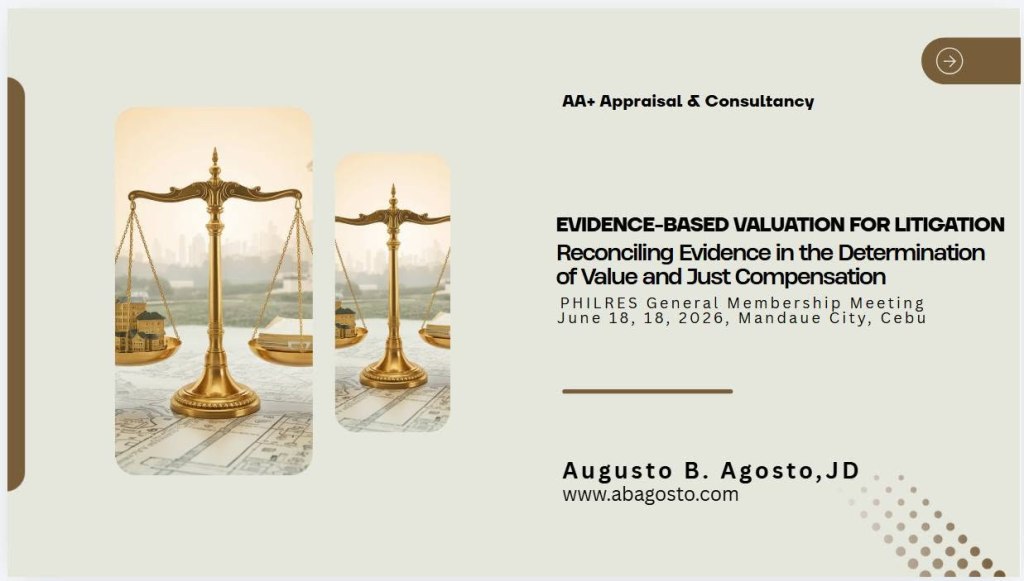
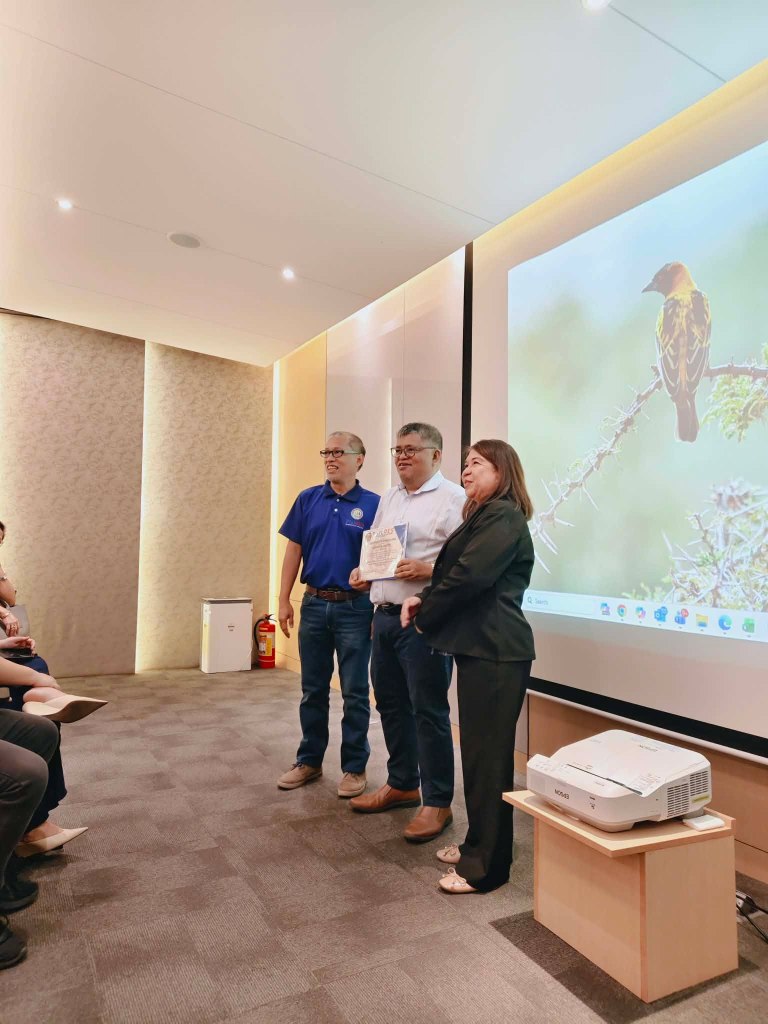
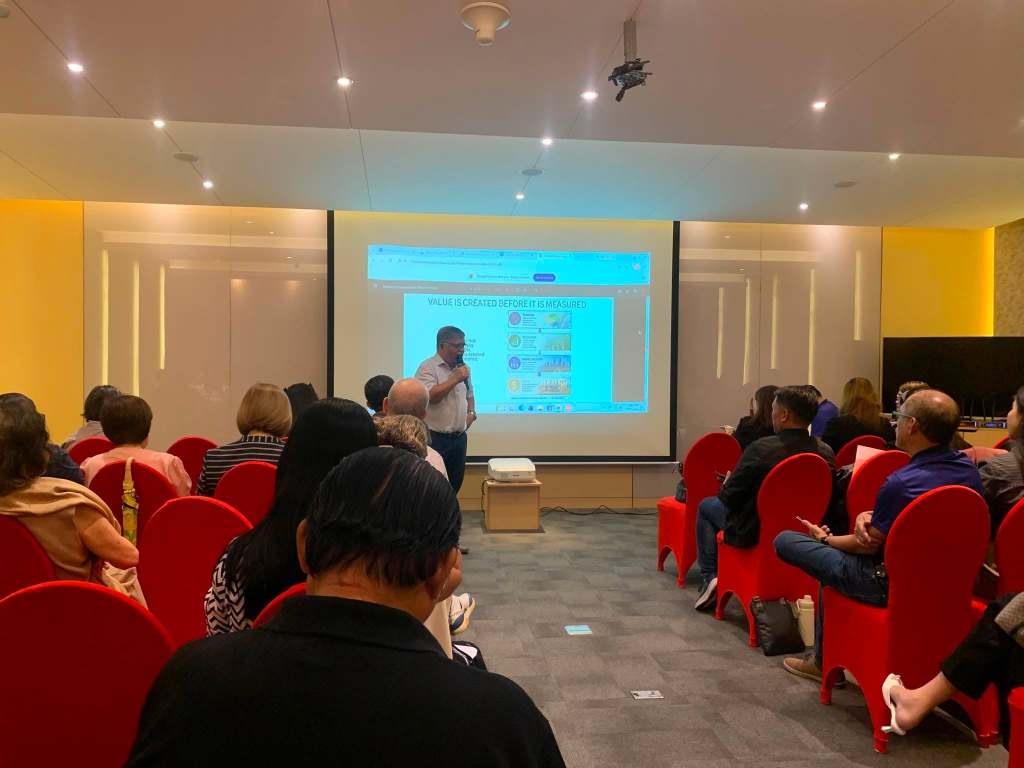
On June 18, 2026, I had the privilege of speaking before the members of the Philippine Real Estate Service Practitioners, Inc. (PhilRES) – Mandaue City Chapter during its 6th General Membership Meeting held at Mandani Bay, Mandaue City. My presentation focused on a subject that has occupied much of my professional work in recent years: Evidence-Based Valuation (EBV) for Litigation, Expropriation, and Just Compensation.
For decades, real estate valuation has relied heavily on the Sales Comparison Approach. Comparable sales remain an important source of market evidence and continue to be one of the most widely accepted methods of determining value. However, in many assignments—particularly expropriation cases, litigation matters, infrastructure projects, and complex property disputes—the question often arises: Is market evidence alone sufficient to explain value?
The traditional appraisal process frequently emphasizes numerical adjustments derived from comparable transactions. While mathematically sound, such an approach may not fully capture the broader factors that influence value. Infrastructure investments, zoning regulations, land use policies, economic growth, scarcity, accessibility, environmental conditions, and development potential all contribute to the creation of value long before they are reflected in actual market transactions.
This observation led to the development of a framework I refer to as Evidence-Based Valuation (EBV).
The central premise of EBV is straightforward: value conclusions should not rely solely on comparable sales but should be supported by the reconciliation of multiple forms of evidence. These include:
Property Evidence – the physical characteristics of the property such as location, area, shape, topography, accessibility, improvements, and development potential.
Planning Evidence – land use plans, zoning classifications, infrastructure projects, government policies, and regulatory controls that influence future utility and development.
Economic Evidence – demand and supply conditions, growth trends, scarcity, investment activity, income potential, and broader economic drivers.
These forms of evidence are not independent of one another. Rather, they interact to influence the highest and best use of a property, which ultimately forms the basis of value.
The concept is equally relevant in both ordinary valuation assignments and special-purpose engagements. Evidence-Based Valuation strengthens the foundation of value conclusions by integrating multiple forms of evidence beyond comparable sales alone. Even in ordinary market valuations, appraisers are expected to provide conclusions that are not only supported by comparable sales but also grounded in a thorough understanding of the property’s characteristics, planning context, and economic environment. Courts are often asked to determine compensation that is fair not only to the government but also to the property owner. In such situations, the challenge is not merely selecting a comparable sale but reconciling all available evidence to arrive at a value conclusion that is credible, transparent, and defensible.
Evidence-Based Valuation does not seek to replace established valuation approaches. Instead, it seeks to strengthen them by expanding the evidentiary foundation upon which value conclusions are formed. Comparable sales remain important, but they should be viewed as one component of a broader evidentiary framework rather than the sole determinant of value.
As valuation professionals, we are increasingly called upon to explain not only what a property is worth, but also why it is worth that amount. This requires a deeper examination of the factors that create, sustain, and influence value.
The EBV framework remains a continuing work in progress. Future developments will explore its application to litigation valuation, water rights valuation, infrastructure projects, feasibility studies, market analysis, and just compensation determinations. The objective is not to create complexity for its own sake, but to improve transparency, strengthen professional judgment, and provide decision-makers with more defensible valuation conclusions.
Ultimately, valuation is not merely a mathematical exercise. It is the process of evaluating evidence, reconciling competing perspectives, and arriving at a reasoned conclusion. In that sense, evidence is not an alternative to valuation—it is the foundation upon which valuation rests.
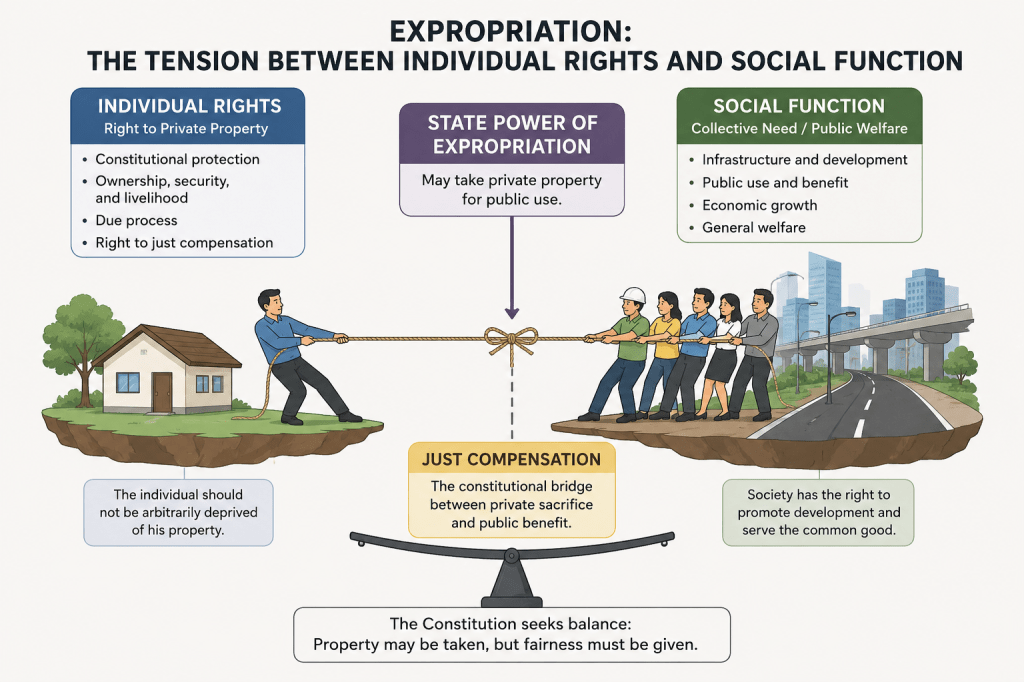
Expropriation is often discussed as a procedural mechanism through which the government acquires private property for roads, bridges, transmission lines, airports, flood control systems, and other public infrastructure. Yet beneath its procedural framework lies one of the deepest constitutional tensions in democratic governance — the tension between the rights of the individual and the demands of the collective.
At the center of every expropriation case is a constitutional balancing process. On one side stands the individual property owner invoking the protection of the Bill of Rights. On the other side stands the State acting in the name of public welfare, infrastructure development, and societal necessity. Eminent domain exists precisely because constitutional democracy recognizes both interests as legitimate.
The Constitution protects private property because ownership is deeply tied to liberty, security, livelihood, and human dignity. Land is not merely a commodity or economic asset. For many families, property represents inheritance, identity, social stability, and intergenerational survival. The taking of property therefore affects more than physical land; it interferes with constitutionally protected expectations and rights.
This is why Article III, Section 9 of the Constitution declares that private property shall not be taken for public use without just compensation. The provision reflects the recognition that while the State may possess sovereign authority to compel the transfer of property for public purposes, such power is never absolute. The Constitution restrains governmental authority by imposing safeguards grounded on fairness and due process.
At the same time, society itself possesses collective needs that cannot be ignored. Modern civilization depends upon infrastructure and public systems that require land. Roads, railways, ports, schools, hospitals, power lines, flood control projects, water systems, and transportation corridors cannot materialize without space. Urbanization, economic development, environmental protection, and disaster resilience increasingly require coordinated public intervention over land use and spatial development.
Without the power of eminent domain, public infrastructure could easily become hostage to fragmented ownership or strategic refusal to sell. Collective welfare would become difficult, if not impossible, to achieve.
Thus, expropriation emerges as a constitutional compromise between private ownership and public necessity. The State may compel the taking of private property for public use, but society cannot impose the burden of public development upon a single owner without compensation. Just compensation therefore becomes the constitutional bridge between collective benefit and private sacrifice.
In many ways, just compensation reflects a principle of distributive justice. If society benefits collectively from a public project, then society — acting through the State — must fairly compensate the individual whose property was sacrificed for that collective benefit. The owner may not necessarily prevent a lawful taking for public use, but the owner possesses the constitutional right to receive the full and fair equivalent of the property taken.
This explains why the Supreme Court consistently emphasizes that the determination of just compensation is a judicial function. Courts serve as constitutional arbiters between governmental power and individual rights. The judiciary ensures that compensation is not dictated solely by political convenience, administrative valuation schedules, or institutional interests. Judicial review prevents the possibility that the coercive power of the State overwhelms constitutional fairness.
The valuation process itself therefore acquires constitutional significance. In expropriation, appraisal is no longer merely technical or commercial. Market value becomes part of constitutional justice. An undervalued appraisal effectively forces the landowner to subsidize public infrastructure unfairly. Conversely, an excessive valuation burdens public resources and ultimately affects society as a whole. The objective is constitutional equilibrium — fairness both to the owner and to the public.
This constitutional balancing also explains the critical role of commissioners under Rule 67 of the Rules of Court. Commissioners are not representatives of the expropriating agency nor advocates for the landowner. They are auxiliaries of the court tasked to assist in the fair and impartial determination of just compensation. Their role carries constitutional implications because they participate directly in balancing individual rights against collective societal interests.
For this reason, the Rules require commissioners to be competent and disinterested. Independence is essential because once valuation becomes driven by institutional loyalty, political pressure, or predetermined outcomes, the constitutional integrity of the expropriation process begins to erode.
The tension between individual rights and collective welfare has become even more complex in contemporary society. Today, expropriation increasingly intersects with climate adaptation, environmental protection, renewable energy, urban redevelopment, mass transportation, disaster mitigation, and sustainability planning. Governments now justify takings not only for traditional infrastructure, but also for broader societal objectives involving environmental resilience and long-term public survival.
As collective interests expand, however, constitutional protections remain indispensable. The challenge of modern governance is not simply to accelerate development, but to ensure that development remains constitutionally just.
This evolving landscape also transforms the nature of property law itself. Expropriation can no longer be understood solely as a procedural remedy or land acquisition mechanism. It now exists at the intersection of constitutional law, valuation, urban planning, economics, environmental governance, and infrastructure policy.
The future property lawyer, appraiser, and land governance specialist must therefore understand not only ownership doctrines and legal procedures, but also how land functions within broader economic, environmental, and societal systems. Questions involving just compensation increasingly require appreciation of market behavior, zoning, infrastructure externalities, environmental regulation, and public policy.
Ultimately, expropriation reflects one of the most profound realities of constitutional democracy: ownership is protected, but ownership is not absolute. Property carries both private rights and social obligations. The State may compel individual sacrifice for the collective good, but the Constitution insists that such sacrifice must never occur without fairness, due process, and just compensation.
That enduring balance between individual rights and collective welfare remains the true constitutional essence of eminent domain.
Brief History of Individual and Collective Rights
The history of political and constitutional philosophy reveals a continuing tension between collective authority and individual liberty. In the ancient and medieval world, collective order, political community, and social hierarchy largely dominated over individual autonomy. The individual was viewed primarily as part of the larger social or political body.
From this collective order eventually emerged the philosophy of individual rights during the Enlightenment. Thinkers such as Locke and other liberal philosophers asserted that human beings possess inherent natural rights — life, liberty, and property — which the State must respect rather than create. This intellectual movement eventually gave rise to liberal constitutionalism and the modern Bill of Rights, where the protection of the individual against arbitrary governmental power became central.
However, the rise of industrialization, economic inequality, labor exploitation, and other societal problems exposed the limitations of purely individualistic systems. As a result, constitutional thought gradually evolved once again toward social rights and collective welfare. Modern constitutions increasingly recognized labor rights, social justice, environmental protection, public welfare, and the social function of property.
Today, modern constitutionalism attempts to balance both traditions. Contemporary constitutions protect individual rights and liberties while simultaneously recognizing legitimate collective interests necessary for social order, development, and public welfare. Thus, modern constitutional law is ultimately an ongoing effort to reconcile individual freedom with the demands of society as a whole.
Why System Thinking Requires Stricter Development Standards
Recent public discussions have reflected different perspectives on the Monterrazas development in Cebu City, including system-level explanations, precautionary considerations, and calls for regulatory review. These illustrate the complexity of decision-making in such contexts.
At first glance, the issue may appear as a familiar tension between development and environmental protection. However, it may be more accurately understood through a different lens.
From an economic perspective, what this situation reflects is a form of the Tragedy of the Commons.
The concern lies in understanding how multiple developments interact within a shared system, and how each contributes to cumulative impacts over time.
Cebu’s upland areas perform essential ecological functions. They absorb rainfall, regulate runoff, and contribute to the stability of downstream communities. These functions do not operate within the boundaries of individual properties. They extend across space, linking different parts of the city through continuous hydrological processes.
In this context, the question of whether a particular development lies within or outside a defined watershed boundary, while relevant in technical terms, does not fully resolve the issue. Environmental systems do not operate as isolated compartments. Their behavior reflects interaction rather than separation.
The scale of that interaction is often difficult to grasp in abstract terms.
Evidence from watersheds within Metro Cebu further clarifies how this system operates—and how development must be understood within it.
Studies of the Mananga watershed show that land-use and land-cover changes—particularly in upstream areas—affect infiltration, surface runoff, and the movement of water across the system. As vegetation is reduced or land is altered, less water is absorbed and more becomes surface flow.
A similar pattern is observed in the Butuanon River watershed. The river originates in upland areas of Cebu City and flows through increasingly urbanized zones before reaching the coast. Upstream areas are already characterized by agricultural and altered land uses, while downstream sections are densely developed. This configuration illustrates how water accumulates as it moves across elevations, shaped by both upstream conditions and downstream constraints.
Altogether, these cases point to a consistent principle:
The watershed is the system within which individual projects must be considered, as runoff is generated across the entire catchment while its behavior is shaped by land-use conditions across different elevations.
This framing is critical. It does not assign causation to any single location. Rather, it defines the proper unit of analysis.
A project is not evaluated in isolation, but in relation to the system it enters—where each intervention contributes to cumulative pressures and must therefore be assessed with reference to the system’s capacity.
It is often observed that flooding in Cebu is multi-causal. Infrastructure limitations, watershed conditions, land-use changes, and rainfall patterns all contribute. This observation is correct.
However, its implication must be properly understood.
If multi-causality is interpreted to mean that no single development can be meaningfully evaluated, then responsibility becomes diffused. Multiple factors contribute, yet accountability becomes less clearly defined.
But the correct implication is the opposite.
If risk is systemic, then evaluation must also be systemic—and correspondingly more rigorous.
The system is not an excuse—it is the basis for stricter evaluation.
This requires a shift in how development decisions are made.
The relevant question is not whether a particular project can be shown to cause a specific flooding event. Rather, it is whether the addition of that project contributes, in combination with others, to increasing pressure on a system that may already be approaching its limits.
The concern lies in the combined effects within a shared system, and in how each individual project contributes to those cumulative impacts.
This leads to a central question:
What is the capacity of the system?
How many developments are already present within a given environmental zone? To what extent has land use already been altered? At what point does additional development begin to significantly affect the system’s ability to absorb rainfall and regulate runoff?
Without a clear understanding of these limits, development decisions are made incrementally, without reference to cumulative thresholds.
The Monterrazas issue, therefore, should be viewed in terms of how development decisions are made when each additional project contributes to a system with finite capacity.
In such a context, compliance at the project level is no longer sufficient. Each additional intervention must be evaluated in relation to the condition of the system as a whole.
This has significant implications for urban development.
First, evaluation must move beyond individual projects toward system-level analysis.
Second, development must be aligned with capacity. Growth is no longer simply a matter of feasibility or compliance, but of whether the system can sustain additional pressure.
Third, planning must shift from reactive to anticipatory. Addressing impacts only after they occur is both inefficient and costly.
Fourth, institutional coordination must ensure that decisions reflect a consistent understanding of cumulative risk.
The Monterrazas issue is not resolved by determining whether it falls within a particular boundary, nor by isolating it from broader conditions.
It must be understood as part of a system where effects accumulate, capacity is finite, and each development contributes to increasing pressure on that system.
It shows that outcomes in shared systems are shaped not only by individual decisions, but by how those decisions accumulate—and whether they are governed by a clear understanding of limits.
Ultimately, the question is not whether a particular project should proceed or not.
It is whether each project is evaluated in light of the system it enters—and whether that system can sustain the additional burden it brings.
Because in such systems, urban development is no longer simply about what can be built.
It is about how each development contributes to a shared environment—and whether the whole remains within its capacity to endure.
Urban land use planning in Cebu City cannot be treated as a purely local spatial exercise. As the primary economic anchor of Central Visayas (Region VII), Cebu City performs metropolitan and regional functions that extend far beyond its administrative boundaries — economically, socially, and spatially.
Cebu City in the Regional Economic Structure
Central Visayas remains one of the fastest-growing regional economies in the Philippines. In 2024, the region’s gross regional domestic product (GRDP) reached about ₱1.28 trillion, expanding at 7.3 percent — higher than the national average — and maintaining its position as the largest economy in Visayas and Mindanao.
Within this context, Cebu City continues to serve as the regional engine:
In 2024, Cebu City’s economy expanded by about 7 percent, with a total output of roughly ₱334.48 billion, driven by trade, finance, and professional services.
According to recent Provincial Product Accounts, Cebu City accounted for about 22.6 percent of Central Visayas’ regional economy in 2023, second only to the entire Province of Cebu.
Cebu City’s economic footprint is not contained within city boundaries: it affects employment patterns, investment flows, infrastructure utilization, and land markets across multiple provinces and cities in the region.
Zoning as a Regional Economic Decision
Urban economic theory explains that development rights — created and modified by zoning — are capitalized into land values and development incentives.
In Cebu City:
The IT Park–Lahug corridor drives strong agglomeration effects.
The CBD–Port core remains a critical commercial and logistics hub.
The South Road Properties (SRP) influence is reshaping coastal development patterns.
Fringe and upland barangays are facing conversion pressures with implications for peri-urban growth.
These dynamics produce a complex land value gradient that must be recognized and regulated in the CLUP.
Regional Spillover Effects
When land values in Cebu City rise due to zoning changes, the pressure is felt in neighboring LGUs:
Housing demand spills over into Consolacion, Lilo-an, and Talisay.
Commuter flows cross city boundaries, stressing transport corridors.
Agricultural land conversion accelerates in fringe municipalities.
This illustrates that Cebu City’s land use decisions are not isolated. They shape regional patterns of growth and require a planning perspective consistent with broader regional development strategies — including the Central Visayas Regional Development Plan.
Why RLUC and DHSUD Review Cebu City’s CLUP
The institutional review structure reflects this regional reality.
The Regional Land Use Committee (RLUC), operating within the regional planning structure of the Department of Economy, Planning, and Development (DEPDev), conducts technical assessment of CLUPs to ensure consistency with regional spatial strategy and economic coherence.
Meanwhile, the Department of Human Settlements and Urban Development (DHSUD) serves as the national approving authority — guaranteeing alignment with national urban development policy, hazard integration, infrastructure standards, and housing obligations.
This layered review is not bureaucratic duplication. It is recognition that Cebu City’s land use decisions have regional repercussions, and thus must be evaluated not only for local coherence but for their impact across the metropolitan and regional system.
Infrastructure and Fiscal Discipline
Allowing density increases without aligning them with infrastructure capacity produces:
Higher capital expenditure demands
Road and drainage system overload
Greater disaster risk exposure
A responsible CLUP must factor in not just spatial demand but also infrastructure load-testing and projected fiscal impact. Growth may increase revenue — but it may also create unfunded liabilities if infrastructure and risk costs are excluded from the analysis.
Climate Risk as an Economic Variable
Hazard-prone areas — floodplains, landslide slopes, coastal lowlands — are not merely environmental concerns. They are economic risk multipliers that, if developed without restraint, impose long-term costs on public budgets and private livelihoods.
To address this, the CLUP must define:
Net Developable Land = Gross Land – Hazard Constraints – Easements – Protected Zones
This adjusted baseline must inform density decisions.
Housing Affordability and Land Cost Capitalization
In high-demand corridors of Cebu City, land cost often represents a major portion of overall housing price. If land value increases faster than housing supply expands, zoning changes alone will not yield affordability — they may worsen it.
This underscores the need for inclusionary mechanisms and spatial strategies that place housing close to jobs, infrastructure, and hazard-safe areas.
Cebu City as Metropolitan Steward
The CLUP of Cebu City must operate as:
A regulator of land value winds
A coordinator of infrastructure investments
A climate risk filter
A promoter of equitable housing outcomes
A mediator of regional economic stability
When Cebu City adjusts density and land use rules, the regional economy adjusts with it.
Planning for Value and Region
Cebu City’s CLUP must transcend the narrow framing of zoning colors on paper. It must be anchored in land economics and regional economic logic — because spatial decisions in this city do not stay within its borders. They shape the future of Central Visayas and influence conditions well beyond.
When we speak about Carbon Market, the conversation is often framed as a city-level redevelopment issue. But from an economist’s and urban planner’s perspective, that framing is incomplete.
Carbon Market is not just a Cebu City asset. It is a regional economic node embedded within:
The Cebu City Comprehensive Land Use Plan (CLUP)
The broader Central Visayas food system
Inter-municipal agricultural and fisheries value chains
Understanding this connection is essential. Because what happens in Carbon Market does not stay in Carbon Market.If the Cebu City CLUP provides the spatial framework within the city, regional development provides the functional framework beyond it.
Carbon Market does not operate within the administrative boundaries of Cebu City alone. Its economic reach extends to:
Vegetable-producing upland municipalities
Coastal fishing communities
Neighboring provinces supplying agricultural and marine products
Informal and micro-enterprise processors embedded in peri-urban zones
In regional economic terms, Carbon Market is a growth linkage node. It performs three critical functions:
Market Access for Peripheral Producers
Regional development theory emphasizes that urban centers must provide stable demand anchors for rural economies. Without reliable access to urban markets, smallholder farmers and fishers face:
Price instability
Dependence on trader-lenders
Higher transaction costs
Reduced bargaining power
Carbon Market shortens this chain. It allows producers from outside Cebu City to plug directly into an urban demand center with high turnover and price transparency.
Weakening that node without creating an equivalent alternative risks pushing producers back into fragmented, less competitive arrangements — deepening regional inequality rather than reducing it.
Cost Distribution Across the Region
When a central distribution hub functions efficiently, it:
Reduces duplication of logistics
Concentrates transport routes
Facilitates bulk aggregation
Lowers spoilage rates
Research on vegetable supply chain losses in Central Philippines shows that inefficiencies in aggregation and storage significantly increase losses before produce reaches consumers. Likewise, studies on Cebu’s fish trade highlight how centralized nodes stabilize pricing and reduce uncertainty in time-sensitive transactions.
If Carbon Market’s role as a distribution hub diminishes, costs do not disappear — they are redistributed. Often, they shift:
Upstream to producers (lower farmgate prices)
Downstream to consumers (higher retail prices)
Outward to peripheral municipalities (logistics strain)
Regional development is not simply about growth. It is about where costs and benefits are spatially allocated.
Urban–Rural Integration
The Cebu City CLUP governs land within the city. But urban land-use decisions influence regional integration.
A well-functioning urban core should:
Complement rural production
Support peri-urban logistics
Serve as an accessible convergence point
Carbon Market historically performs this integrative function. It is a bridge — not a barrier — between rural supply and urban consumption.
If the urban core shifts toward higher-value commercial uses without preserving essential economic infrastructure, the result is functional displacement. Wholesale and distribution activities may be pushed outward into areas less prepared to handle them, increasing congestion, transport time, and land-use conflict.
From a regional planning standpoint, that is inefficiency — not progress.
Resilience Beyond Boundaries
The CLUP incorporates resilience planning within city limits. But food systems operate regionally.
During typhoons, port disruptions, or fuel shocks, centralized and accessible aggregation points allow for rapid redistribution and emergency coordination.
Carbon Market enhances:
Supply continuity
Rapid turnover of perishable goods
Network density among traders and suppliers
If that density fragments, regional resilience weakens.
In a climate-vulnerable region like Central Visayas, food-system stability is not optional. It is structural.
The Regional Development Question
Urban redevelopment often focuses on maximizing land value within city boundaries. But regional development asks a broader question:
Does this spatial change strengthen or weaken urban–rural economic integration?
Carbon Market is not simply an asset of Cebu City. It is a component of Central Visayas’ food economy.
Modernization is possible — even necessary. But modernization must:
Preserve small-producer access
Maintain low transaction costs
Strengthen logistics efficiency
Protect affordability for consumers
Align with the CLUP’s structural intent
Support inclusive regional growth
Otherwise, a local land-use adjustment may unintentionally generate regional economic imbalance.
Planning as System Stewardship
Planning is not merely about zoning compliance or real estate optimization.
It is about system stewardship.
Carbon Market sits at the intersection of:
Land-use planning (CLUP)
Inclusive value-chain development
Regional economic integration
Food-system resilience
Spatial equity
Understanding it as regional infrastructure — not merely local property — allows Cebu to evolve without destabilizing the very economic networks that sustain it.
Author’s Note
Agosto is an economist and urban planner, and a practicing real estate professional whose work examines land-use governance, market institutions, and regional economic systems. His analyses engage the Cebu City Comprehensive Land Use Plan (CLUP) in relation to public markets, food-system resilience, and inclusive regional development in Central Visayas.