SFLMA and the Future of Environmental Asset Governance in the Philippines

I. Introduction

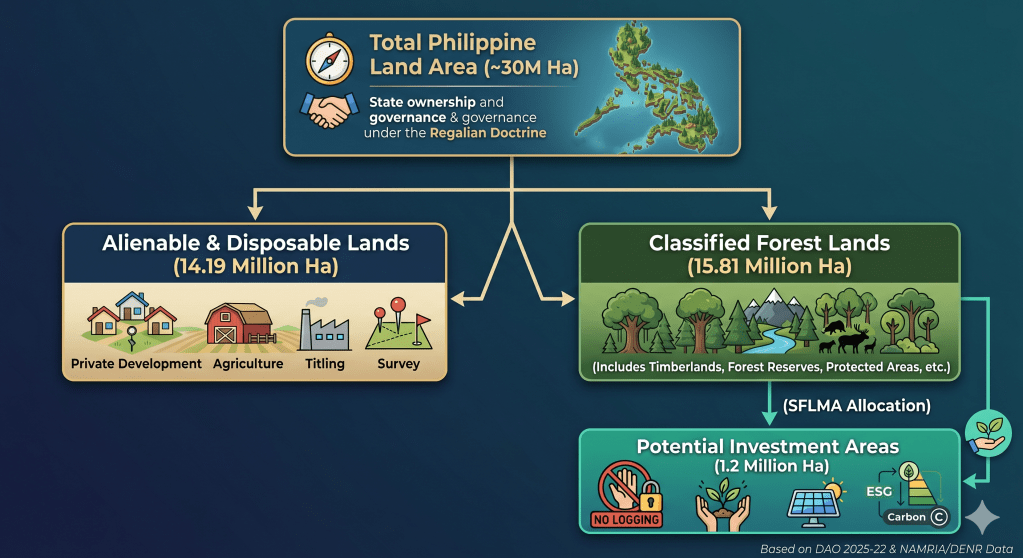
The implementation of the Sustainable Forest Land Management Agreement (SFLMA) under DENR Administrative Order No. 2025-22 marks a transformative shift from traditional, defensive forestry toward active environmental asset governance. This reform takes place against a complex legal backdrop where approximately 15.81 million hectares—over half of the Philippines’ total 30-million-hectare landmass—remain classified as public forest lands under the constitutional mandate of the Regalian Doctrine.

Historically, this system has suffered from institutional inertia, leaving official land boundaries largely unchanged since 2006 and creating a severe mismatch between legal designations and actual land use on the ground. However, the rise of the modern carbon economy has fundamentally reframed these spaces. Rather than treating forests merely as passive timber reserves or off-limits ecological zones, the SFLMA framework targets 1.2 million hectares of degraded public land—distributed across roughly 1,700 mapped parcels—to serve as climate infrastructure, carbon reservoirs, and natural capital assets.

Ultimately, this initiative places Philippine land governance at a critical intersection. The central challenge moving forward is balancing market-driven climate investments and carbon governance with the enduring constitutional principles of stewardship, social justice, and intergenerational responsibility.
II. The Carbon Economy and Legal Consolidation

One of the most consequential dimensions of the SFLMA is its architectural role in the emerging carbon economy. As international compliance and voluntary carbon markets mature, the framework provides the administrative and tenurial foundation required to host land-based carbon projects, verify forest carbon sequestration, and generate tradable carbon credits.

By offering long-term tenurial security, the SFLMA lowers the political and regulatory risk for institutional investors looking to fund nature-based solutions (NbS). Reforestation projects under this framework are uniquely positioned to serve as high-quality carbon sinks capable of issuing verified offsets for both domestic and international transfer.

Furthermore, this framework serves a critical state interest in regulatory streamlining. The SFLMA replaces and consolidates older, fragmented forest tenure systems, officially retiring:

  1. Industrial Forest Management Agreements (IFMA)
  2. Socialized Industrial Forest Management Agreements (SIFMA)
  3. Select commercial components of Community-Based Forest Management Agreements (CBFMA)
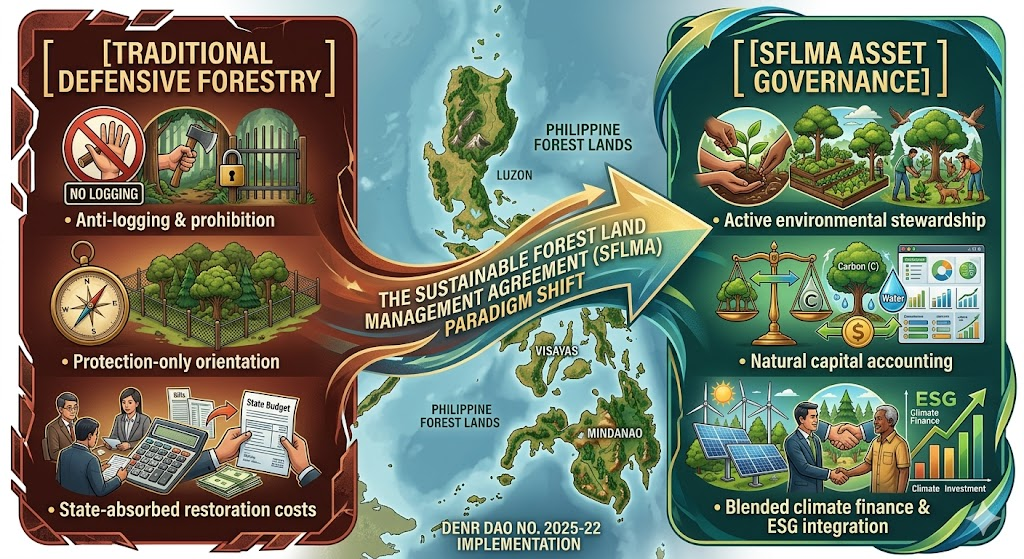
By collapsing these disparate instruments into a single governance mechanism, the DENR aims to eliminate conflicting land-use mandates, minimize institutional red tape, and lower transaction costs for clean-energy and conservation proponents. As the DENR noted during its rollout, the framework is explicitly designed to simultaneously generate rural employment, stimulate local economies, and boost the national gross domestic product (GDP) through sustainable forest enterprises.

III. Operationalizing SFLMA through the PENCAS Act

To properly realize its potential, the SFLMA framework must be linked directly to Republic Act No. 11995, otherwise known as the Philippine Ecosystem and Natural Capital Accounting System (PENCAS) Act. Passed to institutionalize the internationally accepted System of Environmental-Economic Accounting (SEEA), PENCAS provides the statutory framework that turns the theory of “environmental asset governance” into measurable fiscal and physical data.

┌────────────────────────────────────────────────────────┐
│ R.A. 11995 (PENCAS Act) │
│ National Macroeconomic & Data Standards │
└───────────────────────────┬────────────────────────────┘
▼ (Provides Baselines & Metrics)
┌────────────────────────────────────────────────────────┐
│ DENR DAO No. 2025-22 (SFLMA) │
│ Project-Level Allocation & Concessions │
└────────────────────────────────────────────────────────┘

1. The Data Engine for Asset Valuations

While the SFLMA identifies 1.2 million hectares of Potential Investment Areas (PIAs) for carbon sequestration and ecosystem services, establishing their baseline value without a standardized legal methodology invites speculation. The PENCAS Act solves this challenge by mandating the collection and compilation of official statistics on the depletion, degradation, and restoration of natural capital.

  • Asset Accounts: Under PENCAS, the state must maintain strict physical and monetary accounts of timber and land assets, which directly inform SFLMA baseline data. This guarantees that carbon sequestration projects calculate genuine additionality rather than relying on unverified corporate metrics.
  • Quantifying Ecosystem Services: PENCAS legalizes the valuation of “regulating services”—such as carbon storage, water filtration, and flood protection—giving SFLMA proponents a government-sanctioned data framework to back up ESG investments and carbon-credit accounting.

2. Macroeconomic Integration vs. Project-Level Finance

Under R.A. 11995, natural capital statistics are integrated directly into the country’s macroeconomic indicators, meaning major environmental accounts are co-released with traditional economic indicators like GDP. This creates a dual-layered governance system: PENCAS operates at the macro-level to track nature’s aggregated wealth, while the SFLMA operates at the micro-tenurial level. The SFLMA serves as the contractual vehicle allowing private and community actors to manage specific plots of land using the uniform accounting standards established under PENCAS.

3. Verification and Safeguards Against Greenwashing

One of the primary critiques of the SFLMA is the high risk of greenwashing and corporate regulatory capture. The PENCAS Act introduces a critical check on this through its institutionalized accounting metrics. If an SFLMA concessionaire causes ecosystem degradation or implements biodiversity-poor monoculture plantations under the guise of carbon offsets, the localized reduction in ecosystem asset accounts provides public interest litigants with actionable, government-backed data to support petitions for environmental remedies, such as a Writ of Kalikasan.

IV. Constitutional Boundaries: The Public Trust Intersection

Despite its market-oriented mechanics, the SFLMA operates within rigid constitutional boundaries. Under Section 2, Article XII of the 1987 Philippine Constitution, all lands of the public domain and natural resources belong to the State under the Regalian Doctrine (Jura Regalia). Because public forest lands are inalienable, the SFLMA does not transfer ownership. Instead, it grants restricted stewardship and management rights, explicitly conditioned upon the continuous fulfillment of environmental obligations.

This arrangement operationalizes the constitutional philosophy that property bears a social function, meaning the right to utilize natural resources is inherently subordinated to the welfare of the common good. Consequently, the SFLMA sits at a complex legal intersection:
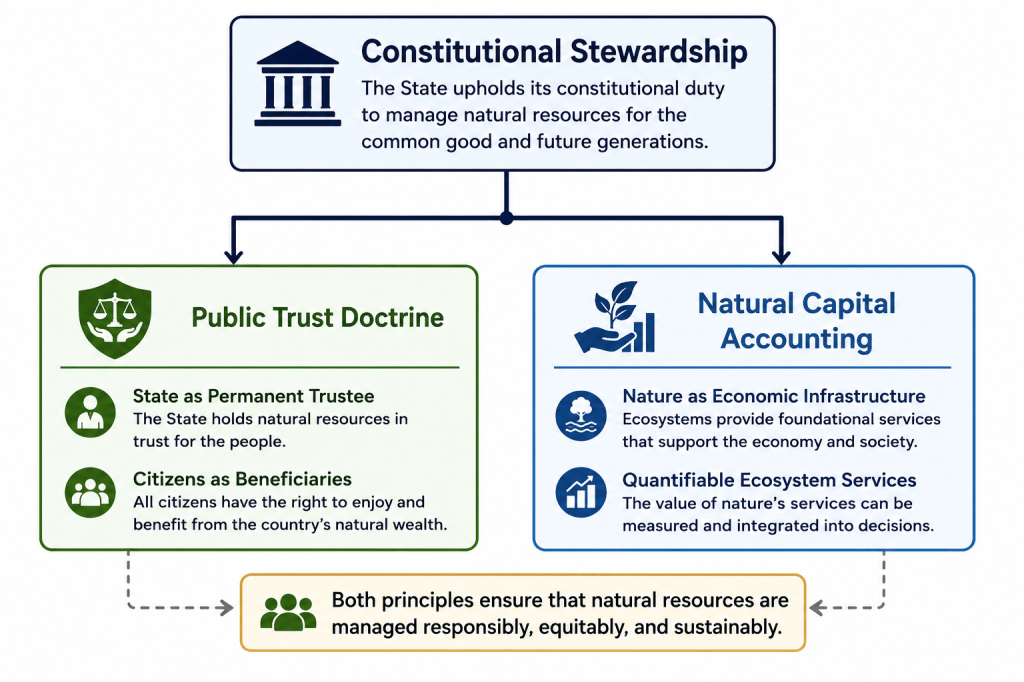
Under the Public Trust Doctrine, the State serves as the perpetual trustee of the nation’s natural wealth, while private and community actors function as temporary, fiduciary stewards. Every SFLMA project must therefore operate within legally defined ecological limits, ensuring that the exploitation of the asset does not impair the underlying public trust.

V. Systemic Risks, Drawbacks, and Structural Critiques

While structurally ambitious, the SFLMA framework exhibits several vulnerabilities, regulatory gaps, and socio-ecological risks that require rigorous mitigation.

1. The Commercialization of Ecospace and Greenwashing

By treating forests as natural capital, there is an immediate risk that environmental governance becomes subordinated to market incentives. If forests are valued primarily for their carbon credit yields and commercial ESG returns, biodiversity and deep ecological integrity may take a backseat.

This commercial focus invites structural greenwashing. Without robust, third-party verification protocols and data-driven carbon audit registries, corporate actors might exploit SFLMA concessions as cheap corporate branding vehicles. Weak state oversight could lead to speculative carbon banking, double-counting of offsets, and the generation of low-integrity carbon credits that fail to achieve genuine additionality.

2. Corporate Concession Dominance and Elite Capture

The framework permits large-scale corporate participation, allowing single entities to hold management rights over extensive tracts of land—in some instances up to 40,000 hectares. This high ceiling raises significant concerns regarding elite capture and land concentration. If large conglomerates dominate the competitive allocation of Potential Investment Areas (PIAs), smaller cooperatives, local civil society organizations, and marginalized upland communities may be priced out of the environmental asset market entirely.

3. Overlaps with Ancestral Domains and IP Exploitation

Spatial mapping data from the DENR indicates a critical geographic tension: approximately 85% of identified SFLMA parcels partially overlap with roughly 15% of ancestral domains occupied by Indigenous Cultural Communities (ICCs) and Indigenous Peoples (IPs).

While the law mandates compliance with the Free and Prior Informed Consent (FPIC) process under the Indigenous Peoples’ Rights Act (IPRA), there is a structural risk that this participation becomes merely transactional or symbolic. If indigenous communities lack equal bargaining power or sophisticated legal representation, they may find themselves excluded from meaningful benefit-sharing mechanisms and long-term project governance.

4. Ecological Conversion and Monoculture Risks

From an ecological standpoint, carbon-sequestration math often favors fast-growing, non-native commercial species over complex, slow-growing native silviculture. Policy research from the University of the Philippines warns that if regulatory safeguards are weak, the SFLMA could inadvertently incentivize the conversion of remaining natural secondary forests into simplified agroforestry or monoculture plantation systems, compromising local biodiversity and watershed resilience in the name of carbon maximization.

5. Regulatory Capture and Institutional Capacity Gaps

Simultaneously managing and auditing more than one million hectares of geographically dispersed forest lands demands an unprecedented level of technical, technological, and regulatory oversight. The DENR currently faces significant budgetary, staffing, and technological constraints. Without advanced remote sensing, real-time drone monitoring, and corruption-resistant auditing platforms, the SFLMA framework remains vulnerable to regulatory capture, illicit land conversions, and enforcement failures on the ground.

VI. Conclusion: Anchoring the Future Framework

The SFLMA brings a foundational tension in modern environmental law to the forefront: Should nature be governed primarily as an inviolable public trust, or as a quantifiable economic asset?

The doctrinal significance of DAO No. 2025-22 lies in its attempt to merge these two paradigms. It demonstrates that the Philippines is actively transitioning from a legacy of reactive environmental regulation to a proactive strategy of environmental asset governance.

The policy challenge moving forward is not whether the Philippines should participate in global climate finance or build domestic carbon markets; rather, it is whether these market mechanisms can remain firmly anchored to constitutional stewardship, social justice, and the principle of intergenerational responsibility (Oposa v. Factoran).

The ultimate success of Philippine carbon governance will depend on the state’s ability to develop a comprehensive legal framework that balances private economic utilization with robust public accountability, ensuring that all environmental assets are managed to serve the common good. The SFLMA has opened the door to market-based conservation; the onus is now on the state, civil society, and private sector to build the governance architecture required to walk through it responsibly.

Selected references and links:

Natural Capital Accounting and the Apo Quarry Case

The recent tax dispute between the Province of Cebu and Apo Land and Quarry Corporation (ALQC) has highlighted the legal limits of provincial taxation authority over quarry operations. The initial assessment of approximately Php1.218 billion was reduced to a proposed Php211 million compromise settlement, now under review by the Provincial Board. While the legal aspects of the dispute revolve around statutory limits on quarry taxation, the case also raises a broader question: how should the economic value of natural landscapes affected by quarry extraction be measured?

The Philippines has recently institutionalized ecosystem and natural capital accounting through Republic Act No. 11995, commonly referred to as PENCAS. This law recognizes ecosystems as economic assets whose value should be reflected in national and local policy decisions. When applied to quarry operations, natural capital accounting allows policymakers to estimate the economic value of ecosystem services that may be affected by extraction activities.

Under the PENCAS framework, the economic value of a natural resource landscape can be expressed as the Total Economic Value, which combines both market output and ecosystem services.

ComponentDescription
Market valueCommercial value of extracted minerals
Natural capital valueEcosystem services such as watershed protection, slope stabilization, and flood mitigation

While traditional taxation captures only the market value of extraction, natural capital accounting attempts to quantify the value of ecosystem functions that support environmental stability and community resilience.

The Apo quarry operations cover an estimated 406 hectares under mining agreements. However, quarry sites typically disturb only a portion of the concession area at any given time. International mining and quarrying studies suggest that active disturbance commonly affects 30–40 percent of the concession area. Applying a mid-range estimate of 35 percent disturbance, the approximate area of affected landscape may be calculated as follows:

IndicatorValue
Total concession area406 hectares
Estimated disturbance ratio35%
Estimated disturbed area142 hectares

Global watershed valuation studies—including the The Economics of Ecosystems and Biodiversity (TEEB) Initiative and the widely cited work of Costanza et al. (2014) Changes in the Global Value of Ecosystem Services—estimate the bundled value of ecosystem services such as watershed protection, flood regulation, erosion control, and groundwater recharge at approximately US$3,000 to US$20,000 per hectare per year depending on ecosystem type.

Also, ecosystem service valuation studies conducted in watershed environments worldwide estimate the value of environmental services such as flood regulation, erosion control, and groundwater recharge at approximately US$10,000–US$20,000 per hectare annually. Converting this range into Philippine pesos results in an estimated Php500,000 to Php1,000,000 per hectare per year.

Using a conservative midpoint estimate of Php900,000 per hectare annually, the potential ecosystem service value associated with the affected landscape may be estimated as follows:

CalculationValue
Disturbed area142 hectares
Estimated ecosystem value per hectarePhp900,000/year
Estimated ecosystem service valuePhp127.8 million per year

This estimated ecological value offers a useful point of comparison with the proposed compromise settlement in the Apo tax case. If the Php211 million settlement is distributed across the approximate 16-year coverage period of the assessment, the provincial fiscal recovery corresponds to roughly Php13.2 million per year.

The comparison between fiscal recovery and estimated ecosystem value may be illustrated as follows:

IndicatorEstimated Value
Ecosystem services valuePhp127.8 million / year
Provincial fiscal recoveryPhp13.2 million / year
Fiscal capture ratio≈10% of ecosystem value

It is important to emphasize that this comparison does not imply a legal liability on the part of the quarry operator. Rather, it illustrates the difference between the fiscal instruments currently available to local governments and the broader environmental value associated with landscapes affected by extraction activities.

Mining agreements in the Philippines typically operate within a 25–30 year timeframe. If the estimated ecosystem service value were projected over a 30-year operational horizon, the cumulative value of ecosystem services associated with the affected landscape could be estimated as follows:

ProjectionValue
Annual ecosystem valuePhp127.8 million
30-year horizon Estimated ecosystem valuePhp3.8 billion

This simplified natural capital ledger helps place the Apo quarry case within a broader economic context.

ComponentEstimated Value
Limestone production value (Cebu quarry sector)~Php225 million/year
Ecosystem service value~Php128 million/year
Estimated 30-year ecosystem value~Php3.8 billion
+ Carbon sequestration+Php8 million
Proposed tax settlementPhp211 million

From a policy perspective, the significance of this analysis lies not in assigning additional financial liability but in recognizing the economic importance of ecosystems within resource governance.Carbon sequestration offers a strong “alternative use” valuation for quarry-disturbed lands like Apo (upland Cebu forests), quantifying foregone climate benefits as an opportunity cost in your natural capital ledger.

The Apo case illustrates the structural characteristics of the Philippine mining governance framework. Mineral resources are owned by the State and administered by the national government, while environmental impacts and land-use implications are often experienced locally. As a result, local governments may face environmental management responsibilities while having limited taxation authority over extraction activities.

Natural capital accounting offers a complementary tool that allows policymakers to understand the broader economic landscape within which resource extraction occurs. Instead of relying solely on traditional taxation mechanisms, governments can use ecosystem accounting to guide policies such as watershed restoration programs, rehabilitation funds, and long-term land-use planning.

In this sense, the Apo quarry case highlights an important shift in public policy thinking. While taxation measures the financial revenue generated from extraction, natural capital accounting helps quantify the environmental assets that support economic activity and community resilience.

As Cebu continues to grow as an economic center in the Visayas, integrating natural capital accounting into resource governance may provide a more comprehensive framework for balancing development, environmental stewardship, and long-term sustainability.

The purpose of this estimation is to illustrate how ecosystem accounting can complement traditional fiscal metrics. While tax assessments measure the financial revenues associated with extraction activities, natural capital accounting helps quantify the environmental services that landscapes provide to surrounding communities.

In this sense, the Apo quarry case underscores the potential policy relevance of ecosystem accounting under Republic Act No. 11995, PENCAS. By recognizing ecosystems as economic assets, natural capital accounting allows policymakers to better understand how natural landscapes contribute to long-term environmental resilience and sustainable development.

The Apo Quarry tax dispute reveals a critical gap in Philippine resource governance: while provincial taxes capture only a fraction (~10%) of extraction’s market value, natural capital accounting under PENCAS quantifies the far broader ecological ledger—Php128 million/year in ecosystem services plus Php8 million/year in foregone carbon sequestration across 142 disturbed hectares.

Integrating these metrics exposes structural imbalances, where local governments bear environmental burdens from nationally administered mining without commensurate fiscal tools. This analysis demonstrates NCA’s power not as a liability hammer, but as a policy compass—guiding watershed restoration bonds, progressive rehab fees, and land-use plans that align development with Cebu’s natural assets.

Bringing PENCAS to Cebu: A Legal Challenge to the City’s New Land Use Plan

Environmental planner and economist Gus Agosto has taken a significant step in Cebu City’s ongoing land‑use debates by filing a formal notice and reservation of objection with the Department of Human Settlements and Urban Development (DHSUD). The notice focuses on the review of the Cebu City Comprehensive Land Use Plan (CLUP) 2023–2032 and raises an issue that has been largely absent from local public discussion: compliance with the Philippine Ecosystem and Natural Capital Accounting System (PENCAS) Act, or Republic Act No. 11995, and its Implementing Rules and Regulations.

At the heart of the filing is a simple but powerful question: can Cebu City still afford to plan growth as if its ecosystems, watersheds, and floodplains are external to the economy? For Agosto, the clear answer is no. RA 11995 declares that “natural capital” – including land, ecosystems, and the services they provide – is a measurable economic asset of the State and its political subdivisions. This is not a mere policy preference. Under PENCAS, natural capital accounting must be integrated into planning and decision‑making, particularly where long‑term land use, infrastructure, and public‑private partnerships are involved. In practice, this means a CLUP can no longer be just a map of zones and a bundle of sectoral plans; it must demonstrate how land‑use allocations respect ecological thresholds, risk patterns, and the economic value of environmental services.

The Cebu City CLUP 2023–2032, as currently framed, does many things right on paper. It outlines sectoral strategies for housing, commerce, industry, transport, and water supply. It references hazard maps and acknowledges flooding and slope risks. But, as Agosto points out, these elements remain largely compartmentalized. The plan stops short of weaving them into a cohesive, risk‑sensitive spatial strategy that clearly shows how development is constrained by carrying capacity, hazard exposure, and environmental limits. The result is a document that appears procedurally complete—boxes ticked, chapters present—but substantively misaligned with the integrated, law‑driven planning model now required under Executive Order No. 72, DHSUD’s own guidelines, and PENCAS.

This critique matters because Cebu City is not planning on a blank slate. It is a dense, highly constrained urban area, bounded by steep uplands and a vulnerable coastline, with a well‑documented history of flooding, traffic bottlenecks, and informal settlements on marginal land. In such a context, “sectoral” planning without genuine spatial integration is not a minor technical flaw; it can translate into very real, very costly risks for communities. If new commercial or residential intensities are allowed in upland or mid‑slope areas without full accounting of downstream flood impacts, the city effectively subsidizes risk—transferring the costs to low‑lying barangays that will experience deeper and more frequent inundation.

PENCAS adds another layer. By requiring natural capital accounting, RA 11995 insists that decisions about where to build, what to conserve, and how to structure public‑private partnerships must be informed by quantified assessments of ecosystem services and environmental limits. Watersheds, coastal zones, and floodplains do not merely host development; they regulate water flows, buffer storms, and sustain fisheries and livelihoods. When these are degraded or overbuilt, the “loss” is not just aesthetic or ecological—it is economic, measurable in damage to infrastructure, loss of productive days, and increased public spending on disaster response. Natural capital accounting is a way of making these hidden costs visible before, not after, decisions are taken.

Agosto’s filing is also a reminder of DHSUD’s central role in ensuring that local planning complies with national law. Executive Order No. 72 designates the CLUP as the primary basis for zoning, infrastructure provision, and land development decisions, and gives national agencies like DHSUD the responsibility to review local plans for conformity with national standards. With PENCAS already in effect, DHSUD is now expected not only to check format and basic legal compliance, but to ask whether plans show evidence of natural capital accounting: have ecosystems been valued, thresholds identified, and risks internalized into zoning and land‑use regulations? Approving a CLUP that treats PENCAS as optional would weaken the law at precisely the moment it is meant to change planning practice on the ground.

Crucially, the notice is not framed as an attempt to stop development or to delegitimize Cebu City’s efforts to adopt a long‑term land‑use plan. Instead, it positions itself as a rights‑based and policy‑grounded reminder to strengthen the CLUP. Agosto emphasizes that the objective is to align Cebu’s growth strategy with three converging realities: the legal obligations under RA 11995 and EO 72, the ecological constraints of a flood‑ and hazard‑prone city, and the long‑term public welfare of residents who will live with the consequences of today’s zoning maps and infrastructure decisions. In other words, the call is not “no development,” but “no development that pretends nature and risk do not count.”

For local stakeholders, planners, and advocates, this intervention offers a preview of what the PENCAS era will look like in practice. Formal plans, joint ventures, and big‑ticket infrastructure will increasingly be assessed not only on their financial terms and engineering feasibility, but also on whether they recognize natural capital as part of the economic equation. Cebu City’s CLUP review is an early and important test case. Whether DHSUD chooses to treat Agosto’s filing as a technical annoyance or as an opportunity to put PENCAS into meaningful operation will say much about the future of urban planning and environmental governance in the Philippines.

Beyond Compliance: Why the ECC Fails to Capture the True Value of Cebu’s Uplands

Environmental decision-making in the Philippines has long relied on the Environmental Compliance Certificate (ECC). It serves as the ultimate regulatory gatekeeper for development. Yet in a province like Cebu, upland forests stabilize water, climate, and communities. The ECC has exposed its deepest limitation. It measures environmental compliance, not environmental value..

This distinction came into sharp public view in Cebu City’s upland development debates. This was most notable in the case of Monterazzas de Cebu. It is a large mixed-use project built within the ecologically significant ridges of Barangays Guadalupe and Buhisan. It is near the headwaters of the Central Cebu Protected Landscape (CCPL) and the Budlaan–Buhisan watershed system.

A Watershed Is More Than a Development Site

Cebu’s uplands function as critical ecological infrastructure. They supply benefits that are foundational, systemic, and often invisible until lost:

  • Groundwater replenishment for Metro Cebu’s aquifers
  • Flood control and runoff regulation protecting low-lying urban districts
  • Carbon storage and microclimate regulation mitigating urban heat impacts
  • Soil retention that prevents landslides and downstream siltation
  • Habitat for endemic species and biodiversity reservoirs
  • Landscape identity and cultural value for Cebuanos

These benefits fall under what environmental economics calls Total Economic Value (TEV)—a framework that includes not only direct use (e.g., water supply), but also indirect use (flood control, climate regulation), option value (future medicine, ecotourism), bequest value (inheritance for future generations), and existence value (nature’s value simply for being there).

The ECC process, however, recognizes none of these as economic assets requiring valuation. It focuses instead on mitigation plans, engineering controls, and compliance commitments, answering only the question:

“Can environmental impacts be managed within acceptable regulatory limits?”

It does not ask the larger, economically decisive question:

“What is the value of what will be lost, even if mitigation is implemented?”

The ECC is a compliance mechanism. It checks if an Environmental Management Plan (EMP) exists. It also checks if mitigation measures are proposed. Finally, it ensures that pollution thresholds fall within permissible standards. But compliance is not valuation, and mitigation is not the same as replacing lost natural capital. This structural limitation represents a market failure. It converts ecological services into unpriced subsidies for development. This shifts costs to communities, households, local governments, and future generations.

The Monterazzas Case: Legally Compliant, Economically Incomplete

Monterazzas secured an ECC because it fulfilled its regulatory obligations. These obligations included drainage systems, slope protection, detention ponds, tree replacement, and environmental monitoring plans. From a compliance standpoint, the approval was defensible.

Yet public backlash surged after severe rain events in 2019 and 2021 intensified flooding in downstream Cebu communities. Flooding cannot be attributed to a single development alone. However, the case crystallized a broader reality. The cumulative cost of upland land conversion was never evaluated in economic terms.

No valuation was conducted for:

  • Reduced aquifer recharge from increased impervious surfaces
  • Lost flood buffering previously performed by forested slopes
  • Carbon stock reduction from land clearing
  • Increased sediment load affecting rivers and drainage systems
  • Public loss of ecological security and landscape heritage

These are not engineering failures. They are valuation failures—costs borne by communities and future generations, not by project balance sheets.

Mitigation Is Not Valuation

A detention pond cannot replace a mountain’s hydrological function.
Tree replanting cannot immediately restore decades of carbon storage.
Slope stabilization cannot substitute the slow work of root-bound soil ecology.

The ECC system can reduce harm, but it cannot measure the economic magnitude of what is permanently altered or foregone. As a result, developments may be:

✔ legally compliant
✖ economically suboptimal
✖ socially contested
✖ ecologically irreversible

Non-Use Values Matter to the Public—Even If the ECC Cannot See Them

What made the debate over Cebu’s uplands emotionally charged was not only flooding—it was the perception of losing something irreplaceable:

  • Cebu’s last remaining green ridgelines
  • Intergenerational access to functioning watersheds
  • The comfort of knowing nature still exists at scale
  • A shared ecological identity built into the Cebuano sense of place

These are non-use values—intangible yet real, and entirely absent in ECC assessment.

Toward a New Standard: Valuing Nature, Not Just Regulating It

If Cebu is to balance growth with survival, environmental governance must change significantly. It must evolve beyond impact mitigation. It should also move toward natural capital valuation.

Future upland development decisions should integrate:

  • Total Economic Valuation (TEV)
  • Hydrological and carbon loss accounting
  • Cumulative impact costing
  • Natural Capital Accounting (aligned with PENCAS)
  • LGU-level ecosystem service valuation in land use planning
  • Public trust and intergenerational equity as development thresholds

Because while the ECC may authorize a project, only economics can reveal its true costs—and only ecology pays them back.

The central lesson from Cebu is clear:

Development must not only comply with environmental rules.
It must account for environmental worth.
Otherwise, what is permitted is not always what is sustainable.

What Is Legal Is Not Always Economic

The ECC ensures projects meet environmental regulations. It does not ensure that development decisions make economic sense when nature’s services are fully priced. In rapidly urbanizing regions like Cebu, ignoring this distinction leads to developments that seem profitable in private ledgers. However, they impose hidden public costs that increase over time.

Cebu’s uplands are not free. Their services are not infinite. And their depreciation is not costless.

Nature’s contributions need to be priced, recorded, and defended like any other form of capital. Without these measures, the province will continue approving projects that are technically compliant. However, these projects will remain economically incomplete.

The ECC prevents illegal environmental harm.
Valuation prevents unaffordable environmental loss.
Cebu urgently needs both.

The Philippines’ New Forest Policy: A Green Revolution or a Risky Gamble?

The Philippines is a nation blessed with incredible biodiversity. However, it is plagued by deforestation. The country is embarking on a new chapter in forest management. Environment Secretary Raphael P.M. Lotilla recently launched the Sustainable Forest Land Management Agreement (SFLMA). He hailed it as a “major shift.” It promises to revolutionize how the country’s 15.8 million hectares of forest land are managed.

On the surface, SFLMA sounds like a win-win. It streamlines seven fragmented forest tenure instruments into a single, renewable 25-year contract. It also encourages diverse uses like agroforestry, tourism, and conservation. The goal? Foster job creation, cut red tape, and promote inclusive economic growth. The DENR even rolled out complementary initiatives: “Forest for Life: 5 Million Trees by 2028” and mapping over 1.18 million hectares as “Potential Investment Areas (PIAs)” ready for private-sector cash.

Officials are calling it a “new era where conservation and commerce go hand-in-hand.” But is it truly a green revolution? Or does it hold hidden risks for the environment? What about the very communities dependent on these forests?

Legal and Economic Foundations: Operationalizing PNEACAS

The SFLMA is not merely a land-use policy; it is the operational execution of the Philippine National Ecosystem and Climate Accounting System (PENCAS) Law (Republic Act No. 11995). PENCAS legally mandates the integration of the environment’s economic value into national policy. It provides the foundational framework for the SFLMA’s valuation requirement. The agreement requires the calculation of the Total Economic Value (TEV) of the forest. It moves beyond traditional resource extraction models. This TEV approach is guided by the United Nations System of Environmental-Economic Accounting (SEEA) standards mandated by PNEACAS. It ensures that forest stewardship is financially incentivized.

The TEV calculation is divided into two distinct components, which define the roles of financial experts and environmental economists. The first, Valuation of Tangible Assets (Market Value), uses financial methods to evaluate profitability. These methods include Discounted Cash Flow (DCF) and Real Options Analysis (ROA). They determine commercial profitability from timber, non-timber products, and fixed user fees. This component is essential for attracting investment and securing financing.

The second and more innovative component is the Valuation of Intangible Services (Non-Market Value). This component monetizes public environmental goods, directly supporting the goals of PNEACAS. By converting ecological preservation into a quantifiable revenue stream, the SFLMA attempts to align conservation with long-term financial interest.

The Critical Role of the Economist

The economist’s function is to serve as the translator between ecological sustainability and financial viability. They achieve this by monetizing non-market benefits. This process directly addresses the core mandates of the PENCAS Law. They generate the data required for policy alignment and incentive design. Specifically, the economist calculates the value of carbon sequestration by applying the Social Cost of Carbon (SCC). This application turns stored carbon into tradable financial assets, known as carbon credits. This conversion establishes a critical revenue stream for reforestation. They apply the Replacement Cost Method to value watershed services. This method involves estimating the expense of building man-made infrastructure to replace the forest’s natural function. Furthermore, they use the Contingent Valuation Method (CVM) in surveys. These surveys quantify the public’s Willingness To Pay (WTP) for biodiversity. They also assess ecotourism. Through these processes, the economist ensures the SFLMA valuation is consistent with the SEEA framework. They guarantee the environmental statistics are credible and can be integrated into the national economic accounts. This demonstrates that the forest is worth more when preserved than when depleted.

Structural Incentives and Regulatory Risks

The SFLMA’s structural benefits include bureaucratic simplification. This reduces red tape. The 25-year long-term tenure provides the necessary security for substantial, sustainable investment. It mandates an integrated management plan, theoretically ensuring holistic management across production and protection uses.

However, critics cite significant policy risks. A primary concern is the potential for elite capture. This concern is driven by unequal land caps. These caps allow corporations to secure up to 40,000 hectares while capping People’s Organizations (POs) at 1,000 hectares. The technical complexity of TEV calculation adds an additional barrier. It requires sophisticated financial modeling such as DCF, ROA, and CVM. This complexity effectively excludes marginalized Indigenous Cultural Communities (ICCs) and POs that lack extensive external technical and financial support.

Furthermore, the policy faces criticism regarding its environmental oversight. The provision allows proponents to secure an Environmental Compliance Certificate (ECC) after the SFLMA is awarded. This reverses standard environmental procedure. It creates a potential loophole for environmentally damaging activities. The broad allowance for “special uses,” including industrial facilities, raises fears. There is concern about the industrial conversion of biodiverse areas into monoculture plantations or logistical hubs. This could potentially undermine the conservation goals inherent in the PNEACAS framework. The unresolved ambiguity surrounding the ownership of benefits from carbon credits also poses a risk. There may be disputes and unfair distribution of benefits among the state, investors, and local communities.

Safeguards and the Critical Path Forward

The DENR has attempted to mitigate these risks by articulating key safeguards. Key safeguards include the strict requirement for Free, Prior, and Informed Consent (FPIC) in ancestral domains. They also involve using Performance-Based Renewal. In this system, the 25-year contract renewal depends on stringent performance against specific Environmental, Social, and Governance (ESG) metrics. SFLMA holders are also mandated to include social development programs to ensure local employment and fair wages.

The success of the SFLMA hinges entirely on the rigorous enforcement of these social and environmental safeguards. For the policy to truly be a green revolution, it must overcome significant institutional challenges. It must ensure that the benefits quantified through the PNEACAS-mandated valuation framework are equitably shared. Community groups must be empowered to participate effectively. They should not be marginalized by the very system designed to value the resources they steward. Without this transparency, the SFLMA cannot succeed. Equitable implementation is essential. Despite its sophisticated economic design, it risks becoming a vehicle for resource consolidation and further environmental degradation.

Reference:

  1. Sustainable Forest Land Management Agreement (SFLMA)
  2. Philippine Ecosystem and Natural Capital Accounting System (PENCAS) Act