Beyond Land and Infrastructure: Rethinking the Valuation of Water-Dependent Enterprises

By Augusto B. Agosto, JD, EnP, Economist, Consultant

When most people think of property valuation, they picture land, buildings, machinery, and infrastructure—tangible assets that can be easily inspected, measured, and compared in the marketplace. For water-dependent enterprises, however, a more fundamental question often arises: What is the value of the resource that makes the entire enterprise possible?

A water treatment plant without water has little utility; pipelines without water cannot generate revenue; and reservoirs without water are merely empty storage facilities. Yet, traditional valuation approaches often focus heavily on physical assets while giving limited attention to the underlying resource and the legal rights that govern access to it.

Recent professional engagements involving bulk water supply systems, utility infrastructure, and water-related enterprises prompted me to revisit a question that sits precisely at the intersection of law, economics, environmental planning, and valuation: Can the value of a water enterprise be fully explained by land and physical improvements alone? The answer is considerably more complex than conventional appraisal practice suggests.

Who Owns the Water?

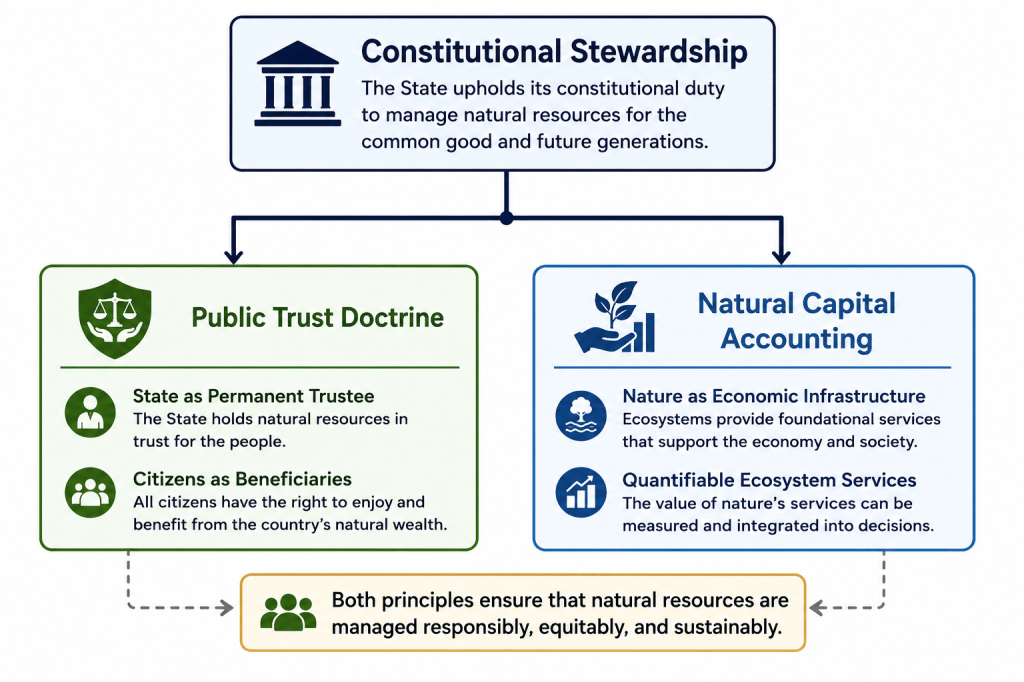
The starting point of any discussion on water rights in the Philippines is the Regalian Doctrine. Under Article XII, Section 2 of the Constitution, all natural resources—including waters—belong to the State. The Water Code of the Philippines (Presidential Decree No. 1067) further reinforces this by declaring that private entities may acquire only the right to appropriate and utilize water, subject to strict state regulation.

This distinction is critical for valuation professionals: private entities generally do not own the water itself. Instead, they acquire the legal authority to access, extract, treat, distribute, and utilize water for beneficial purposes. While a water permit is merely an administrative authorization from a legal perspective, from an economic perspective, that authorization represents a monumental source of value.

Water Rights as Economic Assets

Economics teaches us that value arises from scarcity. Although the Philippines is traditionally viewed as an island nation rich in water resources, many regions face acute water stress driven by population growth, rapid urbanization, watershed degradation, groundwater depletion, and climate-induced seasonal variability. As access to reliable water becomes premium, the economic significance of water rights increases proportionally.

Water rights act as economic catalysts by providing:

  • Access to a Scarce Resource: Guaranteed entry into a restricted natural market.
  • Security of Supply & Legal Certainty: Risk mitigation against operational disruptions and litigation.
  • Priority of Use & Investment Opportunities: The baseline confidence required to deploy heavy capital for infrastructure development.

In effect, water rights serve as the operational bridge that converts unpriced natural resources into productive, revenue-generating economic assets.

Lessons from Practice: Beyond Tangible Assets

Several recent valuation assignments involving watershed-based bulk water supply systems and utility infrastructure projects forced a departure from standard real estate appraisal. These engagements required an evaluation that looked beyond physical infrastructure to assess raw water sources, regulatory authorizations, off-take contractual arrangements, and long-term hydrological sustainability.

One particular assignment involving a watershed-based bulk water supply system raised several non-traditional questions:

  • What precise portion of enterprise value is truly attributable to land versus physical improvements?
  • How should the raw, productive capacity of the surrounding watershed be quantified?
  • What is the isolated economic value of the right to abstract and distribute water?
  • How does the long-term reliability of the water source impact overall enterprise risk and value?
  • To what extent do administrative permits and contractual off-take agreements contribute to the ongoing economic viability of the operation?

Answering these questions required moving past conventional property appraisal and venturing into resource economics, institutional rights, environmental planning, and natural capital accounting. The valuation ultimately demonstrated that the economic performance of the enterprise could not be explained solely by its tangible assets. A massive portion of its utility and income-generating capacity was inherently tied to the underlying water resource and the institutional frameworks safeguarding access to it.

Two Paths to Water Production

Observation of water enterprises in Cebu reveals an interesting operational dichotomy. Different enterprises produce marketable water through completely different asset profiles:

Production TypologyResource ReliancePrimary Value Driver
Natural Capital-DependentWatersheds, springs, and deep groundwater systems.High reliance on natural replenishment and ecological health.
Technology-DependentDesalination plants and advanced treatment systems converting seawater or brackish water.High reliance on produced capital, energy inputs, and technological investments.

While both typologies generate revenue by delivering the same end product, their underlying asset structures differ fundamentally. One depends heavily on natural ecosystems; the other depends on engineered physical infrastructure. Yet, both share the same economic reality: without access to the baseline water resource (whether raw fresh water or raw seawater), neither infrastructure nor technology can generate revenue.

Natural Capital and Water Resources

The emerging field of natural capital accounting provides a precise framework for modernizing valuation practice. Natural capital refers to natural assets capable of generating flow-of-resource economic benefits. In this context, it encompasses:

  • Watersheds, aquifers, and natural springs.
  • Rivers, recharge areas, and critical forest ecosystems that regulate hydrological cycles.

Without healthy watersheds and functioning hydrological systems, physical water supply infrastructure loses its utility. Consequently, the comprehensive valuation of water enterprises demands that we look upstream at the sustainability and ecological health of the resource provider.

Beyond Valuation: Understanding How Water Creates Economic Value

The appraisal of water-dependent enterprises often begins as a valuation exercise. However, the analysis quickly extends beyond traditional questions of market value and into a broader examination of how value is created.

Water enterprises derive their economic significance not merely from land, infrastructure, or equipment, but from the interaction of natural resources, institutions, and markets. Watersheds generate water resources. Legal and regulatory systems allocate access through water rights and permits. Infrastructure transforms the resource into a usable product. Markets create demand. Together, these elements produce economic value.

Viewed from this perspective, water rights valuation is not simply an appraisal problem. It is fundamentally an economic inquiry into how natural capital is transformed into productive capital through institutional arrangements and investment.

The valuation question therefore becomes a gateway to a broader understanding of resource economics, natural capital, and economic development.

Recent developments—including the enactment of the Philippine Ecosystem and Natural Capital Accounting System (PENCAS), the Philippine Statistics Authority’s Water Accounts, and ongoing national water resource assessments—reflect a growing recognition that natural resources are not merely environmental assets but fundamental contributors to economic development and national wealth.

These initiatives have significantly advanced the measurement of water resources, ecosystem services, and natural capital. However, an important gap remains. Much of the existing literature focuses on water availability, water use, allocation, pricing, and conservation. Far less attention has been devoted to understanding how water resources create economic value and how institutional arrangements governing access to those resources influence investment, enterprise development, and wealth creation.

In particular, limited research has examined the role of water rights as institutional mechanisms that transform water resources into productive economic assets. The interaction between natural capital, legal entitlements, infrastructure investment, and economic production remains largely unexplored in the Philippine context. Understanding this relationship is increasingly important as water scarcity, climate risks, and competing resource demands place greater emphasis on the economic significance of water resources.

These questions form the foundation of the author’s ongoing research, which seeks to examine how scarcity, institutions, and water rights interact to create economic value within water-dependent enterprises and, more broadly, within the Philippine economy.

Conclusion

The discussion on water rights ultimately leads to a broader question than valuation itself. While appraisal seeks to measure value, economics seeks to understand how value is created. In the case of water-dependent enterprises, the answer extends beyond land, buildings, treatment facilities, and infrastructure.

The experience of examining bulk water systems suggests that economic value originates from the interaction of natural capital, institutions, and investment. Watersheds, aquifers, springs, and other water resources provide the physical foundation. The State, through the Regalian Doctrine and the Water Code, establishes the institutional framework governing access and allocation. Water rights and permits create certainty, enabling investment in infrastructure, treatment systems, and distribution networks that transform natural resources into economic output.

Viewed from this perspective, water rights are more than regulatory instruments. They serve as institutional mechanisms that connect natural capital to economic production. Understanding their role requires moving beyond traditional discussions of water use and toward a deeper examination of how water resources contribute to enterprise value, regional development, and national wealth.

Recent initiatives such as PENCAS, the PSA Water Accounts, and national water resource assessments signal a growing recognition of the economic importance of natural assets. Yet important questions remain. How do watersheds create economic value? How do institutions influence the allocation of scarce water resources? How do water rights support investment, productivity, and long-term development? These questions remain largely unexplored within Philippine literature and present opportunities for future research.

The inquiry that began as a valuation problem has therefore evolved into a broader economic question: how does a water resource become economic value? Exploring that question may not only improve valuation practice but also contribute to a deeper understanding of water governance, natural capital, and sustainable development in the Philippines. As water scarcity and climate-related challenges become increasingly significant, the ability to understand and account for the value created by water resources may prove essential to both economic policy and resource management in the decades ahead.
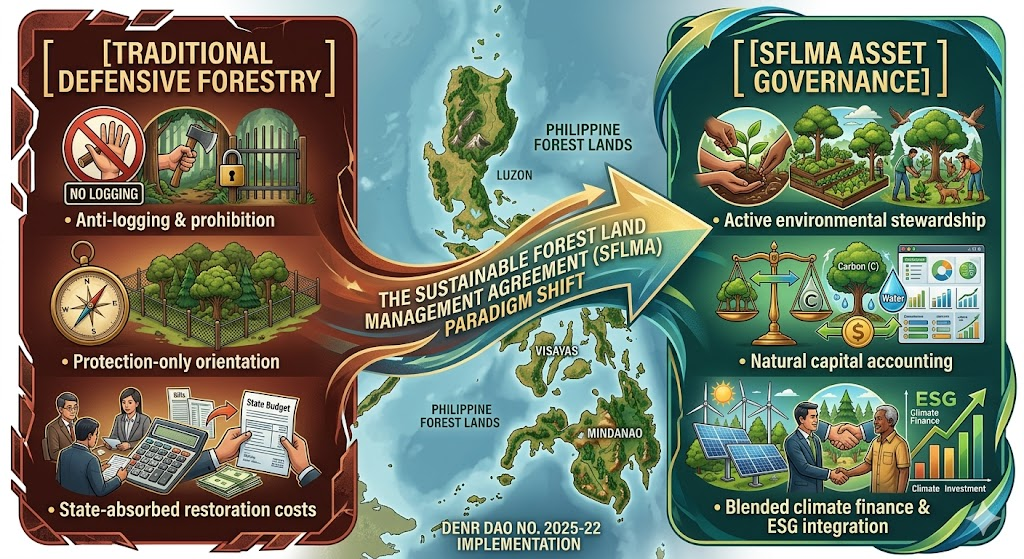
SFLMA and the Future of Environmental Asset Governance in the Philippines

I. Introduction

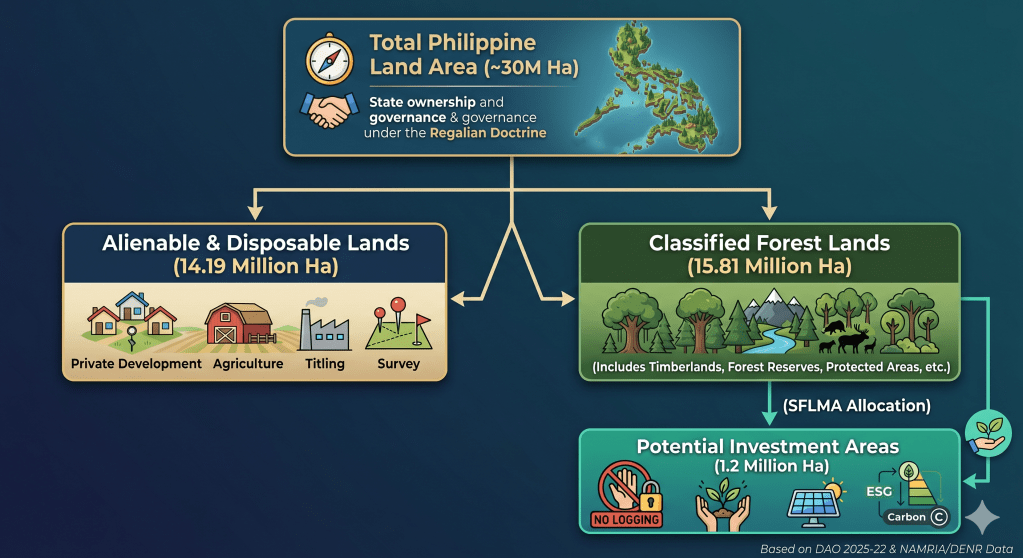
The implementation of the Sustainable Forest Land Management Agreement (SFLMA) under DENR Administrative Order No. 2025-22 marks a transformative shift from traditional, defensive forestry toward active environmental asset governance. This reform takes place against a complex legal backdrop where approximately 15.81 million hectares—over half of the Philippines’ total 30-million-hectare landmass—remain classified as public forest lands under the constitutional mandate of the Regalian Doctrine.

Historically, this system has suffered from institutional inertia, leaving official land boundaries largely unchanged since 2006 and creating a severe mismatch between legal designations and actual land use on the ground. However, the rise of the modern carbon economy has fundamentally reframed these spaces. Rather than treating forests merely as passive timber reserves or off-limits ecological zones, the SFLMA framework targets 1.2 million hectares of degraded public land—distributed across roughly 1,700 mapped parcels—to serve as climate infrastructure, carbon reservoirs, and natural capital assets.

Ultimately, this initiative places Philippine land governance at a critical intersection. The central challenge moving forward is balancing market-driven climate investments and carbon governance with the enduring constitutional principles of stewardship, social justice, and intergenerational responsibility.

II. The Carbon Economy and Legal Consolidation

One of the most consequential dimensions of the SFLMA is its architectural role in the emerging carbon economy. As international compliance and voluntary carbon markets mature, the framework provides the administrative and tenurial foundation required to host land-based carbon projects, verify forest carbon sequestration, and generate tradable carbon credits.

By offering long-term tenurial security, the SFLMA lowers the political and regulatory risk for institutional investors looking to fund nature-based solutions (NbS). Reforestation projects under this framework are uniquely positioned to serve as high-quality carbon sinks capable of issuing verified offsets for both domestic and international transfer.

Furthermore, this framework serves a critical state interest in regulatory streamlining. The SFLMA replaces and consolidates older, fragmented forest tenure systems, officially retiring:

  1. Industrial Forest Management Agreements (IFMA)
  2. Socialized Industrial Forest Management Agreements (SIFMA)
  3. Select commercial components of Community-Based Forest Management Agreements (CBFMA)

By collapsing these disparate instruments into a single governance mechanism, the DENR aims to eliminate conflicting land-use mandates, minimize institutional red tape, and lower transaction costs for clean-energy and conservation proponents. As the DENR noted during its rollout, the framework is explicitly designed to simultaneously generate rural employment, stimulate local economies, and boost the national gross domestic product (GDP) through sustainable forest enterprises.

III. Operationalizing SFLMA through the PENCAS Act

To properly realize its potential, the SFLMA framework must be linked directly to Republic Act No. 11995, otherwise known as the Philippine Ecosystem and Natural Capital Accounting System (PENCAS) Act. Passed to institutionalize the internationally accepted System of Environmental-Economic Accounting (SEEA), PENCAS provides the statutory framework that turns the theory of “environmental asset governance” into measurable fiscal and physical data.

┌────────────────────────────────────────────────────────┐
│ R.A. 11995 (PENCAS Act) │
│ National Macroeconomic & Data Standards │
└───────────────────────────┬────────────────────────────┘
▼ (Provides Baselines & Metrics)
┌────────────────────────────────────────────────────────┐
│ DENR DAO No. 2025-22 (SFLMA) │
│ Project-Level Allocation & Concessions │
└────────────────────────────────────────────────────────┘

1. The Data Engine for Asset Valuations

While the SFLMA identifies 1.2 million hectares of Potential Investment Areas (PIAs) for carbon sequestration and ecosystem services, establishing their baseline value without a standardized legal methodology invites speculation. The PENCAS Act solves this challenge by mandating the collection and compilation of official statistics on the depletion, degradation, and restoration of natural capital.

  • Asset Accounts: Under PENCAS, the state must maintain strict physical and monetary accounts of timber and land assets, which directly inform SFLMA baseline data. This guarantees that carbon sequestration projects calculate genuine additionality rather than relying on unverified corporate metrics.
  • Quantifying Ecosystem Services: PENCAS legalizes the valuation of “regulating services”—such as carbon storage, water filtration, and flood protection—giving SFLMA proponents a government-sanctioned data framework to back up ESG investments and carbon-credit accounting.

2. Macroeconomic Integration vs. Project-Level Finance

Under R.A. 11995, natural capital statistics are integrated directly into the country’s macroeconomic indicators, meaning major environmental accounts are co-released with traditional economic indicators like GDP. This creates a dual-layered governance system: PENCAS operates at the macro-level to track nature’s aggregated wealth, while the SFLMA operates at the micro-tenurial level. The SFLMA serves as the contractual vehicle allowing private and community actors to manage specific plots of land using the uniform accounting standards established under PENCAS.

3. Verification and Safeguards Against Greenwashing

One of the primary critiques of the SFLMA is the high risk of greenwashing and corporate regulatory capture. The PENCAS Act introduces a critical check on this through its institutionalized accounting metrics. If an SFLMA concessionaire causes ecosystem degradation or implements biodiversity-poor monoculture plantations under the guise of carbon offsets, the localized reduction in ecosystem asset accounts provides public interest litigants with actionable, government-backed data to support petitions for environmental remedies, such as a Writ of Kalikasan.

IV. Constitutional Boundaries: The Public Trust Intersection

Despite its market-oriented mechanics, the SFLMA operates within rigid constitutional boundaries. Under Section 2, Article XII of the 1987 Philippine Constitution, all lands of the public domain and natural resources belong to the State under the Regalian Doctrine (Jura Regalia). Because public forest lands are inalienable, the SFLMA does not transfer ownership. Instead, it grants restricted stewardship and management rights, explicitly conditioned upon the continuous fulfillment of environmental obligations.

This arrangement operationalizes the constitutional philosophy that property bears a social function, meaning the right to utilize natural resources is inherently subordinated to the welfare of the common good. Consequently, the SFLMA sits at a complex legal intersection:

Under the Public Trust Doctrine, the State serves as the perpetual trustee of the nation’s natural wealth, while private and community actors function as temporary, fiduciary stewards. Every SFLMA project must therefore operate within legally defined ecological limits, ensuring that the exploitation of the asset does not impair the underlying public trust.

V. Systemic Risks, Drawbacks, and Structural Critiques

While structurally ambitious, the SFLMA framework exhibits several vulnerabilities, regulatory gaps, and socio-ecological risks that require rigorous mitigation.

1. The Commercialization of Ecospace and Greenwashing

By treating forests as natural capital, there is an immediate risk that environmental governance becomes subordinated to market incentives. If forests are valued primarily for their carbon credit yields and commercial ESG returns, biodiversity and deep ecological integrity may take a backseat.

This commercial focus invites structural greenwashing. Without robust, third-party verification protocols and data-driven carbon audit registries, corporate actors might exploit SFLMA concessions as cheap corporate branding vehicles. Weak state oversight could lead to speculative carbon banking, double-counting of offsets, and the generation of low-integrity carbon credits that fail to achieve genuine additionality.

2. Corporate Concession Dominance and Elite Capture

The framework permits large-scale corporate participation, allowing single entities to hold management rights over extensive tracts of land—in some instances up to 40,000 hectares. This high ceiling raises significant concerns regarding elite capture and land concentration. If large conglomerates dominate the competitive allocation of Potential Investment Areas (PIAs), smaller cooperatives, local civil society organizations, and marginalized upland communities may be priced out of the environmental asset market entirely.

3. Overlaps with Ancestral Domains and IP Exploitation

Spatial mapping data from the DENR indicates a critical geographic tension: approximately 85% of identified SFLMA parcels partially overlap with roughly 15% of ancestral domains occupied by Indigenous Cultural Communities (ICCs) and Indigenous Peoples (IPs).

While the law mandates compliance with the Free and Prior Informed Consent (FPIC) process under the Indigenous Peoples’ Rights Act (IPRA), there is a structural risk that this participation becomes merely transactional or symbolic. If indigenous communities lack equal bargaining power or sophisticated legal representation, they may find themselves excluded from meaningful benefit-sharing mechanisms and long-term project governance.

4. Ecological Conversion and Monoculture Risks

From an ecological standpoint, carbon-sequestration math often favors fast-growing, non-native commercial species over complex, slow-growing native silviculture. Policy research from the University of the Philippines warns that if regulatory safeguards are weak, the SFLMA could inadvertently incentivize the conversion of remaining natural secondary forests into simplified agroforestry or monoculture plantation systems, compromising local biodiversity and watershed resilience in the name of carbon maximization.

5. Regulatory Capture and Institutional Capacity Gaps

Simultaneously managing and auditing more than one million hectares of geographically dispersed forest lands demands an unprecedented level of technical, technological, and regulatory oversight. The DENR currently faces significant budgetary, staffing, and technological constraints. Without advanced remote sensing, real-time drone monitoring, and corruption-resistant auditing platforms, the SFLMA framework remains vulnerable to regulatory capture, illicit land conversions, and enforcement failures on the ground.

VI. Conclusion: Anchoring the Future Framework

The SFLMA brings a foundational tension in modern environmental law to the forefront: Should nature be governed primarily as an inviolable public trust, or as a quantifiable economic asset?

The doctrinal significance of DAO No. 2025-22 lies in its attempt to merge these two paradigms. It demonstrates that the Philippines is actively transitioning from a legacy of reactive environmental regulation to a proactive strategy of environmental asset governance.

The policy challenge moving forward is not whether the Philippines should participate in global climate finance or build domestic carbon markets; rather, it is whether these market mechanisms can remain firmly anchored to constitutional stewardship, social justice, and the principle of intergenerational responsibility (Oposa v. Factoran).

The ultimate success of Philippine carbon governance will depend on the state’s ability to develop a comprehensive legal framework that balances private economic utilization with robust public accountability, ensuring that all environmental assets are managed to serve the common good. The SFLMA has opened the door to market-based conservation; the onus is now on the state, civil society, and private sector to build the governance architecture required to walk through it responsibly.

Selected references and links:

On the Integration of the PENCAS Act in Current CLUP Approvals

Today, Gus Agosto, a licensed Environmental Planner, sent his formal reply to the Department of Human Settlements and Urban Development (DHSUD), signaling a continuing exchange on the review of the Cebu City Comprehensive Land Use Plan (CLUP) 2023–2032.

The exchange brings into focus a critical issue in Philippine land use planning: the alignment of existing planning practices with Republic Act No. 11995, or the Philippine Ecosystem and Natural Capital Accounting System (PENCAS) Act.

Gus Agosto, a former ADB Consultant, stressed that “the law is already in force.” Consequently, its requirements—especially the integration of environmental and natural capital considerations into planning and decision-making—are neither prospective nor optional, but are binding elements of the existing legal framework governing land use.

While the Department has emphasized the need for technical readiness, including the development of standardized datasets and frameworks, it is important to underscore that institutional readiness does not suspend legal obligation. A clear distinction must be made between full technical implementation and minimum compliance. Even at present, there are sufficient tools—such as hazard mapping, watershed delineation, and environmental constraints analysis—to begin integrating ecological limits into planning decisions.

Deferring integration to the “next CLUP cycle,” which may span nearly a decade, risks allowing land use decisions to proceed under frameworks that do not reflect current legal and environmental realities. In a region like Cebu, which continues to face recurring disasters and environmental stress, such delay raises serious concerns about the adequacy of planning safeguards.

Recent events—including the Binaliw dumpsite collapse in January 2026 and the widespread devastation caused by Typhoon Tino in 2025—underscore the real-world consequences of land use decisions that fail to fully account for environmental risks. These incidents highlight the urgency of ensuring that planning frameworks evolve in step with both law and lived experience.

“The issue is not whether we can fully implement PENCAS today, but whether we can justify continuing to approve land use decisions that ignore a law already in force. We already know where the risks are. The responsibility now is to ensure that planning decisions reflect that reality—before the next disaster forces the correction.” Consultant Agosto said.

The objective is not to disrupt planning processes, but to strengthen them. A transitional approach—where PENCAS principles are integrated to the extent practicable while full systems are being developed—offers a balanced and legally sound path forward.

The question is not whether we are ready to implement the law, but whether we can afford not to.

Following is my letter reply to the DHSUD:


HON. ATTY. RAMON QUINTIN CLAUDIO C. ALLADO
Undersecretary
Department of Human Settlements and Urban Development (DHSUD)
Kalayaan Avenue, Diliman
Quezon City

CC  : DIRECTOR, LEGAL SERVICE

 Re: Response to DHSUD Letter dated 16 February 2026
On the Review and Implementation of the Cebu City CLUP 2023–2032

Dear Undersecretary Allado:

I acknowledge receipt of your letter dated 16 February 2026 concerning the review and implementation of the Cebu City Comprehensive Land Use Plan (CLUP) 2023–2032 in relation to the Philippine Ecosystem and Natural Capital Accounting System Act (PENCAS, Republic Act No. 11995).

While I appreciate the Department’s recognition of natural capital accounting’s role in land use planning, I respectfully register strong reservations regarding the proposal to defer its integration until complete frameworks, datasets, and guidelines are issued—or to limit it to the next CLUP cycle.

1. Immediate Binding Effect of the PENCAS Act

Republic Act No. 11995 is in full force and binds all government agencies, including DHSUD, in their administrative functions. The absence of complete technical frameworks or datasets does not suspend this obligation; administrative convenience cannot supersede a statutory mandate.

2. CLUP Approval as a Continuing Administrative Act

CLUP review and approval constitute an ongoing administrative function that must align with laws in effect at the time of the decision. Approving a CLUP without incorporating PENCAS requirements undermines its substantive legal validity, irrespective of procedural compliance.

3. Impropriety of Deferral to the Next Cycle

Deferring the integration of PENCAS to the “next cycle”—effectively a decade from the current 2023–2032 planning horizon, especially in a context marked by historical delays in plan updating—is untenable in the face of recurring and intensifying disasters in Cebu. Recent events, including the January 2026 Binaliw dumpsite collapse that claimed 36 lives, and Typhoon Tino (2025), which left at least 158 fatalities, dozens missing, and thousands injured across Compostela, Liloan, Balamban, Danao City, and Cebu City, underscore the grave consequences of inadequate land use planning.

These incidents are not isolated occurrences, but manifestations of systemic vulnerabilities—many of which may be linked to outdated or insufficiently responsive planning frameworks. In this light, a policy of deferring compliance with the PENCAS Act risks perpetuating land use decisions that fail to reflect environmental constraints and hazard realities. This, in turn, increases foreseeable risk and undermines the duty of planning authorities to align land use regulation with existing legal mandates and evolving environmental conditions.

4. Distinction Between Full Implementation and Minimum Compliance

Full technical implementation may await standardized systems, but minimum transitional compliance is feasible now using available tools like hazard mapping, watershed delineation, and environmental constraints analysis. Ecological limits can thus inform planning without full PENCAS operationalization.

5. Request for Clarification

In view of the above, I respectfully seek clarification on:

i. Whether DHSUD plans to approve CLUPs omitting PENCAS requirements;

ii. Whether interim or minimum compliance measures apply to LGUs pending full PENCAS rollout; and

iii. Whether the Department contemplates transitional guidelines to align current planning with legal mandates.

6. Reservation of Rights

This letter is without prejudice to further actions to ensure land use planning complies with the law and addresses environmental and developmental imperatives.

7. Closing

My intent is not to hinder planning but to affirm that natural capital integration is now a legal imperative, not mere policy.

Thank you for your attention.

Respectfully yours,

Augusto B. Agosto, JD

Environmental Planner

Natural Capital Accounting and the Apo Quarry Case

The recent tax dispute between the Province of Cebu and Apo Land and Quarry Corporation (ALQC) has highlighted the legal limits of provincial taxation authority over quarry operations. The initial assessment of approximately Php1.218 billion was reduced to a proposed Php211 million compromise settlement, now under review by the Provincial Board. While the legal aspects of the dispute revolve around statutory limits on quarry taxation, the case also raises a broader question: how should the economic value of natural landscapes affected by quarry extraction be measured?

The Philippines has recently institutionalized ecosystem and natural capital accounting through Republic Act No. 11995, commonly referred to as PENCAS. This law recognizes ecosystems as economic assets whose value should be reflected in national and local policy decisions. When applied to quarry operations, natural capital accounting allows policymakers to estimate the economic value of ecosystem services that may be affected by extraction activities.

Under the PENCAS framework, the economic value of a natural resource landscape can be expressed as the Total Economic Value, which combines both market output and ecosystem services.

ComponentDescription
Market valueCommercial value of extracted minerals
Natural capital valueEcosystem services such as watershed protection, slope stabilization, and flood mitigation

While traditional taxation captures only the market value of extraction, natural capital accounting attempts to quantify the value of ecosystem functions that support environmental stability and community resilience.

The Apo quarry operations cover an estimated 406 hectares under mining agreements. However, quarry sites typically disturb only a portion of the concession area at any given time. International mining and quarrying studies suggest that active disturbance commonly affects 30–40 percent of the concession area. Applying a mid-range estimate of 35 percent disturbance, the approximate area of affected landscape may be calculated as follows:

IndicatorValue
Total concession area406 hectares
Estimated disturbance ratio35%
Estimated disturbed area142 hectares

Global watershed valuation studies—including the The Economics of Ecosystems and Biodiversity (TEEB) Initiative and the widely cited work of Costanza et al. (2014) Changes in the Global Value of Ecosystem Services—estimate the bundled value of ecosystem services such as watershed protection, flood regulation, erosion control, and groundwater recharge at approximately US$3,000 to US$20,000 per hectare per year depending on ecosystem type.

Also, ecosystem service valuation studies conducted in watershed environments worldwide estimate the value of environmental services such as flood regulation, erosion control, and groundwater recharge at approximately US$10,000–US$20,000 per hectare annually. Converting this range into Philippine pesos results in an estimated Php500,000 to Php1,000,000 per hectare per year.

Using a conservative midpoint estimate of Php900,000 per hectare annually, the potential ecosystem service value associated with the affected landscape may be estimated as follows:

CalculationValue
Disturbed area142 hectares
Estimated ecosystem value per hectarePhp900,000/year
Estimated ecosystem service valuePhp127.8 million per year

This estimated ecological value offers a useful point of comparison with the proposed compromise settlement in the Apo tax case. If the Php211 million settlement is distributed across the approximate 16-year coverage period of the assessment, the provincial fiscal recovery corresponds to roughly Php13.2 million per year.

The comparison between fiscal recovery and estimated ecosystem value may be illustrated as follows:

IndicatorEstimated Value
Ecosystem services valuePhp127.8 million / year
Provincial fiscal recoveryPhp13.2 million / year
Fiscal capture ratio≈10% of ecosystem value

It is important to emphasize that this comparison does not imply a legal liability on the part of the quarry operator. Rather, it illustrates the difference between the fiscal instruments currently available to local governments and the broader environmental value associated with landscapes affected by extraction activities.

Mining agreements in the Philippines typically operate within a 25–30 year timeframe. If the estimated ecosystem service value were projected over a 30-year operational horizon, the cumulative value of ecosystem services associated with the affected landscape could be estimated as follows:

ProjectionValue
Annual ecosystem valuePhp127.8 million
30-year horizon Estimated ecosystem valuePhp3.8 billion

This simplified natural capital ledger helps place the Apo quarry case within a broader economic context.

ComponentEstimated Value
Limestone production value (Cebu quarry sector)~Php225 million/year
Ecosystem service value~Php128 million/year
Estimated 30-year ecosystem value~Php3.8 billion
+ Carbon sequestration+Php8 million
Proposed tax settlementPhp211 million

From a policy perspective, the significance of this analysis lies not in assigning additional financial liability but in recognizing the economic importance of ecosystems within resource governance.Carbon sequestration offers a strong “alternative use” valuation for quarry-disturbed lands like Apo (upland Cebu forests), quantifying foregone climate benefits as an opportunity cost in your natural capital ledger.

The Apo case illustrates the structural characteristics of the Philippine mining governance framework. Mineral resources are owned by the State and administered by the national government, while environmental impacts and land-use implications are often experienced locally. As a result, local governments may face environmental management responsibilities while having limited taxation authority over extraction activities.

Natural capital accounting offers a complementary tool that allows policymakers to understand the broader economic landscape within which resource extraction occurs. Instead of relying solely on traditional taxation mechanisms, governments can use ecosystem accounting to guide policies such as watershed restoration programs, rehabilitation funds, and long-term land-use planning.

In this sense, the Apo quarry case highlights an important shift in public policy thinking. While taxation measures the financial revenue generated from extraction, natural capital accounting helps quantify the environmental assets that support economic activity and community resilience.

As Cebu continues to grow as an economic center in the Visayas, integrating natural capital accounting into resource governance may provide a more comprehensive framework for balancing development, environmental stewardship, and long-term sustainability.

The purpose of this estimation is to illustrate how ecosystem accounting can complement traditional fiscal metrics. While tax assessments measure the financial revenues associated with extraction activities, natural capital accounting helps quantify the environmental services that landscapes provide to surrounding communities.

In this sense, the Apo quarry case underscores the potential policy relevance of ecosystem accounting under Republic Act No. 11995, PENCAS. By recognizing ecosystems as economic assets, natural capital accounting allows policymakers to better understand how natural landscapes contribute to long-term environmental resilience and sustainable development.

The Apo Quarry tax dispute reveals a critical gap in Philippine resource governance: while provincial taxes capture only a fraction (~10%) of extraction’s market value, natural capital accounting under PENCAS quantifies the far broader ecological ledger—Php128 million/year in ecosystem services plus Php8 million/year in foregone carbon sequestration across 142 disturbed hectares.

Integrating these metrics exposes structural imbalances, where local governments bear environmental burdens from nationally administered mining without commensurate fiscal tools. This analysis demonstrates NCA’s power not as a liability hammer, but as a policy compass—guiding watershed restoration bonds, progressive rehab fees, and land-use plans that align development with Cebu’s natural assets.

Cebu’s CLUP and the Problem We Refuse to Map: Waste Disposal

Today, I attended a meeting where solid waste disposal finally took center stage. At one point, a lawyer asked me a direct question: If we are against the use of Binaliw as the city’s final disposal site, then where should Cebu put its waste?

I was a bit surprised—not because the question was hostile, but because it reflected a familiar assumption in our planning conversations: that an unsafe site somehow becomes acceptable simply because there is no immediate alternative.

My response was straightforward. If Binaliw is geologically unsafe, environmentally prohibited, or legally non-compliant, then it must be closed or phased out—even if there is no instant replacement yet. The absence of an alternative does not legalize a dangerous site. It only exposes the failure of long-term planning.

That exchange captures the heart of Cebu’s waste dilemma. We are repeatedly forced to choose between maintaining a risky status quo and confronting the harder task of planning properly. In truth, solid waste disposal is not merely an operational problem—it is a land-use problem. And unless it is clearly integrated into the city’s Comprehensive Land Use Plan (CLUP), we will keep asking the same question every time a crisis occurs: If not here, then where?


Waste Is Not a Side Issue. It Is a Planning Constraint.

Every land-use decision produces waste. Higher density means more garbage. Commercial expansion means more packaging waste. Mixed-use zones mean round-the-clock waste generation.

Despite this, solid waste management in Cebu has often been treated as a sectoral concern, discussed in a separate plan, handled by a different office, and enforced at the barangay level—while the CLUP proceeds as if waste were invisible.

This separation is a fundamental planning error.

Under Philippine planning law, solid waste is not optional, operational, or secondary. It is a land-use issue that must be integrated into the CLUP itself.


What the Law Already Recognizes

Republic Act No. 9003, the Ecological Solid Waste Management Act, is explicit: solid waste management must be integrated into local development and land-use planning.

This is not theoretical. The Department of Human Settlements and Urban Development (DHSUD) enforces this principle every day.

A subdivision cannot be approved without:

  • a Materials Recovery Facility (MRF),
  • a waste management plan,
  • and a clear disposal arrangement.

If DHSUD requires this level of scrutiny for a single subdivision, then it follows logically—and legally—that a city-wide CLUP must meet a higher standard, not a lower one.

Yet many CLUPs, including Cebu’s, expand urban development without clearly mapping:

  • where MRFs will be located,
  • where transfer and processing facilities will go,
  • how buffer zones will be enforced,
  • or how increased waste volumes will be safely handled.

The Inayawan Closure and the Illusion of Disposal

Cebu City once relied on the Inayawan Sanitary Landfill. That facility is now closed following environmental and legal challenges.

What replaced it is not a new landfill within the city—but dependence on external disposal arrangements.

There is nothing inherently wrong with regional disposal. In fact, for a dense island city like Cebu, regional solutions often make sense.

But here is the planning problem:

The CLUP does not clearly acknowledge or spatially integrate this dependency.

If waste is transported out of the city, the CLUP must still plan for:

  • transfer stations,
  • waste logistics corridors,
  • processing and diversion facilities,
  • environmental safeguards along the way.

Ignoring these realities does not make them disappear. It simply pushes them into unsafe locations.


Binaliw and the Cost of Planning Silence

The presence of waste-related facilities in upland barangays like Binaliw—and the landslide incidents associated with them—should be a wake-up call.

These are not isolated operational failures. They are predictable outcomes of weak land-use integration.

RA 9003 prohibits waste facilities in environmentally critical and geologically unstable areas. Cebu’s own studies identify upland zones as landslide-prone and ecologically sensitive.

When waste facilities end up there, it is not because the law is unclear. It is because the CLUP failed to make waste a binding spatial constraint.


Barangay Conflicts Are Symptoms, Not Causes

Recent disputes between barangays and City Hall over waste segregation and collection protocols highlight another consequence of poor integration.

Barangays are asked to enforce “no segregation, no collection” policies—but without:

  • sufficient MRFs,
  • zoning support,
  • land reserved for facilities,
  • or clear citywide spatial guidance.

This creates friction, confusion, and inconsistent enforcement. It also undermines public trust.

A CLUP that integrates waste properly does not leave barangays to improvise. It provides spatial clarity and institutional backing.


Regional Solutions Require Local Responsibility

Some argue that final disposal should be regional, not city-based. That may be true.

But regional scale does not excuse local planning.

Even if the landfill or waste-to-energy facility is outside Cebu City, the CLUP must still:

  • prohibit unsafe siting within the city,
  • reserve land for waste processing and transfer,
  • link development intensity to waste system capacity,
  • and protect watersheds and communities from downstream impacts.

Planning ends not at jurisdictional boundaries, but at impact pathways.


The Real Question the CLUP Must Answer

A credible CLUP must be able to answer this simple question:

As Cebu grows denser and more complex, where—and how—will its waste be safely managed?

If that answer is not visible on the zoning map, then the plan is incomplete.

Urban resilience is not built only with roads and buildings. It is built by managing what cities produce—especially what they discard.


Closing Thought

Garbage is not glamorous. It does not attract investors or ribbon cuttings. But it is one of the most honest indicators of whether a city’s planning is grounded in reality.

If waste management is mandatory at the subdivision level, it must be central at the city level.

Because in the end, a land-use plan that cannot account for its waste is not planning for sustainability—it is planning for crisis.

Cebu City’s CLUP as a Regional Economic Instrument:

Why Land Economics Must Anchor Urban Planning

Urban land use planning in Cebu City cannot be treated as a purely local spatial exercise. As the primary economic anchor of Central Visayas (Region VII), Cebu City performs metropolitan and regional functions that extend far beyond its administrative boundaries — economically, socially, and spatially.


Cebu City in the Regional Economic Structure

Central Visayas remains one of the fastest-growing regional economies in the Philippines. In 2024, the region’s gross regional domestic product (GRDP) reached about ₱1.28 trillion, expanding at 7.3 percent — higher than the national average — and maintaining its position as the largest economy in Visayas and Mindanao.

Within this context, Cebu City continues to serve as the regional engine:

  • In 2024, Cebu City’s economy expanded by about 7 percent, with a total output of roughly ₱334.48 billion, driven by trade, finance, and professional services.
  • According to recent Provincial Product Accounts, Cebu City accounted for about 22.6 percent of Central Visayas’ regional economy in 2023, second only to the entire Province of Cebu.

Cebu City’s economic footprint is not contained within city boundaries: it affects employment patterns, investment flows, infrastructure utilization, and land markets across multiple provinces and cities in the region.


Zoning as a Regional Economic Decision

Urban economic theory explains that development rights — created and modified by zoning — are capitalized into land values and development incentives.

In Cebu City:

  • The IT Park–Lahug corridor drives strong agglomeration effects.
  • The CBD–Port core remains a critical commercial and logistics hub.
  • The South Road Properties (SRP) influence is reshaping coastal development patterns.
  • Fringe and upland barangays are facing conversion pressures with implications for peri-urban growth.

These dynamics produce a complex land value gradient that must be recognized and regulated in the CLUP.


Regional Spillover Effects

When land values in Cebu City rise due to zoning changes, the pressure is felt in neighboring LGUs:

  • Housing demand spills over into Consolacion, Lilo-an, and Talisay.
  • Commuter flows cross city boundaries, stressing transport corridors.
  • Agricultural land conversion accelerates in fringe municipalities.

This illustrates that Cebu City’s land use decisions are not isolated. They shape regional patterns of growth and require a planning perspective consistent with broader regional development strategies — including the Central Visayas Regional Development Plan.


Why RLUC and DHSUD Review Cebu City’s CLUP

The institutional review structure reflects this regional reality.

The Regional Land Use Committee (RLUC), operating within the regional planning structure of the Department of Economy, Planning, and Development (DEPDev), conducts technical assessment of CLUPs to ensure consistency with regional spatial strategy and economic coherence.

Meanwhile, the Department of Human Settlements and Urban Development (DHSUD) serves as the national approving authority — guaranteeing alignment with national urban development policy, hazard integration, infrastructure standards, and housing obligations.

This layered review is not bureaucratic duplication. It is recognition that Cebu City’s land use decisions have regional repercussions, and thus must be evaluated not only for local coherence but for their impact across the metropolitan and regional system.


Infrastructure and Fiscal Discipline

Allowing density increases without aligning them with infrastructure capacity produces:

  • Higher capital expenditure demands
  • Road and drainage system overload
  • Greater disaster risk exposure

A responsible CLUP must factor in not just spatial demand but also infrastructure load-testing and projected fiscal impact. Growth may increase revenue — but it may also create unfunded liabilities if infrastructure and risk costs are excluded from the analysis.


Climate Risk as an Economic Variable

Hazard-prone areas — floodplains, landslide slopes, coastal lowlands — are not merely environmental concerns. They are economic risk multipliers that, if developed without restraint, impose long-term costs on public budgets and private livelihoods.

To address this, the CLUP must define:

Net Developable Land =
Gross Land – Hazard Constraints – Easements – Protected Zones

This adjusted baseline must inform density decisions.


Housing Affordability and Land Cost Capitalization

In high-demand corridors of Cebu City, land cost often represents a major portion of overall housing price. If land value increases faster than housing supply expands, zoning changes alone will not yield affordability — they may worsen it.

This underscores the need for inclusionary mechanisms and spatial strategies that place housing close to jobs, infrastructure, and hazard-safe areas.


Cebu City as Metropolitan Steward

The CLUP of Cebu City must operate as:

  • A regulator of land value winds
  • A coordinator of infrastructure investments
  • A climate risk filter
  • A promoter of equitable housing outcomes
  • A mediator of regional economic stability

When Cebu City adjusts density and land use rules, the regional economy adjusts with it.


Planning for Value and Region

Cebu City’s CLUP must transcend the narrow framing of zoning colors on paper. It must be anchored in land economics and regional economic logic — because spatial decisions in this city do not stay within its borders. They shape the future of Central Visayas and influence conditions well beyond.

Beyond the City: Carbon Market and Regional Development

When we speak about Carbon Market, the conversation is often framed as a city-level redevelopment issue. But from an economist’s and urban planner’s perspective, that framing is incomplete.

Carbon Market is not just a Cebu City asset.
It is a regional economic node embedded within:

  • The Cebu City Comprehensive Land Use Plan (CLUP)
  • The broader Central Visayas food system
  • Inter-municipal agricultural and fisheries value chains

Understanding this connection is essential. Because what happens in Carbon Market does not stay in Carbon Market.If the Cebu City CLUP provides the spatial framework within the city, regional development provides the functional framework beyond it.

Carbon Market does not operate within the administrative boundaries of Cebu City alone. Its economic reach extends to:

  • Vegetable-producing upland municipalities
  • Coastal fishing communities
  • Neighboring provinces supplying agricultural and marine products
  • Informal and micro-enterprise processors embedded in peri-urban zones

In regional economic terms, Carbon Market is a growth linkage node. It performs three critical functions:

Market Access for Peripheral Producers

Regional development theory emphasizes that urban centers must provide stable demand anchors for rural economies. Without reliable access to urban markets, smallholder farmers and fishers face:

  • Price instability
  • Dependence on trader-lenders
  • Higher transaction costs
  • Reduced bargaining power

Carbon Market shortens this chain. It allows producers from outside Cebu City to plug directly into an urban demand center with high turnover and price transparency.

Weakening that node without creating an equivalent alternative risks pushing producers back into fragmented, less competitive arrangements — deepening regional inequality rather than reducing it.


Cost Distribution Across the Region

When a central distribution hub functions efficiently, it:

  • Reduces duplication of logistics
  • Concentrates transport routes
  • Facilitates bulk aggregation
  • Lowers spoilage rates

Research on vegetable supply chain losses in Central Philippines shows that inefficiencies in aggregation and storage significantly increase losses before produce reaches consumers. Likewise, studies on Cebu’s fish trade highlight how centralized nodes stabilize pricing and reduce uncertainty in time-sensitive transactions.

If Carbon Market’s role as a distribution hub diminishes, costs do not disappear — they are redistributed. Often, they shift:

  • Upstream to producers (lower farmgate prices)
  • Downstream to consumers (higher retail prices)
  • Outward to peripheral municipalities (logistics strain)

Regional development is not simply about growth. It is about where costs and benefits are spatially allocated.


Urban–Rural Integration

The Cebu City CLUP governs land within the city. But urban land-use decisions influence regional integration.

A well-functioning urban core should:

  • Complement rural production
  • Support peri-urban logistics
  • Serve as an accessible convergence point

Carbon Market historically performs this integrative function. It is a bridge — not a barrier — between rural supply and urban consumption.

If the urban core shifts toward higher-value commercial uses without preserving essential economic infrastructure, the result is functional displacement. Wholesale and distribution activities may be pushed outward into areas less prepared to handle them, increasing congestion, transport time, and land-use conflict.

From a regional planning standpoint, that is inefficiency — not progress.


Resilience Beyond Boundaries

The CLUP incorporates resilience planning within city limits. But food systems operate regionally.

During typhoons, port disruptions, or fuel shocks, centralized and accessible aggregation points allow for rapid redistribution and emergency coordination.

Carbon Market enhances:

  • Supply continuity
  • Rapid turnover of perishable goods
  • Network density among traders and suppliers

If that density fragments, regional resilience weakens.

In a climate-vulnerable region like Central Visayas, food-system stability is not optional. It is structural.


The Regional Development Question

Urban redevelopment often focuses on maximizing land value within city boundaries. But regional development asks a broader question:

Does this spatial change strengthen or weaken urban–rural economic integration?

Carbon Market is not simply an asset of Cebu City. It is a component of Central Visayas’ food economy.

Modernization is possible — even necessary. But modernization must:

  • Preserve small-producer access
  • Maintain low transaction costs
  • Strengthen logistics efficiency
  • Protect affordability for consumers
  • Align with the CLUP’s structural intent
  • Support inclusive regional growth

Otherwise, a local land-use adjustment may unintentionally generate regional economic imbalance.


Planning as System Stewardship

Planning is not merely about zoning compliance or real estate optimization.

It is about system stewardship.

Carbon Market sits at the intersection of:

  • Land-use planning (CLUP)
  • Inclusive value-chain development
  • Regional economic integration
  • Food-system resilience
  • Spatial equity

Understanding it as regional infrastructure — not merely local property — allows Cebu to evolve without destabilizing the very economic networks that sustain it.


Author’s Note

Agosto is an economist and urban planner, and a practicing real estate professional whose work examines land-use governance, market institutions, and regional economic systems. His analyses engage the Cebu City Comprehensive Land Use Plan (CLUP) in relation to public markets, food-system resilience, and inclusive regional development in Central Visayas.

Carbon Market: More Than a Marketplace — A Critical Node in Regional Food Value Chains

When we talk about Carbon Market, the discussion too often centers on infrastructure — bricks, stalls, modernization, redevelopment. But to understand its true economic role, we have to move beyond the physical structure and look at the value chains that give it meaning. From an economist’s and urban planner’s perspective, Carbon Market is not simply a venue; it is a distribution hub, a transaction institution, and a key node where multiple food supply chains converge.

From Farms and Fisheries to City Plates

Academic research helps explain why this matters.

In the Central Philippines, vegetable supply chains are highly vulnerable to losses. Studies show that up to 30–40% of vegetable produce can be lost before it reaches consumers — losses that occur because of poor transport infrastructure, multiple intermediaries, inadequate cold storage, and fragmented market access. These inefficiencies translate into lost income for farmers and higher prices for consumers. (ResearchGate: “Supply chain losses of vegetables in Central Philippines”)

Separately, research into the fish trade in Cebu City highlights how the flow of seafood from producers to consumers is shaped by a complex web of traders, processors, auction markets, and retail outlets. The study illustrates that fish supply chains are highly relational: small fishers depend on buyers who bring their catch into the city, while consumers depend on urban markets to provide diversity, quality, and affordability. (ResearchGate: “The Dynamics of the Fish Trade in Cebu City”)

These findings are not abstract. They confirm something we see every day: food supply in cities like Cebu depends on efficient, accessible, and well-functioning distribution nodes. Carbon Market is one of the most important of these.

Carbon Market as an Institutional Hub

The UP CIDS study on inclusive agricultural value-chain models makes a central point: markets are not neutral transactional spaces. They are institutions — systems of practices, rules, norms, and networks that shape how producers, intermediaries, and consumers interact. When these institutions function well, they lower transaction costs, reduce uncertainties, and give small producers real access to buyers. When the institutions fail, producers are forced into exploitative arrangements, risk losses, and see declining returns on their labor and investment. (UP CIDS)

This institutional perspective helps us understand Carbon Market not just as a physical place, but as an enabling environment for exchange — a hub where logistics, finance, information, and relationships come together.

Why Changes to Carbon Market Disrupt Food Supply Chains

When the character of Carbon Market changes — whether through redevelopment, commercialization, privatization, or regulatory transformation — the effects are rarely neutral. Instead, they reshape the very value chains that feed the city.

Here’s how the available evidence explains this:

1. Supply Chain Losses Are Real and Costly
Vegetable supply chains in the Central Philippines already experience significant losses before produce ever reaches consumers. Any disruption to a major distribution node like Carbon Market — which serves as a point of aggregation and redistribution — will likely exacerbate these losses unless deliberate efficiency and preservation mechanisms are put in place. (ResearchGate: Vegetable losses study)

2. Fisheries Trade Relies on Complex Networks
Fish traders in Cebu City rely on established channels to bring catch from coastal producers into the urban market. Carbon Market participates in this web of relationships — sanctioning trust, pricing norms, and informal arrangements that help balance risk between fishers, buyers, and sellers. Disrupting these networks without substituting effective alternatives increases uncertainty and costs within the entire system. (ResearchGate: Fish trade dynamics)

3. Institutional Voids Hurt Small Actors
The UP CIDS research underscores that without strong market institutions — whether formal contracts or informal norms — small producers get squeezed by intermediaries who set terms, capture rents, and limit market access. When Carbon Market’s institutional role changes without careful planning, these “institutional voids” can widen, leaving small farmers and fishers worse off. (UP CIDS)

Who Bears the Costs?

The outcomes of institutional disruption are not distributed equally:

  • Smallholder farmers and fishers lose affordable access to markets and often face higher transaction costs.
  • Vendors and micro-processors face barriers from rising rents, increased compliance costs, or loss of informal financial arrangements.
  • Consumers — especially low- and middle-income households — face higher prices and reduced access to fresh produce and fish.

This is not speculative. The weight of evidence from multiple studies — in vegetables, fisheries, and institutional economics — shows that food distribution systems are sensitive. They can be improved, but only if redesign respects existing networks and preserves inclusivity.

What Responsible Planning Looks Like

If the goal is to modernize or upgrade Carbon Market — a goal many stakeholders share — it must be guided by principles that reflect its role in multiple value chains:

  • Maintain space for small producers. Institutional support — from vendor cooperatives to flexible credit arrangements — must remain part of the market’s design.
  • Invest in logistics and preservation. Cold storage, loading bays, and organized wholesale operations can help reduce supply chain losses.
  • Strengthen institutions, not dismantle them. Formal contracts, transparent pricing systems, and data-driven logistics can complement — not replace — the informal norms that give small actors agency.
  • Protect consumer access. Any redevelopment must safeguard affordability and access for regular marketgoers.

Carbon Market as Food-System Infrastructure

Carbon Market is more than a collection of stalls. It is a critical node in the regional food system — an institution that connects farms and fisheries to city plates, mediates relationships and prices, and anchors the everyday flow of goods.

Decisions about its future must go beyond aesthetics or real estate valuations. They must be grounded in economic reality, allied with evidence from supply-chain research, and centered on inclusion. Only then can Carbon Market evolve in a way that strengthens, rather than weakens, the economic ecosystem it supports.

Carbon Market is food-system infrastructure.
Treating it as mere real estate risks undermining Cebu’s food security, livelihoods, and urban resilience.

Agosto is an economist, urban planner, and a practicing real estate professional. His work examines how markets, land, and urban systems shape everyday livelihoods, with a particular focus on public finance, inclusive development, and the public-interest role of urban infrastructure.

Why Cebu City Must Revisit Its 2025 CLUP: Lessons from the Binaliw Upland Landfill

The collapse of the Binaliw landfill in Cebu City has been explained away in familiar terms. It has been called an accident. An operational failure. An unfortunate convergence of circumstances. Some have even framed it as a force majeure—an event no one could have reasonably foreseen.

But when examined through the lenses of land-use planning, environmental governance, and disaster risk management, these explanations do not hold.

Binaliw was not an accident.
It was a foreseeable outcome of a planning decision—one that ignored a fundamental principle already embedded in Cebu City’s own Comprehensive Land Use Plan (CLUP) and the JICA Roadmap for Solid Waste Management:

No engineering solution can outweigh an inherently risky upland location.


The Real Frame

Public discussion has focused heavily on whether Binaliw was an “engineered sanitary landfill.” That framing misses the point.

Even a perfectly designed landfill cannot defeat gravity, slope instability, rainfall concentration, and watershed dynamics inherent in an upland area. Engineering can only mitigate risk within the limits set by geography—it cannot erase those limits.

The correct question is not whether Binaliw was engineered.
The correct question is why an upland, risk-sensitive area was assigned a high-intensity waste function in the first place.

That question leads us directly to the CLUP and the JICA study.


The CLUP: Risk Was Acknowledged—Then Overridden

Under the Cebu City Comprehensive Land Use Plan, barangays like Binaliw are identified as part of the City’s upland and environmentally constrained zones. These areas are characterized by:

  • Slope and landslide susceptibility
  • Sensitivity to saturation and runoff
  • Strong influence on downstream flooding and disaster amplification

The CLUP recognizes that such areas require low-intensity, risk-compatible land uses, with infrastructure treated as conditional and transitional, not permanent or intensifying.

Yet in practice, Binaliw was allowed to operate as a major disposal site for metropolitan waste, accumulating mass far beyond what an upland area can safely bear over time.

This was not an oversight.
It was a planning contradiction.


Mixed-Use Zoning: Where Risk Became a Policy Choice

The most critical vulnerability in the CLUP lies in its allowance of mixed-use or conditional development in upland areas.

In lowland urban settings, mixed-use zoning can enhance resilience and efficiency.
In upland, environmentally constrained zones, it does the opposite.

Mixed-use zoning in uplands opens the door to intensity creep:

  1. Risk is acknowledged but not prohibited.
  2. Projects are approved individually, each appearing compliant.
  3. Cumulative load is ignored.
  4. Carrying capacity is exceeded.

A landfill in an upland area is not merely a land use—it is continuous mass loading. Waste is heavy, compressible, water-retentive, and constantly increasing. No zoning flexibility or engineering detail can change that physical reality.

By permitting mixed-use development in upland zones, the CLUP effectively treated risk as negotiable, rather than as a hard limit.

A Warning Issued Long Before the Collapse

What makes the Binaliw disaster even more troubling is that this exact risk was already identified more than a decade ago.

As early as 2015, the JICA Roadmap for Solid Waste Management in Metro Cebu had already reached a clear and technically grounded conclusion: engineering solutions have inherent limits in upland terrain. The study did not merely recommend better landfill design; it explicitly framed upland disposal as a temporary and diminishing option, one that must be progressively relieved of waste load as part of a metropolitan transition strategy.

The 2015 JICA study recognized several realities that remain unchanged today:

  • Upland areas are geomorphologically unstable under sustained mass loading;
  • High rainfall and steep slopes amplify saturation and failure risks;
  • Waste accumulation in uplands contributes not only to local instability but also to downstream flooding and disaster amplification;
  • Reliance on existing upland landfills must therefore be reduced over time, not intensified.

In other words, the JICA Roadmap did not assume that better engineering could permanently solve upland disposal risks. It assumed the opposite: that location imposes non-negotiable limits which engineering can only temporarily mitigate.

This is why the roadmap emphasized a phased exit from upland landfill dependence—through waste diversion, metropolitan disposal facilities, and alternative treatment systems. Upland landfills were never envisioned as permanent infrastructure supporting metropolitan waste volumes.

Why the 2025 Cebu City CLUP Must Be Revisited

The collapse of the Binaliw landfill has transformed what was once a technical planning debate into an urgent governance imperative. What is now clear—beyond reasonable dispute—is that the 2025 Cebu City Comprehensive Land Use Plan (CLUP) must be revisited, particularly its treatment of upland areas and mixed-use zoning.

This is no longer a question of preference, ideology, or development philosophy. It is a question of whether land-use policy will continue to contradict geographic reality.

Mixed-use zoning is often defended as a modern, adaptive planning tool. In lowland urban contexts, that is frequently true. In upland, environmentally constrained areas, however, mixed-use zoning becomes a risk multiplier.

It allows:

  • gradual intensification without clear ceilings;
  • project-by-project approvals that ignore cumulative impact;
  • reliance on engineering solutions where geography has already imposed limits.

The CLUP’s mixed-use provision, when applied to uplands, converts known natural constraints into negotiable policy choices. Binaliw demonstrates the cost of that conversion.

What Revisiting the CLUP Should Mean (Not Cosmetic Amendments)

Revisiting the 2025 CLUP must go beyond clarifications or tighter permitting language. It requires structural correction.

At minimum, a revised CLUP should:

  • Remove or strictly prohibit mixed-use zoning in upland, environmentally constrained areas for high-intensity or mass-loading uses;
  • Explicitly classify uplands as protection-priority zones, not development reserves;
  • Treat any allowed infrastructure as transitional, with:
    • volume caps,
    • sunset clauses,
    • mandatory exit timelines;
  • Align land-use zoning with JICA’s metropolitan transition framework, not short-term disposal convenience.

The Central Policy Lesson

Binaliw has delivered a lesson that planning documents can no longer ignore:

When geography says “no,” zoning must listen.

A CLUP that recognizes upland risk but still permits intensification through mixed-use zoning is internally inconsistent—and now demonstrably unsafe.


A Moment for Course Correction

The call to revisit the 2025 Cebu City CLUP is not anti-development. It is pro-safety, pro-governance, and pro-accountability.

Binaliw should be treated as a planning threshold event—the moment when assumptions were tested against reality and found wanting. To proceed as if nothing fundamental has changed would be to accept that similar disasters are an acceptable cost of “flexibility.”

They are not.

The CLUP must be revised—not because plans failed to exist, but because reality has shown which provisions can no longer be defended.

Planning Is Preventive Law

By the end of 2025, one idea became clearer—not because it was new, but because it finally had a precise legal shape.

Years of working around land use, valuation, environmental constraints, and governance had already revealed a recurring pattern: disasters rarely begin with the event itself. They begin much earlier, quietly, through decisions that shape space, density, and exposure. What the Bar year did was not introduce this reality for the first time, but give it doctrinal clarity.

I came to understand that what we often treat as planning policy is, in truth, law operating in advance.


Planning is usually described in technical terms—maps, zoning colors, land-use matrices, projections stretching years into the future. Because of this, planning questions are often dismissed as administrative or premature, as if they sit outside the core concerns of law. Legal accountability, we are told, comes later—after damage, after injury, after loss.

But this way of thinking misunderstands what planning actually does.

Once a land use plan or zoning ordinance is adopted, it immediately produces legal effects. It authorizes certain uses, prohibits others, and—most importantly—determines where risk is allowed to exist. When residential use is permitted in flood-prone areas, exposure is not accidental. When development is allowed on unstable slopes, vulnerability is not unforeseen. When natural drainage paths are narrowed or built over, flooding is no longer a surprise.

These outcomes do not begin with nature.
They begin with decisions.


Planning as Preventive Law

Preventive law is not an unfamiliar concept. Building codes exist to prevent collapse. Fire regulations exist to prevent loss of life. Health and sanitation laws exist to prevent outbreaks. None of these wait for injury before they matter. Their legal force lies precisely in their ability to act before harm occurs.

Planning belongs to the same family of law, but it operates earlier and more quietly. It governs a stage where future occupants are unknown, where affected communities cannot yet assert their rights, and where consent to risk is rarely informed. That is exactly why the law requires planning to be rational, evidence-based, and compliant with statutory standards.

Seen this way, planning is not optional policy guidance.
It is a preventive legal duty.


The Legal Foundations Already Exist

This understanding is not theoretical. Philippine law already treats planning as a legally mandated function designed to prevent harm.

The 1987 Constitution, particularly Article II, Section 16, obliges the State to protect and advance the right of the people to a balanced and healthful ecology. This duty is preventive in nature. It does not wait for environmental collapse; it requires governance decisions that avoid it.

The Local Government Code (Republic Act No. 7160) reinforces this by vesting local governments with police power and the authority to enact zoning ordinances in the interest of public safety, health, and general welfare. Police power, by definition, is exercised to prevent harm—not merely to respond after the fact. Land-use regulation is one of its clearest preventive expressions.

The Urban Development and Housing Act (Republic Act No. 7279) explicitly requires rational land use and the avoidance of danger areas for human settlements. Allowing communities to be established or intensified in known hazard zones is therefore not just a planning lapse; it is a failure to comply with a statutory preventive mandate.

Environmental laws strengthen this framework. The Philippine Environmental Impact Statement System (Presidential Decree No. 1586) requires environmental impact assessment before project approval. The purpose of the EIA is not remediation but anticipation—to inform decisions so that environmental harm is avoided at the outset.

More recent legislation, such as the Climate Change Act (Republic Act No. 9729) and the Disaster Risk Reduction and Management Act (Republic Act No. 10121), explicitly require risk-informed and hazard-based planning. These laws translate scientific knowledge into legal obligation. Where climate and disaster risks are known or knowable, planning institutions are required to integrate them into land-use decisions.

With the enactment of the Philippine Ecosystem and Natural Capital Accounting System Act (Republic Act No. 11995), the preventive character of planning is made even clearer. By requiring the integration of natural capital considerations into policy and planning, the law recognizes that future environmental loss must be accounted for before decisions are made—not after damage is done.


What the Supreme Court Has Already Said—Implicitly

Philippine jurisprudence has long supported this preventive approach, even if the Court has not always used the term “preventive law.”

In Oposa v. Factoran, the Supreme Court recognized the right of present and future generations to a balanced and healthful ecology, allowing legal action to proceed even before irreversible harm had occurred. The case stands for the principle that environmental protection is anticipatory, not merely remedial.

In MMDA v. Concerned Residents of Manila Bay, the Court emphasized the State’s continuing obligation to protect and rehabilitate the environment. The duty recognized was not episodic or reactive; it was ongoing and proactive—consistent with the idea that governance failures upstream are legally relevant.

In Resident Marine Mammals v. Reyes, the Court applied the precautionary principle and underscored the importance of environmental compliance at the planning and approval stage. While framed in terms of precaution, the decision affirmed that legality is assessed before harm occurs.

Similarly, in West Tower Condominium Corp. v. First Philippine Industrial Corp., the Court focused on risk creation and foreseeability. The ruling made clear that where risk is foreseeable, and proximity exists, a duty arises—even before catastrophic damage fully unfolds.

Taken together, these cases show a consistent judicial posture: the law does not require disaster as a precondition for accountability. Where duty, foreseeability, and legal authority intersect, courts are prepared to intervene upstream.


Why Planning Is Not a Premature Legal Question

The argument that planning issues are “premature” usually rests on the absence of visible injury. But preventive law does not require collapsed homes or lost lives before it can be questioned. If it did, building codes, environmental clearances, and zoning regulations would only become relevant after failure—rendering prevention meaningless.

Once planning is mandated by law and formally adopted, a duty already exists. Once hazard maps, flood histories, and climate data are available, foreseeability already exists. And once plans authorize exposure to known risks, the legal issue is already present.

Damage does not create the breach.
Damage merely confirms what planning already allowed.


Planning, Climate Risk, and Accountability

Climate change has only sharpened this reality. Risk today is rarely uncertain. Flood pathways are mapped. Rainfall patterns are documented. Slope hazards are classified. Climate projections are publicly available. In legal terms, this means that discretion narrows and responsibility expands.

True adaptation does not mean learning to live with avoidable harm. It means adjusting plans, zoning, and land-use decisions so that foreseeable harm is not embedded into future development. Improving evacuation plans while allowing the same dangerous land uses is not adaptation; it is accommodation of failure.


A Closing Reflection

Understanding planning as preventive law changes how accountability is framed. Zoning maps become evidence, not background. Hazard studies become proof of foreseeability, not optional references. Planning approvals become legally reviewable acts, not purely political choices.

Justice should not begin with compensation after loss.
It should begin with decisions made when harm is still avoidable.

That is the perspective 2025 clarified for me—not as a new discovery, but as a consolidation of experience, doctrine, and observation. As we move forward in an era of climate risk, planning must be treated for what it truly is: the law’s first and most consequential opportunity to prevent harm.

Long before the waters rise, the law already has something to say.