A Message to All Cebuanos: The First Victory Is Here—Now Let’s Finish the Fight

In the aftermath of Typhoon Tino, we demanded answers.
We sought accountability.
We refused to accept that flooding, landslides, and danger were “normal.”

Through our collective effort—and through the letter we sent to the Cebu City Council, to the Mayor, and to the Vice Mayor—the City has taken notice.

Because of this united action, a proposed resolution has now been filed calling for a full, urgent review of the Comprehensive Land Use Plan (CLUP) and Zoning Ordinances (ZO) of Cebu City.

This is a direct response to your concerns, your pleas, your stories, and your courage to speak out.

This is our first victory.

But it is only the beginning.


We Need Every Cebuano Now to Push This to Completion

A proposed resolution is not yet an approved resolution.
It is a seed—planted because of our effort.
For it to grow, we must stand together, louder and stronger.

This CLUP/ZO review is critical for Cebu’s future.
It will shine light on:

  • Upland developments that altered natural slopes
  • Flood-prone subdivisions allowed in hazardous areas
  • Blocked rivers and ignored waterways
  • Environmental oversight failures
  • The outdated planning that failed to protect our communities

This is our chance to correct decades of harmful decisions and bring back safety, logic, and environmental balance to our city.


We Started the Ball Rolling—Now We Need You to Roll It Forward

We call on every Cebuano:

  • Homeowners and families
  • Professionals and students
  • Barangays and community leaders
  • Survivors of Typhoon Tino
  • Everyone who believes Cebu deserves a safer future

Stand with us.
Raise your voice.
Tell the City Council: Approve the resolution. Begin the review. Protect the people.

The government has heard us once.
Let’s make sure they hear us all the way to the finish line.


A United Cebu Is Stronger Than Any Storm

Typhoon Tino may have awakened our pain, but it also awakened our strength.

We showed that ordinary citizens can move City Hall.
Now let us show that we can move Cebu toward a safer, more sustainable, and more just future.

This is no longer just my cause, or your cause—
This is Cebu’s cause.

Let us finish what we have begun.

Padayon, Sugbo.
Dili ta mosurrender.
Dili ta magpabilin nga hilom.
Let us stand as one and demand the future that our people deserve.

—Gus Agosto
For a Safer, Smarter, and Sustainable Cebu

Link to Our Letter to the City Council and Officials: https://abagosto.com/urban-risk-and-governance-advisory/

Proposed City Council Resolution https://abagosto.com/2383-2/

Why Cebu Must Revisit Its Land-Use Decisions: A Response to Architect Espina’s Recent Interview

In a recent SunStar interview, Architect Joseph Michael Espina urged Cebu to adopt a watershed-focused development model. This model is based on the JICA 2015 roadmap. His call for green belts, green loops, and floodplain restoration resonates strongly with many Cebuanos. They are still reeling from the devastation of Typhoon Tino.

There is no question that Cebu needs these reforms.
The real question is this:

Why were these measures not implemented when Architect Espina was the Cebu City Planning Coordinator? This was the very position with the power to bring these ideas to life.

For three years, he oversaw the Comprehensive Land Use Plan (CLUP). He managed zoning decisions and upland development controls. He also handled the policy levers that determine whether Cebu’s growth protects people—or puts them in harm’s way. If the JICA model was already seen as the correct approach, why weren’t watershed-based zoning and green belt protections started? Why weren’t upland conservation rules and relocation landbanks initiated when he held the authority to pursue them?

This question becomes even more important when we examine the city’s official land-use data under his watch.


The Numbers Tell a Different Story

The CPDO’s GIS data compares the 2020 existing land use to the proposed 2023–2032 CLUP. (See below). A clear pattern emerges:
Cebu’s land-use trajectory moved away from the very principles Espina is now advocating.

Here are the most critical changes:

  • Forest lands reduced from 9,312 hectares to 2,892 hectares
    A loss of 6,419 hectares of natural upland buffers.
  • Agricultural land collapsed from 13,322 hectares to 3,653 hectares.
    This marks a reduction of 9,668 hectares. It greatly diminishes Cebu’s green belt and natural infiltration areas.
  • Commercial zoning more than doubled. It expanded from 983 hectares. The new size is 2,038 hectares.
    Much of this expansion pushed uphill into barangays like Guadalupe, Banawa, Kalunasan, Lahug–Busay, Tisa, Buhisan, Pardo, Budlaan, and Pulangbato.
  • Residential zones decreased by 183 hectares
    Shrinking livable space instead of preparing relocation areas.
  • Socialized housing remains limited to just 318 hectares
    Only 1.06% of Cebu City’s land area—far too small to make relocation feasible.
  • Industrial land rose only from 43 hectares to 122 hectares
    Just 0.41% of total land area—far below JICA standards for balanced economic growth.
  • Floodplains continued to be developed
    Even where hazard maps warned against it.

In short, the uplands that should have remained green—forested, agricultural, or low-density—were rezoned. They were opened up for commercial, mixed-use, and estate development. The lowlands that should have been protected from encroachment remained under intense development pressure.

These outcomes contradict every principle of watershed conservation, upland protection, and green-belt planning that Espina now proposes.


The Contradiction We Must Confront

It is easy to speak about watershed protection now. Typhoon Tino has claimed lives and displaced families. It has also exposed the fragility of Cebu’s landscape.
But Cebuano communities must ask, fairly and respectfully:

If these solutions were essential, why did Architect Espina not implement them? He had the opportunity, mandate, and authority to do so.
And why does the CLUP he helped shape contradict the very policies he is now promoting?

These questions are not personal.
They concern the public interest.
They concern the future of Cebu’s safety and resilience.

Upland protection was not implemented. Relocation landbanks were not prepared. Watershed overlays were not adopted. Zoning was not aligned with hazard data. These failures directly shaped Cebu’s vulnerability long before Typhoon Tino.


Why This Matters Now

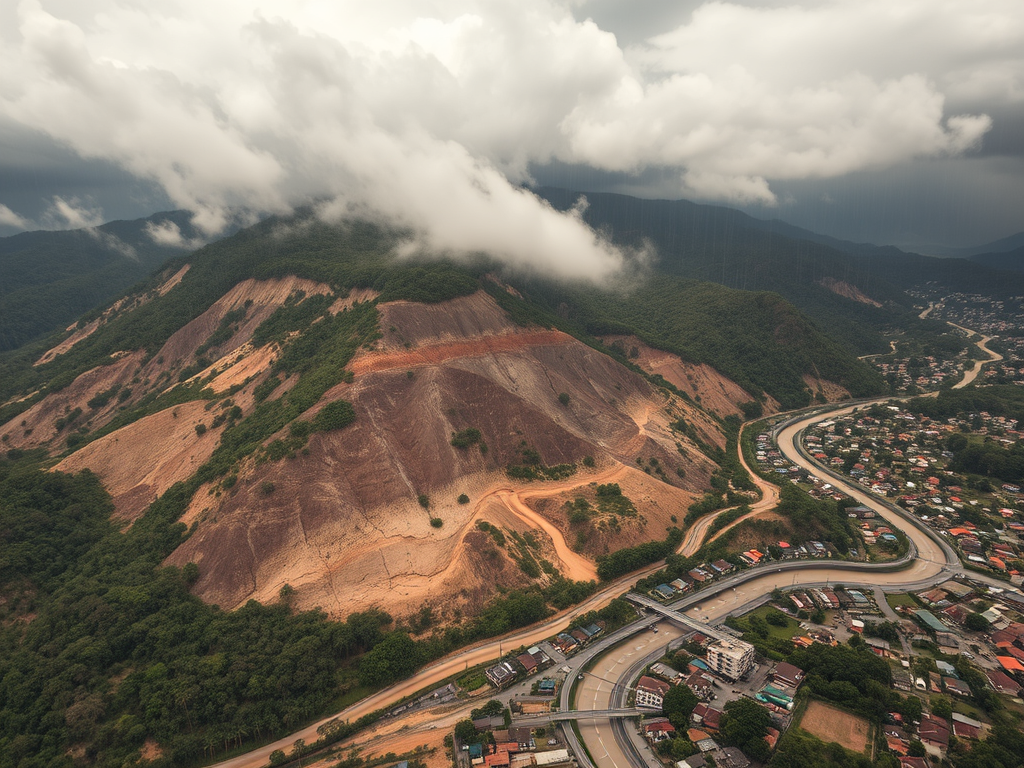
Typhoon Tino did not simply expose natural hazards—it exposed planning decisions.

When forest zones disappear,
when agricultural buffers are erased,
when uplands are commercialized,
when floodplains are built over,
when relocation sites remain unfunded,

—disaster becomes inevitable.

The suffering we witnessed in Banawa, Tisa, Talamban, Tingub, Tipolo, Pardo, and Guadalupe was not simply due to heavy rainfall. Other causes contributed significantly. It was the result of land-use patterns shaped over many years.

As Cebu rebuilds, we must avoid repeating the mistakes of the past. Upland development proceeded without watershed logic. It lacked geohazard integration and long-term relocation planning.


Cebu Deserves Clear, Honest Planning

Cebuano communities deserve transparency—not just about future plans, but about the choices made in recent years that shaped today’s risks.

Moving forward requires two things:

  1. Forward-looking strategies firmly grounded in science, not rhetoric.
  2. A candid, honest reflection on past planning decisions, so that Cebu does not repeat the same dangerous patterns.

Only then can Metro Cebu build a land-use system that is coherent and hazard-sensitive. This system must be resilient enough to protect the city from future disasters.

Source: Cebu City Planning and Development Office

Why I Choose to Speak Out on Upland Development — And Why the Public Must Be Informed

In recent days, a former Cebu City planning official publicly commented on the concerns surrounding the Monterazzas development. This matter has become widely discussed in both local and national circles. The issue is already the subject of a Senate investigation, and the local government has likewise initiated its own review. The former official advised that concerns should not be raised through Facebook or media. Instead, they should be brought exclusively through formal government channels.

I acknowledge that formal complaints are important, and official processes must indeed be followed. In fact, formal complaints are now being prepared for submission to the appropriate national agencies. But urging silence does not resolve the issue.

But I must also be honest: flooding has reached communities that have never experienced it. Upland slopes are being altered without clarity on compliance with national laws. Environmental decisions affect thousands of people downstream. Staying silent is not an option. Speaking only within bureaucratic channels is not enough.

And what is worse, this approach shifts the focus away from the actual environmental and legal issues. It focuses on silencing public participation. This happens even as thousands of residents in the lowlands are dealing with unprecedented flooding. Urging people to stay quiet does not resolve the problem; it only deepens public confusion and delays accountability.

I speak publicly because environmental governance in the Philippines is built on public participation, public disclosure, and public vigilance. Our own laws require it. PD 1586 (the EIA System) underlines the public’s rights. RA 9729 (Climate Change Act), RA 11038 (ENIPAS Act), and RA 10587 (Environmental Planning Act) also support these rights. Additionally, even the 1987 Constitution itself emphasizes the public’s right to know what is happening in their environment. It also stresses their duty to stay informed.

Environmental harm does not happen in isolation. It does not wait for paperwork. And it does not confine its effects to the offices where documents are filed. It spills into homes, businesses, rivers, roads, and ecosystems.

The recent flooding in Cebu City’s lowland barangays is a painful reminder of this reality. People who never experienced flooding in their lifetime suddenly found water inside their homes. They deserve clear answers—not after months of internal review, but now. They deserve transparency on upland developments. They need clear information on slope stability and ECC issuances. It is necessary to confirm if laws like PD 705 and PD 1998 were followed. This is especially crucial in areas where slopes exceed the 18% restriction.

Public discussion does not undermine government processes. It strengthens them. It forms a record and mobilizes awareness. It gives voice to communities. They may not know how to navigate official channels. However, they certainly feel the consequences of development decisions made in the highlands.

Yes, I will file formal complaints. That is being done. But informing the public, raising awareness, sharing technical findings, and inviting civic discussion are equally necessary. They are not acts of defiance—they are acts of democratic participation. These actions are fully protected by our Constitution’s guarantee of access to matters of public concern. It also ensures the right to a balanced and healthful ecology.

To the many who asked why I speak up: I speak because the public deserves the truth. I speak because environmental planning is not merely about documents—it is about people, communities, watersheds, and future generations. I speak because what happens in the uplands affects what happens in the lowlands. And I speak because silence, when there is a clear environmental risk, would do more harm. It would be a greater disservice than discomforting a few.

Transparency protects communities. Silence protects no one.

Who Controls the Uplands? Cebu’s Extractive Landscape and Flood Vulnerability

The upland regions of Cebu represent the island’s watersheds, recharge zones, forests, limestone formations, and mineral deposits. These regions are the ecological backbone of the province. These areas perform critical hydrological functions, anchor biodiversity, and mitigate the worst impacts of storms, flooding, and extreme weather events. Yet, from a political economy perspective, the control, use, and allocation of upland spaces reveal deep asymmetries of power. There are persistent institutional weaknesses. Long-standing tensions exist between economic extraction and ecological stability. Understanding who controls the uplands is essential. Additionally, knowing how these controls shape risks and vulnerabilities is crucial. This knowledge helps explain why Cebu is increasingly prone to catastrophic flooding. Moreover, it explains the occurrences of slope failures.

Historically, Cebu’s uplands were governed under a fragmented regime of land classifications. These included forestlands, timberlands, alienable and disposable lands, ancestral domains, and protected areas. This system was established by national decrees and colonial land laws. Presidential Decree No. 705 (Revised Forestry Code) and Presidential Decree No. 1998 put most upland forests under State ownership. This pertains to lands with an eighteen percent slope or more in the provinces of Cebu and Benguet. However, weak enforcement gradually eroded these controls. Unregulated settlements and local political brokerage also contributed to this erosion.

In the 1980s and 1990s, selective logging, quarrying, and small-scale mineral extraction expanded. These activities were often facilitated by patronage ties. The growing political influence of local business groups also played a role. Super Typhoon Ruping (Typhoon Mike) struck in November 1990. It demolished 60% of Cebu’s buildings. Additionally, it displaced over 80,000 people in the province and sank 88 ships in Cebu Harbor. This should have been a watershed moment for upland governance. Yet despite the catastrophe, extractive pressures not only continued but also intensified. This occurred in the decades that followed. Quarrying and mining became intertwined with urban growth, cement production, and construction demand.

An examination of official records shows that Cebu’s uplands today are substantially shaped by the extractive sector. Based on the Directory of Operating Mines and Quarries (2024), the province has 81 active quarry and mining operators. They cover a total of 31,853.0599 hectares. This footprint exceeds the combined land areas of several Cebu municipalities. These operators extract a wide range of commodities. The commodities include limestone, shale, basalt, greywacke, clay, dolomite, and bentonite. They also extract sandstone, copper, gold, and silver.

Large-scale corporate players dominate, among them Republic Cement & Building Materials Inc. These include Solid Earth Development Corporation and Apo Land & Quarry Corporation. South Western Cement Corporation and Dolomite Mining Corporation also play a role. Additionally, there are Carmen Copper Corporation and JLR Construction & Aggregates Corporation. Their operations span from Asturias and Danao to Naga and Toledo. They also operate in Malabuyoc, San Fernando, Alcoy, Dalaguete, and Minglanilla. These operations cover vast sections of Cebu’s upland landscapes.

These companies hold long-term Mineral Production Sharing Agreements (MPSAs). Some of them extend into the year 2048. An example is the 607-hectare operation of Quarry Ventures Phils., Inc. The largest individual MPSAs include 2,551 hectares (Republic Cement – Danao & Carmen) and 2,383 hectares (Republic Cement – Asturias). Other significant MPSAs are 1,492 hectares for Solid Earth – San Fernando. 648 hectares are for Carmen Copper – Toledo. 524 hectares are for Dolomite Mining – Alcoy & Dalaguete. From a political economy standpoint, long-term control over upland spaces has significant implications. These mineral extraction regimes have locked in decades of upland land use patterns. This process effectively privileges corporate economic interests over watershed protection. It also undermines forest integrity and climate resilience.

This raises fundamental questions: Who benefits from the current upland configuration, and who suffers from its consequences? The primary beneficiaries are, unsurprisingly, the large corporations with long-term extraction rights. They benefit from mineral resources, cement production, and quarrying royalties. These corporations also gain from upland-to-lowland value chains. Local governments also generate revenues from extraction fees, business taxes, and employment opportunities, albeit often limited to short-term financial gains.

However, upland communities bear the environmental and social costs disproportionately. So do downstream barangays, riverine settlements, and informal households. Ultimately, the broader Cebuano public is affected as well. These populations endure increased flooding, faster runoff, declining groundwater recharge, degraded watershed capacity, and heightened risks of landslides and subsidence.

The pattern becomes even clearer when viewed against Cebu’s recent experience with disasters. In the last two decades, the province suffered recurrent catastrophic events. These include floods in Mandaue and Cebu City (2020, 2024), and multiple landslides. The deadly 2018 Naga City landslide killed at least 53 people. These events underscore a disturbing trajectory: hydrological systems strained by decades of upland extraction are progressively failing. Typhoon Kalmaegi (“Tino”) struck Cebu in November 2025. It caused some of the worst flooding in local history. Dozens were dead, thousands displaced, and the lowlands were submerged. This made the role of altered upland landscapes indisputable. And yet, the political economy driving upland control remains intact.

Super Typhoon Ruping serves as a historical anchor for understanding this trajectory. Ruping revealed, as early as 1990, the catastrophic vulnerability of Cebu’s built and ecological systems. The storm’s devastation was immense. It flattened structures, disabled utilities, and caused unparalleled maritime losses. These impacts were rooted in a combination of extreme climatic hazard and fragile landscape integrity. The subsequent “CEBOOM” era of reconstruction accelerated economic growth. However, it did not adequately address upland deforestation. There were also shortcomings in addressing watershed degradation and land-use mismanagement. What followed was a pattern in which Cebu’s economic expansion deepened its ecological vulnerability.

Thus, a political economy analysis of Cebu’s flooding problem is necessarily an analysis of upland control. State authority, corporate extraction, and local political networks are involved. Land use decisions and regulatory gaps play a role too. Together, they have produced a landscape where the uplands—meant to protect the island from hydrological extremes—have been systematically weakened. The result is a province increasingly exposed to the combined pressures of climate change, urban expansion, and ecological degradation.

Addressing Cebu’s flooding crisis requires engineering interventions and urban drainage upgrades. It also demands a structural rethinking of upland governance. This includes a reassessment of long-term extraction contracts, stricter enforcement of environmental laws, transparent land-use planning, and hazard-informed zoning. Additionally, public welfare must be prioritized over private extraction.

The question of who controls the uplands is not merely academic. It is central to Cebu’s survival in an era of intensifying climate risks.

Why Cebu Must Value Both Use and Non-Use Benefits of Its Uplands

Public discussions on Cebu’s upland resources often rely on a narrow and misleading definition of “economic value.” For years, local discourse has focused on equating economic worth with the revenues earned from quarrying and extraction. This creates the persistent and dangerous misnomer that natural wealth is measured solely by use value.

This belief is repeated in public forums, policy pronouncements, and fiscal reports. It suggests that whatever Cebu can extract, haul, crush, or sell represents the true economic contribution of its uplands. In reality, economics does not define wealth this way. Modern environmental economics evaluates natural systems differently. True economic valuation includes use values. It also includes non-use values. Ignoring non-use values results in incomplete analysis. This leads to flawed public policy. It causes environmental decline. It exacerbates climate vulnerability.

Before addressing this conceptual flaw, the scale of Cebu’s mineral economy must be clearly understood. The province is not operating a ₱600-million quarrying industry, as public officials often portray. It is operating a ₱20-billion extraction economy per year. When metallic and non-metallic activities are combined, the actual size of Cebu’s mineral economy becomes undeniable: ₱20.18 billion in 2024, ₱21.53 billion in 2023, and ₱19.32 billion in 2022. This is the real magnitude of extraction occurring in the uplands—far larger than what provincial income statements suggest.

Cebu’s quarry operators, processors, haulers, and construction supply chains transact between ₱7.5–₱12.5 billion annually in non-metallic sales alone, while metallic operations consistently exceed ₱18 billion per year. By contrast, government revenue—₱628 million in 2023—represents only 2–4% of Cebu’s total mineral economy. Thus, a massive private extraction economy generates billions in sales and profit. Meanwhile, public income is thin. It is too small to offset the environmental and social costs borne by the public.

This fixation on quarry revenue—and even the broader ₱20-billion extraction economy—reveals the deeper misconception underpinning current policies. It is the assumption that the value of natural resources lies primarily in what can be extracted from them.

This is not how economics works. Modern environmental economics, natural resource theory, and the Total Economic Value (TEV) framework all provide important lessons. They teach that real economic worth consists of use values and non-use values. Use values include quarrying, water extraction, timber, and agriculture. Recreation and tourism are also included. These activities are easily monetized and prominently appear in financial statements. Yet these represent only a fraction of total wealth.

Non-use values, although invisible in budgets and COA reports, are economically real. They represent the benefit of simply knowing that forests and watersheds exist (existence value). They also include the value of leaving ecosystems intact for future generations (bequest value). Non-use values cover the value of keeping nature available for future or unknown uses (option value). They encompass the value derived from knowing that other communities benefit from intact uplands (altruistic value). These are precisely the values Cebu loses. This happens the moment a mountain is cut, a slope is excavated, or a watershed is bulldozed.

The consequences of ignoring non-use values are visible today in the worsening flooding across Metro Cebu. Cebu’s intense focus on use values and extraction leads to destruction. This destruction affects the non-use values that sustain long-term stability. When uplands are stripped, infiltration declines; runoff accelerates; sedimentation increases; river capacity shrinks; and flood peaks intensify. This is why Metro Cebu now floods even without typhoons and why ordinary rainfall brings cities to a halt. Every ton of aggregates removed from Cebu’s uplands reduces the natural economy. This reduction affects flood mitigation, slope stability, groundwater recharge, biodiversity, and climate regulation.

In short, this is the heart of Cebu’s political economy of flooding:

  • A ₱20-billion extraction economy drives upland degradation.
  • A ₱600-million public revenue creates the illusion of fiscal benefit.
  • A multi-billion-peso ecological loss is imposed on the public.
  • A non-functioning natural protection system results in chronic flooding.

Short-term extraction is displacing long-term security.

These losses constitute ecological depreciation—the downward adjustment of natural capital from human activity. Government does not record this depreciation. However, households and businesses pay for it. They endure flooded homes. Business districts are paralyzed, and infrastructure is damaged. Transportation is disrupted. There are lost workdays, medical incidents, and increased LGU emergency spending. Against these losses, quarry revenues are negligible.

The core economic argument is simple: Cebu is counting the small gains and ignoring the massive losses. The province records quarry taxes, permit fees, operator sales, and extraction-based employment. However, it does not account for the loss of watershed integrity, slope stability, and infiltration capacity. It also overlooks groundwater reserves, biodiversity, and climate resilience. Social cohesion, cultural heritage, and intergenerational equity are ignored too. This is not just incomplete economics—it is incorrect economics. One cannot claim economic benefit from quarrying while ignoring the far greater economic harm caused by upland degradation. A ₱20-billion extraction economy is running alongside a collapsing natural economy. The outcome is predictable. The province gains short-term financial flows but accumulates long-term environmental debt.

This dynamic lies at the heart of Cebu’s political economy of flooding. A ₱20-billion extraction economy continues to drive upland degradation. A ₱600-million public revenue stream creates the illusion of fiscal benefit. A multi-billion-peso ecological loss is imposed on the public. And a weakened, fragmented natural protection system results in chronic flooding across urban and peri-urban areas. Short-term extraction has displaced long-term security, and the costs are borne disproportionately by downstream communities—not the operators who profit upstream.

Moving forward, Cebu can no longer afford a development model that counts quarry revenue but ignores watershed collapse. The province must make rational, future-oriented decisions. To do so, it must abandon the misnomer that use value alone defines economic wealth. The real economy of Cebu’s uplands includes their role as natural flood buffers. These uplands function as water towers and contribute to climate regulation. They have cultural and identity significance. Their value is also crucial to future generations. Cebu cannot call itself progressive if it treats natural capital as expendable. It cannot claim resilience if it undermines the uplands that protect the lowlands.

Economics is not about extraction. It is the total value—use and non-use, present and future, private gain and public cost. Until Cebu adopts this full accounting, it will continue to profit in pesos. However, it will lose wealth in floods, landslides, and ecological decline.

When Nature Shows the Evidence

For weeks, many have asked me a simple question. It is an important question:
“Why speak out only now about the unlicensed ENP preparer and violations of PD 705 and PD 1998?”

My answer is based on three intertwined developments. The first is a new and material fact. The second is my academic training. The third is my consistent advocacy as an Environmental Planner.

First, a new and undeniable fact has emerged. The recent flooding in Cebu’s lowland communities is unprecedented. Long-time residents—many who have lived there for 30 to 50 years—told me the same thing. They have never seen floodwaters enter their homes. This includes even during the strongest typhoons. Statements like “Bisag bagyo sauna, wa gyud misud ang tubig diri” convey a shared ecological memory. “This is the first time in our lifetime” also conveys a shared ecological memory. These are not isolated anecdotes—they are community testimonies that mark a fundamental change in Cebu’s environmental landscape. For half a century these areas remained dry. Suddenly, they are underwater. Something upstream has shifted.

This new reality exposes how technical upland issues are no longer abstract violations. These include cutting slopes beyond 18%, disturbing watersheds, altering natural drainage lines, and removing vegetation. It also involves submitting environmental studies signed by unlicensed individuals. They now have downstream victims. When upland water behaves unnaturally, lives in the lowlands are placed at risk. The consequences of violating PD 705, PD 1998, PD 1586, and RA 10587 are now apparent. They manifest in Cebuano homes, streets, and livelihoods.

Second, my Master of Laws training at the University of Santo Tomas has given me a sharper perspective. It has allowed me to see these events through a legal lens. It also provides an environmental viewpoint. Studying Climate Change Law and Tenurial Instruments has given me a deeper understanding of several important topics. These include the constitutional right to a balanced ecology and the public trust doctrine. I have also gained insights into climate risk governance, community land rights, and upland–lowland hydrology. These doctrines are not theoretical; they mirror exactly what Cebu is experiencing today. The law comes alive when the ground realities match the very risks we study in class.

Third, this position is consistent with my long-standing advocacy as an Environmental Planner. For years, I have promoted slope-compatible development, watershed protection, hazard-aware planning, and compliance with environmental laws. My past writings show a clear stance: development must respect natural systems, or nature will respond. The recent flood only confirms what I have been warning about long before this event. This includes my repeated concerns about reclamation projects. These projects constrict coastlines and narrow river outflows. They weaken storm-surge buffers, reduce coastal water capacity, and block upland floodwaters. When disturbed uplands combine with reclaimed coastlines, the lowlands become the unavoidable casualty.

These three developments—a new environmental fact, reinforced academic grounding, and a history of advocacy—converge at this moment. This is the right and responsible time to speak out. This is not a late protest. It is a necessary one.

Cebu cannot continue developing its uplands, lowlands, and coasts without respecting the laws and natural systems that protect its people. With new evidence in plain sight, staying silent would be negligence.

To speak is not only a right—it is a professional duty.

Environmental Planner Flags Legal and Technical Violations in Upland Development

A recent climate change consultation attended by Cebu Governor Pam Baricuatro, Environmental Planner Gus Agosto raised compelling concerns. He is a member of the Visayas Environmental Impact Assessment (EIA) Review Committee.

Cebu experienced alarming flooding during Typhoon Tino. Agosto, who served as a former Asian Development Bank consultant, urged provincial and city authorities to re-examine how developments in steep, geohazard-prone areas are evaluated and approved. During the consultation, he highlighted two major legal issues surrounding the Monterrazas development. He warned these issues may signify a broader pattern across Cebu Province.


Two Legal Issues at the Core of the Monterrazas Controversy

1. Possible Violation of RA 10587 (Environmental Planning Act of 2013)

Agosto raised questions about the Environmental Impact Statement (EIS) and planning documents. He asked if the supporters of the Monterrazas project’s Environmental Compliance Certificate (ECC) were prepared by licensed Environmental Planners. He also wanted to know if they were signed by them, as required by Republic Act No. 10587.

He explained that environmental planning—including suitability studies, land capability assessments, and geohazard evaluations—is a regulated professional practice. Documents submitted to support an ECC must meet the standards and signatures mandated by the law.

If unlicensed individuals prepared or signed these documents, Agosto noted, the EIS would be procedurally defective. The ECC would be legally vulnerable. The locational clearance issued by the Cebu City Planning Office would be questionable.


2. Questions on Compliance with PD 705 and PD 1998 (18% Slope and Forest Land Restrictions)

The second issue concerns compliance with Presidential Decree No. 705, which classifies lands with slopes beyond 18% as forest lands, and thus not disposable or privately developable.

Cebu has a special law—PD 1998—that allows limited slope reclassification, but only under tightly defined and historical conditions:

  • continuous occupation prior to May 19, 1975
  • existing pre-1975 settlement or agricultural use
  • maintenance of vegetation and erosion control
  • land capability survey
  • automatic reversion for violations

Agosto warned that Monterrazas, a modern hillside estate involving extensive cut-and-fill, does not fit the conditions required for slope reclassification. These conditions have been historically mandatory. Development in such terrain without full compliance with PD 705 and PD 1998 exposes downstream communities to heightened geohazard risks.

He stressed:

“If these upland slope restrictions were not followed in Monterrazas, there is no reason to assume compliance was strictly observed elsewhere in the province.”


Call for Provincial Oversight and Transparency

Agosto emphasized that upland development errors are transboundary. When a landslide occurs in Cebu City’s highlands, it causes flooding and sedimentation. This affects downstream barangays and even other municipalities.

He called on the Province to assert its oversight role by reviewing:

  • validity of ECCs
  • licensure of technical preparers
  • slope classification and suitability assessments
  • drainage and retention design
  • compliance with national laws

Governor Baricuatro responded positively, acknowledging the gravity of the issues raised. She expressed support for a province-wide review of upland subdivision developments, covering all LGUs under Cebu Province.

This includes a systematic examination of developments’ compliance with:

  • RA 10587 (Environmental Planning licensure)
  • PD 705 (18% slope rule)
  • PD 1998 (Cebu-specific slope provisions)
  • environmental impact laws
  • watershed-based coordination

Cebu’s hydrological systems are under increasing pressure. This moment may prove decisive in determining the future response to storms. They could become manageable events or lead to repeated disasters.]

Planners Must Assert Their Role in Society

At a time when environmental risks, climate pressures, and rapid urbanization converge, planners must reclaim their central role in shaping the trajectory of development. Environmental and urban planners are not mere technical consultants—they are the country’s front line in safeguarding land, water, and communities. The law recognizes this role: RA 10587 was enacted precisely because planning requires expertise, accountability, and professional judgment grounded in science. When planners remain silent or sidelined, hazardous developments proceed unchecked, upland forests are fragmented, and downstream communities pay the price. It is therefore imperative that planners—whether in government, private practice, or civil society—assert their mandate, uphold planning ethics, and insist on lawful, evidence-based land-use decisions. Doing so is not an act of opposition; it is an act of stewardship. Planners protect the public interest by ensuring that development is resilient, equitable, and aligned with the ecological limits of our islands.

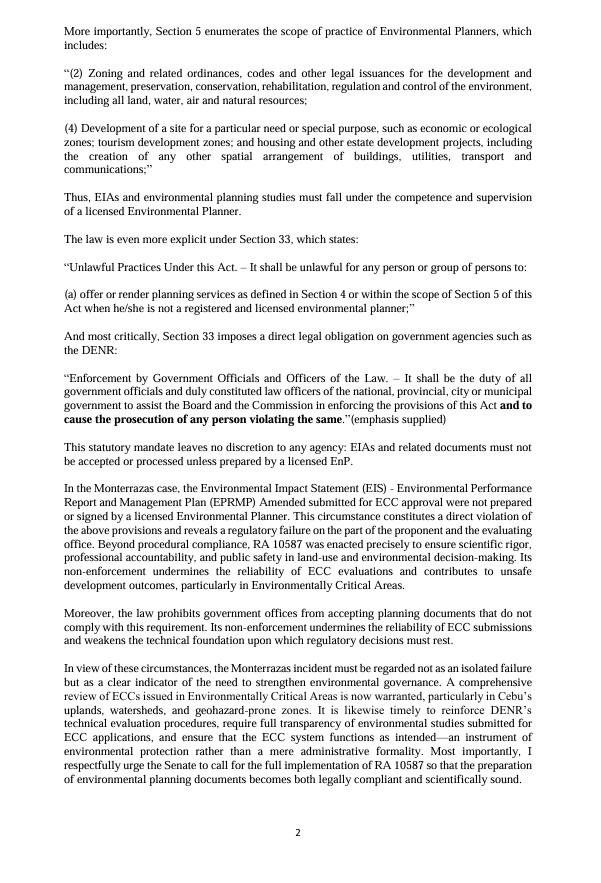
Why I Wrote to the Senate: Strengthening ECC Governance and Enforcing RA 10587

The recent events surrounding the Monterrazas de Cebu development—and the Senate investigation that followed—have brought national attention. These events have highlighted long-standing weaknesses in our environmental regulatory system. The incident goes beyond the tragic flooding and slope failures. It exposes deeper structural issues in the way Environmental Compliance Certificates (ECCs) are evaluated and approved. This is especially concerning in areas that the law classifies as Environmentally Critical Areas (ECAs).

I work as an Environmental Planner, Real Estate Consultant, and researcher. My fields intersect law, economics, and natural capital. I felt compelled to articulate these systemic concerns. I did this through a formal letter addressed to Senator Risa Hontiveros and the members of the Senate.

My letter emphasizes three core points:

First, Proclamation No. 2146 and Presidential Decree No. 1586 clearly designate steep slopes, geohazard zones, and watershed recharge areas as Environmentally Critical Areas. These areas require the highest level of scientific scrutiny. This must happen before any development is allowed. Despite this, ECCs continue to be issued in areas of high ecological and hazard sensitivity.

Second, the Environmental Planning Act of 2013 (RA 10587) contains mandates. It requires that licensed Environmental Planners prepare and sign environmental planning work. This work includes EIAs, hazard studies, hydrologic analyses, and land-use planning. In the case of Monterrazas, this requirement was not met. Non-enforcement of this law compromises the scientific integrity of ECC submissions.

Third, the Monterrazas incident is not an isolated oversight but a symptom of a broader institutional problem. ECCs are too often granted despite incomplete or inadequate assessments. Clear statutory obligations are in place to safeguard communities and ecological systems, yet they are ignored.

My letter respectfully calls on the Senate to strengthen environmental governance. This can be done by ensuring that legal requirements, particularly RA 10587, are fully enforced. ECCs issued in Environmentally Critical Areas should be thoroughly reviewed. Additionally, DENR’s evaluation systems need strengthening and increased transparency.

This moment provides a crucial opportunity to elevate environmental planning. It also helps restore public confidence in regulatory mechanisms. Additionally, it offers better protection for vulnerable landscapes and communities. I hope this contribution is useful to the Senate’s ongoing inquiry. It is also meant to aid our collective effort to build a more climate-resilient and accountable governance system.

The Political Economy of Flooding in Cebu

Every flood follows the laws of physics—but the damage it brings follows the laws of politics and economics. To understand Cebu’s recurring floods, we must examine not just rivers and drains, but land markets, incentives, and power structures.

A civic group recently released a petition calling for accountability. They demand institutional reforms and immediate interventions after the November 4, 2025 flooding. There is a deeper structural truth behind these recurrent failures—one that cannot be resolved through flood-control works alone. Flooding in Cebu is not simply a hydraulic engineering problem. It is a political economy problem. It is shaped by land markets and governance incentives. It also involves institutional weaknesses and the complex interactions between urban development and ecological systems.

The physical manifestations of Cebu’s flooding are evident. They include overflowing rivers, silted channels, blocked waterways, undersized drainage lines, and deteriorated uplands. These issues are symptoms of underlying drivers embedded in the way land is valued, used, occupied, and regulated. These systemic forces determine where people settle and where capital flows. They dictate how infrastructure is prioritized. They also influence which environmental limits are observed or ignored. Understanding the city’s flood crisis requires a new perspective. We must shift from short-term engineering responses. We should focus on a long-term examination of Cebu’s land governance and socio-economic structures.


The Limits of Engineering-Centered Solutions

For decades, Cebu’s response to flooding has relied on traditional engineering. This includes the expansion of drainage networks. It also involves the construction of embankments and the deepening of rivers. Additionally, there is the installation of floodwalls and diversion channels. These are necessary interventions and form part of any modern urban infrastructure system.

However, the severe flooding of November 4 demonstrated an important fact. Structural measures cannot compensate for degraded watersheds. They cannot make up for constricted waterways either. Additionally, land-use choices that contradict hydrological realities are not offset by these measures.

The core limitations are clear:

  • Upstream forests have thinned, reducing water absorption.
  • Urban surfaces have become more impermeable, rapidly increasing runoff.
  • Natural retention areas have been converted into residential and commercial zones.
  • Rivers have narrowed due to settlements, obstructions, and encroachments.
  • Drainage systems designed for past rainfall patterns are now overwhelmed by climate-intensified storms.

Engineering solutions, however well-designed, cannot fully absorb the consequences of decades of unsustainable land use and misaligned development patterns.


Land Market Pressures and Development in High-Risk Areas

Cebu’s flooding problem cannot be separated from the economics of land. As urban land becomes increasingly scarce and valuable, development pressures intensify toward hazard-prone areas:

  • river easements and riparian buffers,
  • wetlands and marshes,
  • floodplains and low-lying coastal areas,
  • steep upland slopes and watershed zones.

These areas historically served as natural drainage or water retention systems. Yet economic incentives—combined with regulatory concessions—have enabled their transformation into buildable parcels.

This trend reflects a market-driven logic: when prime land is limited, the pressure to develop environmentally sensitive areas becomes stronger. The result is a spatial configuration that maximizes short-term economic gains but increases long-term exposure to floods.

Thus, flooding is not merely caused by extreme rainfall. It is shaped by land scarcity and speculative development. Permissive regulatory environments also play a role in its formation. It is shaped by the interaction between land scarcity, speculative development, and permissive regulatory environments.


Political Incentives Favor Visible Infrastructure Over Preventive Governance

Flood-control infrastructures are politically compelling projects. They offer:

  • highly visible outputs,
  • significant budgets,
  • recurring maintenance contracts,
  • and narratives of action and responsiveness.

Because they are technically complex, such projects often escape broader public scrutiny. At the same time, some measures reduce long-term flood risk most effectively. These include watershed rehabilitation, strict easement enforcement, and climate-informed zoning. However, they are politically challenging. They require displacements, long-term planning consistency, and actions that may produce limited immediate political returns.

This imbalance in incentives explains why Cebu sees many flood-control structures. These structures do not always address the underlying drivers of vulnerability. Sometimes, they even worsen the situation.

Flooding persists not simply because engineering solutions are inadequate. It also occurs because political incentives prioritize short-term, highly visible outputs. These outputs are prioritized over structural preventive governance.

The issue is not a lack of technical knowledge among agencies. The problem continues because actions conflict with the interests of those who hold political and economic power.

This is the essence of the political economy argument.


River Degradation and Extractive Activities

Siltation, riverbed changes, and sediment buildup are major contributors to flood severity. These issues are exacerbated by:

  • sand and gravel extraction,
  • upland clearing for agriculture or development,
  • informal excavation,
  • and poor adherence to environmental safeguards.

These activities are sustained because they are economically profitable and often backed by political or economic influence. Despite their known impacts, they persist due to entrenched interests along the value chain—from local employment to construction demand.

Thus, river degradation is not merely a technical or enforcement issue. It is a governance challenge linked to resource extraction, revenue dependence, and regulatory gaps.


Enforcement Challenges Reflect Institutional Capture and Regulatory Asymmetry

Calls for strict enforcement frequently assume that institutions lack capacity or technical competence. In reality, enforcement failures are often tied to:

  • local political alliances,
  • informal settlements that represent vote-rich constituencies,
  • economic actors with significant influence over land use decisions,
  • fragmented authority across agencies,
  • inconsistent application of zoning and environmental rules.

Hazard-prone areas become zones of negotiation rather than regulation. This institutional dynamic contributes to weak compliance, reinforcing land-use patterns that increase flood exposure.

Flooding, therefore, arises not only from natural or physical factors but also from institutional capture and uneven regulatory power.


From Flood Control to Flood Governance

The arguments focusing on removing obstructions, correcting flawed structures, or improving inter-agency coordination are important. Yet they must be integrated into a broader, structural framework of flood governance, one that recognizes the interconnectedness of:

  • land markets,
  • watershed systems,
  • ecological integrity,
  • urban density,
  • climate projections,
  • institutional frameworks,
  • and political incentives.

A governance-centered approach requires:

  • climate-sensitive and risk-informed land use planning,
  • protection and restoration of watershed and riparian systems,
  • strict implementation of easements and hazard-zone regulations,
  • upstream retention strategies and nature-based solutions,
  • green infrastructure that enhances urban permeability,
  • basin-wide management across LGU boundaries,
  • resilient zoning and development controls,
  • and institutional reforms that shield planning from political and economic capture.

Cebu’s long-term resilience depends on integrating these elements into a coherent governance structure.


Conclusion

The November 4, 2025 flood event underscored the limitations of relying primarily on engineering-centric flood control. While structural interventions remain essential, they are insufficient against systemic land-use pressures. Institutional weaknesses and economic incentives drive risky development.

Flooding in Cebu is a political economy issue—rooted in how land is valued, governed, and contested. Meaningful solutions require a transition from reactive flood-control efforts. These solutions must embrace a comprehensive approach rooted in land governance, ecological integrity, institutional accountability, and long-term urban planning.

Cebu can only move toward true resilience through this shift. It will reduce its vulnerability to the increasingly severe impacts of climate and development pressures.

Beyond Compliance: Why the ECC Fails to Capture the True Value of Cebu’s Uplands

Environmental decision-making in the Philippines has long relied on the Environmental Compliance Certificate (ECC). It serves as the ultimate regulatory gatekeeper for development. Yet in a province like Cebu, upland forests stabilize water, climate, and communities. The ECC has exposed its deepest limitation. It measures environmental compliance, not environmental value..

This distinction came into sharp public view in Cebu City’s upland development debates. This was most notable in the case of Monterazzas de Cebu. It is a large mixed-use project built within the ecologically significant ridges of Barangays Guadalupe and Buhisan. It is near the headwaters of the Central Cebu Protected Landscape (CCPL) and the Budlaan–Buhisan watershed system.

A Watershed Is More Than a Development Site

Cebu’s uplands function as critical ecological infrastructure. They supply benefits that are foundational, systemic, and often invisible until lost:

  • Groundwater replenishment for Metro Cebu’s aquifers
  • Flood control and runoff regulation protecting low-lying urban districts
  • Carbon storage and microclimate regulation mitigating urban heat impacts
  • Soil retention that prevents landslides and downstream siltation
  • Habitat for endemic species and biodiversity reservoirs
  • Landscape identity and cultural value for Cebuanos

These benefits fall under what environmental economics calls Total Economic Value (TEV)—a framework that includes not only direct use (e.g., water supply), but also indirect use (flood control, climate regulation), option value (future medicine, ecotourism), bequest value (inheritance for future generations), and existence value (nature’s value simply for being there).

The ECC process, however, recognizes none of these as economic assets requiring valuation. It focuses instead on mitigation plans, engineering controls, and compliance commitments, answering only the question:

“Can environmental impacts be managed within acceptable regulatory limits?”

It does not ask the larger, economically decisive question:

“What is the value of what will be lost, even if mitigation is implemented?”

The ECC is a compliance mechanism. It checks if an Environmental Management Plan (EMP) exists. It also checks if mitigation measures are proposed. Finally, it ensures that pollution thresholds fall within permissible standards. But compliance is not valuation, and mitigation is not the same as replacing lost natural capital. This structural limitation represents a market failure. It converts ecological services into unpriced subsidies for development. This shifts costs to communities, households, local governments, and future generations.

The Monterazzas Case: Legally Compliant, Economically Incomplete

Monterazzas secured an ECC because it fulfilled its regulatory obligations. These obligations included drainage systems, slope protection, detention ponds, tree replacement, and environmental monitoring plans. From a compliance standpoint, the approval was defensible.

Yet public backlash surged after severe rain events in 2019 and 2021 intensified flooding in downstream Cebu communities. Flooding cannot be attributed to a single development alone. However, the case crystallized a broader reality. The cumulative cost of upland land conversion was never evaluated in economic terms.

No valuation was conducted for:

  • Reduced aquifer recharge from increased impervious surfaces
  • Lost flood buffering previously performed by forested slopes
  • Carbon stock reduction from land clearing
  • Increased sediment load affecting rivers and drainage systems
  • Public loss of ecological security and landscape heritage

These are not engineering failures. They are valuation failures—costs borne by communities and future generations, not by project balance sheets.

Mitigation Is Not Valuation

A detention pond cannot replace a mountain’s hydrological function.
Tree replanting cannot immediately restore decades of carbon storage.
Slope stabilization cannot substitute the slow work of root-bound soil ecology.

The ECC system can reduce harm, but it cannot measure the economic magnitude of what is permanently altered or foregone. As a result, developments may be:

✔ legally compliant
✖ economically suboptimal
✖ socially contested
✖ ecologically irreversible

Non-Use Values Matter to the Public—Even If the ECC Cannot See Them

What made the debate over Cebu’s uplands emotionally charged was not only flooding—it was the perception of losing something irreplaceable:

  • Cebu’s last remaining green ridgelines
  • Intergenerational access to functioning watersheds
  • The comfort of knowing nature still exists at scale
  • A shared ecological identity built into the Cebuano sense of place

These are non-use values—intangible yet real, and entirely absent in ECC assessment.

Toward a New Standard: Valuing Nature, Not Just Regulating It

If Cebu is to balance growth with survival, environmental governance must change significantly. It must evolve beyond impact mitigation. It should also move toward natural capital valuation.

Future upland development decisions should integrate:

  • Total Economic Valuation (TEV)
  • Hydrological and carbon loss accounting
  • Cumulative impact costing
  • Natural Capital Accounting (aligned with PENCAS)
  • LGU-level ecosystem service valuation in land use planning
  • Public trust and intergenerational equity as development thresholds

Because while the ECC may authorize a project, only economics can reveal its true costs—and only ecology pays them back.

The central lesson from Cebu is clear:

Development must not only comply with environmental rules.
It must account for environmental worth.
Otherwise, what is permitted is not always what is sustainable.

What Is Legal Is Not Always Economic

The ECC ensures projects meet environmental regulations. It does not ensure that development decisions make economic sense when nature’s services are fully priced. In rapidly urbanizing regions like Cebu, ignoring this distinction leads to developments that seem profitable in private ledgers. However, they impose hidden public costs that increase over time.

Cebu’s uplands are not free. Their services are not infinite. And their depreciation is not costless.

Nature’s contributions need to be priced, recorded, and defended like any other form of capital. Without these measures, the province will continue approving projects that are technically compliant. However, these projects will remain economically incomplete.

The ECC prevents illegal environmental harm.
Valuation prevents unaffordable environmental loss.
Cebu urgently needs both.