
Why Title Annotations and Encumbrances Matter in Property Appraisal

In valuation, the fine print on the title can be as valuable—or as dangerous—as the land itself.

In real estate appraisal, numbers alone do not tell the whole story. A property’s legal status—particularly the annotations and encumbrances appearing on its title or tax declaration—can drastically alter its worth. While some may view these legal markings as mere notarial footnotes, a seasoned property appraiser understands that such entries are crucial to determining the property’s true value, marketability, and risk profile.  One of the most important but sometimes overlooked aspects of valuation is the presence of annotations and encumbrances on the property’s Transfer Certificate of Title (TCT), Original Certificate of Title (OCT), or Tax Declaration. These annotations—whether involving tax delinquency, pending litigation, or other restrictions—can drastically alter a property’s value, marketability, and highest and best use (HBU). For the professional appraiser, understanding and correctly interpreting these legal markings is essential, not optional.

Why Appraisers Must Pay Attention

There are several compelling reasons why a diligent appraiser must care about annotations and encumbrances.

First, these legal burdens directly affect market value—the core product of any appraisal. Buyers in the open market are generally unwilling to pay full price for a property encumbered by unresolved claims, legal disputes, or forfeiture risks. Appraisers must therefore consider how each annotation may cause potential buyers to either walk away or demand a discount.

Second, legal risk translates to value risk. Annotations such as a lis pendens, adverse claim, or a writ of attachment signal potential issues with ownership, possession, or future usability. Even if a property looks physically sound, a legal cloud on its title will make it less attractive and inherently riskier. Prudent appraisers account for this by adjusting their valuation assumptions, often applying a discount or issuing a qualified opinion.

Third, these annotations frequently affect the property’s highest and best use (HBU)—a foundational concept in valuation. If a property is subject to restrictive covenants, reversionary clauses, or foreshore lease limitations, its legal permissibility for development or other productive use may be severely constrained. The appraiser must therefore revise the HBU analysis and its associated value estimate accordingly.

Fourth, annotations impair a property’s marketability. For instance, a property that has been auctioned off for tax delinquency but is still within the redemption period cannot be sold with confidence. Similarly, if a property was inherited but the title transfer is not yet perfected, there may be co-heir disputes or administrative delays. In both cases, the property may be legally transferable only in theory, but not in practice—at least not without cost or time delays.

Fifth, annotations affect the property’s loanable value or equity value. Banks and other financial institutions are wary of lending against titles that carry risks. For example, a property mortgaged beyond its current market value or encumbered with a lien from unpaid taxes may only be eligible for partial financing, or worse, may be rejected altogether as loan collateral. This has direct implications for the appraiser’s task in estimating not just market value, but the net realizable or mortgageable value.

Finally, ignoring these factors may violate the appraiser’s professional and legal responsibilities. Under the Real Estate Service Act (RA 9646), the appraiser is required to exercise due diligence and report all material conditions that affect the value of the property. International Valuation Standards (IVS) and the Uniform Standards of Professional Appraisal Practice (USPAP) similarly require full disclosure and the proper interpretation of legal burdens. Failing to do so may expose the appraiser to liability, loss of license, or reputational damage.

Understanding the Specific Impact of Common Annotations

To make these risks and responsibilities more concrete, let’s examine how common annotations and encumbrances impact valuation:

A Notice of Tax Delinquency or Forfeiture carries a negative impact on value and significantly impairs marketability due to the risk of government seizure. When a Certificate of Sale appears on the title—typically following a tax auction—the buyer only has conditional ownership until the redemption period lapses. This also warrants a discounted valuation and caution in reporting.

A Lis Pendens indicates that the property is subject to ongoing litigation. Its presence severely impairs marketability and imposes legal uncertainty, which in turn reduces value. An Adverse Claim similarly signals a third-party interest in the property that contradicts the titleholder’s claim. While not always litigated, it still creates hesitation for buyers and lenders, pulling values downward.

A Levy or Writ of Attachment represents a judicial restriction. Courts attach the property to secure a possible judgment, and while the property is not yet seized, its transferability is legally curtailed. This justifies a risk adjustment in the valuation.

If the title carries a Foreshore Lease or a Department of Environment and Natural Resources (DENR) annotation, it usually means that the property is within the public domain (such as coastal or reclaimed land). Ownership is limited to leasehold rights, not fee simple. This not only reduces the appraised value to the leasehold interest but also conditions its use based on government regulation.

An Affidavit of Loss or Reconstitution of title temporarily affects the property’s marketability, especially if the reconstitution process is incomplete. Although this may only have a neutral to slightly negative impact on value, it still warrants disclosure and may be included as a limiting condition in the report.

A Real Estate Mortgage (REM), if current and performing, generally has a neutral impact on market value, assuming the appraisal is for market purposes and not equity extraction. However, the appraiser must still distinguish between total market value and the equity portion when applicable.

An Easement or Servitude, such as a right of way or drainage restriction, slightly reduces the value and may condition the property’s utility. If the easement affects buildable area or accessibility, this becomes a material consideration.

Reversion clauses or restrictive covenants are more serious. These limit future development, prohibit certain uses, or allow the property to revert to a former owner under certain conditions. As these significantly constrain HBU and market flexibility, they usually result in a negative value adjustment.

Lastly, annotations involving Deeds of Donation, Inheritance, or Partition may suggest that the property was recently transferred or is part of a co-ownership arrangement. If the legal transfer is incomplete or the estate is unsettled, the title remains in flux. This affects both value and marketability, particularly if there is a risk of future claims or if the sale requires consent from multiple parties.

In real estate valuation, legal clarity is just as important as physical condition. Title annotations and encumbrances represent real risks, limitations, and burdens that influence the value of a property. Whether through discounted sales, delayed transactions, restricted use, or diminished loanability, these legal notations affect how market participants perceive and engage with real estate assets.

The professional appraiser must go beyond mere physical inspection and apply legal awareness, risk sensitivity, and valuation expertise to provide credible, well-supported opinions of value. Every annotation tells a story—of ownership, encumbrance, or uncertainty—and the appraiser must read, interpret, and reflect that story in the appraisal report.

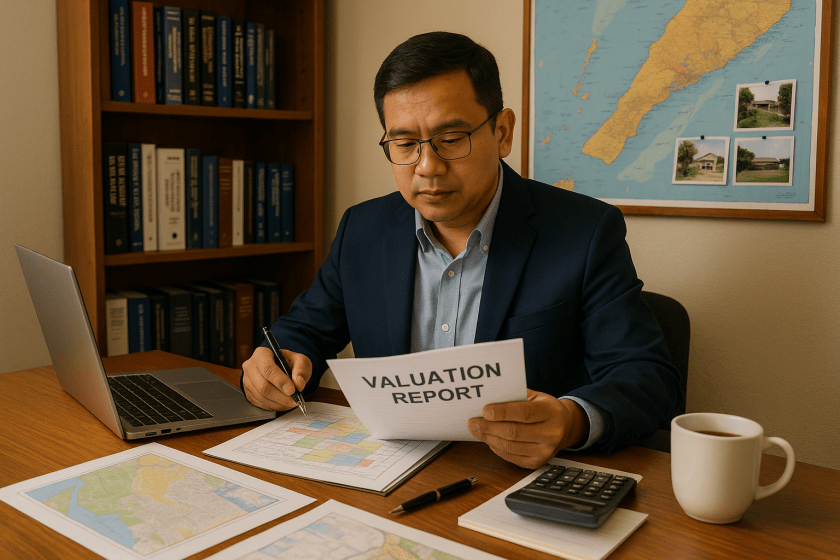
Property Identification: The Sacred Foundation of Real Estate Appraisal

In the meticulous world of real estate appraisal, one principle stands above all others: you cannot value what you cannot identify correctly. Whether working on a condominium in Makati, a farmland in Bukidnon, or a contested estate in Cebu, the first and most sacred duty of any appraiser is to accurately and defensibly identify the subject property. This is not just a technical requirement—it is the foundation of credibility, legality, and fairness in valuation. A mistake in property identification is not a small error. It invalidates every step that follows: the market comparison, highest and best use analysis, risk assessment, and final value estimate. Simply put, wrong property means wrong valuation.

Property identification involves several components. It means correctly determining the legal identity of the land—via Transfer Certificate of Title (TCT), technical description, and lot number. It also means identifying the actual physical location and ensuring it matches the documents, zoning classification, and any physical improvements or encumbrances. Every valuation method—whether it’s the market approach, cost approach, or income approach—relies on this first step. If you appraise the wrong lot, all your calculations, assumptions, and conclusions become legally and factually meaningless.

This is why misidentification carries not only technical consequences but also legal and ethical ones. A wrong appraisal can lead to court rejection of the report, denial of loans by banks, and even legal liability for misleading courts or clients. Under Article 19 of the Civil Code of the Philippines, professionals have a duty to act with justice, give everyone their due, and observe honesty and good faith. The Philippine Valuation Standards likewise emphasize that appraisers must exercise due diligence and care—beginning with accurate property identification.

Some of the most common pitfalls in this process include relying solely on the owner’s verbal claim without matching it against documentary evidence, misplotting technical descriptions, failing to check for easements or encroachments, and confusing adjacent lots with similar features. These errors are preventable with a disciplined and documented approach. A responsible appraiser will cross-check TCT data with the tax map and zoning ordinance, conduct field validation through site visits, use geotagged photos or drones, and even consult barangay officials or boundary markers when in doubt.

The risks of inaccuracy are very real. Imagine an appraiser tasked to value Lot 6 but instead inspects and reports on Lot 5. If Lot 5 is under threat of expropriation or prone to flooding, while Lot 6 is not, the valuation will be drastically wrong. In judicial proceedings, such a mistake may result in an unjust award of compensation or legal challenge. In lending, it may lead to defective collateralization. The appraiser’s name—and the integrity of the profession—are on the line.

I always emphasize that property identification is not just a preliminary step—it is the moral compass of professional practice. It sets the tone for the accuracy, fairness, and trustworthiness of the entire report. Real estate is a high-stakes industry. The margin for error is slim, and the cost of error is great. That is why we say: Property identification is sacred. Wrong property is wrong valuation. Always.

“Work to Learn, Then Earn”: An Appraiser’s Story

An excerpt from an interview with Appraiser Gus Agosto

In this special feature, a Bachelor of Science in Real Estate Management (BSREM) student sits down with Appraiser Gus Agosto to learn about his early journey into the world of real estate appraisal. From his first spark of interest to navigating the challenges of starting, Appraiser Agosto shares how his background in economics, passion for learning, and hands-on experience shaped his professional path. This insightful conversation offers valuable lessons and inspiration for students and aspiring appraisers alike.

Interviewer:

Welcome, Appraiser Gus Agosto. We’re excited to learn more about your journey into the world of real estate valuation. Let’s begin with your early inspiration.

1. What initially drew you to the field of real estate appraisal, and can you recall the moment you decided to pursue it as a career?

Appraiser Gus Agosto:

My journey into appraisal began during my time as a real estate salesperson and property investment specialist. More than a decade has passed since then. One vivid memory stands out: I was in a developer’s office when I met a gentleman who was reviewing for the appraiser’s licensure exam. I watched him work through a complex mathematical problem and admired the analytical skill involved. That moment sparked a deep curiosity in me, one that never left.

Later, during my broker’s review, I began to understand the nuances of the different professions within real estate. Our lecturers were very encouraging, and I gravitated toward appraisal because of its close ties to economics and mathematics—two subjects I’ve always been passionate about. Given my background as a researcher, writer, and a graduate in economics, the transition felt natural. That’s when I firmly decided to pursue a career in real estate appraisal.

2. How did your educational background or early professional experiences prepare you for the demands of property valuation work?

Appraiser Gus Agosto:

I hold a degree in economics and spent several years engaged in research before entering real estate. I conducted studies on local economies, enterprises, and development trends—work that laid the groundwork for the analytical mindset essential in valuation.

My stint as a real estate salesperson further broadened my understanding. I was exposed to different types of properties and transactions, attended seminars, and got to know the real-world workings of the industry. Steve Jobs once said, “You can only connect the dots looking backward.” In my case, those dots connected my work as a researcher, writer, lecturer, and a real estate practitioner, all of which converged toward a solid foundation in appraisal.


3. What challenges did you face when you were just starting out as an appraiser, and how did you overcome them?

Appraiser Gus Agosto:

Like many beginners in the field, I faced the usual questions: Where do I begin? How do I get clients? One piece of advice from a lecturer stuck with me—start with your “KKK”: Kamag-anak, Kliyente, at Kakilala—your natural network. That became my launching pad.

At one professional association event, I met a fellow appraiser who owned an appraisal firm. She invited me to join their Cebu branch, and I accepted without hesitation. It was a valuable opportunity. The company had a structured system, an established client base, and a culture of mentorship. We focused on the core operations—site inspections, analysis, and report writing. Each report we submitted was reviewed by seasoned appraisers, turning every assignment into a learning experience.

Later on, I had the opportunity to work with another appraisal firm in Metro Manila whose clients included major banks and large corporations. There, I learned the discipline of working in a highly coordinated team with tight turnaround times—often just three days per report. The volume of work was intense, but it sharpened my ability to deliver accurate reports under pressure, without compromising quality.

When I returned to Cebu, I reconnected with mentors who were among the pioneering appraisers in Visayas and Mindanao—back when there were only about five of them in the region. They welcomed me into their practice without formal discussions about fees. For me, the priority was learning. I was exposed to a different side of the profession: that of the individual practitioner. Besides Cebu and nearby provinces, I handled assignments even in remote areas such as Kapatagan in Lanao del Norte, Ozamis, and Clarin. I also had the opportunity to appraise properties of prominent Cebuano families and large-scale developments. That phase lasted for at least two years and deepened my understanding of valuation beyond the corporate environment.

Eventually, a batchmate invited me to serve as an appraiser for a nationwide cooperative, marking the start of my independent practice. I traveled to various locations, encountered a wide range of property types and development conditions, met people from all walks of life, and balanced time in the field with desk work in the office. Those routines became the rhythm of my early appraisal career.

In those formative years, I worked with at least three appraisal firms and three respected individual appraisers. My guiding principle was simple: “Work to learn, and earning will follow.” I was driven by a deep eagerness to grow in the profession, more than anything else.

Looking back, my journey—from economic researcher to real estate salesperson to hands-on valuation—was a kind of “gestation period.” Each phase played a vital role in sharpening my skills and shaping my professional identity as a full-fledged appraiser.

4. Looking back at your first appraisal assignment, what lessons did you learn that still guide your practice today?

Appraiser Gus Agosto:

I’ll never forget my first assignment—it was a warehouse in Pagsabungan, Mandaue. My buddy and I were eager and nervous. We did everything manually—measuring the structure, crawling into tight spaces, and sweating through the inspection. It was tough, but also rewarding.

The biggest lesson I learned was about trust. Clients allow us into their private spaces and rely on our judgment to assign value to their property. That responsibility has always stayed with me. I make sure to explain to my clients how I arrived at the valuation and why it’s fair. For me, valuation is not just about figures—it’s about credibility, integrity, and professionalism. Trust is the foundation of our practice, and I continue to uphold that principle in every report I sign.

Advice to Aspiring Appraisers:

Appraiser Gus Agosto:

To those just starting: “Work to learn first, not just to earn.” Be open to guidance, surround yourself with mentors, and never stop asking questions. This profession is built not just on numbers, but on experience, trust, and continuous growth. Stay curious, stay humble, and stay committed.

Interviewer Wrap-Up:
Thank you, Appraiser Gus Agosto, for that inspiring and grounded look into your journey. Your story is not only a blueprint for aspiring appraisers but also a testament to how passion, persistence, and purpose can shape a meaningful career.

Why Effective Report Writing Adds Value

In the practice of real estate appraisal, much emphasis is often placed on the technical process of valuation—data collection, market analysis, and the application of valuation approaches. However, as Mr. Gus Agosto emphasized in a recent lecture on Appraisal Report Writing, one of the most overlooked yet indispensable components of the appraisal process is the ability to clearly and effectively communicate its outcome. Effective appraisal, as he asserts, means effective reporting.

Drawing from over a decade of experience in the field, Mr. Agosto highlighted that writing an appraisal report is not merely a clerical task or an afterthought to technical valuation. It is the final product—the formal articulation of an appraiser’s professional opinion of value. This report must not only present data but must also comply with standards, reflect sound judgment, and demonstrate adherence to the legal and ethical expectations of the profession.

Some appraisal reports currently in circulation—particularly those used as templates—were created prior to the passage of Republic Act No. 9646, known as the Real Estate Service Act of the Philippines (RESA Law). Others are adapted from international formats that may not fully conform to Philippine legal and regulatory requirements. While these templates may serve as useful starting points, Mr. Agosto stressed that they are insufficient if not updated to reflect local laws and contemporary standards. Over the past decade, numerous laws and administrative issuances have been enacted, including the Philippine Valuation Standards (PVS), Data Privacy Act, Electronic Commerce Act, Anti-Money Laundering Act, updates to BIR Revenue Regulations, and court procedural rules, which must now be reflected in appraisal report writing.

Under Section 3(g) of the RESA Law, a real estate appraiser is legally defined as a professional who “performs or renders, or offers to perform services in estimating and arriving at an opinion of or acts as an expert on real estate values,” and whose services “shall be finally rendered by the preparation of the report in acceptable written form.” This statutory requirement emphasizes that the report is not a mere formality; it is the legal expression of the appraiser’s findings and professional responsibility.

Further, Section 5(c) of the Implementing Rules and Regulations (IRR) of R.A. 9646 mandates that licensed appraisers shall “prepare, sign, and issue a real estate appraisal report” in accordance with accepted principles and standards prescribed by the Board and the Professional Regulation Commission (PRC). The PVS, aligns with the International Valuation Standards (IVS) but is tailored to Philippine law and practice. Reports must demonstrate transparency in methodology, accuracy in assumptions, and consistency in legal compliance.

Mr. Agosto also pointed out that appraisal reports are not generic in nature. They must be purpose-specific, as each type of valuation engagement—litigation, insurance, sales, taxation, lease, or expropriation—carries distinct reporting requirements, legal standards, and evidentiary burdens. Moreover, Mr. Agosto emphasized that the appraiser’s ability to communicate effectively, through proper grammar, structure, and clarity, is just as important as analytical rigor. A report written in poor language or filled with jargon may undermine its credibility, even if technically correct. Thus, he encourages appraisers to continually upskill in both technical and language proficiency, utilize digital tools, apply peer review, and align with style guides that enhance report readability and presentation.

Appraisal reports serve as vital documents in court cases, bank financing, taxation, and public policy. Thus, Mr. Agosto explained, they must be credible, compliant, and defensible. This requires not only legal and technical knowledge, but also proficiency in professional communication. The appraiser must be able to clearly convey complex data, defend conclusions logically, and eliminate ambiguity through proper grammar, sentence structure, and vocabulary. In an era where reports are often read by legal, financial, and lay audiences alike, the precision and clarity of language can determine whether the report is useful—or even admissible.

Hence, appraisal report writing is not just a skill—it is a professional obligation grounded in law, ethics, and service to the public good. It transforms raw valuation data into a structured, credible, and actionable opinion of value. As Mr. Agosto aptly concluded: “Your report is your professional signature. It must speak with competence, integrity, and purpose long after you’ve signed it.”

Housing Paradox

In recent months, news reports have painted a troubling picture of Metro Manila’s condominium market. The oversupply of residential units has reached concerning levels, raising questions about market stability and prompting analysts to propose various recommendations. While analysts focus on strategies to address the oversupply, there has been little to no effort to connect this phenomenon with the broader issue of unmet housing needs. This creates a puzzling paradox -on one side of the real estate spectrum, developers are grappling with excessive inventory in urban centers. On the other side, millions of Filipinos still lack access to adequate, affordable housing.

The stark imbalance highlights a deeper, systemic problem within the housing sector: a misalignment between supply and demand, where the needs of the population are not being met despite the abundance of residential units.

Currently, the oversupply in the condominium market translates to about 34 months of inventory at the current sales pace—nearly three times the ideal benchmark of a 12-month supply. Urban centers like Quezon City, Ortigas, and Pasay are particularly affected, with thousands of unsold units. For example, Quezon City alone has 18,500 available units, followed by Ortigas with 13,500 and Pasay’s Bay Area with 10,500. Meanwhile, high-end areas like Makati and Bonifacio Global City maintain lower inventories, reflecting steadier demand in the luxury segment.

The reasons behind this oversupply are multifaceted. High interest rates, external economic pressures, and shifting consumer preferences towards single-detached homes in suburban areas have all played a role. Developers, driven by the high returns in the mid- to high-tier condominium market, have focused on urban centers, inadvertently creating a bubble of excess inventory in certain locations.

On the other side of this paradox lies the staggering national housing backlog of 6.5 million units. This deficit primarily affects low- to middle-income families who cannot afford the properties being developed. In Central Visayas alone, the housing need is over half a million units, and while government programs like the Pambansang Pabahay para sa Pilipino Program (4PH) aim to address the backlog, progress has been slow. For instance, in Central Visayas, the Department of Human Settlements and Urban Development (DHSUD) has set a modest target of 13,000 housing units under 4PH—far from the region’s actual needs.

This paradox underscores a severe mismatch between the type of housing being supplied and the housing people need. The oversupply is concentrated in mid- to high-tier condominiums in urban areas, which are unaffordable to most Filipinos. Meanwhile, the housing backlog affects families who struggle to find even basic, affordable shelter. Rapid urbanization has driven developers to focus on city centers, where demand for high-end properties has slowed, while the needs of provincial and low-income communities remain unmet.

This misalignment has wide-ranging implications. Developers face financial losses as unsold inventories pile up, while families without access to affordable housing continue to live in substandard conditions. The situation also affects the broader economy, as stagnation in urban property markets and inadequate housing solutions limit economic mobility and growth.

To address this complex challenge, a coordinated effort is needed. Policymakers, developers, and stakeholders must work together to realign the market. Incentivizing developers to prioritize affordable housing, particularly in areas with high backlogs, is essential. Improving transportation infrastructure to make suburban housing more accessible can also help ease the concentration of developments in urban areas. Additionally, accessible financing options for low- to middle-income families, public-private partnerships, and stricter regulations to prevent future oversupply are crucial steps.

The coexistence of housing oversupply and a massive backlog highlights fundamental flaws in the Philippine real estate market. Solving this paradox requires a shift in priorities—from catering mainly to profit-driven urban developments to addressing the genuine housing needs of the majority. By doing so, the sector can foster sustainable growth, improve living conditions, and create a more equitable future for all Filipinos.

The solution to the Philippine housing paradox lies not in shifting the focus of condominium developments to other regions but in prioritizing the unmet demand for affordable housing. The fundamental issue is not merely the geographic concentration of real estate projects but the failure to align supply with the genuine needs of the population. Addressing this misalignment is key to resolving both the oversupply and the housing backlog.

Augusto B. Agosto is a passionate blogger, economist, a university professor and thought leader in real estate and urban development. With extensive experience in analyzing economic trends and real estate dynamics, he offers insightful perspectives on pressing issues such as housing, land use, and property market trends in the Philippines.

Prof. Agosto Invited to Speak at International Forum on Real Estate

Prof. Gus Agosto, president of the Society of Litigation Valuation Experts (SOLVE), was invited as one of the speakers at the International Forum on Real Estate held from August 28 to September 1, 2024, in Bangkok, Thailand. The prestigious event brought together top industry leaders, policymakers, and real estate professionals to discuss the latest trends, challenges, and innovations in global real estate markets.

Agosto, known for his expertise in real estate appraisal and litigation valuation, addressed key issues such as the evolving role of government regulation, the importance of professional accreditation, and best practices for real estate valuation. Drawing from his extensive experience in shaping industry reforms, including his participation in issues such as the Proposed Professional Guidelines, and the Real Property Valuation Reform Act (RPVRA), Agosto emphasized the need for transparency and high standards in real estate practices.

His participation in the forum underscored his commitment to advancing professional standards in the industry and contributing to a more sustainable and equitable real estate market not only in the country but also around the world.