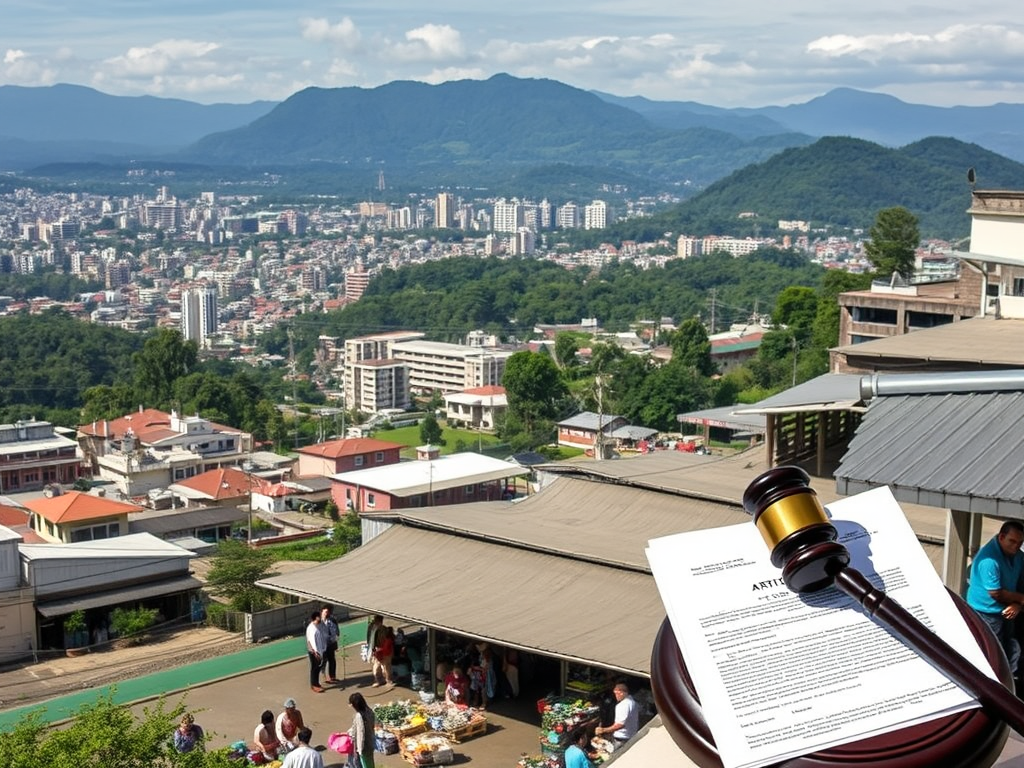
Green on Paper, Wet on the Ground: How Multiple-Use Zoning Shapes Cebu’s Flood Risk

The Cebu City Comprehensive Land Use Plan (CLUP) 2023–2032 is often defended on the ground that it significantly expands environmental protection because more than half of the city is now classified under the National Integrated Protected Areas System (NIPAS) Central Cebu Protected Landscape. On paper, the figures appear impressive. Forest land drops from 9,312.31 hectares, or 31.08 percent of the city’s land area in 2020, to just 2,892.91 hectares, or 9.65 percent, while a new category—NIPAS CCPL—suddenly expands to 15,102.10 hectares, or 50.40 percent. At first glance, this seems to suggest that forest loss has been offset by a dramatic increase in protected area coverage. In reality, this shift is largely a reclassification, not a conservation gain.

Forest Reduction and NIPAS CCPL Expansion under the Cebu City CLUP (2020 vs. 2023–2032)

Land Use Category2020 Area (ha)2020 Share of City (%)2023–2032 Area (ha)2023–2032 Share of City (%)Change (ha)Change (percentage points)
Forest9,312.3131.08%2,892.919.65%–6,419.40–21.43 pp
NIPAS CCPL15,102.1050.40%+15,102.10+50.40 pp

The crucial detail lies in how the NIPAS CCPL is treated internally under the CLUP and its implementing zoning ordinance. The protected landscape is not governed as a single protection category. It is subdivided into Strict Protection Sub-Zones and Multiple-Use Zones. These two sub-zones have radically different legal and ecological effects, yet they are collapsed into a single “NIPAS CCPL” figure in the comparative land-use table. This aggregation creates the impression of expanded protection while concealing a fundamental change in how large portions of the uplands are actually regulated.

Strict Protection Sub-Zones are designed to keep ecosystems intact. They prohibit roads, structures, utilities, and settlement, allowing only limited scientific or educational activity. By contrast, Multiple-Use Zones explicitly allow settlement, agriculture, agroforestry, infrastructure, utilities, livelihood activities, and even extractive uses, subject to conditions, variances, and environmental impact assessments. In practical terms, strict protection constrains development, while multiple use manages development. Treating both as equivalent under a single “protected area” label obscures this distinction.

The land-use data strongly suggest that much of what was previously classified simply as forest in 2020 did not become strictly protected. Instead, it was absorbed into the NIPAS CCPL category and then zoned as Multiple-Use Zone. Only a smaller core—typically the most intact, high-elevation, and least accessible forest blocks—could realistically have been placed under strict protection. Areas closer to barangays, with existing settlements, road access, or development pressure, could not have been placed in strict protection and were therefore zoned as multiple use. This includes large portions of the former forest cover at the urban–upland interface.

This permissive framework is further reinforced by the city ordinance’s treatment of socialized housing within the Multiple-Use Zone. Even within the protected landscape, the zoning ordinance allows socialized housing projects to proceed if they are deemed “essential” and are claimed to have minimal environmental impact. In such cases, the proponent is required to seek variances and exceptions from the Zoning Board, supported by an Environmental Impact Assessment and an Environmental Impact Statement, which must be presented prior to the issuance of an Environmental Compliance Certificate by the DENR–Environmental Management Bureau. The project must also be certified by the Department of Human Settlements and Urban Development as a socialized housing project. Where granted special authorization, development is limited to single-detached units on lots of at least 64 square meters and a maximum building height of seven meters.

While these conditions appear restrictive on paper, they underscore the deeper structural issue: land that is otherwise acknowledged as ecologically sensitive and disaster-prone is rendered negotiable through administrative discretion. The safeguards operate at the project level, not at the landscape or watershed level. They assume that environmental risk can be mitigated case by case, rather than avoided altogether through strict land-use exclusion. In a steep, erosion-prone watershed, even low-rise, low-density housing introduces roads, slope cuts, drainage alteration, and cumulative runoff effects that no project-specific EIA can fully neutralize. In this sense, the socialized housing exception does not soften the impact of Multiple-Use Zones—it institutionalizes it.

What Necessarily Went Into Multiple-Use Zones (MUZ)

MUZ is the only CCPL sub-zone where the zoning ordinance allows:

  • settlement and relocation sites,
  • agriculture and agroforestry,
  • infrastructure and utilities,
  • agro-industrial activities,
  • sale and disposition of titled land,
  • and even sand and gravel extraction, subject to EIA.

As a result, any part of the CCPL that:

  • already had settlements,
  • lay adjacent to barangays,
  • had road access,
  • or was earmarked for housing, utilities, or livelihood expansion,

could not have been placed in SPZ and was almost certainly zoned as MUZ.

The CLUP zoning maps explicitly identify CCPL Multiple-Use Zones (MUZ) in at least 22 upland barangays, including Adlawon, Agsungot, Babag, Buhisan, Guba, Sirao, Sudlon I and II, Tabunan, Taptap, Toong, and others. These are not peripheral areas. They are headwaters, slopes, and watershed interfaces directly influencing river systems that drain into Cebu City’s urban core.

Functionally, this represents a downgrade in protection. Forest converted into strict protection retains its hydrological and ecological role. Forest converted into a multiple-use zone does not. Even if development is limited to 30 percent of the land area, that 30 percent often consists of roads, access cuts, building pads, and slope modification. These interventions fragment the remaining vegetation, reduce infiltration, increase runoff velocity, destabilize slopes, and raise sediment loads. Hydrologically, a multiple-use zone does not behave like a forest. The correct comparison, therefore, is not forest versus NIPAS, but forest and strict protection versus multiple use. Measured this way, the CLUP reflects a net weakening of upland and watershed protection.

This matters because the uplands of Central Cebu are not just scenic backdrops. They are natural flood infrastructure. Forested slopes slow rainfall, store water, stabilize soils, and regulate downstream flows. When zoning allows these functions to be negotiated away through settlement, roads, utilities, and extractive activities, flood risk is displaced downhill. The cost is borne by lowland communities that experience more frequent and more severe flooding, even as upland development is justified as “controlled” or “sustainable.”

The zoning ordinance itself makes the contrast unmistakable. In the Strict Protection Sub-Zone (SPZ), the City recognizes that certain upland areas must be treated as non-negotiable ecological infrastructure: no roads, no utilities, no structures, and no human activity beyond science and education, precisely because these areas are highly erodible, disaster-prone, and critical for soil, water, and flood regulation. Yet within the same protected landscape, the Multiple-Use Zone (MUZ) operates on the opposite logic. It allows settlement, roads, utilities, land disposition, and even extraction—subject only to conditions and approvals—on the premise that environmental risk can be managed rather than avoided. The contradiction is stark: SPZ accepts that some areas must be left alone to reduce flooding and disaster risk, while MUZ assumes that development in equally sensitive upland watersheds can be negotiated without consequence. Floodwaters, however, do not distinguish between zones. What is permitted in MUZ ultimately undermines what SPZ is meant to protect.

Question of Legal Authority

There is also a legal dimension to this shift that is often overlooked. NIPAS allows multiple-use zones only to the extent prescribed in the Protected Area Management Plan approved by the Protected Area Management Board. Local governments are required to align their plans with these prescriptions, not replace them with their own discretionary zoning regimes. By defining allowable uses, authorizing variances, and substituting zoning-board discretion and project-level environmental assessments for management-plan limits, the ordinance exceeds the authority delegated to the city under national law. In legal terms, this is an ultra vires act—an exercise of power beyond what the law allows. Environmental compliance certificates and impact assessments cannot cure this defect, because procedural safeguards do not legalize land-use policies that are unlawful at their core.

The implications extend beyond technical planning debates. When a land-use plan presents an apparent expansion of protected areas while quietly converting large portions of former forest into multiple-use zones, it creates an illusion of environmental progress. The label changes, but the watershed function deteriorates. In a city repeatedly hit by flooding, this distinction is not academic. It is the difference between treating the uplands as non-negotiable ecological infrastructure and treating them as a managed development frontier.

Ultimately, the question is not whether development should occur in Cebu, but where, how, and under whose authority. When forest protection is diluted under the banner of multiple use, the consequences do not stay in the uplands. They flow, quite literally, downhill.

A Welcome Pause — But One That Exposes a Deeper Contradiction

The recent announcement of a moratorium on upland development is, at first glance, a welcome development. It signals an overdue recognition that what happens in the uplands does not remain confined there. Upland activities—slope cutting, land conversion, quarrying, and hillside construction—directly affect runoff, sedimentation, and flood risk downstream. After years of recurring floods, this acknowledgment matters.

But a pause alone is not the same as reform. And taken together with the current planning situation, the moratorium exposes a serious institutional contradiction that cannot be ignored.

At present, the Cebu City Comprehensive Land Use Plan and Zoning Ordinance (CLUP–ZO) 2023–2032 remains pending review and approval by the Department of Human Settlements and Urban Development (DHSUD). This is important. A CLUP is supposed to be the city’s definitive spatial framework—one that integrates land use, environmental constraints, hazard data, and long-term development direction.

Declaring a moratorium while allowing the CLUP to continue through the approval process sends mixed signals. On one hand, the City is saying that upland development policies, zoning ordinances, and risk assessments require comprehensive review. On the other, it is permitting a plan—prepared under those same assumptions—to move forward as if those concerns did not exist.

These two positions are institutionally inconsistent.

A moratorium is not merely a pause in permitting; it is an implicit admission that something in the existing planning framework is flawed or incomplete. Allowing the CLUP–ZO to proceed while simultaneously questioning its foundations risks locking in the very policies now being reconsidered. If the review is serious, the planning document built on those policies cannot be treated as settled.

More importantly, the value of the moratorium will depend entirely on what happens during the pause.

A meaningful review must go beyond surface-level policy checks or inventorying existing regulations. It must confront the structural causes of flooding, which did not arise overnight. This includes revisiting historical zoning amendments enacted without adequate technical studies, particularly those that incrementally intensified upland development. It also requires a cumulative assessment of upland impacts on downstream flooding, rather than treating each project or permit as an isolated case.

For decades, zoning decisions were often made in fragments—project by project, amendment by amendment—without basin-wide hydrological analysis or long-term carrying capacity studies. The downstream consequences of those decisions are now visible in flood-prone communities. Any review that fails to reckon with this history risks becoming procedural rather than corrective.

Finally, all findings from the moratorium review must be anchored to an EO 72–compliant Comprehensive Land Use Plan. Executive Order No. 72 was designed precisely to prevent piecemeal land-use decisions by requiring that zoning be subordinate to a comprehensive, technically grounded plan. Flood risk, hazard exposure, and environmental limits must be integrated at the CLUP level—not appended as afterthoughts.

If the moratorium results in a genuine reassessment of upland policies, a review of past zoning decisions, and meaningful revisions to the CLUP before it is resubmitted for approval, then the pause will have served its purpose.

If not, the moratorium risks becoming a symbolic gesture—a temporary halt that leaves the underlying planning framework unchanged, while flood risks continue to accumulate downstream.

A pause is welcome.
But integrity in planning demands consistency, accountability, and correction—not just restraint.

A Brief Context: Years of Zoning Without a Comprehensive Plan

To understand why the moratorium has become necessary, it helps to revisit how Cebu’s land-use rules evolved.

For much of the past three decades, zoning ordinances and amendments moved ahead in the absence of a fully EO 72–compliant Comprehensive Land Use Plan (CLUP). Instead of zoning being the implementing tool of a comprehensive plan, the process was effectively reversed: zoning became the primary mechanism through which land-use decisions were made.

Beginning with the 1996 Zoning Ordinance, and continuing through numerous subsequent amendments, land-use classifications were adjusted incrementally—often in response to specific proposals, developments, or economic pressures. These amendments were typically stand-alone actions, not products of basin-wide hydrological studies, cumulative flood modeling, or carrying-capacity analysis.

Over time, this resulted in:

  • Incremental intensification of upland and slope areas, approved project by project;
  • Fragmented land-use decisions, evaluated individually rather than cumulatively;
  • Absence of technical backup studies linking upland approvals to downstream flood risk.

Each amendment, taken alone, may have appeared manageable. But collectively, they reshaped watersheds, increased surface runoff, and weakened natural flood-regulating functions—without those impacts ever being fully measured or accounted for.

The flood overlay zones now reflected in the CLUP 2023–2032 are, in many ways, a delayed recognition of this history. They acknowledge risks that accumulated gradually through years of zoning decisions made without a unifying, science-based framework.

Seen against this backdrop, the current moratorium is not a sudden shift in policy. It is a corrective response to a long period of planning through amendments rather than through a comprehensive, EO 72–compliant CLUP.

Bringing PENCAS to Cebu: A Legal Challenge to the City’s New Land Use Plan

Environmental planner and economist Gus Agosto has taken a significant step in Cebu City’s ongoing land‑use debates by filing a formal notice and reservation of objection with the Department of Human Settlements and Urban Development (DHSUD). The notice focuses on the review of the Cebu City Comprehensive Land Use Plan (CLUP) 2023–2032 and raises an issue that has been largely absent from local public discussion: compliance with the Philippine Ecosystem and Natural Capital Accounting System (PENCAS) Act, or Republic Act No. 11995, and its Implementing Rules and Regulations.

At the heart of the filing is a simple but powerful question: can Cebu City still afford to plan growth as if its ecosystems, watersheds, and floodplains are external to the economy? For Agosto, the clear answer is no. RA 11995 declares that “natural capital” – including land, ecosystems, and the services they provide – is a measurable economic asset of the State and its political subdivisions. This is not a mere policy preference. Under PENCAS, natural capital accounting must be integrated into planning and decision‑making, particularly where long‑term land use, infrastructure, and public‑private partnerships are involved. In practice, this means a CLUP can no longer be just a map of zones and a bundle of sectoral plans; it must demonstrate how land‑use allocations respect ecological thresholds, risk patterns, and the economic value of environmental services.

The Cebu City CLUP 2023–2032, as currently framed, does many things right on paper. It outlines sectoral strategies for housing, commerce, industry, transport, and water supply. It references hazard maps and acknowledges flooding and slope risks. But, as Agosto points out, these elements remain largely compartmentalized. The plan stops short of weaving them into a cohesive, risk‑sensitive spatial strategy that clearly shows how development is constrained by carrying capacity, hazard exposure, and environmental limits. The result is a document that appears procedurally complete—boxes ticked, chapters present—but substantively misaligned with the integrated, law‑driven planning model now required under Executive Order No. 72, DHSUD’s own guidelines, and PENCAS.

This critique matters because Cebu City is not planning on a blank slate. It is a dense, highly constrained urban area, bounded by steep uplands and a vulnerable coastline, with a well‑documented history of flooding, traffic bottlenecks, and informal settlements on marginal land. In such a context, “sectoral” planning without genuine spatial integration is not a minor technical flaw; it can translate into very real, very costly risks for communities. If new commercial or residential intensities are allowed in upland or mid‑slope areas without full accounting of downstream flood impacts, the city effectively subsidizes risk—transferring the costs to low‑lying barangays that will experience deeper and more frequent inundation.

PENCAS adds another layer. By requiring natural capital accounting, RA 11995 insists that decisions about where to build, what to conserve, and how to structure public‑private partnerships must be informed by quantified assessments of ecosystem services and environmental limits. Watersheds, coastal zones, and floodplains do not merely host development; they regulate water flows, buffer storms, and sustain fisheries and livelihoods. When these are degraded or overbuilt, the “loss” is not just aesthetic or ecological—it is economic, measurable in damage to infrastructure, loss of productive days, and increased public spending on disaster response. Natural capital accounting is a way of making these hidden costs visible before, not after, decisions are taken.

Agosto’s filing is also a reminder of DHSUD’s central role in ensuring that local planning complies with national law. Executive Order No. 72 designates the CLUP as the primary basis for zoning, infrastructure provision, and land development decisions, and gives national agencies like DHSUD the responsibility to review local plans for conformity with national standards. With PENCAS already in effect, DHSUD is now expected not only to check format and basic legal compliance, but to ask whether plans show evidence of natural capital accounting: have ecosystems been valued, thresholds identified, and risks internalized into zoning and land‑use regulations? Approving a CLUP that treats PENCAS as optional would weaken the law at precisely the moment it is meant to change planning practice on the ground.

Crucially, the notice is not framed as an attempt to stop development or to delegitimize Cebu City’s efforts to adopt a long‑term land‑use plan. Instead, it positions itself as a rights‑based and policy‑grounded reminder to strengthen the CLUP. Agosto emphasizes that the objective is to align Cebu’s growth strategy with three converging realities: the legal obligations under RA 11995 and EO 72, the ecological constraints of a flood‑ and hazard‑prone city, and the long‑term public welfare of residents who will live with the consequences of today’s zoning maps and infrastructure decisions. In other words, the call is not “no development,” but “no development that pretends nature and risk do not count.”

For local stakeholders, planners, and advocates, this intervention offers a preview of what the PENCAS era will look like in practice. Formal plans, joint ventures, and big‑ticket infrastructure will increasingly be assessed not only on their financial terms and engineering feasibility, but also on whether they recognize natural capital as part of the economic equation. Cebu City’s CLUP review is an early and important test case. Whether DHSUD chooses to treat Agosto’s filing as a technical annoyance or as an opportunity to put PENCAS into meaningful operation will say much about the future of urban planning and environmental governance in the Philippines.

Environmental Rights Are Human Rights: Why Cebu Must Defend Its Constitutional Right to a Balanced and Healthful Ecology

HUMAN RIGHTS DAY MESSAGE

Today, the world commemorates International Human Rights Day, marking the anniversary of the Universal Declaration of Human Rights.

But in Cebu, this day carries a deeper, more urgent meaning. In our island—where critical watersheds are shrinking, fragile slopes are carved for profit, rivers are choked with silt, and communities drown in entirely preventable floods—one fundamental human right is under unprecedented threat:

The Right to a Balanced and Healthful Ecology.

This is not a political slogan or an aspirational ideal. It is a constitutional mandate, enshrined in Article II, Section 16 of the 1987 Philippine Constitution:

“The State shall protect and advance the right of the people to a balanced and healthful ecology in accord with the rhythm and harmony of nature.”

This right is further affirmed by the Supreme Court in the landmark case of Oposa v. Factoran (1993), which established that environmental rights are intergenerational, enforceable in court, and impose a mandatory duty on all government officials to protect the environment for present and future generations.


I. Environmental Neglect is a Human Rights Violation

Human Rights are not solely civil and political; they are inextricably environmental, social, and economic.

Cebuanos cannot fully enjoy their right to life, security, livelihood, or safe housing if their communities are systematically placed in harm’s way by governance failures, including:

  • Scientifically unsound land-use decisions.
  • Approval of upland developments in known hazard-prone areas.
  • Zoning ordinances that ignore hydrological and watershed limits.
  • Failure to integrate mandatory hazard maps and natural capital accounting.
  • Non-compliance with national laws such as RA 11995 (PENCAS) and RA 11038 (E-NIPAS).

When a city tolerates policies that exacerbate climate risks and disaster intensity, the resulting flooding and landslides cease to be “natural disasters.” They become human rights violations caused by official negligence, abuse of authority, and systemic disregard for public safety.

The government, by transferring disaster risk from developers and decision-makers onto the most vulnerable communities, violates the people’s constitutional right to: Health, Security, Safety, Due Process, Life, and Environmental Equity.


II. The Human Cost of Environmental Injustice in Cebu

Recent disasters, such as the flash floods caused by Typhoon Tino and similar weather events, tragically revealed the truth Cebuanos have felt for years: Catastrophic flooding is not inevitable. It is the direct consequence of human decisions—of upland reclassification, politically influenced zoning, weak enforcement, and the dangerous disregard for the island’s carrying capacity.

In areas like Bacayan, Mananga, Compostela, and Subangdaku, lives have been lost, homes destroyed, and families displaced. These are not isolated tragedies. They are symptoms of a profound governance failure, violating both the tenets of environmental protection and the principles of social justice.


III. Accountability Mandated by Law: The PENCAS Defect

The law requires more from our leaders, particularly following the enactment of the Philippine Ecosystem and Natural Capital Accounting System Act (RA 11995).

PENCAS, effective in May 2024, made it mandatory for all government units to:

  • Integrate natural capital valuation in all planning.
  • Consider ecological thresholds before approving developments.
  • Quantify environmental losses and risks to protect critical ecosystems.

However, the recently approved Cebu City CLUP and Zoning Ordinance 2025—passed after PENCAS took effect—demonstrates an alarming failure to integrate these mandatory principles.

This is not only a profound legal defect but, more importantly, a human rights crisis. When planning willfully ignores ecological science and mandatory laws, the people ultimately pay the price with their lives, homes, and livelihoods.


IV. Environmental Justice is Human Rights Justice

The Constitution demands “harmony with nature.” Conversely, our current planning trajectory is in direct conflict with nature.

Scientific data consistently shows that the uplands contribute 55–60% of Cebu’s floodwater runoff. Yet, land-use decisions continue to open these crucial slopes and midlands to:

  • Excessive reclassification and rezoning.
  • Expansive subdivisions and commercial sprawl.
  • Aggressive road cuts and quarrying.

This pattern is not development; it is risk accumulation. Every time a watershed is weakened, a slope is destabilized, or a flood basin is paved over, we fundamentally undermine the people’s rights to safety and a sustainable future.

Environmental Justice demands that:

  • Those who benefit from development must not be allowed to inflict harm on those downstream.
  • Government decisions must be based on science and must not endanger the public they swore to protect.
  • Vulnerable communities must not be sacrificed for private gain and political expediency.

V. A Call for Action and Accountability

On this International Human Rights Day, we stand together to assert that:

  • Flood safety is a Human Right.
  • Compliance with environmental law (RA 11995) is a mandatory duty.
  • Hazard-informed planning is a legal requirement.
  • No zoning ordinance should contradict science, and no public official has the authority to gamble with ecological security.

We assert our right to demand accountability, transparency, correction of defective plans, and the unwavering protection of our uplands and watersheds.

We look forward to A Cebu That Honors Human Rights: a city built on the right to safe communities, flood resilience, and ecological integrity.

Environmental Rights ARE Human Rights. Justice for Cebu.

LEGALESE

Why the CLUP Cannot Be Overridden by a Simple Ordinance

In conversations about Cebu City’s development, one dangerous misconception keeps circulating:

“The CLUP is just a tool. The City Council can always pass a new ordinance to change it.”

This idea is not only false —
it is illegal, misleading, and destructive to long-term planning.

The CLUP is not a casual instrument.
It is the foundation of the city’s entire land-use system, backed by national law, Supreme Court jurisprudence, and technical standards.

This explainer breaks down, in clear language, why the CLUP cannot be casually altered, and why it must remain the city’s controlling land-use document.


1. The CLUP Is a Legal Mandate — Not an Optional Planning Tool

The Local Government Code (RA 7160) is explicit:

“Local government units SHALL prepare their comprehensive land use plans…
which SHALL be the PRIMARY and DOMINANT bases for land use.”

(Sec. 20, RA 7160)

Let’s unpack this:

✔ “SHALL” — means mandatory, not optional

✔ “PRIMARY and DOMINANT” — means superior to all land-use ordinances

✔ “Bases for land use” — means all zoning and land decisions MUST follow it

The CLUP is NOT:

  • a guideline
  • an advisory document
  • a flexible policy tool

It is a statutory requirement and it shapes every land-use decision the city makes.


2. The CLUP Is Approved by National Agencies — So a Simple Ordinance Cannot Override It

Under Executive Order 72 and DHSUD/HLURB Rules, the CLUP must pass through:

  1. Technical planning
  2. Public consultations
  3. CPDO review
  4. City Council adoption
  5. Regional Land Use Committee (RLUC) approval
  6. NEDA oversight

This makes the CLUP part of the national planning system.

A regular ordinance:

  • does not undergo national review
  • does not pass through RLUC
  • does not require technical studies
  • is not evaluated for hazards, transport, drainage, or environmental impact

Therefore:

A local ordinance cannot overrule a document that required multi-level approval.

The CLUP is a nationally aligned, technically vetted plan.
A zoning amendment is not.


3. The Zoning Ordinance (ZO) Is Only Valid if It Conforms to the CLUP

This is often misunderstood.

The Zoning Ordinance is the implementing arm of the CLUP.
It cannot contradict the CLUP — it must FOLLOW it.

The Supreme Court has said this in black-and-white:

A. Rizal v. Mandaluyong (2005)

Zoning must conform to the CLUP; otherwise, the ordinance is invalid.

B. Fernando v. St. Scholastica’s (2008)

Any deviation from the CLUP requires a CLUP amendment FIRST.

C. Hacienda Luisita v. DAR (2011)

Land-use changes must be consistent with the approved CLUP.

These rulings make one thing clear:

A zoning ordinance that contradicts the CLUP is illegal and void.

So the common LGU practice of “rezoning by ordinance” without CLUP amendment is contrary to law.


4. The CLUP Protects Cebuanos Against Dangerous, Arbitrary, or Politically Driven Land-Use Changes

This is the purpose of having a legally binding CLUP.

Without a strong CLUP:

  • developers can lobby for spot zoning
  • upland areas can be converted illegally
  • floodplains can be reclassified as commercial
  • hazard zones can be opened for construction
  • transport systems lose their logic
  • water supply planning collapses
  • disaster risk increases
  • the environment becomes negotiable

The CLUP ensures decisions are based on:

  • science
  • terrain
  • hazard maps
  • environmental limits
  • water capacity
  • transport systems
  • long-term growth

—not political influence.

A casual ordinance bypasses all of these safeguards.


5. Changing the CLUP Requires a Full, Regulated Amendment Process — Not a Shortcut

Can the CLUP be amended?
YES — but only through a formal, technical process, not by a simple ordinance.

CLUP amendments require:

  • updated technical studies
  • barangay consultations
  • environmental and hazard assessments
  • CPDO evaluation
  • Sanggunian approval
  • DHSUD regional approval
  • RLUC/NEDA conformity

That takes months, sometimes years.

A zoning ordinance alone takes a few weeks —
which is why some LGUs prefer shortcuts.

But these shortcuts are illegal and expose the city to legal, environmental, and governance risks.


6. The CLUP Has Constitutional Weight

The 1987 Constitution guarantees:

“The right to a balanced and healthful ecology.”
(Art II Sec 16)

Land use planning is one of the main instruments used by LGUs to fulfill this constitutional mandate.

If officials bypass, ignore, or override the CLUP, they violate:

  • Constitutional policy
  • Environmental safety
  • National planning standards
  • Due process
  • Risk reduction principles

This is why the CLUP is not a tool —
it is a constitutional obligation.


7. What Happens If Cebu Treats the CLUP as “Just a Tool”?

The consequences are immediate and severe:

✔ legally void zoning ordinances

✔ invalid permits

✔ increased liability for LGU officials

✔ misaligned infrastructure

✔ worsening flooding

✔ unregulated upland development

✔ breakdown of transport logic

✔ worsening housing crisis

✔ environmental degradation

✔ higher disaster risk

Cebu City cannot afford these outcomes —
not with its limited land, growing population, and worsening climate hazards.


The CLUP Is the City’s Land-Use Constitution

It is:

  • mandated by national law
  • affirmed by the Supreme Court
  • integrated with national planning bodies
  • approved through RLUC
  • the basis of zoning
  • the backbone of environmental protection
  • the anchor of water, transport, and infrastructure planning
  • the legal safeguard against arbitrary land-use decisions

When officials say:

“We can override the CLUP with a new ordinance,”

they are misunderstanding —
or ignoring —
the entire Philippine land-use legal system.

Cebu deserves better.
Cebu deserves planning grounded in law, science, and long-term vision —
not shortcuts.

CLUP/ZO SERIES – PART 1

Why Cebu City’s Housing Plan Cannot Work: A Critical Look at the CLUP’s Most Serious Weakness

This article begins my multi-part series on Cebu City’s new Comprehensive Land Use Plan (CLUP) and Zoning Ordinance (ZO).
Over the next few weeks, we will look closely at what this plan gets right, what it gets wrong, and how its flaws shape Cebu’s future — for better or for worse.

We begin with the sector that affects all others: HOUSING.

Because where people live determines how they move, how they work, how communities grow, and ultimately whether a city becomes livable — or collapses under its own weight.

And right now, Cebu City’s housing plan is on the wrong path.


The Huge Gap Between Housing Needs and Housing Reality

The City estimates that 865,725 housing units are needed to address the backlog and future demand.
To accommodate that number, the CLUP calculates that Cebu City would need 15,169 hectares of additional residential land.

But here is the problem:

Cebu City does not have 15,169 hectares of buildable land.

It doesn’t even come close.

Cebu is not a flat province like Cavite or Laguna.
It is a mountain city with narrow slopes, rivers, steep terrain, coastal hazards, and protected watersheds.

Only about 25–30% of Cebu’s total land is actually suitable for safe residential development.

In other words:

The very formula used to compute Cebu’s housing demand does not fit Cebu’s geography.

It’s like measuring a mountain with a ruler designed for plains.

And because the method is wrong, the strategies that follow also fall apart.


So Where Will Cebu Build? The CLUP’s Answer: SRP

Because Cebu lacks large, flat, safe tracts of land, the CLUP turns almost entirely to the South Road Properties (SRP) — a reclaimed area exposed to storm surge, subsidence, and liquefaction — as the primary relocation site for the urban poor.

The City actually owns 313 hectares of land across 211 parcels.
But a massive 240 hectares (76%) of this land is in SRP.

This explains the CLUP’s insistence on building:

  • Temporary housing in SRP
  • Permanent high-rise housing in SRP
  • Social housing clusters in SRP

SRP is the easiest to access politically.
But it is also one of the most dangerous places to house the poor.

Relocating families from riverbanks and hazard zones only to place them in a coastal hazard zone is not progress — it is risk transfer.

It moves people out of danger… and into another kind of danger.


The “Permanent Housing” Plan Is Even Harder to Believe

The CLUP describes an ambitious “South Coastal Urban Development” (SCUD) project:

  • 5-storey, 10-storey, and 20-storey MRBs
  • Long-term leases “like Singapore”
  • Thousands of families relocated to high-density towers

But the proposed site is still underwater.
The land does not exist yet — it must be reclaimed first.

Even if the concept is good, the location and timing are not.

It will take years before the land is ready.
And billions upon billions before the buildings rise.

Which brings us to another uncomfortable truth.


The CLUP Claims ₱26 Billion Per Year for Housing — Cebu’s Budget Is Only ₱13 Billion

The CLUP states that the City is allocating ₱26 billion annually for MRB construction.

But Cebu City’s entire 2026 budget is only ₱13 billion.

Meaning:

  • The housing plan requires twice the city’s entire budget
  • No one knows where the money will come from
  • No financing model, PPP structure, or national commitment is presented

It is a beautiful idea with no financial backbone.

Housing towers may be drawn on paper,
but they cannot be built with numbers that do not exist.


So Why Not Use the City’s Other Land?

Outside SRP, the City owns:

66.37 hectares

Used for schools, barangay halls, and urban poor housing.

These areas could be transformed into strategic mid-rise communities connected to jobs and transport.
But the CLUP does not propose land consolidation, urban regeneration, or vertical redevelopment.

6.79 hectares

Remain idle — mostly upland, steep, or constrained.

These lands are unsuitable for housing and should remain ecological buffers.


The Housing Plan Is Isolated — Not Integrated With Transport, Jobs, Commerce, or Water

Housing is not a standalone sector.
It must align with:

  • transportation systems
  • BRT corridors
  • commercial centers
  • industrial zones
  • water supply
  • hazard maps
  • drainage systems

But Cebu’s housing plan exists in a silo.

It does not place housing near jobs.

It does not place housing near BRT stations.

It does not expand residential areas near commercial centers.

It does not address water scarcity for 865,000 new units.

It does not protect uplands from overdevelopment.

It does not calculate relocation impacts on transport or flooding.

It treats housing as if it floats above the city, unaffected by everything else.

That is not how cities work.


What We Are Left With Is a Housing Plan That Cannot Succeed

❌ The method is wrong for Cebu’s geography

❌ The land available does not match the land required

❌ The largest landholding (SRP) is hazard-prone

❌ The permanent housing site is underwater

❌ The budget is twice the city’s capability

❌ The plan does not integrate with transport, jobs, or water

❌ The uplands cannot support more sprawl

❌ The poor are relocated to isolation

This is not simply an imperfect plan.
It is a plan built on structural contradictions.

Cebu needs a housing strategy grounded in:

  • vertical development
  • transit-oriented planning
  • safe, accessible locations
  • integrated public land redevelopment
  • financial realism
  • environmental science
  • climate resilience

The CLUP does not offer that.

Not yet.

What Comes Next in This Series

In the next articles, we’ll dive into:

Part 2 — Transport & Mobility: Where the CLUP Went Wrong

Why the BRT is disconnected from land use, and how transport planning became an afterthought.

Part 3 — Commercial & Industrial Zones: Misalignment and Missed Opportunities

A look at the political economy of zoning.

Part 4 — Environment, Flooding & Watersheds: The Consequences of Poor Planning

How upland mismanagement worsens lowland floods.

Part 5 — Governance, Variances & Loopholes: How the Zoning Board Can Override Everything

The silent powers shaping Cebu’s future.

This is the beginning of a deeper conversation —
one Cebu desperately needs.

Why Cebu’s CLUP Must Be Reviewed Now:

The Law Has Changed — Our Planning Must Change With It

Urban planning is not just about drawing maps or assigning colors to land. It is about shaping how people live, how cities grow, and how communities stay safe. In a time when flooding has reached catastrophic levels in Cebu, we can no longer pretend that our current land-use system is enough.

The truth is simple: Cebu City’s Comprehensive Land Use Plan (CLUP) is outdated. It no longer reflects the new legal, scientific, and ecological standards that planners are now required to follow. And unless the CLUP is reviewed and corrected, the city will continue to make decisions that worsen flooding, landslides, and environmental collapse.

1. PENCAS Changed the Entire Landscape of Land-Use Planning

The Philippine Ecosystem and Natural Capital Accounting System (PENCAS) Act introduced a revolutionary requirement:
Government must account for the value of ecosystems, watershed functions, water recharge, soil stability, and the economic value of nature itself.

PENCAS was signed into law on May 22, 2024 as Republic Act 11995. Meanwhile, the Comprehensive Zoning Ordinance on June 30,2025.

Before PENCAS, CLUPs mainly focused on land use—where houses, commercial buildings, roads, or industries should go. After PENCAS, that is no longer enough.

A compliant CLUP must now quantify:

  • How much forest, river, or watershed capacity is being lost
  • How upland developments reduce water absorption
  • How much “natural capital” is being depleted when slopes are cut
  • How these losses translate into economic damage (flooding, disasters, carbon loss, siltation)

Cebu’s current CLUP does not do this. It is operating on an old framework while the law has moved forward.

2. ECCs for Upland Developments Also Fall Short

Environmental Compliance Certificates (ECCs) for subdivisions, commercial estates, and roads in the uplands were issued using pre-PENCAS standards.

Most Environmental Impact Statements focused on:

  • earthworks
  • drainage structures
  • erosion controls
    But almost none assessed watershed function, downstream flood risk, cumulative basin impact, or natural capital loss—which PENCAS now requires.

This is why upland developments continue to be approved even if they sit on steep slopes, natural drainage paths, and fragile geological formations.

3. This Is Not Optional Knowledge — Planners Must Know This by Heart

Environmental planners, geologists, engineers, and city officials are now expected to integrate natural capital accounting into every zoning decision. That includes:

  • development suitability analysis
  • watershed carrying capacity
  • runoff modeling
  • ridge-to-reef planning
  • accounting for carbon sinks and biodiversity

If planners continue operating with outdated tools, they are making decisions that violate the very law they swore to uphold.

4. A Non-Compliant CLUP Is a Legal Liability

A CLUP that does not integrate PENCAS can be questioned for:

  • grave abuse of discretion
  • failure to perform ministerial duties under the Local Government Code and PENCAS
  • violating the constitutional right to a balanced and healthful ecology

Cebu City cannot afford to implement a plan that is legally vulnerable and scientifically obsolete—especially when thousands of lives and billions in property are at stake.

5. The Consequences Are Measurable: More Flooding, More Damage

Flooding in Cebu is not simply caused by rain.
It is the product of upland disruption:

  • excessive cut-and-fill
  • blocked natural waterways
  • subdivisions and roads acting as mini-dams
  • forest cover loss
  • soil compaction
  • reduced infiltration

When a CLUP does not account for these, the result is predictable: water that should have been absorbed in the uplands rushes violently into lowland communities.

The disaster we saw during Typhoon Tino is not an accident.
It is the output of planning failures.

6. Reviewing the CLUP Is Not Political — It Is a Legal, Scientific, and Moral Responsibility

A CLUP cannot remain static in a time of climate crisis. It must evolve with:

  • new hazard data
  • new scientific findings
  • new national laws
  • new development pressures
  • new experiences of disaster

If the city refuses to review its CLUP now, it is refusing to learn, refusing to adapt, and refusing to protect its people.


Final Word: Cebu Deserves a CLUP That Protects, Not Endangers

Cebu does not lack intelligence, science, or expertise. It lacks alignment.
The CLUP must be updated.
ECC processes must be reformed.
Planners must operate using modern standards.
And citizens must demand a planning system that finally honors the value of our uplands, our watersheds, and our right to safety.

A CLUP review is not just a technical exercise.
It is a step toward a safer Cebu, a smarter Cebu, and a Cebu that finally plans with the future—not the past—in mind.

A Message to All Cebuanos: The First Victory Is Here—Now Let’s Finish the Fight

In the aftermath of Typhoon Tino, we demanded answers.
We sought accountability.
We refused to accept that flooding, landslides, and danger were “normal.”

Through our collective effort—and through the letter we sent to the Cebu City Council, to the Mayor, and to the Vice Mayor—the City has taken notice.

Because of this united action, a proposed resolution has now been filed calling for a full, urgent review of the Comprehensive Land Use Plan (CLUP) and Zoning Ordinances (ZO) of Cebu City.

This is a direct response to your concerns, your pleas, your stories, and your courage to speak out.

This is our first victory.

But it is only the beginning.


We Need Every Cebuano Now to Push This to Completion

A proposed resolution is not yet an approved resolution.
It is a seed—planted because of our effort.
For it to grow, we must stand together, louder and stronger.

This CLUP/ZO review is critical for Cebu’s future.
It will shine light on:

  • Upland developments that altered natural slopes
  • Flood-prone subdivisions allowed in hazardous areas
  • Blocked rivers and ignored waterways
  • Environmental oversight failures
  • The outdated planning that failed to protect our communities

This is our chance to correct decades of harmful decisions and bring back safety, logic, and environmental balance to our city.


We Started the Ball Rolling—Now We Need You to Roll It Forward

We call on every Cebuano:

  • Homeowners and families
  • Professionals and students
  • Barangays and community leaders
  • Survivors of Typhoon Tino
  • Everyone who believes Cebu deserves a safer future

Stand with us.
Raise your voice.
Tell the City Council: Approve the resolution. Begin the review. Protect the people.

The government has heard us once.
Let’s make sure they hear us all the way to the finish line.


A United Cebu Is Stronger Than Any Storm

Typhoon Tino may have awakened our pain, but it also awakened our strength.

We showed that ordinary citizens can move City Hall.
Now let us show that we can move Cebu toward a safer, more sustainable, and more just future.

This is no longer just my cause, or your cause—
This is Cebu’s cause.

Let us finish what we have begun.

Padayon, Sugbo.
Dili ta mosurrender.
Dili ta magpabilin nga hilom.
Let us stand as one and demand the future that our people deserve.

—Gus Agosto
For a Safer, Smarter, and Sustainable Cebu

Link to Our Letter to the City Council and Officials: https://abagosto.com/urban-risk-and-governance-advisory/

Proposed City Council Resolution https://abagosto.com/2383-2/

Why Cebu Must Revisit Its Land-Use Decisions: A Response to Architect Espina’s Recent Interview

In a recent SunStar interview, Architect Joseph Michael Espina urged Cebu to adopt a watershed-focused development model. This model is based on the JICA 2015 roadmap. His call for green belts, green loops, and floodplain restoration resonates strongly with many Cebuanos. They are still reeling from the devastation of Typhoon Tino.

There is no question that Cebu needs these reforms.
The real question is this:

Why were these measures not implemented when Architect Espina was the Cebu City Planning Coordinator? This was the very position with the power to bring these ideas to life.

For three years, he oversaw the Comprehensive Land Use Plan (CLUP). He managed zoning decisions and upland development controls. He also handled the policy levers that determine whether Cebu’s growth protects people—or puts them in harm’s way. If the JICA model was already seen as the correct approach, why weren’t watershed-based zoning and green belt protections started? Why weren’t upland conservation rules and relocation landbanks initiated when he held the authority to pursue them?

This question becomes even more important when we examine the city’s official land-use data under his watch.


The Numbers Tell a Different Story

The CPDO’s GIS data compares the 2020 existing land use to the proposed 2023–2032 CLUP. (See below). A clear pattern emerges:
Cebu’s land-use trajectory moved away from the very principles Espina is now advocating.

Here are the most critical changes:

  • Forest lands reduced from 9,312 hectares to 2,892 hectares
    A loss of 6,419 hectares of natural upland buffers.
  • Agricultural land collapsed from 13,322 hectares to 3,653 hectares.
    This marks a reduction of 9,668 hectares. It greatly diminishes Cebu’s green belt and natural infiltration areas.
  • Commercial zoning more than doubled. It expanded from 983 hectares. The new size is 2,038 hectares.
    Much of this expansion pushed uphill into barangays like Guadalupe, Banawa, Kalunasan, Lahug–Busay, Tisa, Buhisan, Pardo, Budlaan, and Pulangbato.
  • Residential zones decreased by 183 hectares
    Shrinking livable space instead of preparing relocation areas.
  • Socialized housing remains limited to just 318 hectares
    Only 1.06% of Cebu City’s land area—far too small to make relocation feasible.
  • Industrial land rose only from 43 hectares to 122 hectares
    Just 0.41% of total land area—far below JICA standards for balanced economic growth.
  • Floodplains continued to be developed
    Even where hazard maps warned against it.

In short, the uplands that should have remained green—forested, agricultural, or low-density—were rezoned. They were opened up for commercial, mixed-use, and estate development. The lowlands that should have been protected from encroachment remained under intense development pressure.

These outcomes contradict every principle of watershed conservation, upland protection, and green-belt planning that Espina now proposes.


The Contradiction We Must Confront

It is easy to speak about watershed protection now. Typhoon Tino has claimed lives and displaced families. It has also exposed the fragility of Cebu’s landscape.
But Cebuano communities must ask, fairly and respectfully:

If these solutions were essential, why did Architect Espina not implement them? He had the opportunity, mandate, and authority to do so.
And why does the CLUP he helped shape contradict the very policies he is now promoting?

These questions are not personal.
They concern the public interest.
They concern the future of Cebu’s safety and resilience.

Upland protection was not implemented. Relocation landbanks were not prepared. Watershed overlays were not adopted. Zoning was not aligned with hazard data. These failures directly shaped Cebu’s vulnerability long before Typhoon Tino.


Why This Matters Now

Typhoon Tino did not simply expose natural hazards—it exposed planning decisions.

When forest zones disappear,
when agricultural buffers are erased,
when uplands are commercialized,
when floodplains are built over,
when relocation sites remain unfunded,

—disaster becomes inevitable.

The suffering we witnessed in Banawa, Tisa, Talamban, Tingub, Tipolo, Pardo, and Guadalupe was not simply due to heavy rainfall. Other causes contributed significantly. It was the result of land-use patterns shaped over many years.

As Cebu rebuilds, we must avoid repeating the mistakes of the past. Upland development proceeded without watershed logic. It lacked geohazard integration and long-term relocation planning.


Cebu Deserves Clear, Honest Planning

Cebuano communities deserve transparency—not just about future plans, but about the choices made in recent years that shaped today’s risks.

Moving forward requires two things:

  1. Forward-looking strategies firmly grounded in science, not rhetoric.
  2. A candid, honest reflection on past planning decisions, so that Cebu does not repeat the same dangerous patterns.

Only then can Metro Cebu build a land-use system that is coherent and hazard-sensitive. This system must be resilient enough to protect the city from future disasters.

Source: Cebu City Planning and Development Office

Why I Choose to Speak Out on Upland Development — And Why the Public Must Be Informed

In recent days, a former Cebu City planning official publicly commented on the concerns surrounding the Monterazzas development. This matter has become widely discussed in both local and national circles. The issue is already the subject of a Senate investigation, and the local government has likewise initiated its own review. The former official advised that concerns should not be raised through Facebook or media. Instead, they should be brought exclusively through formal government channels.

I acknowledge that formal complaints are important, and official processes must indeed be followed. In fact, formal complaints are now being prepared for submission to the appropriate national agencies. But urging silence does not resolve the issue.

But I must also be honest: flooding has reached communities that have never experienced it. Upland slopes are being altered without clarity on compliance with national laws. Environmental decisions affect thousands of people downstream. Staying silent is not an option. Speaking only within bureaucratic channels is not enough.

And what is worse, this approach shifts the focus away from the actual environmental and legal issues. It focuses on silencing public participation. This happens even as thousands of residents in the lowlands are dealing with unprecedented flooding. Urging people to stay quiet does not resolve the problem; it only deepens public confusion and delays accountability.

I speak publicly because environmental governance in the Philippines is built on public participation, public disclosure, and public vigilance. Our own laws require it. PD 1586 (the EIA System) underlines the public’s rights. RA 9729 (Climate Change Act), RA 11038 (ENIPAS Act), and RA 10587 (Environmental Planning Act) also support these rights. Additionally, even the 1987 Constitution itself emphasizes the public’s right to know what is happening in their environment. It also stresses their duty to stay informed.

Environmental harm does not happen in isolation. It does not wait for paperwork. And it does not confine its effects to the offices where documents are filed. It spills into homes, businesses, rivers, roads, and ecosystems.

The recent flooding in Cebu City’s lowland barangays is a painful reminder of this reality. People who never experienced flooding in their lifetime suddenly found water inside their homes. They deserve clear answers—not after months of internal review, but now. They deserve transparency on upland developments. They need clear information on slope stability and ECC issuances. It is necessary to confirm if laws like PD 705 and PD 1998 were followed. This is especially crucial in areas where slopes exceed the 18% restriction.

Public discussion does not undermine government processes. It strengthens them. It forms a record and mobilizes awareness. It gives voice to communities. They may not know how to navigate official channels. However, they certainly feel the consequences of development decisions made in the highlands.

Yes, I will file formal complaints. That is being done. But informing the public, raising awareness, sharing technical findings, and inviting civic discussion are equally necessary. They are not acts of defiance—they are acts of democratic participation. These actions are fully protected by our Constitution’s guarantee of access to matters of public concern. It also ensures the right to a balanced and healthful ecology.

To the many who asked why I speak up: I speak because the public deserves the truth. I speak because environmental planning is not merely about documents—it is about people, communities, watersheds, and future generations. I speak because what happens in the uplands affects what happens in the lowlands. And I speak because silence, when there is a clear environmental risk, would do more harm. It would be a greater disservice than discomforting a few.

Transparency protects communities. Silence protects no one.