Green on Paper, Wet on the Ground: How Multiple-Use Zoning Shapes Cebu’s Flood Risk

The Cebu City Comprehensive Land Use Plan (CLUP) 2023–2032 is often defended on the ground that it significantly expands environmental protection because more than half of the city is now classified under the National Integrated Protected Areas System (NIPAS) Central Cebu Protected Landscape. On paper, the figures appear impressive. Forest land drops from 9,312.31 hectares, or 31.08 percent of the city’s land area in 2020, to just 2,892.91 hectares, or 9.65 percent, while a new category—NIPAS CCPL—suddenly expands to 15,102.10 hectares, or 50.40 percent. At first glance, this seems to suggest that forest loss has been offset by a dramatic increase in protected area coverage. In reality, this shift is largely a reclassification, not a conservation gain.

Forest Reduction and NIPAS CCPL Expansion under the Cebu City CLUP (2020 vs. 2023–2032)

Land Use Category2020 Area (ha)2020 Share of City (%)2023–2032 Area (ha)2023–2032 Share of City (%)Change (ha)Change (percentage points)
Forest9,312.3131.08%2,892.919.65%–6,419.40–21.43 pp
NIPAS CCPL15,102.1050.40%+15,102.10+50.40 pp

The crucial detail lies in how the NIPAS CCPL is treated internally under the CLUP and its implementing zoning ordinance. The protected landscape is not governed as a single protection category. It is subdivided into Strict Protection Sub-Zones and Multiple-Use Zones. These two sub-zones have radically different legal and ecological effects, yet they are collapsed into a single “NIPAS CCPL” figure in the comparative land-use table. This aggregation creates the impression of expanded protection while concealing a fundamental change in how large portions of the uplands are actually regulated.

Strict Protection Sub-Zones are designed to keep ecosystems intact. They prohibit roads, structures, utilities, and settlement, allowing only limited scientific or educational activity. By contrast, Multiple-Use Zones explicitly allow settlement, agriculture, agroforestry, infrastructure, utilities, livelihood activities, and even extractive uses, subject to conditions, variances, and environmental impact assessments. In practical terms, strict protection constrains development, while multiple use manages development. Treating both as equivalent under a single “protected area” label obscures this distinction.

The land-use data strongly suggest that much of what was previously classified simply as forest in 2020 did not become strictly protected. Instead, it was absorbed into the NIPAS CCPL category and then zoned as Multiple-Use Zone. Only a smaller core—typically the most intact, high-elevation, and least accessible forest blocks—could realistically have been placed under strict protection. Areas closer to barangays, with existing settlements, road access, or development pressure, could not have been placed in strict protection and were therefore zoned as multiple use. This includes large portions of the former forest cover at the urban–upland interface.

This permissive framework is further reinforced by the city ordinance’s treatment of socialized housing within the Multiple-Use Zone. Even within the protected landscape, the zoning ordinance allows socialized housing projects to proceed if they are deemed “essential” and are claimed to have minimal environmental impact. In such cases, the proponent is required to seek variances and exceptions from the Zoning Board, supported by an Environmental Impact Assessment and an Environmental Impact Statement, which must be presented prior to the issuance of an Environmental Compliance Certificate by the DENR–Environmental Management Bureau. The project must also be certified by the Department of Human Settlements and Urban Development as a socialized housing project. Where granted special authorization, development is limited to single-detached units on lots of at least 64 square meters and a maximum building height of seven meters.

While these conditions appear restrictive on paper, they underscore the deeper structural issue: land that is otherwise acknowledged as ecologically sensitive and disaster-prone is rendered negotiable through administrative discretion. The safeguards operate at the project level, not at the landscape or watershed level. They assume that environmental risk can be mitigated case by case, rather than avoided altogether through strict land-use exclusion. In a steep, erosion-prone watershed, even low-rise, low-density housing introduces roads, slope cuts, drainage alteration, and cumulative runoff effects that no project-specific EIA can fully neutralize. In this sense, the socialized housing exception does not soften the impact of Multiple-Use Zones—it institutionalizes it.

What Necessarily Went Into Multiple-Use Zones (MUZ)

MUZ is the only CCPL sub-zone where the zoning ordinance allows:

  • settlement and relocation sites,
  • agriculture and agroforestry,
  • infrastructure and utilities,
  • agro-industrial activities,
  • sale and disposition of titled land,
  • and even sand and gravel extraction, subject to EIA.

As a result, any part of the CCPL that:

  • already had settlements,
  • lay adjacent to barangays,
  • had road access,
  • or was earmarked for housing, utilities, or livelihood expansion,

could not have been placed in SPZ and was almost certainly zoned as MUZ.

The CLUP zoning maps explicitly identify CCPL Multiple-Use Zones (MUZ) in at least 22 upland barangays, including Adlawon, Agsungot, Babag, Buhisan, Guba, Sirao, Sudlon I and II, Tabunan, Taptap, Toong, and others. These are not peripheral areas. They are headwaters, slopes, and watershed interfaces directly influencing river systems that drain into Cebu City’s urban core.

Functionally, this represents a downgrade in protection. Forest converted into strict protection retains its hydrological and ecological role. Forest converted into a multiple-use zone does not. Even if development is limited to 30 percent of the land area, that 30 percent often consists of roads, access cuts, building pads, and slope modification. These interventions fragment the remaining vegetation, reduce infiltration, increase runoff velocity, destabilize slopes, and raise sediment loads. Hydrologically, a multiple-use zone does not behave like a forest. The correct comparison, therefore, is not forest versus NIPAS, but forest and strict protection versus multiple use. Measured this way, the CLUP reflects a net weakening of upland and watershed protection.

This matters because the uplands of Central Cebu are not just scenic backdrops. They are natural flood infrastructure. Forested slopes slow rainfall, store water, stabilize soils, and regulate downstream flows. When zoning allows these functions to be negotiated away through settlement, roads, utilities, and extractive activities, flood risk is displaced downhill. The cost is borne by lowland communities that experience more frequent and more severe flooding, even as upland development is justified as “controlled” or “sustainable.”

The zoning ordinance itself makes the contrast unmistakable. In the Strict Protection Sub-Zone (SPZ), the City recognizes that certain upland areas must be treated as non-negotiable ecological infrastructure: no roads, no utilities, no structures, and no human activity beyond science and education, precisely because these areas are highly erodible, disaster-prone, and critical for soil, water, and flood regulation. Yet within the same protected landscape, the Multiple-Use Zone (MUZ) operates on the opposite logic. It allows settlement, roads, utilities, land disposition, and even extraction—subject only to conditions and approvals—on the premise that environmental risk can be managed rather than avoided. The contradiction is stark: SPZ accepts that some areas must be left alone to reduce flooding and disaster risk, while MUZ assumes that development in equally sensitive upland watersheds can be negotiated without consequence. Floodwaters, however, do not distinguish between zones. What is permitted in MUZ ultimately undermines what SPZ is meant to protect.

Question of Legal Authority

There is also a legal dimension to this shift that is often overlooked. NIPAS allows multiple-use zones only to the extent prescribed in the Protected Area Management Plan approved by the Protected Area Management Board. Local governments are required to align their plans with these prescriptions, not replace them with their own discretionary zoning regimes. By defining allowable uses, authorizing variances, and substituting zoning-board discretion and project-level environmental assessments for management-plan limits, the ordinance exceeds the authority delegated to the city under national law. In legal terms, this is an ultra vires act—an exercise of power beyond what the law allows. Environmental compliance certificates and impact assessments cannot cure this defect, because procedural safeguards do not legalize land-use policies that are unlawful at their core.

The implications extend beyond technical planning debates. When a land-use plan presents an apparent expansion of protected areas while quietly converting large portions of former forest into multiple-use zones, it creates an illusion of environmental progress. The label changes, but the watershed function deteriorates. In a city repeatedly hit by flooding, this distinction is not academic. It is the difference between treating the uplands as non-negotiable ecological infrastructure and treating them as a managed development frontier.

Ultimately, the question is not whether development should occur in Cebu, but where, how, and under whose authority. When forest protection is diluted under the banner of multiple use, the consequences do not stay in the uplands. They flow, quite literally, downhill.

A Welcome Pause — But One That Exposes a Deeper Contradiction

The recent announcement of a moratorium on upland development is, at first glance, a welcome development. It signals an overdue recognition that what happens in the uplands does not remain confined there. Upland activities—slope cutting, land conversion, quarrying, and hillside construction—directly affect runoff, sedimentation, and flood risk downstream. After years of recurring floods, this acknowledgment matters.

But a pause alone is not the same as reform. And taken together with the current planning situation, the moratorium exposes a serious institutional contradiction that cannot be ignored.

At present, the Cebu City Comprehensive Land Use Plan and Zoning Ordinance (CLUP–ZO) 2023–2032 remains pending review and approval by the Department of Human Settlements and Urban Development (DHSUD). This is important. A CLUP is supposed to be the city’s definitive spatial framework—one that integrates land use, environmental constraints, hazard data, and long-term development direction.

Declaring a moratorium while allowing the CLUP to continue through the approval process sends mixed signals. On one hand, the City is saying that upland development policies, zoning ordinances, and risk assessments require comprehensive review. On the other, it is permitting a plan—prepared under those same assumptions—to move forward as if those concerns did not exist.

These two positions are institutionally inconsistent.

A moratorium is not merely a pause in permitting; it is an implicit admission that something in the existing planning framework is flawed or incomplete. Allowing the CLUP–ZO to proceed while simultaneously questioning its foundations risks locking in the very policies now being reconsidered. If the review is serious, the planning document built on those policies cannot be treated as settled.

More importantly, the value of the moratorium will depend entirely on what happens during the pause.

A meaningful review must go beyond surface-level policy checks or inventorying existing regulations. It must confront the structural causes of flooding, which did not arise overnight. This includes revisiting historical zoning amendments enacted without adequate technical studies, particularly those that incrementally intensified upland development. It also requires a cumulative assessment of upland impacts on downstream flooding, rather than treating each project or permit as an isolated case.

For decades, zoning decisions were often made in fragments—project by project, amendment by amendment—without basin-wide hydrological analysis or long-term carrying capacity studies. The downstream consequences of those decisions are now visible in flood-prone communities. Any review that fails to reckon with this history risks becoming procedural rather than corrective.

Finally, all findings from the moratorium review must be anchored to an EO 72–compliant Comprehensive Land Use Plan. Executive Order No. 72 was designed precisely to prevent piecemeal land-use decisions by requiring that zoning be subordinate to a comprehensive, technically grounded plan. Flood risk, hazard exposure, and environmental limits must be integrated at the CLUP level—not appended as afterthoughts.

If the moratorium results in a genuine reassessment of upland policies, a review of past zoning decisions, and meaningful revisions to the CLUP before it is resubmitted for approval, then the pause will have served its purpose.

If not, the moratorium risks becoming a symbolic gesture—a temporary halt that leaves the underlying planning framework unchanged, while flood risks continue to accumulate downstream.

A pause is welcome.
But integrity in planning demands consistency, accountability, and correction—not just restraint.

A Brief Context: Years of Zoning Without a Comprehensive Plan

To understand why the moratorium has become necessary, it helps to revisit how Cebu’s land-use rules evolved.

For much of the past three decades, zoning ordinances and amendments moved ahead in the absence of a fully EO 72–compliant Comprehensive Land Use Plan (CLUP). Instead of zoning being the implementing tool of a comprehensive plan, the process was effectively reversed: zoning became the primary mechanism through which land-use decisions were made.

Beginning with the 1996 Zoning Ordinance, and continuing through numerous subsequent amendments, land-use classifications were adjusted incrementally—often in response to specific proposals, developments, or economic pressures. These amendments were typically stand-alone actions, not products of basin-wide hydrological studies, cumulative flood modeling, or carrying-capacity analysis.

Over time, this resulted in:

  • Incremental intensification of upland and slope areas, approved project by project;
  • Fragmented land-use decisions, evaluated individually rather than cumulatively;
  • Absence of technical backup studies linking upland approvals to downstream flood risk.

Each amendment, taken alone, may have appeared manageable. But collectively, they reshaped watersheds, increased surface runoff, and weakened natural flood-regulating functions—without those impacts ever being fully measured or accounted for.

The flood overlay zones now reflected in the CLUP 2023–2032 are, in many ways, a delayed recognition of this history. They acknowledge risks that accumulated gradually through years of zoning decisions made without a unifying, science-based framework.

Seen against this backdrop, the current moratorium is not a sudden shift in policy. It is a corrective response to a long period of planning through amendments rather than through a comprehensive, EO 72–compliant CLUP.

Bringing PENCAS to Cebu: A Legal Challenge to the City’s New Land Use Plan

Environmental planner and economist Gus Agosto has taken a significant step in Cebu City’s ongoing land‑use debates by filing a formal notice and reservation of objection with the Department of Human Settlements and Urban Development (DHSUD). The notice focuses on the review of the Cebu City Comprehensive Land Use Plan (CLUP) 2023–2032 and raises an issue that has been largely absent from local public discussion: compliance with the Philippine Ecosystem and Natural Capital Accounting System (PENCAS) Act, or Republic Act No. 11995, and its Implementing Rules and Regulations.

At the heart of the filing is a simple but powerful question: can Cebu City still afford to plan growth as if its ecosystems, watersheds, and floodplains are external to the economy? For Agosto, the clear answer is no. RA 11995 declares that “natural capital” – including land, ecosystems, and the services they provide – is a measurable economic asset of the State and its political subdivisions. This is not a mere policy preference. Under PENCAS, natural capital accounting must be integrated into planning and decision‑making, particularly where long‑term land use, infrastructure, and public‑private partnerships are involved. In practice, this means a CLUP can no longer be just a map of zones and a bundle of sectoral plans; it must demonstrate how land‑use allocations respect ecological thresholds, risk patterns, and the economic value of environmental services.

The Cebu City CLUP 2023–2032, as currently framed, does many things right on paper. It outlines sectoral strategies for housing, commerce, industry, transport, and water supply. It references hazard maps and acknowledges flooding and slope risks. But, as Agosto points out, these elements remain largely compartmentalized. The plan stops short of weaving them into a cohesive, risk‑sensitive spatial strategy that clearly shows how development is constrained by carrying capacity, hazard exposure, and environmental limits. The result is a document that appears procedurally complete—boxes ticked, chapters present—but substantively misaligned with the integrated, law‑driven planning model now required under Executive Order No. 72, DHSUD’s own guidelines, and PENCAS.

This critique matters because Cebu City is not planning on a blank slate. It is a dense, highly constrained urban area, bounded by steep uplands and a vulnerable coastline, with a well‑documented history of flooding, traffic bottlenecks, and informal settlements on marginal land. In such a context, “sectoral” planning without genuine spatial integration is not a minor technical flaw; it can translate into very real, very costly risks for communities. If new commercial or residential intensities are allowed in upland or mid‑slope areas without full accounting of downstream flood impacts, the city effectively subsidizes risk—transferring the costs to low‑lying barangays that will experience deeper and more frequent inundation.

PENCAS adds another layer. By requiring natural capital accounting, RA 11995 insists that decisions about where to build, what to conserve, and how to structure public‑private partnerships must be informed by quantified assessments of ecosystem services and environmental limits. Watersheds, coastal zones, and floodplains do not merely host development; they regulate water flows, buffer storms, and sustain fisheries and livelihoods. When these are degraded or overbuilt, the “loss” is not just aesthetic or ecological—it is economic, measurable in damage to infrastructure, loss of productive days, and increased public spending on disaster response. Natural capital accounting is a way of making these hidden costs visible before, not after, decisions are taken.

Agosto’s filing is also a reminder of DHSUD’s central role in ensuring that local planning complies with national law. Executive Order No. 72 designates the CLUP as the primary basis for zoning, infrastructure provision, and land development decisions, and gives national agencies like DHSUD the responsibility to review local plans for conformity with national standards. With PENCAS already in effect, DHSUD is now expected not only to check format and basic legal compliance, but to ask whether plans show evidence of natural capital accounting: have ecosystems been valued, thresholds identified, and risks internalized into zoning and land‑use regulations? Approving a CLUP that treats PENCAS as optional would weaken the law at precisely the moment it is meant to change planning practice on the ground.

Crucially, the notice is not framed as an attempt to stop development or to delegitimize Cebu City’s efforts to adopt a long‑term land‑use plan. Instead, it positions itself as a rights‑based and policy‑grounded reminder to strengthen the CLUP. Agosto emphasizes that the objective is to align Cebu’s growth strategy with three converging realities: the legal obligations under RA 11995 and EO 72, the ecological constraints of a flood‑ and hazard‑prone city, and the long‑term public welfare of residents who will live with the consequences of today’s zoning maps and infrastructure decisions. In other words, the call is not “no development,” but “no development that pretends nature and risk do not count.”

For local stakeholders, planners, and advocates, this intervention offers a preview of what the PENCAS era will look like in practice. Formal plans, joint ventures, and big‑ticket infrastructure will increasingly be assessed not only on their financial terms and engineering feasibility, but also on whether they recognize natural capital as part of the economic equation. Cebu City’s CLUP review is an early and important test case. Whether DHSUD chooses to treat Agosto’s filing as a technical annoyance or as an opportunity to put PENCAS into meaningful operation will say much about the future of urban planning and environmental governance in the Philippines.

Why Cebu’s CLUP Must Be Reviewed Now:

The Law Has Changed — Our Planning Must Change With It

Urban planning is not just about drawing maps or assigning colors to land. It is about shaping how people live, how cities grow, and how communities stay safe. In a time when flooding has reached catastrophic levels in Cebu, we can no longer pretend that our current land-use system is enough.

The truth is simple: Cebu City’s Comprehensive Land Use Plan (CLUP) is outdated. It no longer reflects the new legal, scientific, and ecological standards that planners are now required to follow. And unless the CLUP is reviewed and corrected, the city will continue to make decisions that worsen flooding, landslides, and environmental collapse.

1. PENCAS Changed the Entire Landscape of Land-Use Planning

The Philippine Ecosystem and Natural Capital Accounting System (PENCAS) Act introduced a revolutionary requirement:
Government must account for the value of ecosystems, watershed functions, water recharge, soil stability, and the economic value of nature itself.

PENCAS was signed into law on May 22, 2024 as Republic Act 11995. Meanwhile, the Comprehensive Zoning Ordinance on June 30,2025.

Before PENCAS, CLUPs mainly focused on land use—where houses, commercial buildings, roads, or industries should go. After PENCAS, that is no longer enough.

A compliant CLUP must now quantify:

  • How much forest, river, or watershed capacity is being lost
  • How upland developments reduce water absorption
  • How much “natural capital” is being depleted when slopes are cut
  • How these losses translate into economic damage (flooding, disasters, carbon loss, siltation)

Cebu’s current CLUP does not do this. It is operating on an old framework while the law has moved forward.

2. ECCs for Upland Developments Also Fall Short

Environmental Compliance Certificates (ECCs) for subdivisions, commercial estates, and roads in the uplands were issued using pre-PENCAS standards.

Most Environmental Impact Statements focused on:

  • earthworks
  • drainage structures
  • erosion controls
    But almost none assessed watershed function, downstream flood risk, cumulative basin impact, or natural capital loss—which PENCAS now requires.

This is why upland developments continue to be approved even if they sit on steep slopes, natural drainage paths, and fragile geological formations.

3. This Is Not Optional Knowledge — Planners Must Know This by Heart

Environmental planners, geologists, engineers, and city officials are now expected to integrate natural capital accounting into every zoning decision. That includes:

  • development suitability analysis
  • watershed carrying capacity
  • runoff modeling
  • ridge-to-reef planning
  • accounting for carbon sinks and biodiversity

If planners continue operating with outdated tools, they are making decisions that violate the very law they swore to uphold.

4. A Non-Compliant CLUP Is a Legal Liability

A CLUP that does not integrate PENCAS can be questioned for:

  • grave abuse of discretion
  • failure to perform ministerial duties under the Local Government Code and PENCAS
  • violating the constitutional right to a balanced and healthful ecology

Cebu City cannot afford to implement a plan that is legally vulnerable and scientifically obsolete—especially when thousands of lives and billions in property are at stake.

5. The Consequences Are Measurable: More Flooding, More Damage

Flooding in Cebu is not simply caused by rain.
It is the product of upland disruption:

  • excessive cut-and-fill
  • blocked natural waterways
  • subdivisions and roads acting as mini-dams
  • forest cover loss
  • soil compaction
  • reduced infiltration

When a CLUP does not account for these, the result is predictable: water that should have been absorbed in the uplands rushes violently into lowland communities.

The disaster we saw during Typhoon Tino is not an accident.
It is the output of planning failures.

6. Reviewing the CLUP Is Not Political — It Is a Legal, Scientific, and Moral Responsibility

A CLUP cannot remain static in a time of climate crisis. It must evolve with:

  • new hazard data
  • new scientific findings
  • new national laws
  • new development pressures
  • new experiences of disaster

If the city refuses to review its CLUP now, it is refusing to learn, refusing to adapt, and refusing to protect its people.


Final Word: Cebu Deserves a CLUP That Protects, Not Endangers

Cebu does not lack intelligence, science, or expertise. It lacks alignment.
The CLUP must be updated.
ECC processes must be reformed.
Planners must operate using modern standards.
And citizens must demand a planning system that finally honors the value of our uplands, our watersheds, and our right to safety.

A CLUP review is not just a technical exercise.
It is a step toward a safer Cebu, a smarter Cebu, and a Cebu that finally plans with the future—not the past—in mind.

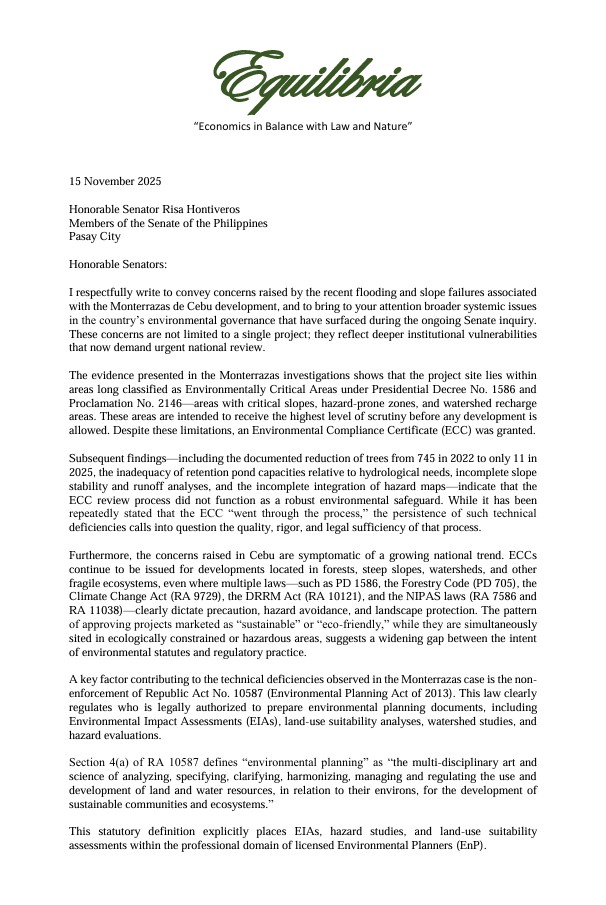
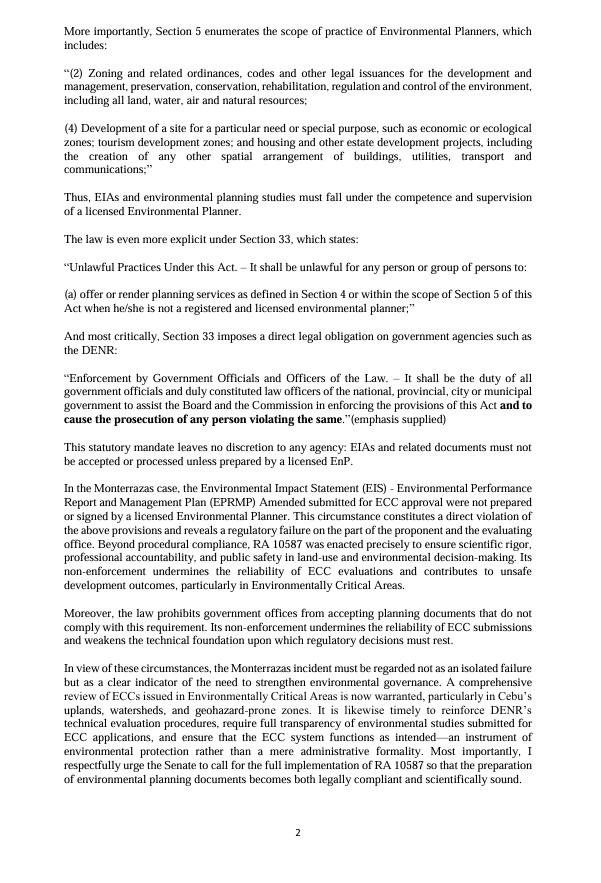
Why I Wrote to the Senate: Strengthening ECC Governance and Enforcing RA 10587

The recent events surrounding the Monterrazas de Cebu development—and the Senate investigation that followed—have brought national attention. These events have highlighted long-standing weaknesses in our environmental regulatory system. The incident goes beyond the tragic flooding and slope failures. It exposes deeper structural issues in the way Environmental Compliance Certificates (ECCs) are evaluated and approved. This is especially concerning in areas that the law classifies as Environmentally Critical Areas (ECAs).

I work as an Environmental Planner, Real Estate Consultant, and researcher. My fields intersect law, economics, and natural capital. I felt compelled to articulate these systemic concerns. I did this through a formal letter addressed to Senator Risa Hontiveros and the members of the Senate.

My letter emphasizes three core points:

First, Proclamation No. 2146 and Presidential Decree No. 1586 clearly designate steep slopes, geohazard zones, and watershed recharge areas as Environmentally Critical Areas. These areas require the highest level of scientific scrutiny. This must happen before any development is allowed. Despite this, ECCs continue to be issued in areas of high ecological and hazard sensitivity.

Second, the Environmental Planning Act of 2013 (RA 10587) contains mandates. It requires that licensed Environmental Planners prepare and sign environmental planning work. This work includes EIAs, hazard studies, hydrologic analyses, and land-use planning. In the case of Monterrazas, this requirement was not met. Non-enforcement of this law compromises the scientific integrity of ECC submissions.

Third, the Monterrazas incident is not an isolated oversight but a symptom of a broader institutional problem. ECCs are too often granted despite incomplete or inadequate assessments. Clear statutory obligations are in place to safeguard communities and ecological systems, yet they are ignored.

My letter respectfully calls on the Senate to strengthen environmental governance. This can be done by ensuring that legal requirements, particularly RA 10587, are fully enforced. ECCs issued in Environmentally Critical Areas should be thoroughly reviewed. Additionally, DENR’s evaluation systems need strengthening and increased transparency.

This moment provides a crucial opportunity to elevate environmental planning. It also helps restore public confidence in regulatory mechanisms. Additionally, it offers better protection for vulnerable landscapes and communities. I hope this contribution is useful to the Senate’s ongoing inquiry. It is also meant to aid our collective effort to build a more climate-resilient and accountable governance system.

Beyond Compliance: Why the ECC Fails to Capture the True Value of Cebu’s Uplands

Environmental decision-making in the Philippines has long relied on the Environmental Compliance Certificate (ECC). It serves as the ultimate regulatory gatekeeper for development. Yet in a province like Cebu, upland forests stabilize water, climate, and communities. The ECC has exposed its deepest limitation. It measures environmental compliance, not environmental value..

This distinction came into sharp public view in Cebu City’s upland development debates. This was most notable in the case of Monterazzas de Cebu. It is a large mixed-use project built within the ecologically significant ridges of Barangays Guadalupe and Buhisan. It is near the headwaters of the Central Cebu Protected Landscape (CCPL) and the Budlaan–Buhisan watershed system.

A Watershed Is More Than a Development Site

Cebu’s uplands function as critical ecological infrastructure. They supply benefits that are foundational, systemic, and often invisible until lost:

  • Groundwater replenishment for Metro Cebu’s aquifers
  • Flood control and runoff regulation protecting low-lying urban districts
  • Carbon storage and microclimate regulation mitigating urban heat impacts
  • Soil retention that prevents landslides and downstream siltation
  • Habitat for endemic species and biodiversity reservoirs
  • Landscape identity and cultural value for Cebuanos

These benefits fall under what environmental economics calls Total Economic Value (TEV)—a framework that includes not only direct use (e.g., water supply), but also indirect use (flood control, climate regulation), option value (future medicine, ecotourism), bequest value (inheritance for future generations), and existence value (nature’s value simply for being there).

The ECC process, however, recognizes none of these as economic assets requiring valuation. It focuses instead on mitigation plans, engineering controls, and compliance commitments, answering only the question:

“Can environmental impacts be managed within acceptable regulatory limits?”

It does not ask the larger, economically decisive question:

“What is the value of what will be lost, even if mitigation is implemented?”

The ECC is a compliance mechanism. It checks if an Environmental Management Plan (EMP) exists. It also checks if mitigation measures are proposed. Finally, it ensures that pollution thresholds fall within permissible standards. But compliance is not valuation, and mitigation is not the same as replacing lost natural capital. This structural limitation represents a market failure. It converts ecological services into unpriced subsidies for development. This shifts costs to communities, households, local governments, and future generations.

The Monterazzas Case: Legally Compliant, Economically Incomplete

Monterazzas secured an ECC because it fulfilled its regulatory obligations. These obligations included drainage systems, slope protection, detention ponds, tree replacement, and environmental monitoring plans. From a compliance standpoint, the approval was defensible.

Yet public backlash surged after severe rain events in 2019 and 2021 intensified flooding in downstream Cebu communities. Flooding cannot be attributed to a single development alone. However, the case crystallized a broader reality. The cumulative cost of upland land conversion was never evaluated in economic terms.

No valuation was conducted for:

  • Reduced aquifer recharge from increased impervious surfaces
  • Lost flood buffering previously performed by forested slopes
  • Carbon stock reduction from land clearing
  • Increased sediment load affecting rivers and drainage systems
  • Public loss of ecological security and landscape heritage

These are not engineering failures. They are valuation failures—costs borne by communities and future generations, not by project balance sheets.

Mitigation Is Not Valuation

A detention pond cannot replace a mountain’s hydrological function.
Tree replanting cannot immediately restore decades of carbon storage.
Slope stabilization cannot substitute the slow work of root-bound soil ecology.

The ECC system can reduce harm, but it cannot measure the economic magnitude of what is permanently altered or foregone. As a result, developments may be:

✔ legally compliant
✖ economically suboptimal
✖ socially contested
✖ ecologically irreversible

Non-Use Values Matter to the Public—Even If the ECC Cannot See Them

What made the debate over Cebu’s uplands emotionally charged was not only flooding—it was the perception of losing something irreplaceable:

  • Cebu’s last remaining green ridgelines
  • Intergenerational access to functioning watersheds
  • The comfort of knowing nature still exists at scale
  • A shared ecological identity built into the Cebuano sense of place

These are non-use values—intangible yet real, and entirely absent in ECC assessment.

Toward a New Standard: Valuing Nature, Not Just Regulating It

If Cebu is to balance growth with survival, environmental governance must change significantly. It must evolve beyond impact mitigation. It should also move toward natural capital valuation.

Future upland development decisions should integrate:

  • Total Economic Valuation (TEV)
  • Hydrological and carbon loss accounting
  • Cumulative impact costing
  • Natural Capital Accounting (aligned with PENCAS)
  • LGU-level ecosystem service valuation in land use planning
  • Public trust and intergenerational equity as development thresholds

Because while the ECC may authorize a project, only economics can reveal its true costs—and only ecology pays them back.

The central lesson from Cebu is clear:

Development must not only comply with environmental rules.
It must account for environmental worth.
Otherwise, what is permitted is not always what is sustainable.

What Is Legal Is Not Always Economic

The ECC ensures projects meet environmental regulations. It does not ensure that development decisions make economic sense when nature’s services are fully priced. In rapidly urbanizing regions like Cebu, ignoring this distinction leads to developments that seem profitable in private ledgers. However, they impose hidden public costs that increase over time.

Cebu’s uplands are not free. Their services are not infinite. And their depreciation is not costless.

Nature’s contributions need to be priced, recorded, and defended like any other form of capital. Without these measures, the province will continue approving projects that are technically compliant. However, these projects will remain economically incomplete.

The ECC prevents illegal environmental harm.
Valuation prevents unaffordable environmental loss.
Cebu urgently needs both.

Flood-Control Projects Alone Will Not Save Cebu—Land Use Will

The declaration by experts confirms that infrastructure alone cannot solve Cebu’s flooding crisis. Planners, scientists, and community advocates have long warned this truth. Drainage projects may manage water. However, land use decisions determine where the water goes.

No flood control masterplan, regardless of engineering quality, will succeed while:

  • Upland forests and recharge zones shrink faster than detention basins are built
  • Commercial land zones double, increasing impervious surface cover
  • Core city residential areas are compressed, pushing communities into hazard-prone uplands
  • Agricultural and green buffer landscapes decline at scale
  • Critical slope, soil, and watershed protections remain advisory—not mandatory

The problem is not simply inadequate pipes and culverts.
The problem is unregulated sprawl, declining absorption capacity, and the absence of enforceable ecological limits in land development.

The science is clear: Flooding is a land use failure before it is an engineering failure.

A city loses flood resilience when rainfall has nowhere to go. This happens when forests are fragmented. It also occurs when slopes are sealed and floodplains are built over. Additionally, housing is pushed uphill without geotechnical, drainage, or watershed safeguards.

The recently approved Cebu City CLUP and Zoning Ordinance thus arrives at a critical inflection point.
Commercial zones have expanded. Forests have been reduced. Affordable housing provision is minimal. The plan must now integrate mandatory disaster-responsive corrections in its implementation phase. This must happen before more irreversible exposure is built into the urban footprint.

We call on city decision-makers to embed the following as binding implementation requirements:

  • Slope-based and hazard-based development controls for uplands
  • Mandatory stormwater detention, permeable surface thresholds, and infiltration standards per project
  • Watershed and ridge-to-reef protection zones with enforceable buffers
  • Moratorium on approvals in high-risk upland settlements pending risk audit
  • Mid-rise affordable housing incentives within safe urban zones to prevent uphill displacement
  • Integration of Metro Cebu-wide watershed governance beyond city political boundaries
  • Creation of an independent CLUP implementation oversight body

Development is not the crisis. Ungoverned development is.

No amount of pumping stations, river walks, canal clearing, or floodgates can compensate for lost forests. They cannot compensate for paved watersheds. They cannot address displaced communities and weakened soil absorption systems. Lost forests, paved watersheds, displaced communities, and weakened soil absorption systems.

Cebu must move beyond treating floods as an aftermath problem.
Flood risk must be prevented at the point of land conversion, zoning approval, and building permit. It should not be addressed only by draining after the storm.

“What protects a city is not just how it builds its drainage…

but how it plans its land.”

We urge the City Government to ensure that CLUP implementation corrects the risk drivers of future disasters. National oversight agencies should also ensure corrective measures are taken. It should not institutionalize these risk drivers.

The aspiration should change. It should not be:
“Cebu that survives floods.” It should be:
“Cebu that no longer floods because it was planned correctly.”

Spaces of Growth, Zones of Risk: Cebu’s Land Use Paradox

The impacts of Typhoon Tino offered a stark reminder. Floods are not solely natural hazards. Instead, they are hydrological imprints of spatial decisions. Land allocation, slope conversion, river encroachment, and watershed disruption manifest their consequences most visibly during extreme weather events.

The approval of Cebu City’s Comprehensive Land Use Plan (CLUP) 2023–2032 redirects the public agenda. It moves from legislative formality to the more consequential arena of implementation. The legitimacy of a land use plan is not proven by its passage. Instead, it is validated by the development outcomes it produces. This is especially true when these outcomes are tested by climate, geography, and population pressure.

The new CLUP reveals major spatial shifts that carry long-term implications. Commercial land allocation more than doubled, while agricultural lands declined dramatically, and forest areas registered significant reduction. Meanwhile, socialized housing allocation remains strikingly minimal. The pattern points to a clear directional tilt. Commercial land expansion is accelerating faster than ecological buffering. It is also outpacing safe residential capacity.

As land values intensify within the urban core, households priced out of the city do not vanish. They relocate to the margins where land is cheaper and regulations are thinner. In Cebu, this relocation increasingly occurs toward upland barangays, steeper slopes, informal drainage basins, and unengineered terrain. The result is not accidental sprawl but policy-induced spatial displacement, where affordability gradients align dangerously with hazard gradients.

A persistent public misconception aggravates this risk calculus. Many people think that uplands newly classified under NIPAS (National Integrated Protected Areas System) are automatically protected. They believe these areas are free from settlement and land conversion. The law says otherwise. Under DENR Administrative Order 2008-26, Section 10(e), carried into the IRR of RA 11038, NIPAS areas may contain Multiple-Use Zones. In these zones, settlement, agriculture, agroforestry, extraction, and livelihood activities may be permitted. Even land tenure rights can be allowed, subject to the Protected Area Management Plan. In other words, NIPAS is a regulatory designation, not an automatic forest preservation guarantee. Hydrology responds to slope, soil porosity, and tree cover — not legal cartography.

Commerce expands more quickly than contour lines can withstand. Three outcomes converge. Land values rise without a parallel safe housing supply. Ecological buffers shrink faster than drainage systems are upgraded. Disaster risk is redistributed rather than reduced. The city becomes economically attractive yet environmentally fragile — bankable in dry months, breakable in wet ones.

The core policy question is therefore not “Should Cebu grow? but rather, Should Cebu grow without slope limits, drainage safeguards, housing balance, and hydrological discipline? A land use plan that expands markets can be beneficial. However, if it creates flood risks for vulnerable communities, it does not represent a development strategy. It is a liability transfer encoded in zoning policy.

Urban planning must retire the outdated metric of success defined by hectares converted. It should adopt a new standard measured in households protected, watersheds stabilized, and risks prevented. Cities do not fail when the economy slows. They fail when slopes collapse and rivers overflow. Institutions run out of answers during the rainfall test they were meant to anticipate.

Cebu City now stands at a pivotal governance moment. The challenge ahead is not to stop development, but to civilize its direction. We need to build where water can be managed. Settling families in areas where slopes are stable is crucial. We must treat forests as infrastructure. Defending watersheds as life-support systems, not land reserves awaiting extraction, is vital.

The legacy of the CLUP will ultimately be judged by evacuation numbers. It will also be judged by flood marks and the geography of survival when the next typhoon arrives. Investment portfolios or skylines will not determine this legacy.

Progress is not proven by buildings standing in fair weather,
but by communities still standing after the storm.

Why the URC Bais Molasses Spill Demands an Official Economic Valuation

On October 26, 2025, the tailing pond of the URC Bais Distillery collapsed. As a result, thousands of cubic meters of molasses wastewater spilled into the Tañon Strait. This spill polluted over 3,000 hectares of marine waters between Negros Oriental and Cebu. The spill killed fish and discolored the water. It forced tourism operators in Bais and Manjuyod to suspend dolphin-watching and sandbar activities. What unfolded was more than an ecological crisis. It was an economic crisis as well. This crisis rippled through coastal communities. Their livelihoods depend on clean water, healthy fish stocks, and tourism income. Yet, despite the extent of the damage, there has been no official economic valuation. Without valuation, harm remains visible to the eye but invisible to the law.

Economic valuation is not about assigning a price to nature. It is about recognizing the real value of ecosystem services that sustain livelihoods and well-being. It transforms abstract losses into measurable, actionable data that policymakers and courts can use to demand accountability and rehabilitation. In the absence of valuation, justice often fails to materialize. The Clean Water Act requires the government to quantify and integrate environmental costs into planning and policy. The Philippine Ecosystem and Natural Capital Accounting System (PENCAS) Act also imposes this duty. However, in many cases these studies are never conducted. As a result, environmental disasters become administrative events instead of economic wrongs.

This failure is not theoretical. In the case of Ang Aroroy ay Alagaan, Inc. v. Filminera Resources Corp., environmental advocates in Masbate filed a petition. They aimed to stop gold mining operations. These operations were alleged to have caused water pollution and marine degradation. The case was dismissed. The petitioners did not provide scientific evidence linking the mining activity to the harm. They also failed to provide valuation evidence. The courts held that while the right to a balanced and healthful ecology is self-executory, it cannot rest on speculation. Without measurable data, there was no causal proof, and therefore no justice. This shows that when environmental damage is not quantified, the legal system has nothing to compensate. It has no foundation to impose liability. There is also no guide to direct restoration.

The law, however, provides a way to act amid scientific uncertainty through the precautionary principle. This principle is enshrined in Rule 20, Section 1 of the Rules of Procedure for Environmental Cases. It allows courts to act even when causation is not fully proven. It shifts the burden of proof to the polluter once a prima facie case of environmental risk is shown. In the landmark case Resident Marine Mammals of the Tañon Strait v. Reyes, the Supreme Court ruled that complete scientific certainty is unnecessary. Action should not be postponed if it can prevent environmental harm. In practice, however, the Filminera case demonstrates that courts hesitate to apply this principle. This happens when there is no baseline data or valuation study to demonstrate measurable harm. The absence of valuation deprives the precautionary principle of its factual footing.

In the URC Bais Distillery spill, the Environmental Management Bureau itself confirmed the contamination of thousands of hectares. They also confirmed the presence of fish kills and the closure of tourism activities. These are not speculative claims—they are facts. The prima facie case for environmental harm already exists. Therefore, failing to conduct an economic valuation at this stage runs counter to the very spirit of the precautionary principle. The principle demands preventive and remedial action even amid uncertainty, and valuation is the mechanism that gives it economic expression. Quantifying losses in fisheries, tourism, and household costs is necessary not just to demand accountability. Estimating non-market ecosystem values is also essential to guide rehabilitation and compensation.

When valuation is absent, the government cannot compute what justice demands. Victims receive no restitution, ecosystems receive no quantified restoration, and polluters face no cost proportional to the damage they cause. Without numbers, there are no remedies. Without valuation, there is no justice. And without accountability, pollution becomes merely another cost of doing business. The precautionary principle tells us to act before harm becomes irreversible. For that action to have meaning, it must be backed by measurement.

The Tañon Strait is not just a channel between two islands. It is a living system that feeds communities. It attracts tourism and anchors the regional economy. Its value is not speculative but measurable. Government agencies such as DENR, NEDA, BFAR, and local governments have a duty. They must translate this value into policy through formal economic valuation. Only then can we ensure that environmental protection is not symbolic but substantial. The spill in Bais should be a turning point. It should teach us that when damage has no price, accountability disappears. To value nature is to defend it. To measure loss is to make justice possible.

To value nature is not to commercialize it but to defend it. Measurement gives law and policy their moral weight. When damage has no price, accountability disappears. But when we count every lost fish, canceled tour, and poisoned tide, we remind the nation that ecology is economy. Justice begins with knowing what we have truly lost.

Further reading:

Love letter to Tanon Strait

The Philippines’ New Forest Policy: A Green Revolution or a Risky Gamble?

The Philippines is a nation blessed with incredible biodiversity. However, it is plagued by deforestation. The country is embarking on a new chapter in forest management. Environment Secretary Raphael P.M. Lotilla recently launched the Sustainable Forest Land Management Agreement (SFLMA). He hailed it as a “major shift.” It promises to revolutionize how the country’s 15.8 million hectares of forest land are managed.

On the surface, SFLMA sounds like a win-win. It streamlines seven fragmented forest tenure instruments into a single, renewable 25-year contract. It also encourages diverse uses like agroforestry, tourism, and conservation. The goal? Foster job creation, cut red tape, and promote inclusive economic growth. The DENR even rolled out complementary initiatives: “Forest for Life: 5 Million Trees by 2028” and mapping over 1.18 million hectares as “Potential Investment Areas (PIAs)” ready for private-sector cash.

Officials are calling it a “new era where conservation and commerce go hand-in-hand.” But is it truly a green revolution? Or does it hold hidden risks for the environment? What about the very communities dependent on these forests?

Legal and Economic Foundations: Operationalizing PNEACAS

The SFLMA is not merely a land-use policy; it is the operational execution of the Philippine National Ecosystem and Climate Accounting System (PENCAS) Law (Republic Act No. 11995). PENCAS legally mandates the integration of the environment’s economic value into national policy. It provides the foundational framework for the SFLMA’s valuation requirement. The agreement requires the calculation of the Total Economic Value (TEV) of the forest. It moves beyond traditional resource extraction models. This TEV approach is guided by the United Nations System of Environmental-Economic Accounting (SEEA) standards mandated by PNEACAS. It ensures that forest stewardship is financially incentivized.

The TEV calculation is divided into two distinct components, which define the roles of financial experts and environmental economists. The first, Valuation of Tangible Assets (Market Value), uses financial methods to evaluate profitability. These methods include Discounted Cash Flow (DCF) and Real Options Analysis (ROA). They determine commercial profitability from timber, non-timber products, and fixed user fees. This component is essential for attracting investment and securing financing.

The second and more innovative component is the Valuation of Intangible Services (Non-Market Value). This component monetizes public environmental goods, directly supporting the goals of PNEACAS. By converting ecological preservation into a quantifiable revenue stream, the SFLMA attempts to align conservation with long-term financial interest.

The Critical Role of the Economist

The economist’s function is to serve as the translator between ecological sustainability and financial viability. They achieve this by monetizing non-market benefits. This process directly addresses the core mandates of the PENCAS Law. They generate the data required for policy alignment and incentive design. Specifically, the economist calculates the value of carbon sequestration by applying the Social Cost of Carbon (SCC). This application turns stored carbon into tradable financial assets, known as carbon credits. This conversion establishes a critical revenue stream for reforestation. They apply the Replacement Cost Method to value watershed services. This method involves estimating the expense of building man-made infrastructure to replace the forest’s natural function. Furthermore, they use the Contingent Valuation Method (CVM) in surveys. These surveys quantify the public’s Willingness To Pay (WTP) for biodiversity. They also assess ecotourism. Through these processes, the economist ensures the SFLMA valuation is consistent with the SEEA framework. They guarantee the environmental statistics are credible and can be integrated into the national economic accounts. This demonstrates that the forest is worth more when preserved than when depleted.

Structural Incentives and Regulatory Risks

The SFLMA’s structural benefits include bureaucratic simplification. This reduces red tape. The 25-year long-term tenure provides the necessary security for substantial, sustainable investment. It mandates an integrated management plan, theoretically ensuring holistic management across production and protection uses.

However, critics cite significant policy risks. A primary concern is the potential for elite capture. This concern is driven by unequal land caps. These caps allow corporations to secure up to 40,000 hectares while capping People’s Organizations (POs) at 1,000 hectares. The technical complexity of TEV calculation adds an additional barrier. It requires sophisticated financial modeling such as DCF, ROA, and CVM. This complexity effectively excludes marginalized Indigenous Cultural Communities (ICCs) and POs that lack extensive external technical and financial support.

Furthermore, the policy faces criticism regarding its environmental oversight. The provision allows proponents to secure an Environmental Compliance Certificate (ECC) after the SFLMA is awarded. This reverses standard environmental procedure. It creates a potential loophole for environmentally damaging activities. The broad allowance for “special uses,” including industrial facilities, raises fears. There is concern about the industrial conversion of biodiverse areas into monoculture plantations or logistical hubs. This could potentially undermine the conservation goals inherent in the PNEACAS framework. The unresolved ambiguity surrounding the ownership of benefits from carbon credits also poses a risk. There may be disputes and unfair distribution of benefits among the state, investors, and local communities.

Safeguards and the Critical Path Forward

The DENR has attempted to mitigate these risks by articulating key safeguards. Key safeguards include the strict requirement for Free, Prior, and Informed Consent (FPIC) in ancestral domains. They also involve using Performance-Based Renewal. In this system, the 25-year contract renewal depends on stringent performance against specific Environmental, Social, and Governance (ESG) metrics. SFLMA holders are also mandated to include social development programs to ensure local employment and fair wages.

The success of the SFLMA hinges entirely on the rigorous enforcement of these social and environmental safeguards. For the policy to truly be a green revolution, it must overcome significant institutional challenges. It must ensure that the benefits quantified through the PNEACAS-mandated valuation framework are equitably shared. Community groups must be empowered to participate effectively. They should not be marginalized by the very system designed to value the resources they steward. Without this transparency, the SFLMA cannot succeed. Equitable implementation is essential. Despite its sophisticated economic design, it risks becoming a vehicle for resource consolidation and further environmental degradation.

Reference:

  1. Sustainable Forest Land Management Agreement (SFLMA)
  2. Philippine Ecosystem and Natural Capital Accounting System (PENCAS) Act