Why I Choose to Speak Out on Upland Development — And Why the Public Must Be Informed

In recent days, a former Cebu City planning official publicly commented on the concerns surrounding the Monterazzas development. This matter has become widely discussed in both local and national circles. The issue is already the subject of a Senate investigation, and the local government has likewise initiated its own review. The former official advised that concerns should not be raised through Facebook or media. Instead, they should be brought exclusively through formal government channels.

I acknowledge that formal complaints are important, and official processes must indeed be followed. In fact, formal complaints are now being prepared for submission to the appropriate national agencies. But urging silence does not resolve the issue.

But I must also be honest: flooding has reached communities that have never experienced it. Upland slopes are being altered without clarity on compliance with national laws. Environmental decisions affect thousands of people downstream. Staying silent is not an option. Speaking only within bureaucratic channels is not enough.

And what is worse, this approach shifts the focus away from the actual environmental and legal issues. It focuses on silencing public participation. This happens even as thousands of residents in the lowlands are dealing with unprecedented flooding. Urging people to stay quiet does not resolve the problem; it only deepens public confusion and delays accountability.

I speak publicly because environmental governance in the Philippines is built on public participation, public disclosure, and public vigilance. Our own laws require it. PD 1586 (the EIA System) underlines the public’s rights. RA 9729 (Climate Change Act), RA 11038 (ENIPAS Act), and RA 10587 (Environmental Planning Act) also support these rights. Additionally, even the 1987 Constitution itself emphasizes the public’s right to know what is happening in their environment. It also stresses their duty to stay informed.

Environmental harm does not happen in isolation. It does not wait for paperwork. And it does not confine its effects to the offices where documents are filed. It spills into homes, businesses, rivers, roads, and ecosystems.

The recent flooding in Cebu City’s lowland barangays is a painful reminder of this reality. People who never experienced flooding in their lifetime suddenly found water inside their homes. They deserve clear answers—not after months of internal review, but now. They deserve transparency on upland developments. They need clear information on slope stability and ECC issuances. It is necessary to confirm if laws like PD 705 and PD 1998 were followed. This is especially crucial in areas where slopes exceed the 18% restriction.

Public discussion does not undermine government processes. It strengthens them. It forms a record and mobilizes awareness. It gives voice to communities. They may not know how to navigate official channels. However, they certainly feel the consequences of development decisions made in the highlands.

Yes, I will file formal complaints. That is being done. But informing the public, raising awareness, sharing technical findings, and inviting civic discussion are equally necessary. They are not acts of defiance—they are acts of democratic participation. These actions are fully protected by our Constitution’s guarantee of access to matters of public concern. It also ensures the right to a balanced and healthful ecology.

To the many who asked why I speak up: I speak because the public deserves the truth. I speak because environmental planning is not merely about documents—it is about people, communities, watersheds, and future generations. I speak because what happens in the uplands affects what happens in the lowlands. And I speak because silence, when there is a clear environmental risk, would do more harm. It would be a greater disservice than discomforting a few.

Transparency protects communities. Silence protects no one.

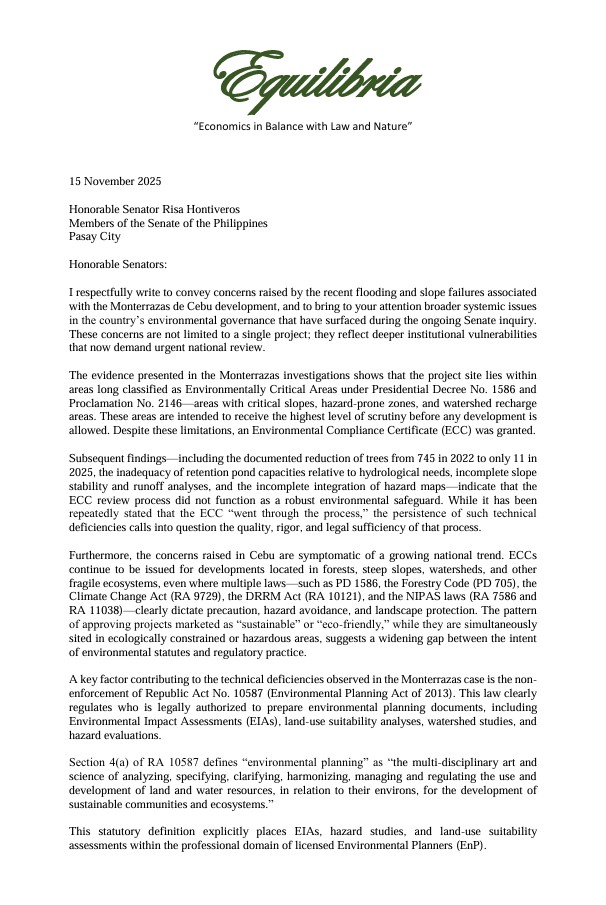
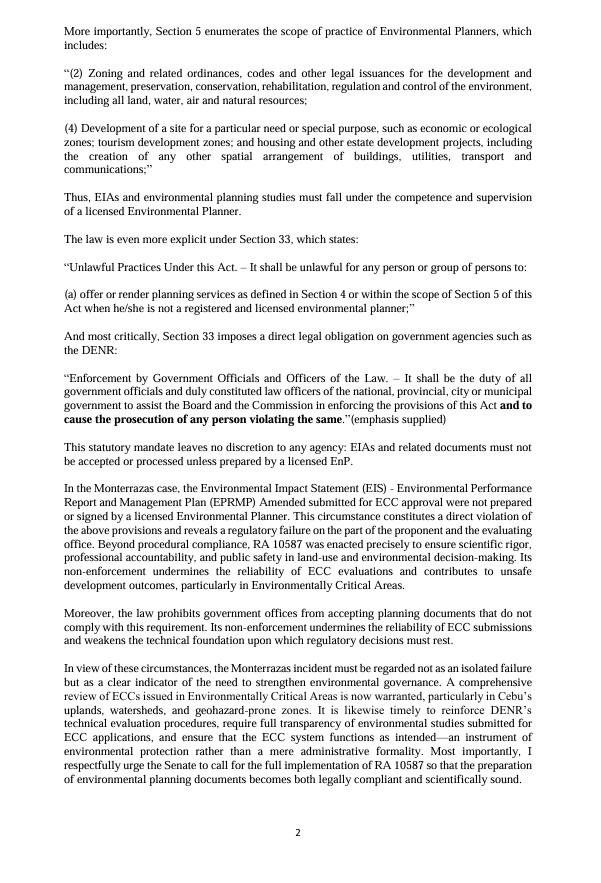
Why I Wrote to the Senate: Strengthening ECC Governance and Enforcing RA 10587

The recent events surrounding the Monterrazas de Cebu development—and the Senate investigation that followed—have brought national attention. These events have highlighted long-standing weaknesses in our environmental regulatory system. The incident goes beyond the tragic flooding and slope failures. It exposes deeper structural issues in the way Environmental Compliance Certificates (ECCs) are evaluated and approved. This is especially concerning in areas that the law classifies as Environmentally Critical Areas (ECAs).

I work as an Environmental Planner, Real Estate Consultant, and researcher. My fields intersect law, economics, and natural capital. I felt compelled to articulate these systemic concerns. I did this through a formal letter addressed to Senator Risa Hontiveros and the members of the Senate.

My letter emphasizes three core points:

First, Proclamation No. 2146 and Presidential Decree No. 1586 clearly designate steep slopes, geohazard zones, and watershed recharge areas as Environmentally Critical Areas. These areas require the highest level of scientific scrutiny. This must happen before any development is allowed. Despite this, ECCs continue to be issued in areas of high ecological and hazard sensitivity.

Second, the Environmental Planning Act of 2013 (RA 10587) contains mandates. It requires that licensed Environmental Planners prepare and sign environmental planning work. This work includes EIAs, hazard studies, hydrologic analyses, and land-use planning. In the case of Monterrazas, this requirement was not met. Non-enforcement of this law compromises the scientific integrity of ECC submissions.

Third, the Monterrazas incident is not an isolated oversight but a symptom of a broader institutional problem. ECCs are too often granted despite incomplete or inadequate assessments. Clear statutory obligations are in place to safeguard communities and ecological systems, yet they are ignored.

My letter respectfully calls on the Senate to strengthen environmental governance. This can be done by ensuring that legal requirements, particularly RA 10587, are fully enforced. ECCs issued in Environmentally Critical Areas should be thoroughly reviewed. Additionally, DENR’s evaluation systems need strengthening and increased transparency.

This moment provides a crucial opportunity to elevate environmental planning. It also helps restore public confidence in regulatory mechanisms. Additionally, it offers better protection for vulnerable landscapes and communities. I hope this contribution is useful to the Senate’s ongoing inquiry. It is also meant to aid our collective effort to build a more climate-resilient and accountable governance system.

The Political Economy of Flooding in Cebu

Every flood follows the laws of physics—but the damage it brings follows the laws of politics and economics. To understand Cebu’s recurring floods, we must examine not just rivers and drains, but land markets, incentives, and power structures.

A civic group recently released a petition calling for accountability. They demand institutional reforms and immediate interventions after the November 4, 2025 flooding. There is a deeper structural truth behind these recurrent failures—one that cannot be resolved through flood-control works alone. Flooding in Cebu is not simply a hydraulic engineering problem. It is a political economy problem. It is shaped by land markets and governance incentives. It also involves institutional weaknesses and the complex interactions between urban development and ecological systems.

The physical manifestations of Cebu’s flooding are evident. They include overflowing rivers, silted channels, blocked waterways, undersized drainage lines, and deteriorated uplands. These issues are symptoms of underlying drivers embedded in the way land is valued, used, occupied, and regulated. These systemic forces determine where people settle and where capital flows. They dictate how infrastructure is prioritized. They also influence which environmental limits are observed or ignored. Understanding the city’s flood crisis requires a new perspective. We must shift from short-term engineering responses. We should focus on a long-term examination of Cebu’s land governance and socio-economic structures.


The Limits of Engineering-Centered Solutions

For decades, Cebu’s response to flooding has relied on traditional engineering. This includes the expansion of drainage networks. It also involves the construction of embankments and the deepening of rivers. Additionally, there is the installation of floodwalls and diversion channels. These are necessary interventions and form part of any modern urban infrastructure system.

However, the severe flooding of November 4 demonstrated an important fact. Structural measures cannot compensate for degraded watersheds. They cannot make up for constricted waterways either. Additionally, land-use choices that contradict hydrological realities are not offset by these measures.

The core limitations are clear:

  • Upstream forests have thinned, reducing water absorption.
  • Urban surfaces have become more impermeable, rapidly increasing runoff.
  • Natural retention areas have been converted into residential and commercial zones.
  • Rivers have narrowed due to settlements, obstructions, and encroachments.
  • Drainage systems designed for past rainfall patterns are now overwhelmed by climate-intensified storms.

Engineering solutions, however well-designed, cannot fully absorb the consequences of decades of unsustainable land use and misaligned development patterns.


Land Market Pressures and Development in High-Risk Areas

Cebu’s flooding problem cannot be separated from the economics of land. As urban land becomes increasingly scarce and valuable, development pressures intensify toward hazard-prone areas:

  • river easements and riparian buffers,
  • wetlands and marshes,
  • floodplains and low-lying coastal areas,
  • steep upland slopes and watershed zones.

These areas historically served as natural drainage or water retention systems. Yet economic incentives—combined with regulatory concessions—have enabled their transformation into buildable parcels.

This trend reflects a market-driven logic: when prime land is limited, the pressure to develop environmentally sensitive areas becomes stronger. The result is a spatial configuration that maximizes short-term economic gains but increases long-term exposure to floods.

Thus, flooding is not merely caused by extreme rainfall. It is shaped by land scarcity and speculative development. Permissive regulatory environments also play a role in its formation. It is shaped by the interaction between land scarcity, speculative development, and permissive regulatory environments.


Political Incentives Favor Visible Infrastructure Over Preventive Governance

Flood-control infrastructures are politically compelling projects. They offer:

  • highly visible outputs,
  • significant budgets,
  • recurring maintenance contracts,
  • and narratives of action and responsiveness.

Because they are technically complex, such projects often escape broader public scrutiny. At the same time, some measures reduce long-term flood risk most effectively. These include watershed rehabilitation, strict easement enforcement, and climate-informed zoning. However, they are politically challenging. They require displacements, long-term planning consistency, and actions that may produce limited immediate political returns.

This imbalance in incentives explains why Cebu sees many flood-control structures. These structures do not always address the underlying drivers of vulnerability. Sometimes, they even worsen the situation.

Flooding persists not simply because engineering solutions are inadequate. It also occurs because political incentives prioritize short-term, highly visible outputs. These outputs are prioritized over structural preventive governance.

The issue is not a lack of technical knowledge among agencies. The problem continues because actions conflict with the interests of those who hold political and economic power.

This is the essence of the political economy argument.


River Degradation and Extractive Activities

Siltation, riverbed changes, and sediment buildup are major contributors to flood severity. These issues are exacerbated by:

  • sand and gravel extraction,
  • upland clearing for agriculture or development,
  • informal excavation,
  • and poor adherence to environmental safeguards.

These activities are sustained because they are economically profitable and often backed by political or economic influence. Despite their known impacts, they persist due to entrenched interests along the value chain—from local employment to construction demand.

Thus, river degradation is not merely a technical or enforcement issue. It is a governance challenge linked to resource extraction, revenue dependence, and regulatory gaps.


Enforcement Challenges Reflect Institutional Capture and Regulatory Asymmetry

Calls for strict enforcement frequently assume that institutions lack capacity or technical competence. In reality, enforcement failures are often tied to:

  • local political alliances,
  • informal settlements that represent vote-rich constituencies,
  • economic actors with significant influence over land use decisions,
  • fragmented authority across agencies,
  • inconsistent application of zoning and environmental rules.

Hazard-prone areas become zones of negotiation rather than regulation. This institutional dynamic contributes to weak compliance, reinforcing land-use patterns that increase flood exposure.

Flooding, therefore, arises not only from natural or physical factors but also from institutional capture and uneven regulatory power.


From Flood Control to Flood Governance

The arguments focusing on removing obstructions, correcting flawed structures, or improving inter-agency coordination are important. Yet they must be integrated into a broader, structural framework of flood governance, one that recognizes the interconnectedness of:

  • land markets,
  • watershed systems,
  • ecological integrity,
  • urban density,
  • climate projections,
  • institutional frameworks,
  • and political incentives.

A governance-centered approach requires:

  • climate-sensitive and risk-informed land use planning,
  • protection and restoration of watershed and riparian systems,
  • strict implementation of easements and hazard-zone regulations,
  • upstream retention strategies and nature-based solutions,
  • green infrastructure that enhances urban permeability,
  • basin-wide management across LGU boundaries,
  • resilient zoning and development controls,
  • and institutional reforms that shield planning from political and economic capture.

Cebu’s long-term resilience depends on integrating these elements into a coherent governance structure.


Conclusion

The November 4, 2025 flood event underscored the limitations of relying primarily on engineering-centric flood control. While structural interventions remain essential, they are insufficient against systemic land-use pressures. Institutional weaknesses and economic incentives drive risky development.

Flooding in Cebu is a political economy issue—rooted in how land is valued, governed, and contested. Meaningful solutions require a transition from reactive flood-control efforts. These solutions must embrace a comprehensive approach rooted in land governance, ecological integrity, institutional accountability, and long-term urban planning.

Cebu can only move toward true resilience through this shift. It will reduce its vulnerability to the increasingly severe impacts of climate and development pressures.

36 Years Later: Why Association of Small Landowners v. Secretary of Agrarian Reform Matters?

Thirty-six years since its 1989 ruling, Association of Small Landowners v. Secretary of Agrarian Reform remains the cornerstone of Philippine expropriation law—defining “just compensation” as the full and fair equivalent of property taken, not merely its cash price, and proving that reform and fairness can coexist under the rule of law.

It has been more than three decades since the Supreme Court decided Association of Small Landowners in the Philippines, Inc. v. Secretary of Agrarian Reform (G.R. Nos. 78742, 79310, 79744, 79777, July 14, 1989). Yet, the echoes of that landmark case still resonate across today’s debates on land rights, expropriation, and social justice. The case remains a constitutional compass for expropriation and land valuation. It guides the ongoing struggle to harmonize social justice with property rights.

This 1989 decision — penned by Justice Isagani A. Cruz — did more than uphold the constitutionality of agrarian reform under President Corazon Aquino. It defined how the State must pursue justice without committing injustice.

The 1989 decision, penned by Justice Isagani A. Cruz, arose at a pivotal moment. The Philippines had just ratified the 1987 Constitution. This called for genuine agrarian reform as a cornerstone of social justice. Acting under that mandate, President Corazon Aquino issued Proclamation No. 131 and Executive Order No. 229, launching the Comprehensive Agrarian Reform Program (CARP). These measures authorized the compulsory acquisition of private agricultural lands. Payment was provided not solely in cash. It also included government bonds, shares of stock, and other financial instruments.

Many landowners objected, arguing that such payment schemes were confiscatory and unconstitutional. They contended that agrarian reform could not override the constitutional protection of private property. They insisted that compensation must be paid in full and in money. The case reached the Supreme Court. The issue was not the legitimacy of reform itself. Instead, it was about the manner by which it was to be carried out.

Justice Cruz spoke for the Court. He upheld the constitutionality of the government’s agrarian reform measures. He delivered what would become one of the most defining interpretations of the Constitution’s takings clause. He explained that agrarian reform is “police power in purpose but eminent domain in method.” It is justified by the public welfare. Yet it involves the taking of private property. Therefore, it requires the payment of just compensation.

🟩 “The measure of compensation is the full and fair equivalent of the property taken from its owner by the expropriator. The word ‘just’ is used to intensify the meaning of the word ‘compensation,’ to convey the idea that the equivalent to be rendered for the property taken shall be real, substantial, full, and ample. Such payment need not always be made in money. It may be in other things of equivalent value, as long as it is real, substantial, and just.”
Justice Isagani A. Cruz, Association of Small Landowners (1989)

The Court emphasized that the question of just compensation is judicial in nature. Courts have the final word on what is fair and just, not any administrative or legislative body. This passage marked a turning point in Philippine constitutional law. It did not abandon market value as the measure of compensation. Instead, it broadened the understanding of how justice may be delivered in its equivalent form.

Justice Isagani Cruz, writing for the Court, clarified that the measure of compensation remains the property’s market value. This is the price that a willing buyer would pay to a willing seller under normal conditions.
What the Court changed was not the measure, but the form.

The Court held that just compensation need not always be paid in cash. The owner must receive the full and fair equivalent of the property’s market value. This means that payment can be made through bonds, stocks, or other financial instruments, provided they reflect true, realizable worth.

The logic was both constitutional and practical. Implementing agrarian reform on a national scale would have been impossible. This task involves millions of hectares. It would not be feasible if the government were required to pay every landowner in full cash. The Court allowed flexibility. However, it insisted that the total value received must be real, substantial, and equivalent to what was taken.

In other words:

The market value remains the yardstick,
while equivalent value is the means of payment.

The Court recognized that the price paid must reflect the full and fair value of the property taken. It should be the true market value. However, under exceptional circumstances, the government will pay through instruments of equivalent value. These instruments can be bonds or shares, as long as their worth is real and realizable. This doctrinal shift was both pragmatic and principled. The State can pursue a massive redistribution of land. It did so without collapsing under fiscal burden. Meanwhile, it safeguarded the constitutional rights of landowners to fair recompense.

Later decisions, including Land Bank of the Philippines v. Wycoco (2004) and Land Bank v. Honeycomb Farms (2009), reaffirmed this doctrine. Courts must determine just compensation based on market indicators, which include comparable sales, income potential, and zonal valuations. This holds even if the payment is made through other equivalent means. Thus, while the form of payment may vary, the standard of fairness does not. The Small Landowners decision preserved the essence of justice. It ensures that the value taken must be replaced by the same value returned. This must be done in whatever lawful form.

Beyond its technical rulings, the case represents a moral and constitutional reconciliation. It proved that reform need not be confiscation. Social justice must operate within the boundaries of the rule of law. The State may pursue redistribution and public welfare. However, it cannot deny fairness to those from whom the property is taken. In that balance lies the very heart of constitutional democracy.

More than three decades later, the decision continues to influence modern expropriation cases, such as Republic v. Arellano University (G.R. No. 260038, 2025), where the Court reaffirmed that just compensation cannot be based merely on administrative valuations or outdated schedules of market values. It must reflect all relevant market conditions. It should consider the property’s location and potential. Other factual considerations must make compensation truly fair. These modern cases, while dealing with urban development and public infrastructure, trace their constitutional lineage directly to Small Landowners.

The ruling’s wisdom resonates today in broader contexts. These include urban redevelopment, socialized housing, and environmental expropriations. It is also present in discussions on carbon markets and the just transition. Its enduring message is that reform must be fair, and fairness must be real. The law may adapt to new social challenges, but its foundation in justice and due process remains unchanged.

Association of Small Landowners remains a testament to the idea that progress and fairness are not adversaries but partners. The decision did not merely uphold agrarian reform; it humanized it. It emphasized that while the State may right historical wrongs, it must ensure the integrity of law is preserved. Thirty-six years later, it continues to serve as a reminder to both the government and citizens. Social justice should not be pursued at the expense of constitutional justice. No taking, however noble its purpose, is truly just without just compensation.

Why It Matters Today

The decision remains a bedrock precedent in property law, agrarian reform, and expropriation. It clarified the balance between individual property rights and collective welfare. This decision shapes how courts interpret “just compensation” in modern takings. These include cases from agrarian lands to urban redevelopment, road widening, and environmental expropriations.

In contemporary jurisprudence (e.g., City Government of Pasay v. Arellano University, 2025), the same principles continue to ensure that landowners are fairly compensated, while allowing the State to pursue inclusive, socially just development.

For further reading:

  1. Association of Small Landowners in the Philippines, Inc. v. Secretary of Agrarian Reform (1989) https://lawphil.net/judjuris/juri1989/jul1989/gr_78742_1989.html

2. City Government of Pasay v. Arellano University, 2025 https://sc.judiciary.gov.ph/260038-city-government-of-pasay-vs-arellano-university/

Clarifying “Market Value” in the Supreme Court’s Pasay–Arellano Decision Post

The Supreme Court of the Philippines recently released a press statement. It is titled “SC: Just compensation in land expropriation must consider all relevant factors, not just market value.” This statement refers to its decision in G.R. No. 260038 (City Government of Pasay v. Arellano University).

The ruling reiterates a fundamental principle in expropriation law. Just compensation must be real, full, and fair. It is determined not by a single administrative figure, but through judicial evaluation of all circumstances surrounding the property.

However, the Court’s post also offers a chance to clarify a common terminological confusion. The use of “market value” as cited in the post does not refer to true open-market value. Instead, it refers to the Schedule of Market Values (SMV). Local assessors use this administrative instrument for taxation purposes.

Arellano University owned an 805-square-meter parcel of land in Barangay San Isidro, Pasay City. The City Government turned this property into a public road. It is now known as Menlo Street. This was done without expropriation proceedings or payment of just compensation.

The Pasay City Assessor’s Office had assigned the land a value of Php200 per square meter. This was based on its 1978 Schedule of Market Values. The trial court later used this figure to compute compensation.

The Supreme Court, however, clarified that such assessor-based valuations are not determinative of just compensation. They can guide fiscal assessments, but they are not substitutes for market evidence or judicial determination.


Market Value vs. Schedule of Market Values

This distinction lies at the heart of both valuation and constitutional law.

ConceptMeaningPurposeAuthority
Market ValueThe price a willing buyer would pay to a willing seller in an open market. Both parties act knowledgeably and without compulsion.Reflects real market behavior, used in appraisals, investments, and expropriation.Defined under PVS 102 and IVS 104; affirmed in Republic v. CA, G.R. No. 146587 (2002).
Schedule of Market Values (SMV)A uniform benchmark value prepared by the local assessor for tax assessment purposes.Ensures equity in real property taxation under the Local Government Code.Authorized under Sections 212–216, LGC of 1991.

The PVS (Philippine Valuation Standards) and IVS (International Valuation Standards) define market value as:

The estimated amount as the price for which an asset exchanges between a willing buyer and a willing seller. This occurs in an arm’s-length transaction after proper marketing. The parties act knowledgeably, prudently, and without compulsion.

In contrast, the Schedule of Market Values is an administrative tool. It is updated every few years. It is designed to standardize taxation but not to represent real-time market dynamics.

The Supreme Court has consistently drawn this line in cases such as NPC v. Manubay Agro-Industrial Corp. and Republic v. CA: the SMV may be indicative. However, it cannot replace the judicial process of valuation. This process ensures constitutionally mandated just compensation.

My Letter to the Supreme Court

To support accurate public understanding of this distinction, I have respectfully written to the Supreme Court Public Information Office.
My letter explains that the “Php 200 per square meter market value” is mentioned in the decision. It comes from the 1978 Schedule of Market Values. This should not be mistaken for actual market value as understood in valuation and jurisprudence.

You may read my full letter here.

In essence, my correspondence acknowledges the Court’s sound reasoning. It emphasizes the need to maintain terminological precision. This principle is crucial not only to valuation professionals but also to the legal system itself.

The phrase “market value” may appear technical. However, in matters of public taking, it defines the line between administrative convenience and constitutional fairness.
When government takes private property, just compensation must reflect the property’s true worth—its economic value, not its tax-assessed figure.

Ensuring this distinction honors both the rule of law and the integrity of valuation practice. It safeguards landowners’ rights and guides courts, assessors, and appraisers toward a shared language of fairness and precision.

The City of Pasay v. Arellano University decision reinforces a timeless principle:

Just compensation is not a matter of administrative convenience—it is a constitutional right grounded in fairness and factual valuation.

As valuation professionals, we have a responsibility to ensure that public discourse around “market value” remains technically accurate. It must also be legally sound. Clarity in language leads to clarity in justice.

⚖️ Legal Brief in Real Estate

By: AB Agosto, JD

When an earthquake caused the collapse of the Ruby Tower in Manila in 1968, the tragedy raised a profound legal question: could the contractors, architects, and engineers be held liable for damages, or was the destruction purely an act of God? This question was resolved in Nakpil & Sons v. Court of Appeals (G.R. No. L-47851, October 3, 1986), a case that remains a cornerstone of Philippine jurisprudence on real estate liability.

The petitioners argued that the earthquake was a fortuitous event, beyond human control, and that under Article 1174 of the Civil Code, they should be exempt from liability. The Court, however, examined the evidence and concluded that negligence in design and construction had contributed to the building’s collapse. The ruling made it clear: a fortuitous event does not excuse liability when human negligence concurs in producing the damage.

The Court declared, “The principle of fortuitous event cannot apply where the negligence of the obligor concurs with the fortuitous event in producing the damage. Negligence is not excused by fortuitous event.” In other words, while the earthquake was indeed an act of nature, the faulty workmanship and design defects were man-made, and together they caused the catastrophic failure.

This case remains directly relevant to real estate practice because it clarifies how responsibility is allocated when property is damaged by natural disasters. For builders and developers, Nakpil is a stern warning. It shows that compliance with the Building Code, zoning ordinances, and engineering standards is not optional but a legal duty. An earthquake may be unavoidable, but if poor materials, inadequate structural design, or shortcuts in construction contribute to the collapse, liability attaches. Developers cannot simply invoke force majeure; their reputation, financial exposure, and even criminal liability may be at stake.

For appraisers, the ruling highlights a subtle but crucial point. When valuing damaged property, it is necessary to ask: Was the loss caused solely by the disaster, or was it aggravated by negligence? If the latter, the cost to cure or diminution in value may be subject to claims against contractors, engineers, or insurers. This affects appraisal reports for insurance claims, litigation support, and even expropriation where consequential damages are assessed.

For insurers, Nakpil clarifies the boundaries of coverage. Many property policies exclude “acts of God” like earthquakes, but this case shows that where negligence coexists with a natural event, liability persists. Thus, insurers must carefully examine claims to determine if negligence by contractors or owners triggered coverage. It also guides insurers in drafting clearer clauses about fortuitous events, exclusions, and subrogation rights.

For property owners, the case is a lesson in vigilance and due diligence. Choosing competent contractors, hiring licensed engineers and architects, and ensuring that designs comply with earthquake-resistant standards are not just business decisions but safeguards against loss. Owners cannot assume that “insurance will pay” or that “the disaster was unavoidable.” The law demands that owners protect their property with foresight.

For the broader real estate industry, Nakpil underscores the link between law, valuation, and social responsibility. The safety and integrity of buildings directly affect communities, not just investors. When negligence meets disaster, lives and livelihoods are lost. By holding professionals accountable, the Supreme Court reinforced a culture of responsibility — one that appraisers, brokers, assessors, and developers must uphold in a disaster-prone country like the Philippines.

The continuing lesson of Nakpil is accountability- natural events may be unavoidable, but their impact is often determined by human foresight, planning, and diligence. In a country as disaster-prone as the Philippines, this doctrine safeguards the public by ensuring that responsibility cannot be avoided under the blanket excuse of force majeure.

Doctrine: Nakpil ensures that earthquakes and other disasters do not excuse negligence. Builders must build right, appraisers must distinguish causes of damage, insurers must test the limits of coverage, and property owners must demand quality. In real estate, accountability and preparedness remain the first defenses against natural calamities.

Further Reading

  • Full text of Nakpil & Sons v. Court of Appeals on Lawphil.net
  • Civil Code of the Philippines, Title I, Chapter 2 (Obligations and Contracts)

Why the DOJ Holds the Key to the Witness Protection Program

One of the landmark reforms in the Philippine criminal justice system is Republic Act No. 6981, otherwise known as the Witness Protection, Security and Benefit Act. The law was enacted to encourage witnesses to testify in criminal cases by granting them immunity from prosecution and providing protection and benefits that ensure their safety and livelihood. At the heart of this reform is the central role of the Department of Justice (DOJ), whose authority was tested in the high-profile case of Webb v. De Leon (G.R. Nos. 121234, 121245, 121297, August 23, 1995).

Under Section 12 of R.A. 6981, the DOJ has the power to admit witnesses into the program. Once admitted, the certification issued by the DOJ must be given full faith and credit by public prosecutors. This means that prosecutors are barred from including the admitted witness in any criminal complaint or information, and if the witness has already been charged, the prosecutor is duty-bound to move for his or her discharge. Admission also grants the witness immunity from prosecution for the related offenses, together with access to rights and benefits such as security, relocation, subsistence, and employment assistance.

This provision was challenged by petitioner Hubert Webb, who argued that only the courts, under Rule 119 of the Rules of Court, have the authority to discharge an accused as a state witness. He claimed that allowing the DOJ to decide on the admission of witnesses intrudes upon judicial prerogatives and violates the separation of powers.

The Supreme Court disagreed. It held that the prosecution of crimes is fundamentally an executive function, anchored on the constitutional duty of the executive branch to “faithfully execute the laws.” The discretion to determine whether, what, and whom to charge—including who may be used as a state witness—properly belongs to the DOJ as part of its prosecutorial power. The Court clarified that while Rule 119 empowers courts to discharge an accused once jurisdiction has been acquired, this authority is jurisdictional rather than inherent. It ensures that proceedings remain orderly, but it does not strip the DOJ of its primary role in deciding witness admissions under R.A. 6981.

The decision underscores the delicate balance between the branches of government: the executive determines who to prosecute and who to use as a state witness, while the judiciary supervises proceedings once a case is filed. By upholding the DOJ’s role, the Court strengthened the Witness Protection Program as a vital tool for combating crime. As the DOJ itself pointed out, many cases in the past had been dismissed due to witnesses refusing to testify out of fear or economic dislocation. R.A. 6981 and its interpretation in Webb directly address this challenge by protecting witnesses and ensuring their cooperation.

The Webb v. De Leon ruling affirms that the DOJ’s role in the Witness Protection Program is constitutionally sound and crucial for the administration of criminal justice. By empowering the DOJ to certify and immunize state witnesses, the law tackles one of the biggest obstacles in criminal prosecutions: the silence of those who know the truth. In a justice system often hampered by fear and intimidation, the law sends a clear message—witnesses will be protected, and their courage will not be in vain.

You may download the Supreme Court case here:

https://lawphil.net/judjuris/juri1995/aug1995/gr_121234_1995.html

Restitution Is the Law, Not a Loophole

Senator Erwin Tulfo’s recent statement during the Senate Blue Ribbon Committee hearing on the flood control mess — that sometimes you have to “bend the law” to heed the people’s cry for restitution — has drawn both applause and criticism. Justice Secretary Jesus Crispin Remulla affirmed his sentiment, but some quarters now warn that such remarks suggest moving outside the Constitution.

In my view, there is no need to bend the law at all. The law itself, through both the Constitution and the Civil Code, already mandates restitution.

Accountability in the flood control mess does not stop with public officials. Even private contractors who enriched themselves from irregular projects are bound by law to return the money. The Civil Code, through Articles 19 and 22, prohibits unjust enrichment, while the Constitution itself (Article II, Section 27) commands the State to take effective measures against graft and corruption. Restitution therefore, is not a bending of the law — it is the law itself at work.

The Civil Code reinforces this duty through two key provisions:

  • Article 19: “Every person must, in the exercise of his rights and in the performance of his duties, act with justice, give everyone his due, and observe honesty and good faith.”
  • Article 22: “Every person who through an act of performance by another, or any other means, acquires or comes into possession of something at the expense of the latter without just or legal ground, shall return the same to him.”

Taken together, these make restitution a legal requirement. It is not a technicality, nor a concession to public clamor. It is the natural consequence of unjust enrichment.

When protesters at Luneta shouted “Ibalik ang pera ng bayan,” they were not demanding that the law be ignored or bent. They were, perhaps unknowingly, demanding that the law be faithfully enforced. The people’s voice and the law’s command align perfectly here.

This is why I believe Senator Tulfo’s passion is not at odds with the rule of law. The better framing is this: the law itself already bends toward justice. To demand restitution is not to defy legal principles but to uphold them.

My take is simple: restitution is not just a moral duty, nor is it merely a populist cry. It is a constitutional and legal obligation. There is no conflict between the will of the people and the rule of law on this issue. Both demand the same thing: that what was wrongfully taken from the Filipino people must be returned.

We live in abnormal times when asking to return stolen money is treated as if it were illegal.

How an Expert Witness Prepares for Trial

“An expert witness is expected to assist the court in understanding technical evidence by providing independent, objective, and reasoned opinions based on established expertise.” — Tortona v. Gregorio, G.R. No. 202612, Jan. 17, 2018

Appearing in court as an expert witness is a serious responsibility. It demands more than just professional qualifications—it requires thorough preparation, clarity in communication, and strict adherence to both legal and ethical standards. Whether in the field of real estate appraisal, engineering, accounting, or any technical discipline, the effectiveness of an expert witness lies in how well they understand their role and how clearly they can assist the court.

The preparation begins with a full understanding of the case. The expert must study the pleadings, judicial affidavits, motions, and any relevant reports to grasp the context of the legal dispute. This understanding helps frame the opinion the expert will give. Once the scope of the engagement is clear, the expert proceeds to draft and finalize their report. The report must be factual, supported by data, and rooted in accepted professional standards—such as the Philippine Valuation Standards for appraisers or the relevant codes of ethics and methodology in other professions. This report, along with the judicial affidavit required by the Rules of Court, becomes the backbone of the expert’s courtroom presentation.

Communication with counsel is vital. The lawyer and the expert must align on what issues the expert will testify to, what documents and evidence will be referred to, and how the expert can best support the legal theory of the case without overstepping their bounds. A good lawyer will also simulate a mock direct and cross-examination to help the expert anticipate difficult or technical questions, and practice answering in a way that is truthful, clear, and calm.

On the day of the trial, the expert must come prepared. This means dressing professionally, arriving early, and bringing all necessary materials—copies of the report, affidavits, supporting documentation, and visual aids such as charts or maps. During testimony, the expert is first qualified by the court. Once recognized as an expert in their field, they proceed to give their opinion under oath, guided by the direct examination of counsel. The expert must maintain composure during cross-examination, avoid defensive behavior, and be honest if they don’t know the answer to a question. Judges value precision and honesty over attempts to impress or advocate for one party.

Ultimately, the credibility of an expert witness rests not only on credentials but on the ability to explain complex matters in a straightforward and impartial manner. A well-prepared expert supports the truth-seeking function of the court. By grounding their opinion in verifiable data and presenting it clearly, the expert becomes a bridge between technical knowledge and legal judgment. Preparation, professionalism, and integrity are the foundation of any expert testimony that truly helps the court reach a just and informed decision.

Serving as an expert witness requires more than just subject matter expertise. It demands professionalism, preparation, and precision. Whether you’re a real estate appraiser, economist, forensic analyst, or valuation consultant, the courtroom is your stage to translate complex findings into reliable, understandable truth.

With proper preparation, your testimony can become the turning point in delivering justice.

Why Expert Witnesses are Crucial in Modern Litigation

In the resolution of civil disputes in the Philippines, courts are increasingly confronted with cases involving factual and technical issues that fall outside the competence of judges or laypersons. In such instances, the assistance of expert witnesses becomes indispensable. Expert reports—submitted by persons possessing special knowledge, skill, experience, training, or education in a particular field—help the courts understand, assess, and decide on matters requiring specialized inquiry. These reports are commonly used in civil litigation involving businesses, medical negligence, engineering defects, property valuation, environmental compliance, intellectual property disputes, accounting and taxation issues, financial rehabilitation proceedings, actions to quiet title, and assessment of actual or consequential damages.

The admissibility and evidentiary value of expert reports in the Philippine legal system are governed by Rule 130 of the Revised Rules on Evidence, as amended by A.M. No. 19-08-15-SC (2020). Section 22 authorizes the reception of expert opinion on matters requiring special knowledge, skill, experience, or training, provided the witness is properly qualified. Section 23 further clarifies that an expert’s opinion is not inadmissible merely because it touches on the ultimate issue to be decided by the court. Section 24 permits experts to base their opinions on personal knowledge or on data made known to them prior to the hearing—even if such underlying facts are not independently admissible—so long as they are of a type reasonably relied upon by professionals in the field. These provisions affirm the judiciary’s recognition of expert testimony as an essential tool in the adjudication of fact-intensive and technical disputes.

In practice, expert reports are submitted through judicial affidavits pursuant to A.M. No. 12-8-8-SC. These affidavits must identify the expert’s credentials, state the matters covered by the opinion, explain the data and methodology relied upon, and present the conclusions reached. During trial, the expert must be presented for direct and cross-examination, thereby allowing the opposing party and the court to test the validity, accuracy, and credibility of the findings. The report itself may be offered as documentary evidence, provided it is properly identified, authenticated, and formally offered in accordance with the rules on evidence.

Philippine jurisprudence strongly supports the admissibility and evidentiary weight of expert testimony. In National Power Corporation v. Sps. Saludares (G.R. No. 183053, January 13, 2016), the Court held that valuation reports carry probative weight if they apply recognized standards and methodologies. In Department of Agrarian Reform v. Heirs of Deleste (G.R. No. 195838, March 12, 2014), the Court accepted the use of formula-based valuation reports, affirming the relevance of expert input. Beyond valuation, in People v. Manalansan (G.R. No. 194844, February 10, 2014), the Court acknowledged that expert testimony is vital in matters involving scientific or medical evidence that judges are not expected to understand without professional assistance.

In complex civil forfeiture cases, such as Republic v. Corona, where the state seeks to recover allegedly ill-gotten wealth, expert witnesses—specifically forensic accountants or financial analysts—are indispensable due to the voluminous and intricate financial data involved. Their crucial role encompasses reconstructing and analyzing financial transactions, aggregating diverse financial documents, calculating wealth discrepancies by comparing income with acquired assets, and explaining complex financial concepts (e.g., co-mingling funds, offshore accounts) to the court. They are vital for identifying inconsistencies, presenting findings clearly, and even rebutting defense arguments. Without their specialized expertise, it would be virtually impossible for the court to navigate the technical barriers of financial information, prove key elements like “unexplained wealth,” and bridge the knowledge gap between raw financial data and the legal framework, ultimately transforming complex financial patterns into comprehensible evidence.

Another clear example of the value of expert testimony is found in Tortona v. Gregorio (G.R. No. 202612, January 17, 2018), where the Supreme Court upheld the annulment of a notarized deed of sale based on the expert findings of an NBI fingerprint examiner. The examiner concluded that the thumbmarks on the deed did not belong to the deceased owner. While the Court of Appeals relied on the presumption of regularity in notarized documents, the Supreme Court ruled that the expert’s analysis constituted “clear and convincing evidence” sufficient to rebut such presumption. The Court emphasized that when issues involve technical matters beyond common understanding, credible expert opinion may be given controlling weight.

Expert testimony also plays a vital role in cases involving taxation, rehabilitation, and complex financial disputes. For instance, in tax litigation, an expert in tax compliance or accounting may be necessary to explain corporate records, reconcile audit findings, or assess alleged deficiencies. In petitions for corporate rehabilitation or liquidation under the Financial Rehabilitation and Insolvency Act (FRIA), expert financial analysts or restructuring professionals help the court evaluate feasibility studies, business plans, or asset schedules. In land disputes involving conflicting titles or boundary issues, land surveyors or geodetic engineers offer clarity on technical descriptions and mapping inconsistencies. In actions for damages, whether contractual or quasi-delictual, economic experts or forensic accountants may be called upon to quantify actual loss, opportunity cost, or lost profits with precision. In all these scenarios, the expert’s role is to provide clarity and credibility to otherwise complex matters, enabling the court to make an informed and just decision.

In line with this, Mr. Gus Agosto—a licensed real estate practitioner and economist—has served as an expert witness in various court proceedings, offering professional opinion on matters involving taxation, business forecasting, property valuation, and applied economics. His independent analyses have supported judicial determinations in numerous cases, including those involving corporate rehabilitation, tax assessments, and property disputes. His experience underscores the crucial role that credible and well-grounded expert opinions play in bridging technical complexity and judicial understanding.

The weight accorded to expert reports depends on the qualifications of the witness, the soundness of the methodology used, and the extent to which the conclusions are anchored in factual and reliable data. While expert opinions are not binding on the court, they may be given substantial persuasive value. Courts may disregard expert testimony if it is speculative, methodologically unsound, or tainted by bias. Nevertheless, when grounded in proper expertise and presented with clarity and integrity, expert evidence often proves pivotal in resolving factual controversies.

Expert reports serve a vital function in civil litigation. They assist courts in resolving technical matters that demand professional judgment, supplement the court’s understanding of complex factual scenarios, and contribute to the just and efficient resolution of disputes. The Philippine Rules of Court and jurisprudence recognize and regulate the role of expert witnesses with sufficient clarity and flexibility, enabling trial courts to benefit from specialized knowledge without abdicating their judicial function. For litigants and counsel, engaging a credible expert and presenting a well-structured report is not merely a procedural strategy—it is often an indispensable element in building a persuasive and well-supported case.

Expert witnesses are not merely helpful—they are often essential to proving or rebutting complex factual claims in civil litigation. Their testimony ensures that the court is not left to speculate on matters requiring specialized understanding. As jurisprudence affirms, when the facts are too complex for lay judgment, expert testimony becomes a cornerstone of a fair trial.