Flood-Control Projects Alone Will Not Save Cebu—Land Use Will

The declaration by experts confirms that infrastructure alone cannot solve Cebu’s flooding crisis. Planners, scientists, and community advocates have long warned this truth. Drainage projects may manage water. However, land use decisions determine where the water goes.

No flood control masterplan, regardless of engineering quality, will succeed while:

  • Upland forests and recharge zones shrink faster than detention basins are built
  • Commercial land zones double, increasing impervious surface cover
  • Core city residential areas are compressed, pushing communities into hazard-prone uplands
  • Agricultural and green buffer landscapes decline at scale
  • Critical slope, soil, and watershed protections remain advisory—not mandatory

The problem is not simply inadequate pipes and culverts.
The problem is unregulated sprawl, declining absorption capacity, and the absence of enforceable ecological limits in land development.

The science is clear: Flooding is a land use failure before it is an engineering failure.

A city loses flood resilience when rainfall has nowhere to go. This happens when forests are fragmented. It also occurs when slopes are sealed and floodplains are built over. Additionally, housing is pushed uphill without geotechnical, drainage, or watershed safeguards.

The recently approved Cebu City CLUP and Zoning Ordinance thus arrives at a critical inflection point.
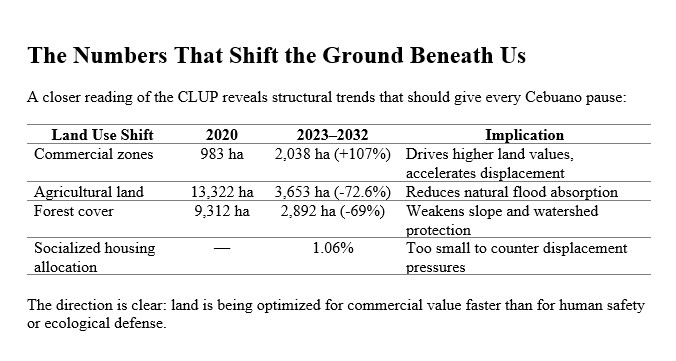
Commercial zones have expanded. Forests have been reduced. Affordable housing provision is minimal. The plan must now integrate mandatory disaster-responsive corrections in its implementation phase. This must happen before more irreversible exposure is built into the urban footprint.

We call on city decision-makers to embed the following as binding implementation requirements:

  • Slope-based and hazard-based development controls for uplands
  • Mandatory stormwater detention, permeable surface thresholds, and infiltration standards per project
  • Watershed and ridge-to-reef protection zones with enforceable buffers
  • Moratorium on approvals in high-risk upland settlements pending risk audit
  • Mid-rise affordable housing incentives within safe urban zones to prevent uphill displacement
  • Integration of Metro Cebu-wide watershed governance beyond city political boundaries
  • Creation of an independent CLUP implementation oversight body

Development is not the crisis. Ungoverned development is.

No amount of pumping stations, river walks, canal clearing, or floodgates can compensate for lost forests. They cannot compensate for paved watersheds. They cannot address displaced communities and weakened soil absorption systems. Lost forests, paved watersheds, displaced communities, and weakened soil absorption systems.

Cebu must move beyond treating floods as an aftermath problem.
Flood risk must be prevented at the point of land conversion, zoning approval, and building permit. It should not be addressed only by draining after the storm.

“What protects a city is not just how it builds its drainage…

but how it plans its land.”

We urge the City Government to ensure that CLUP implementation corrects the risk drivers of future disasters. National oversight agencies should also ensure corrective measures are taken. It should not institutionalize these risk drivers.

The aspiration should change. It should not be:
“Cebu that survives floods.” It should be:
“Cebu that no longer floods because it was planned correctly.”
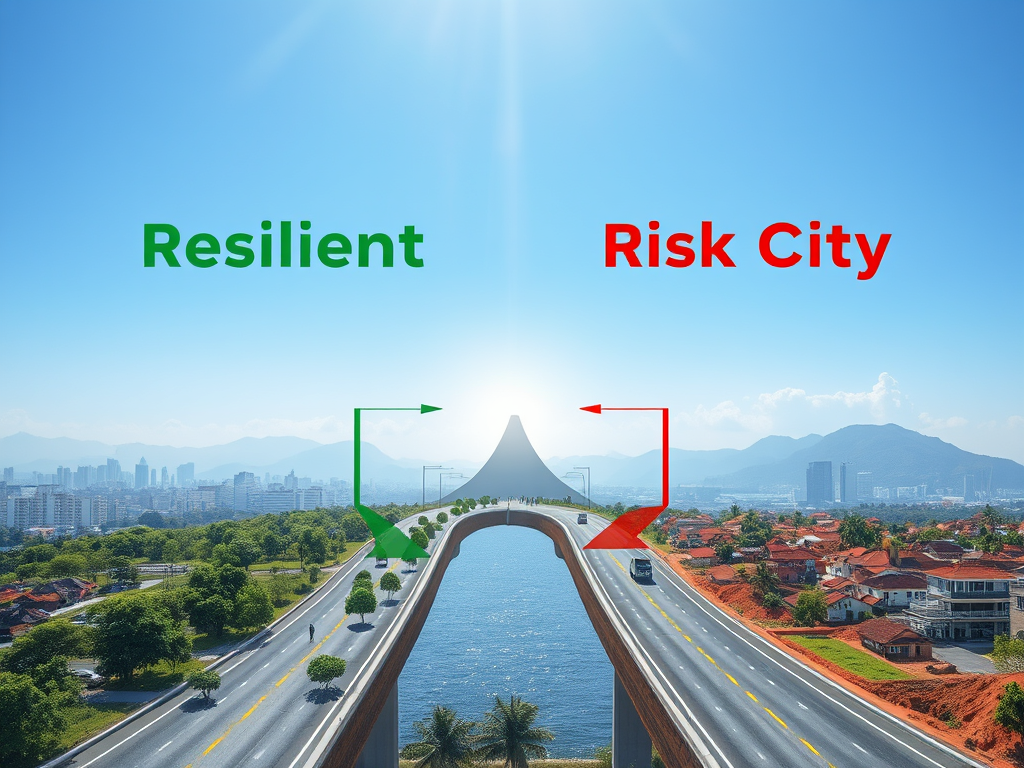
Spaces of Growth, Zones of Risk: Cebu’s Land Use Paradox

The impacts of Typhoon Tino offered a stark reminder. Floods are not solely natural hazards. Instead, they are hydrological imprints of spatial decisions. Land allocation, slope conversion, river encroachment, and watershed disruption manifest their consequences most visibly during extreme weather events.

The approval of Cebu City’s Comprehensive Land Use Plan (CLUP) 2023–2032 redirects the public agenda. It moves from legislative formality to the more consequential arena of implementation. The legitimacy of a land use plan is not proven by its passage. Instead, it is validated by the development outcomes it produces. This is especially true when these outcomes are tested by climate, geography, and population pressure.

The new CLUP reveals major spatial shifts that carry long-term implications. Commercial land allocation more than doubled, while agricultural lands declined dramatically, and forest areas registered significant reduction. Meanwhile, socialized housing allocation remains strikingly minimal. The pattern points to a clear directional tilt. Commercial land expansion is accelerating faster than ecological buffering. It is also outpacing safe residential capacity.

As land values intensify within the urban core, households priced out of the city do not vanish. They relocate to the margins where land is cheaper and regulations are thinner. In Cebu, this relocation increasingly occurs toward upland barangays, steeper slopes, informal drainage basins, and unengineered terrain. The result is not accidental sprawl but policy-induced spatial displacement, where affordability gradients align dangerously with hazard gradients.

A persistent public misconception aggravates this risk calculus. Many people think that uplands newly classified under NIPAS (National Integrated Protected Areas System) are automatically protected. They believe these areas are free from settlement and land conversion. The law says otherwise. Under DENR Administrative Order 2008-26, Section 10(e), carried into the IRR of RA 11038, NIPAS areas may contain Multiple-Use Zones. In these zones, settlement, agriculture, agroforestry, extraction, and livelihood activities may be permitted. Even land tenure rights can be allowed, subject to the Protected Area Management Plan. In other words, NIPAS is a regulatory designation, not an automatic forest preservation guarantee. Hydrology responds to slope, soil porosity, and tree cover — not legal cartography.

Commerce expands more quickly than contour lines can withstand. Three outcomes converge. Land values rise without a parallel safe housing supply. Ecological buffers shrink faster than drainage systems are upgraded. Disaster risk is redistributed rather than reduced. The city becomes economically attractive yet environmentally fragile — bankable in dry months, breakable in wet ones.

The core policy question is therefore not “Should Cebu grow? but rather, Should Cebu grow without slope limits, drainage safeguards, housing balance, and hydrological discipline? A land use plan that expands markets can be beneficial. However, if it creates flood risks for vulnerable communities, it does not represent a development strategy. It is a liability transfer encoded in zoning policy.

Urban planning must retire the outdated metric of success defined by hectares converted. It should adopt a new standard measured in households protected, watersheds stabilized, and risks prevented. Cities do not fail when the economy slows. They fail when slopes collapse and rivers overflow. Institutions run out of answers during the rainfall test they were meant to anticipate.

Cebu City now stands at a pivotal governance moment. The challenge ahead is not to stop development, but to civilize its direction. We need to build where water can be managed. Settling families in areas where slopes are stable is crucial. We must treat forests as infrastructure. Defending watersheds as life-support systems, not land reserves awaiting extraction, is vital.

The legacy of the CLUP will ultimately be judged by evacuation numbers. It will also be judged by flood marks and the geography of survival when the next typhoon arrives. Investment portfolios or skylines will not determine this legacy.

Progress is not proven by buildings standing in fair weather,
but by communities still standing after the storm.

Why the URC Bais Molasses Spill Demands an Official Economic Valuation

On October 26, 2025, the tailing pond of the URC Bais Distillery collapsed. As a result, thousands of cubic meters of molasses wastewater spilled into the Tañon Strait. This spill polluted over 3,000 hectares of marine waters between Negros Oriental and Cebu. The spill killed fish and discolored the water. It forced tourism operators in Bais and Manjuyod to suspend dolphin-watching and sandbar activities. What unfolded was more than an ecological crisis. It was an economic crisis as well. This crisis rippled through coastal communities. Their livelihoods depend on clean water, healthy fish stocks, and tourism income. Yet, despite the extent of the damage, there has been no official economic valuation. Without valuation, harm remains visible to the eye but invisible to the law.

Economic valuation is not about assigning a price to nature. It is about recognizing the real value of ecosystem services that sustain livelihoods and well-being. It transforms abstract losses into measurable, actionable data that policymakers and courts can use to demand accountability and rehabilitation. In the absence of valuation, justice often fails to materialize. The Clean Water Act requires the government to quantify and integrate environmental costs into planning and policy. The Philippine Ecosystem and Natural Capital Accounting System (PENCAS) Act also imposes this duty. However, in many cases these studies are never conducted. As a result, environmental disasters become administrative events instead of economic wrongs.

This failure is not theoretical. In the case of Ang Aroroy ay Alagaan, Inc. v. Filminera Resources Corp., environmental advocates in Masbate filed a petition. They aimed to stop gold mining operations. These operations were alleged to have caused water pollution and marine degradation. The case was dismissed. The petitioners did not provide scientific evidence linking the mining activity to the harm. They also failed to provide valuation evidence. The courts held that while the right to a balanced and healthful ecology is self-executory, it cannot rest on speculation. Without measurable data, there was no causal proof, and therefore no justice. This shows that when environmental damage is not quantified, the legal system has nothing to compensate. It has no foundation to impose liability. There is also no guide to direct restoration.

The law, however, provides a way to act amid scientific uncertainty through the precautionary principle. This principle is enshrined in Rule 20, Section 1 of the Rules of Procedure for Environmental Cases. It allows courts to act even when causation is not fully proven. It shifts the burden of proof to the polluter once a prima facie case of environmental risk is shown. In the landmark case Resident Marine Mammals of the Tañon Strait v. Reyes, the Supreme Court ruled that complete scientific certainty is unnecessary. Action should not be postponed if it can prevent environmental harm. In practice, however, the Filminera case demonstrates that courts hesitate to apply this principle. This happens when there is no baseline data or valuation study to demonstrate measurable harm. The absence of valuation deprives the precautionary principle of its factual footing.

In the URC Bais Distillery spill, the Environmental Management Bureau itself confirmed the contamination of thousands of hectares. They also confirmed the presence of fish kills and the closure of tourism activities. These are not speculative claims—they are facts. The prima facie case for environmental harm already exists. Therefore, failing to conduct an economic valuation at this stage runs counter to the very spirit of the precautionary principle. The principle demands preventive and remedial action even amid uncertainty, and valuation is the mechanism that gives it economic expression. Quantifying losses in fisheries, tourism, and household costs is necessary not just to demand accountability. Estimating non-market ecosystem values is also essential to guide rehabilitation and compensation.

When valuation is absent, the government cannot compute what justice demands. Victims receive no restitution, ecosystems receive no quantified restoration, and polluters face no cost proportional to the damage they cause. Without numbers, there are no remedies. Without valuation, there is no justice. And without accountability, pollution becomes merely another cost of doing business. The precautionary principle tells us to act before harm becomes irreversible. For that action to have meaning, it must be backed by measurement.

The Tañon Strait is not just a channel between two islands. It is a living system that feeds communities. It attracts tourism and anchors the regional economy. Its value is not speculative but measurable. Government agencies such as DENR, NEDA, BFAR, and local governments have a duty. They must translate this value into policy through formal economic valuation. Only then can we ensure that environmental protection is not symbolic but substantial. The spill in Bais should be a turning point. It should teach us that when damage has no price, accountability disappears. To value nature is to defend it. To measure loss is to make justice possible.

To value nature is not to commercialize it but to defend it. Measurement gives law and policy their moral weight. When damage has no price, accountability disappears. But when we count every lost fish, canceled tour, and poisoned tide, we remind the nation that ecology is economy. Justice begins with knowing what we have truly lost.

Further reading:

Love letter to Tanon Strait

The Philippines’ New Forest Policy: A Green Revolution or a Risky Gamble?

The Philippines is a nation blessed with incredible biodiversity. However, it is plagued by deforestation. The country is embarking on a new chapter in forest management. Environment Secretary Raphael P.M. Lotilla recently launched the Sustainable Forest Land Management Agreement (SFLMA). He hailed it as a “major shift.” It promises to revolutionize how the country’s 15.8 million hectares of forest land are managed.

On the surface, SFLMA sounds like a win-win. It streamlines seven fragmented forest tenure instruments into a single, renewable 25-year contract. It also encourages diverse uses like agroforestry, tourism, and conservation. The goal? Foster job creation, cut red tape, and promote inclusive economic growth. The DENR even rolled out complementary initiatives: “Forest for Life: 5 Million Trees by 2028” and mapping over 1.18 million hectares as “Potential Investment Areas (PIAs)” ready for private-sector cash.

Officials are calling it a “new era where conservation and commerce go hand-in-hand.” But is it truly a green revolution? Or does it hold hidden risks for the environment? What about the very communities dependent on these forests?

Legal and Economic Foundations: Operationalizing PNEACAS

The SFLMA is not merely a land-use policy; it is the operational execution of the Philippine National Ecosystem and Climate Accounting System (PENCAS) Law (Republic Act No. 11995). PENCAS legally mandates the integration of the environment’s economic value into national policy. It provides the foundational framework for the SFLMA’s valuation requirement. The agreement requires the calculation of the Total Economic Value (TEV) of the forest. It moves beyond traditional resource extraction models. This TEV approach is guided by the United Nations System of Environmental-Economic Accounting (SEEA) standards mandated by PNEACAS. It ensures that forest stewardship is financially incentivized.

The TEV calculation is divided into two distinct components, which define the roles of financial experts and environmental economists. The first, Valuation of Tangible Assets (Market Value), uses financial methods to evaluate profitability. These methods include Discounted Cash Flow (DCF) and Real Options Analysis (ROA). They determine commercial profitability from timber, non-timber products, and fixed user fees. This component is essential for attracting investment and securing financing.

The second and more innovative component is the Valuation of Intangible Services (Non-Market Value). This component monetizes public environmental goods, directly supporting the goals of PNEACAS. By converting ecological preservation into a quantifiable revenue stream, the SFLMA attempts to align conservation with long-term financial interest.

The Critical Role of the Economist

The economist’s function is to serve as the translator between ecological sustainability and financial viability. They achieve this by monetizing non-market benefits. This process directly addresses the core mandates of the PENCAS Law. They generate the data required for policy alignment and incentive design. Specifically, the economist calculates the value of carbon sequestration by applying the Social Cost of Carbon (SCC). This application turns stored carbon into tradable financial assets, known as carbon credits. This conversion establishes a critical revenue stream for reforestation. They apply the Replacement Cost Method to value watershed services. This method involves estimating the expense of building man-made infrastructure to replace the forest’s natural function. Furthermore, they use the Contingent Valuation Method (CVM) in surveys. These surveys quantify the public’s Willingness To Pay (WTP) for biodiversity. They also assess ecotourism. Through these processes, the economist ensures the SFLMA valuation is consistent with the SEEA framework. They guarantee the environmental statistics are credible and can be integrated into the national economic accounts. This demonstrates that the forest is worth more when preserved than when depleted.

Structural Incentives and Regulatory Risks

The SFLMA’s structural benefits include bureaucratic simplification. This reduces red tape. The 25-year long-term tenure provides the necessary security for substantial, sustainable investment. It mandates an integrated management plan, theoretically ensuring holistic management across production and protection uses.

However, critics cite significant policy risks. A primary concern is the potential for elite capture. This concern is driven by unequal land caps. These caps allow corporations to secure up to 40,000 hectares while capping People’s Organizations (POs) at 1,000 hectares. The technical complexity of TEV calculation adds an additional barrier. It requires sophisticated financial modeling such as DCF, ROA, and CVM. This complexity effectively excludes marginalized Indigenous Cultural Communities (ICCs) and POs that lack extensive external technical and financial support.

Furthermore, the policy faces criticism regarding its environmental oversight. The provision allows proponents to secure an Environmental Compliance Certificate (ECC) after the SFLMA is awarded. This reverses standard environmental procedure. It creates a potential loophole for environmentally damaging activities. The broad allowance for “special uses,” including industrial facilities, raises fears. There is concern about the industrial conversion of biodiverse areas into monoculture plantations or logistical hubs. This could potentially undermine the conservation goals inherent in the PNEACAS framework. The unresolved ambiguity surrounding the ownership of benefits from carbon credits also poses a risk. There may be disputes and unfair distribution of benefits among the state, investors, and local communities.

Safeguards and the Critical Path Forward

The DENR has attempted to mitigate these risks by articulating key safeguards. Key safeguards include the strict requirement for Free, Prior, and Informed Consent (FPIC) in ancestral domains. They also involve using Performance-Based Renewal. In this system, the 25-year contract renewal depends on stringent performance against specific Environmental, Social, and Governance (ESG) metrics. SFLMA holders are also mandated to include social development programs to ensure local employment and fair wages.

The success of the SFLMA hinges entirely on the rigorous enforcement of these social and environmental safeguards. For the policy to truly be a green revolution, it must overcome significant institutional challenges. It must ensure that the benefits quantified through the PNEACAS-mandated valuation framework are equitably shared. Community groups must be empowered to participate effectively. They should not be marginalized by the very system designed to value the resources they steward. Without this transparency, the SFLMA cannot succeed. Equitable implementation is essential. Despite its sophisticated economic design, it risks becoming a vehicle for resource consolidation and further environmental degradation.

Reference:

  1. Sustainable Forest Land Management Agreement (SFLMA)
  2. Philippine Ecosystem and Natural Capital Accounting System (PENCAS) Act

The Impact of the WorldRisk Report on Philippine Real Estate

The Philippines, a nation of islands situated in the typhoon belt, remains one of the world’s most disaster-prone countries. The WorldRisk Report 2025 is a publication of Bündnis Entwicklung Hilft. It is also published by the Institute for International Law of Peace and Armed Conflict (IFHV) of Ruhr-University Bochum. It places the country among those with the highest global risk exposure. This conclusion is once again highlighted. The report has a special focus on floods. Floods are the most frequent and destructive natural hazard worldwide. Between 2000 and 2009, floods accounted for 44 percent of all global catastrophes, affecting more than 1.6 billion people and causing losses exceeding USD 650 billion. In the Philippines, flood vulnerability continues to rise because of climate-related rainfall intensification. Unregulated urbanization contributes to the risk. The degradation of natural buffers such as wetlands and mangroves exacerbates the situation.

These recurring flood events are no longer isolated environmental phenomena. They are now central to understanding how real estate functions. They are also central to understanding how real estate is valued. Climate risk directly influences property demand, development feasibility, and investment decisions. What once defined value purely in economic terms—location, accessibility, and market trends—now includes resilience, adaptability, and sustainability. Floods not only damage structures and displace communities but also recalibrate the long-term performance and desirability of land.

The Real Property Valuation and Assessment Reform Act (RA 12001), enacted in 2024, reflects this changing reality. It establishes a uniform national valuation framework, standardizes market-based approaches, and introduces mechanisms for adaptive reassessment. Among its provisions, Section 18 explicitly recognizes that disasters and calamities can alter property market values. It authorizes local government units to revise their Schedules of Market Values. This occurs whenever “significant changes” happen due to calamities or disasters. These changes can be man-made or natural. This provision marks a significant legal milestone. It integrates disaster risk into valuation governance. It acknowledges that climate events are legitimate economic variables. These variables can affect land and building worth.

This legal recognition aligns with the 2025 WorldRisk Report findings. The report calls for an integrated response. It combines four key perspectives: political, technological, social, and ecological. Political measures emphasize decentralized governance and the inclusion of risk management in land-use planning. Technological innovation encourages the use of satellite data, LiDAR mapping, and AI-based flood forecasting to inform planning and decision-making. Social resilience underscores community preparedness and traditional knowledge systems that reduce vulnerability. Ecological solutions advocate for mangrove reforestation, wetland restoration, and nature-based flood control, which simultaneously protect biodiversity and buffer human settlements.

In real estate valuation, these four dimensions translate into practical implications. Under the cost approach, flood exposure accelerates physical deterioration. It shortens the remaining economic life of improvements. Appraisers must apply higher depreciation rates. They also need to use more conservative estimates of useful life. The income approach must consider flood-induced operating expenses. It should also factor in reduced rentability and risk-based capitalization rates. These considerations help to account for uncertainty in income streams. Meanwhile, the market approach must segregate comparable sales based on hazard exposure. This is important since properties within flood-prone zones typically transact at discounted prices. These properties also exhibit longer marketing periods.

Beyond appraisal technique, the relationship between flood risk and property value also reflects broader behavioral and institutional adjustments. Developers now prioritize elevation, drainage systems, and green design. Lenders are requiring flood-risk assessments before approving mortgages. Insurers have introduced differentiated premiums based on hazard classification. These market adjustments demonstrate that resilience has become a form of economic capital—one that safeguards value and attracts investment.

Yet the transformation brought by the WorldRisk Report and RA 12001 extends far beyond valuation methodology. It is reshaping the Philippine real estate sector as a whole. Urban planning now integrates flood risk into Comprehensive Land Use Plans (CLUPs). Developers incorporate retention ponds and elevated designs as standard practice. Financial institutions are embedding environmental risk into credit assessments. The convergence of scientific data, legal frameworks, and market adaptation signals a new era in property governance. In this era, resilience is not peripheral but central to defining and protecting value.

In this evolving landscape, real estate valuation has likewise been methodologically reshaped. It is no longer a static appraisal of economic worth but a dynamic assessment of risk, sustainability, and adaptive capacity. Properties are now judged by their performance under pressure. This includes how they resist, how they recover, and how they remain useful during climate events. The very meaning of “value” has expanded: it now includes the ability to endure.

Ultimately, the 2025 WorldRisk Report and RA 12001 together redefine the fundamentals of real estate in the Philippines. The former provides the global scientific context for understanding hazard exposure. The latter establishes the national legal mechanism to respond to this exposure. Together, they transform how property is developed, managed, financed, and valued. In the age of climate uncertainty, the true measure of real estate is no longer limited to its square meters. It is also not defined by its location. Instead, it lies in its resilience per square meter.

In this century of rising tides and shifting ground, resilience is not just protection—it is value itself.


References

Bündnis Entwicklung Hilft & IFHV Ruhr-University Bochum. WorldRiskReport 2025. Available at: https://weltrisikobericht.de/worldriskreport/
Republic Act No. 12001. Real Property Valuation and Assessment Reform Act of 2024. Official Gazette of the Republic of the Philippines.
Department of Finance – Bureau of Local Government Finance. Philippine Valuation Standards (PVS 2023).

On BBM’s Right of Way Policy Proposition

President BBM’s recent proposition to return to a previous system for handling right-of-way issues, where the government would pay only 15 percent of the property value upfront and resolve any subsequent valuation disputes in court, has significant implications not only for landowners but also for the general public.

Key infrastructure flagship projects currently facing right of way (ROW) issues include the Cagayan de Oro Diversion Road Extension, the Davao City Bypass Construction Project, the Samal Island-Davao City Connector Bridge, the Light Rail Transit-1 Cavite Extension Project, and the EDSA Greenways Project.

One of the primary motivations behind President BBM’s proposal is to expedite infrastructure projects. Projects could proceed without delay by taking possession of the property with an initial 15 percent payment and allowing valuation disputes to be settled later. This could lead to quicker completion of essential infrastructure such as roads, bridges, and public utilities, benefiting the public by improving transportation, connectivity, and access to services.

However, this expedited process might come at a cost. The reliance on courts to resolve valuation disputes can increase the judicial system’s burden, potentially causing delays in other legal proceedings. Additionally, the cost of prolonged litigation could ultimately be borne by taxpayers, increasing public expenditure.

The public perception of the government’s commitment to fair and just practices could be affected. If the policy unfairly favors infrastructure development at the expense of property owner’s rights, it could lead to public dissent and erode trust in government institutions. Ensuring a transparent and fair process is crucial for maintaining public confidence.

Efficient and timely infrastructure development can have positive economic impacts, such as stimulating investment, creating jobs, and boosting economic growth. Improved infrastructure enhances the overall business environment, making it easier for companies to operate and expand. However, if the process is perceived as unjust, it might deter investment, particularly in real estate and property development sectors, due to concerns about property rights and fair compensation.

The rapid acquisition of property for infrastructure projects can lead to community displacement. This has social implications, as displaced families and communities may face significant challenges in finding new homes, and jobs, and adjusting to new environments. Ensuring displaced individuals are adequately compensated and supported through the transition is essential to mitigate these impacts.

A system that prioritizes quick project completion over fair compensation may disproportionately affect vulnerable populations. Lower initial compensation could exacerbate the financial instability of low-income families and marginalized communities. Ensuring equitable treatment for all property owners, regardless of their socio-economic status, is critical for social justice.

Therefore, President BBM’s proposal to modify the right-of-way process has the potential to accelerate infrastructure development, benefiting the public through improved services and economic growth. However, it also raises significant concerns about legal and financial burdens, public trust, social impacts, and equity. A balanced approach that maintains fairness, transparency, and support for affected individuals is essential to ensure that the benefits of infrastructure projects are realized without compromising the rights and welfare of property owners and the broader community.

The Essential Role of Master Planning in Real Estate

Clients often want to explore what their properties can become, not just what they are worth today. Potential encompasses the possible future uses and developments that can enhance the value and utility of the property. Through master planning, we analyze various factors such as location, market trends, demographic shifts, and regional growth patterns to identify opportunities for development and improvement.

Maximal use refers to optimizing the utilization of a property to achieve its highest and best use. This involves detailed planning and strategic decision-making to ensure that the property is developed in a way that maximizes its value, functionality, and sustainability. We consider various scenarios and use cases, from residential and commercial developments to mixed-use projects, ensuring that every square meter of the property is used effectively.

In contrast to conventional master plans focused narrowly on technical and physical aspects, our approach is more expansive and inclusive. We go beyond traditional boundaries of architecture and engineering to incorporate rigorous analyses of market trends, legal, economic feasibility, environmental sustainability, and comprehensive risk management. This broader perspective ensures that our projects are not only viable but also resilient and adaptive to changing environments and challenges.

The Role of Master Planning

Our master planning services begin with a thorough analysis of the property, including its legal and physical characteristics, existing infrastructure, and environmental conditions. We also conduct market and feasibility studies to understand the economic viability of potential developments. This comprehensive analysis forms the foundation of our master plans, ensuring they are grounded in reality and aligned with market demands.

Master planning is about creating a strategic vision for the property’s future. We collaborate with our clients to understand their goals and aspirations, integrating their vision into the master plan. This strategic approach ensures that the plan not only addresses immediate needs but also sets a course for long-term growth and development.

Market Analysis

Market analysis is a cornerstone of effective master planning in real estate, providing essential insights into market trends, demand-supply dynamics, and consumer behavior. By conducting thorough analyses, master planners can identify opportunities, mitigate risks, and optimize strategies to enhance project feasibility and long-term success. Integrating market insights ensures that developments are not only responsive to current market conditions but also positioned for sustainable growth and resilience in the future.

Financial Analysis

Financial viability is a cornerstone of successful master planning. We conduct detailed financial analyses to assess the feasibility of proposed developments. This includes market analysis, financial modelling, cost estimation, revenue projections, and return on investment calculations. By evaluating the financial aspects thoroughly, we help clients make informed decisions and attract potential investors.

Economic Impact

Master planning also considers the broader economic impact of development projects. Economic analysis in real estate and investment decisions involves several key tools and techniques that guide investors and developers in making informed choices. We analyze how proposed developments can stimulate local economies, create job opportunities, and attract businesses and investments. This holistic view ensures that the development contributes positively to the economic vitality of the region.

Environmental Sustainability

Sustainable development is at the core of our planning process. We conduct comprehensive environmental impact assessments to understand and mitigate the ecological footprint of developments. This includes evaluating potential impacts on air and water quality, natural habitats, and biodiversity. Our plans incorporate green building practices, energy efficiency measures, and renewable energy solutions to minimize environmental impact.

Our master plans emphasize the integration of green spaces, parks, and recreational areas to enhance the quality of life for residents and promote environmental sustainability. These spaces not only provide aesthetic and health benefits but also contribute to the ecological balance of the area.

Legal and Regulatory Compliance

Legal due diligence and proactive management of ownership and legal barriers are integral to effective master planning in real estate. By verifying ownership, identifying legal barriers, and ensuring regulatory compliance, we mitigate risks, enhance project feasibility, and facilitate smooth implementation. We also ensure that all projects comply with local, regional, and national regulations. This includes zoning laws, building codes, environmental regulations, and land use policies. This proactive approach enhances project feasibility, mitigates risks, and facilitates smooth implementation

Risk management is integral to our master planning approach. We identify potential legal, financial, and environmental risks and develop strategies to mitigate them. This proactive approach ensures the long-term success and sustainability of our projects.

Conclusion

Our clients look to us for more than just property valuations; they seek insights into the potential and maximal use of their properties. Through our comprehensive master planning services, we provide the strategic vision, detailed analysis, and innovative solutions needed to unlock that potential and maximize use. By integrating financial viability, economic impact, environmental sustainability, and legal compliance, we ensure that our projects are sustainable, resilient, and successful.

This holistic approach not only enhances the value of the property but also ensures balanced growth that preserves natural resources, promotes community well-being, and fosters long-term economic vitality. Our expertise in master planning positions us to lead in nurturing and developing thriving communities that stand the test of time.

AB Agosto was named to the Environmental Impact Assessment Review Committee

In a significant development, Gus Agosto has been listed as a member of the newly established Environmental Impact Assessment (EIA) Review Committee in Region 7. The EIA process, aimed at foreseeing the environmental impact of a development, involves the preparation of an Environmental Impact Statement (EIS). This document, submitted by the project proponent or EIA consultant, serves as the application for an environmental compliance certificate (ECC).

“I am deeply honored and humbled by the appointment to serve in the EIA Review Committee. The importance of responsible and sustainable development cannot be overstated, and I am committed to contributing my expertise to ensure that development projects in our region align with environmental standards,” commented the Environmental Planner.

The ECC is granted based on a comprehensive study of a project’s significant impacts on the environment and the proposed environmental management plan. Agosto’s role in the committee involves contributing to the thorough analysis required during the review of EIS. This analysis includes evaluating data accuracy, the soundness of analysis, and the appropriateness of proposed mitigation measures.

According to DENR Administrative Order 2003-30, the Environmental Management Bureau (EMB) is entrusted with implementing the Philippine Environmental Impact Statement System (PEISS). The EMB can commission independent professionals, academic experts, and representatives from relevant government agencies as members of the EIA Review Committee (EIARC).

The EIARC, a body of independent technical experts and professionals of known probity from various fields, evaluates EIA reports and provides recommendations on the issuance or non-issuance of an ECC. It plays a crucial role in ensuring the environmental sustainability of development projects.

Project proponents are mandated to secure an ECC before commencing any development initiative. The issuance of this certificate is contingent upon a positive review of the EIS by the EIARC, highlighting the significance of this committee in upholding environmental standards in development projects.

“I believe that fostering a balance between development and environmental preservation is crucial for the well-being of our communities,” Mr. Agosto concluded.

ABA Economic Consulting Set to Redefine the Consulting Practice in VisMin Regions

In a strategic leap towards enhancing its service spectrum in the VisMin (Visayas and Mindanao) region, ABA Economics Consulting is poised to reshape the consulting paradigm. The unveiling of a pioneering Economics consulting practice marks a transformative milestone for the firm, with AB Agosto, a seasoned economist, steering this groundbreaking initiative.

Agosto’s wealth of expertise, derived from practical applications of economics across diverse industries, positions him as a dynamic leader for this venture. His notable contributions as a consultant for the Asian Development Bank (ADB), coupled with his policy consulting engagements for the Cebu Chamber of Commerce and comprehensive analysis for a Mindanao real estate developer, underscore his ability to translate economic theories into tangible strategies.

Headquartered in Cebu, the newly established Economics practice aims to elevate ABA Economics Consulting’s capabilities, focusing on economic analysis within the domains of economics and urban planning. Key services encompass policy advisory assessments, valuations, cost and benefits analysis, demand analysis, property taxation, public finance, and investment analysis.

This strategic expansion solidifies ABA’s commitment to delivering holistic solutions in the VisMin region. Under the astute leadership of AB Agosto, the Economics consulting practice signifies a pivotal shift in the firm’s trajectory, ensuring its continued prominence in delivering impactful and tailored services across various economic sectors.

“The development of an Economics practice is the next step in the firm’s exciting growth journey and further widens our service offering in the dispute resolution space,” expressed AB Agosto, emphasizing the strategic importance of this innovative endeavor.

As the lead of this transformative practice, Agosto’s dynamic leadership is expected to play a central role in positioning ABA Economics Consulting as the go-to partner for clients seeking expertise in economic analysis and comprehensive dispute resolution solutions. The launch of the Economics consulting practice is poised to redefine consulting standards in the VisMin region, ushering in unparalleled insights and strategies for a diverse clientele.

RBH No. 6’s Impact on Philippine Urban Economics

As an urban economist scrutinizing the proposed Resolution of Both Houses (RBH) No. 6 in the Philippines, which aims to amend economic provisions, particularly in foreign ownership restrictions, my analysis delves into the intricate interplay between policy shifts, land dynamics, and the urban economic landscape.

RBH No. 6 seeks to introduce a clause, “unless provided by law,” particularly targeting the easing of limitations on foreign ownership of industries, including public utilities, currently adhering to a 60% Filipino – 40% foreign ownership rule. This proposed change has sparked concerns and discussions surrounding its potential impact on land prices, speculation, and housing dynamics.

With the nation’s total land area officially designated at 30 million hectares, featuring 14.2 million hectares of alienable and disposable land and 15.8 million hectares classified as forestland, RBH No. 6 introduces a crucial clause, “unless provided by law,” indicating a strategic move to ease restrictions on foreign ownership, notably in public utilities.

From an urban economic standpoint, the proposal is a harbinger of potential shifts in the demand and supply dynamics of the real estate market. The envisioned increased access to land ownership by foreign entities is anticipated to stimulate demand, particularly in prime urban locations or areas ripe for development. This surge in demand, coupled with heightened competition for available land, is poised to exert upward pressure on land prices, creating a complex economic environment.

Historically, rising land prices have been a catalyst for speculative activities in real estate markets. Local and foreign investors may strategically position themselves, acquiring land not for immediate utilization but with an eye on future profit margins. The resultant speculation poses challenges to the principles of efficient urban economic markets and warrants careful consideration in the broader economic landscape.

In the field of urban planning, the proposed changes present both opportunities and challenges. Increased foreign capital may translate into a wave of urban development projects, shaping the physical and economic landscape of cities. This influx of investment has the potential to bring innovation, modern infrastructure, and sustainable practices to the forefront of urban planning initiatives, aligning with contemporary economic paradigms.

However, the lens of an urban economist also necessitates a nuanced understanding of potential pitfalls. Gentrification, a potential byproduct of increased foreign investment in select urban areas, raises concerns about the equitable distribution of economic benefits. As property values rise and the cost of living increases, the risk of displacement for existing communities becomes a significant urban economic consideration.

Navigating the economic implications of RBH No. 6 requires adept policy responses. Effective government intervention, characterized by judicious regulation and strategic urban planning, is essential to harness the positive economic forces while mitigating potential negatives. Measures such as targeted taxation, zoning regulations, and policies to safeguard affordable housing are paramount.

As RBH No. 6 continues to be a focal point of discourse, urban economists emphasize the need for a holistic approach. Rigorous economic analyses, coupled with an understanding of urban dynamics, are imperative to inform policymakers on how to balance the influx of foreign investment with the preservation of economic equity, sustainable urban development, and the overarching economic resilience of the Philippines.