Beyond Bato: Individual Rights, Collective Justice, and the Constitutional Dilemma of Modern Democracy

The controversy surrounding Ronald dela Rosa is often discussed through the language of individual constitutional rights. Public debates revolve around due process, habeas corpus, unlawful arrest, jurisdiction, and the limits of state power. Lawyers argue over warrants, detention, treaty obligations, and procedural safeguards. In the courtroom and in legal commentary, the central figure becomes the accused individual whose liberty is under threat. Yet beneath this procedural surface lies a deeper and more uncomfortable question: why does society seem more consumed with the constitutional rights of the accused than with the collective rights of the victims whose deaths, suffering, and grievances gave rise to the controversy in the first place?

The answer lies in the very history of constitutional democracy itself. Modern constitutional systems were born out of humanity’s long struggle against unchecked political power. For centuries, rulers possessed enormous authority over life and liberty. Kings imprisoned enemies without trial, governments confiscated property at will, and political dissent was often crushed through violence or arbitrary detention. In response, constitutionalism emerged as a shield for the individual against the State. The great constitutional traditions of the world—from the Magna Carta to the modern Bill of Rights—were fundamentally designed to restrain governmental power. Thus arose the core protections now deeply embedded in democratic societies: due process, presumption of innocence, right to counsel, protection against arbitrary arrest, and the writ of habeas corpus.

These rights were intentionally crafted to protect even the unpopular, the accused, and the politically vulnerable. Constitutional law assumes that if rights apply only to the favored or the innocent, then they are not truly rights at all. This is why legal discourse instinctively focuses on the liberty of the person facing arrest or detention. Courts are structurally designed to examine whether the State acted lawfully before they examine the larger political or moral implications of a case. The immediate question becomes whether government power was exercised within constitutional limits.

But modern constitutionalism did not stop with the protection of individual liberty. Over time, societies realized that an excessive emphasis on individual rights alone could also produce injustice. Industrial inequality, systemic oppression, human rights abuses, and social violence revealed that society itself possesses legitimate interests deserving constitutional protection. Thus emerged the concept of collective rights: the rights of communities to justice, security, dignity, accountability, and social order. Modern constitutions increasingly recognized that the law must not only protect individuals from the State but also protect society from impunity and institutional abuse.

This tension becomes especially visible in cases involving alleged large-scale killings or crimes against humanity. The victims are no longer viewed merely as isolated individuals. Their deaths become part of a broader societal injury. Families seek truth. Communities seek accountability. Society demands recognition that human dignity was violated on a collective scale. In this context, supporters of accountability argue that focusing solely on the procedural rights of the accused risks reducing constitutional law into a purely technical exercise while the suffering of victims fades into the background.

International criminal law reflects this shift in perspective. Traditional criminal law generally frames cases as disputes between the State and the accused. But international criminal law reframes certain acts as offenses against humanity itself. Institutions such as the International Criminal Court operate on the principle that some crimes are so grave that they implicate not only individual victims but the moral conscience of the international community. Under this framework, justice is no longer exclusively about punishing offenders; it also involves acknowledging victims, preserving collective memory, and preventing future impunity.

Yet constitutional democracies remain cautious. They understand the danger of allowing collective outrage to overwhelm individual liberty. History repeatedly demonstrates that governments invoking “public welfare” or “justice” can become instruments of persecution if procedural safeguards disappear. Without due process, even noble causes may evolve into authoritarian practices. This is why constitutional systems insist that the rights of the accused must still be respected, even in emotionally charged or politically divisive cases.

At the same time, there is also danger in the opposite extreme. If society becomes so focused on procedural protections that accountability becomes nearly impossible, public trust in institutions erodes. Victims begin to feel invisible. Justice appears selective or inaccessible. Constitutional rights may then be perceived not as instruments of liberty but as shields for impunity. The law therefore stands in a constant struggle to maintain equilibrium between liberty and accountability, between individual protection and collective justice.

This same constitutional tension exists beyond criminal law. In expropriation, for example, the Constitution protects private property while simultaneously recognizing the State’s authority to take land for public use upon payment of just compensation. Neither the individual property owner nor the collective needs of society absolutely prevail. Instead, the Constitution attempts to balance both through due process and fairness. Modern constitutional democracy operates on this same balancing principle across many areas of law.

Ultimately, the controversy surrounding Bato is not merely about one senator, one arrest, or one procedural remedy. It is part of a larger constitutional conversation about the direction of democratic society itself. The real issue is whether a constitutional order can simultaneously protect the liberty of the accused while honoring the rights of victims and society’s demand for justice. That tension may never fully disappear because it reflects the very complexity of human civilization. Constitutional democracy survives not by choosing only liberty or only collective justice, but by continually attempting to reconcile both within the rule of law.
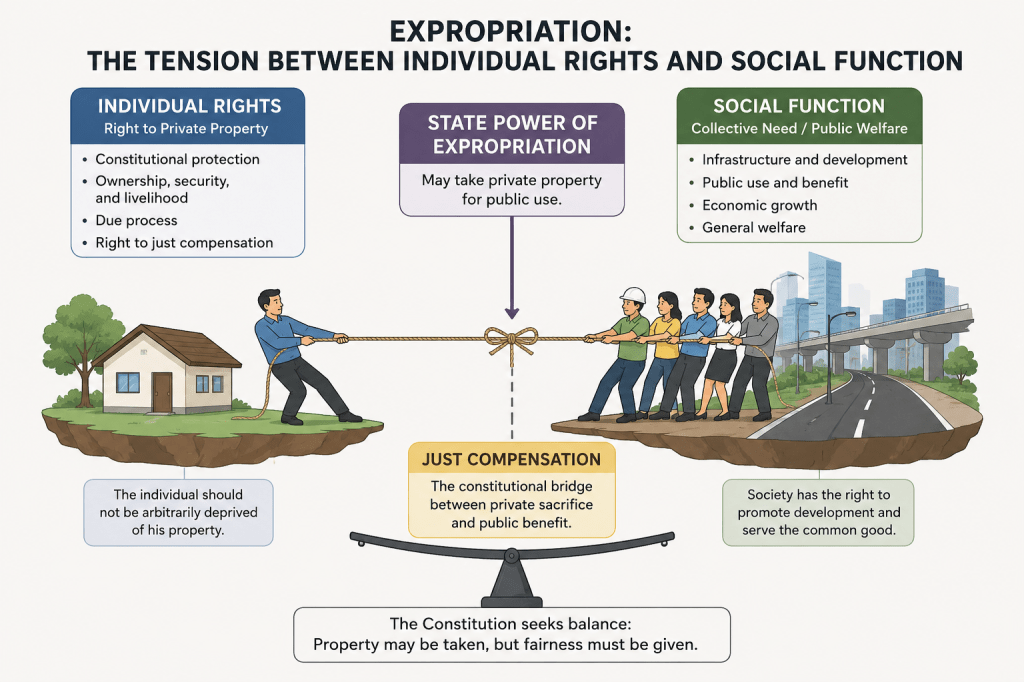
Expropriation and Just Compensation: Between Individual Rights and Social Function

Expropriation is often discussed as a procedural mechanism through which the government acquires private property for roads, bridges, transmission lines, airports, flood control systems, and other public infrastructure. Yet beneath its procedural framework lies one of the deepest constitutional tensions in democratic governance — the tension between the rights of the individual and the demands of the collective.

At the center of every expropriation case is a constitutional balancing process. On one side stands the individual property owner invoking the protection of the Bill of Rights. On the other side stands the State acting in the name of public welfare, infrastructure development, and societal necessity. Eminent domain exists precisely because constitutional democracy recognizes both interests as legitimate.

The Constitution protects private property because ownership is deeply tied to liberty, security, livelihood, and human dignity. Land is not merely a commodity or economic asset. For many families, property represents inheritance, identity, social stability, and intergenerational survival. The taking of property therefore affects more than physical land; it interferes with constitutionally protected expectations and rights.

This is why Article III, Section 9 of the Constitution declares that private property shall not be taken for public use without just compensation. The provision reflects the recognition that while the State may possess sovereign authority to compel the transfer of property for public purposes, such power is never absolute. The Constitution restrains governmental authority by imposing safeguards grounded on fairness and due process.

At the same time, society itself possesses collective needs that cannot be ignored. Modern civilization depends upon infrastructure and public systems that require land. Roads, railways, ports, schools, hospitals, power lines, flood control projects, water systems, and transportation corridors cannot materialize without space. Urbanization, economic development, environmental protection, and disaster resilience increasingly require coordinated public intervention over land use and spatial development.

Without the power of eminent domain, public infrastructure could easily become hostage to fragmented ownership or strategic refusal to sell. Collective welfare would become difficult, if not impossible, to achieve.

Thus, expropriation emerges as a constitutional compromise between private ownership and public necessity. The State may compel the taking of private property for public use, but society cannot impose the burden of public development upon a single owner without compensation. Just compensation therefore becomes the constitutional bridge between collective benefit and private sacrifice.

In many ways, just compensation reflects a principle of distributive justice. If society benefits collectively from a public project, then society — acting through the State — must fairly compensate the individual whose property was sacrificed for that collective benefit. The owner may not necessarily prevent a lawful taking for public use, but the owner possesses the constitutional right to receive the full and fair equivalent of the property taken.

This explains why the Supreme Court consistently emphasizes that the determination of just compensation is a judicial function. Courts serve as constitutional arbiters between governmental power and individual rights. The judiciary ensures that compensation is not dictated solely by political convenience, administrative valuation schedules, or institutional interests. Judicial review prevents the possibility that the coercive power of the State overwhelms constitutional fairness.

The valuation process itself therefore acquires constitutional significance. In expropriation, appraisal is no longer merely technical or commercial. Market value becomes part of constitutional justice. An undervalued appraisal effectively forces the landowner to subsidize public infrastructure unfairly. Conversely, an excessive valuation burdens public resources and ultimately affects society as a whole. The objective is constitutional equilibrium — fairness both to the owner and to the public.

This constitutional balancing also explains the critical role of commissioners under Rule 67 of the Rules of Court. Commissioners are not representatives of the expropriating agency nor advocates for the landowner. They are auxiliaries of the court tasked to assist in the fair and impartial determination of just compensation. Their role carries constitutional implications because they participate directly in balancing individual rights against collective societal interests.

For this reason, the Rules require commissioners to be competent and disinterested. Independence is essential because once valuation becomes driven by institutional loyalty, political pressure, or predetermined outcomes, the constitutional integrity of the expropriation process begins to erode.

The tension between individual rights and collective welfare has become even more complex in contemporary society. Today, expropriation increasingly intersects with climate adaptation, environmental protection, renewable energy, urban redevelopment, mass transportation, disaster mitigation, and sustainability planning. Governments now justify takings not only for traditional infrastructure, but also for broader societal objectives involving environmental resilience and long-term public survival.

As collective interests expand, however, constitutional protections remain indispensable. The challenge of modern governance is not simply to accelerate development, but to ensure that development remains constitutionally just.

This evolving landscape also transforms the nature of property law itself. Expropriation can no longer be understood solely as a procedural remedy or land acquisition mechanism. It now exists at the intersection of constitutional law, valuation, urban planning, economics, environmental governance, and infrastructure policy.

The future property lawyer, appraiser, and land governance specialist must therefore understand not only ownership doctrines and legal procedures, but also how land functions within broader economic, environmental, and societal systems. Questions involving just compensation increasingly require appreciation of market behavior, zoning, infrastructure externalities, environmental regulation, and public policy.

Ultimately, expropriation reflects one of the most profound realities of constitutional democracy: ownership is protected, but ownership is not absolute. Property carries both private rights and social obligations. The State may compel individual sacrifice for the collective good, but the Constitution insists that such sacrifice must never occur without fairness, due process, and just compensation.

That enduring balance between individual rights and collective welfare remains the true constitutional essence of eminent domain.

Brief History of Individual and Collective Rights

The history of political and constitutional philosophy reveals a continuing tension between collective authority and individual liberty. In the ancient and medieval world, collective order, political community, and social hierarchy largely dominated over individual autonomy. The individual was viewed primarily as part of the larger social or political body.

From this collective order eventually emerged the philosophy of individual rights during the Enlightenment. Thinkers such as Locke and other liberal philosophers asserted that human beings possess inherent natural rights — life, liberty, and property — which the State must respect rather than create. This intellectual movement eventually gave rise to liberal constitutionalism and the modern Bill of Rights, where the protection of the individual against arbitrary governmental power became central.

However, the rise of industrialization, economic inequality, labor exploitation, and other societal problems exposed the limitations of purely individualistic systems. As a result, constitutional thought gradually evolved once again toward social rights and collective welfare. Modern constitutions increasingly recognized labor rights, social justice, environmental protection, public welfare, and the social function of property.

Today, modern constitutionalism attempts to balance both traditions. Contemporary constitutions protect individual rights and liberties while simultaneously recognizing legitimate collective interests necessary for social order, development, and public welfare. Thus, modern constitutional law is ultimately an ongoing effort to reconcile individual freedom with the demands of society as a whole.

Police Power or Eminent Domain? Lessons from Banco de Oro v. South Rich Acres

One of the recurring constitutional tensions in land use regulation and infrastructure development is the blurred line between police power and eminent domain. Government agencies and local government units often invoke public welfare, regulation, or urban necessity to justify interference with private property rights. Yet the Constitution draws a critical distinction: regulation may be allowed without compensation, but taking requires the payment of just compensation.

This distinction was strongly reaffirmed by the Supreme Court in Banco de Oro v. South Rich Acres, G.R. Nos. 202384 and 202397, decided on May 4, 2021.

The case arose from a dispute involving Marcos Alvarez Avenue in Las Piñas City. South Rich Acres, Inc. (SRA) and Top Service, Inc. owned several parcels of land comprising the road. Over time, the road became heavily used by motorists and residents, eventually functioning as an important access route within the area.

Invoking public welfare and long public use, the City Government of Las Piñas enacted City Ordinance No. 343-97 declaring Marcos Alvarez Avenue a public road. The City essentially argued that the ordinance was merely a regulatory measure under the State’s police power, especially considering the public character the road had already assumed through years of use.

SRA and Top Service challenged the ordinance, arguing that the City had effectively deprived them of ownership and control of their property without payment of just compensation. Meanwhile, Equitable PCI Bank — now Banco de Oro Unibank, Inc. — intervened and supported the City’s position, arguing that subdivision roads had already become public under laws such as.

The Supreme Court rejected these arguments and declared the ordinance unconstitutional.

The Court ruled that the City’s action was not a mere regulation under police power, but an actual taking of private property for public use. Although the road had long been used by the public, the property remained privately titled. Declaring it public through ordinance effectively transferred the beneficial use and control of the property to the public without payment of compensation.

The decision is significant because it sharply clarifies the constitutional distinction between police power and eminent domain.

Police power allows the State to regulate property to promote public welfare, safety, health, and order. Regulation may impose restrictions on how property is used, but ownership remains with the private owner. Since the government merely regulates rather than appropriates the property, compensation is generally unnecessary.

Eminent domain, however, is fundamentally different. It involves the actual taking or appropriation of private property for public use. Once government action effectively deprives the owner of dominion, beneficial use, control, or economic value of the property, the Constitution requires payment of just compensation.

In Banco de Oro v. South Rich Acres, the Court concluded that the ordinance crossed the line from regulation into appropriation. The ordinance did not simply regulate traffic or impose land use restrictions. It effectively converted privately owned property into public property without compensation. The Court viewed the measure as a classic example of eminent domain disguised as police power.

The ruling sends an important warning to local government units and public agencies. Government cannot avoid the constitutional requirements of eminent domain by simply labeling an act as regulation or public welfare legislation. The nature of governmental action is determined not by its title, but by its actual effect on property rights.

This issue is not merely theoretical. It frequently surfaces in actual governance and land use discussions. In one discussion involving an LGU, a public official advocated the use of police power as a basis for utilizing private property for public purposes without compensation. The conversation highlighted how easily the distinction between police power and eminent domain can become blurred in practice, particularly when public infrastructure, access roads, easements, open spaces, or urban development objectives are involved.

This is precisely why the Banco de Oro ruling is highly instructive for LGU executives, planners, assessors, engineers, lawyers, and real estate practitioners alike.

The danger arises when governmental bodies attempt to justify what is effectively a taking under the language of regulation or public welfare. In practice, LGUs may invoke police power to justify road access, public use corridors, environmental restrictions, or land use controls without fully appreciating that certain measures may already constitute compensable taking under the Constitution.

The Supreme Court reminds us that courts will always look beyond labels and examine the actual effect of governmental action on property rights. A measure framed as zoning regulation, traffic management, environmental control, or public welfare legislation may still amount to eminent domain if it effectively converts private property into public use or substantially deprives the owner of beneficial ownership and economic utility.

For LGU executives, the case serves as a constitutional governance guidepost. Public purpose alone does not automatically validate uncompensated intrusion into private property rights. Constitutional safeguards remain applicable even when the intended objective is beneficial to the public.

For real estate practitioners, appraisers, consultants, and lawyers, the distinction is equally important in advising clients, evaluating government actions, assessing damages, and determining whether a governmental measure has crossed the line from regulation into compensable taking.

The case is especially relevant today as infrastructure expansion, urban redevelopment, environmental regulation, and public utility projects increasingly intersect with private property rights. The pressure to accelerate public projects often creates institutional temptation to blur constitutional boundaries in the name of efficiency or public necessity.

But the Constitution imposes limits.

The power of eminent domain remains one of the most intrusive powers of the State because it authorizes the compulsory taking of private property. For this reason, the constitutional guarantee of just compensation serves not merely as a procedural requirement, but as a safeguard against arbitrary deprivation of property.

Banco de Oro v. South Rich Acres reinforces a fundamental constitutional principle: police power cannot be used as a shortcut to acquire private property without compensation. Once regulation crosses the line into appropriation, the State must comply with the constitutional safeguards governing eminent domain.

For further reading, here is the link of the case.

Banco de Oro v. South Rich Acres

RTC Cannot Decide Contractual Condo Disputes Reserved for HLURB/HSAC

Case Alert | Cadungog v. Jung

In the recent case of, the Supreme Court clarified an important jurisdictional distinction involving condominium disputes and criminal violations under.

The case stemmed from a condominium transaction where the buyer filed a criminal complaint for violation of P.D. 957 against the developer. During the proceedings, the RTC not only resolved the criminal aspect of the case but also ruled on contractual matters arising from the parties’ Contract to Sell, including reimbursement and delivery of the condominium unit.

The Supreme Court ruled that while the RTC properly exercised jurisdiction over the criminal prosecution, it had no jurisdiction over the contractual disputes between the buyer and the developer.

According to the Court, the civil liability imposed by the RTC was not civil liability arising from the crime (ex delicto), but civil liability arising from contract (ex contractu). Since the source of the obligation was contractual, jurisdiction belonged exclusively to the HLURB — now the (HSAC) — under P.D. No. 1344.

The Court emphasized that disputes involving:

  • refund,
  • reimbursement,
  • delivery of condominium units,
  • specific performance, and
  • other buyer-developer contractual obligations

fall within the exclusive jurisdiction of the HLURB/HSAC and must be filed separately from the criminal case.

As a result, the RTC’s ruling on the contractual civil aspect was declared void for lack of subject matter jurisdiction.

The ruling is significant because it reinforces the distinction between civil liability ex delicto and civil liability ex contractu. While civil liability arising from a crime may generally be impliedly instituted with the criminal action, this rule does not apply when the obligation arises from contract. In such cases, jurisdiction is determined not by the criminal charge, but by the nature of the contractual dispute and the special law granting exclusive jurisdiction to the HLURB/HSAC.

The decision serves as an important reminder for lawyers, real estate practitioners, and condominium buyers that criminal proceedings under P.D. 957 do not automatically authorize regular courts to resolve contractual disputes reserved by law to specialized housing adjudication bodies.

For further reading, here is the link of the case:

Cadungog v. Jung, GR. 254543

The Courtroom as the Ultimate Test of Appraisal Practice

A recent court hearing involving an expropriation case provided an important and revealing glimpse into the realities of litigation appraisal and the role of commissioners under Rule 67 of the Rules of Court. The proceeding highlighted not only the technical demands of valuation in expropriation cases, but also the constitutional importance of independence and competence among commissioners appointed to assist the court.

In the hearing, one of the commissioners nominated by the plaintiff, the National Grid Corporation of the Philippines (NGCP), was placed on the witness stand and subjected to cross-examination. The commissioner testified that she had served for around thirty years with Napocor and NGCP and had appeared in more than 300 expropriation proceedings as commissioner. On the surface, the credentials appeared extensive and impressive.

However, as the testimony progressed, serious questions emerged regarding the valuation approach and the commissioner’s understanding of her role under Rule 67.

Under Sections 6 and 7 of Rule 67, commissioners occupy a unique position in expropriation proceedings. They are not ordinary witnesses, nor are they advocates for the parties who nominated them. Commissioners are auxiliaries of the court — technical aides tasked to assist the judge in determining just compensation. Because expropriation involves the constitutional taking of private property, the Rules expressly require commissioners to be “competent and disinterested.”

The hearing illustrated why these qualifications are indispensable.

Although the commissioner presented three comparable sales in her report, she ultimately anchored her conclusion on the BIR zonal value and treated it as the basis for just compensation. Defense counsel immediately challenged this methodology, correctly arguing that BIR zonal values are primarily intended for taxation purposes and are not, by themselves, determinative of market value in expropriation proceedings.

Even the trial judge appeared unconvinced and questioned why the valuation could not exceed the zonal value despite the comparable market indicators presented in the report. The commissioner’s response — “makatapal mi ana, Judge” — became a telling moment during the hearing.

At that point, the issue ceased to be merely methodological. It became a question of competence, independence, and fidelity to the commissioner’s duty under Rule 67.

The situation became even more significant when defense counsel asked whether, as an NGCP engineer, the commissioner was protecting the interests of the company. The commissioner answered in the affirmative.

That admission goes directly to the heart of the Rules of Court. A commissioner is not appointed to protect the interests of either the expropriating agency or the landowner. The commissioner’s duty is owed to the court. The obligation is to provide an independent, objective, and professionally defensible opinion to assist the judge in arriving at just compensation. Once a commissioner openly identifies with the interests of one party, the requirement that the commissioner be “disinterested” is placed into serious question.

The hearing likewise provides valuable lessons for new appraisers and those planning to enter litigation appraisal practice.

Courtroom valuation is fundamentally different from ordinary appraisal assignments conducted for banks, internal corporate use, or taxation purposes. In litigation, every assumption, adjustment, methodology, comparable sale, and conclusion may be subjected to intense scrutiny through cross-examination and judicial evaluation. A report is not judged merely by how it is written, but by whether it can withstand legal and technical examination under oath.

More importantly, litigation appraisal is not simply about arriving at a value. It is about demonstrating professional independence, analytical rigor, credibility, and ethical discipline. An appraiser who enters the courtroom without a strong grasp of valuation principles, legal standards, evidentiary requirements, and the constitutional framework governing just compensation risks not only discrediting the report, but also undermining the court’s search for fairness.

The hearing also reflects a broader concern within expropriation practice. There remains a tendency among some commissioners and agency appraisers to treat zonal values as ceilings rather than mere tax benchmarks. Others become overly aligned with institutional interests. But the constitutional standard is neither convenience nor accommodation. The constitutional standard is just compensation.

At the final analysis, the courtroom remains the ultimate testing ground of appraisal practice. Reports must not only be prepared — they must be defensible. Opinions must not only be asserted — they must be supported by evidence, methodology, and independent reasoning. Above all, the appraiser must remember that the duty is not to produce a value desired by a party, but to assist the court in the fair and impartial determination of value.

Beyond Metropolitan Concentration: Why Central Visayas Must Think Like an Archipelagic Economy

I recently wrote a comment on the Central Visayas Regional Development Plan 2023–2028 examining the region from the perspective of regional economics, spatial planning, and archipelagic development. The paper has likewise been formally transmitted to the Regional Development Council (RDC-VII) and the Department of Economy, Planning, and Development (DepDev) Region VII for their consideration as part of the broader discussion on the future development trajectory of Central Visayas.

I believe that sharing these discussions with the broader public is equally important. Regional development planning should not remain confined solely within technical institutions, planning agencies, or government offices. The future of Central Visayas affects communities, businesses, local governments, professionals, environmental sectors, transport systems, housing systems, and the broader regional economy itself. Public discussion, academic engagement, and policy discourse are therefore essential in strengthening long-term regional planning and institutional decision-making.

For decades, development in Central Visayas has largely been driven by infrastructure expansion, metropolitan growth, and connectivity. In many ways, this strategy worked. Metro Cebu emerged as the country’s second major metropolitan economy outside Metro Manila, supported by expanding ports, airports, logistics systems, tourism, and commercial activity.

But beneath this success lies a deeper regional challenge.

Central Visayas is not simply a metropolitan corridor—it is an archipelagic regional economy composed of fragmented island systems heavily dependent on transportation, maritime connectivity, logistics, and coastal urbanization. Cebu and Bohol alone consist of hundreds of islands and islets linked through ports, ferry systems, airports, tourism corridors, and inter-island transportation networks.

In archipelagic economies, infrastructure plays a dual role. Connectivity strengthens mobility, trade, tourism, and economic integration. At the same time, however, it also concentrates economic activity around dominant urban-maritime nodes. In the Visayas, that node became Metro Cebu.

Over time, Metro Cebu evolved into the region’s dominant metropolitan intermediary, integrating transportation systems, labor mobility, logistics networks, tourism activity, and higher-order urban functions across interconnected island economies. This generated rapid economic growth, with Central Visayas becoming one of the Philippines’ fastest-growing regional economies.

Yet the same concentration dynamics also intensified traffic congestion, infrastructure saturation, housing pressures, rising land values, flooding vulnerability, watershed encroachment, and ecological stress. Many peripheral territories likewise became increasingly dependent upon Metro Cebu for employment, transportation access, investment flows, logistics systems, and higher-order services.

The long-term challenge confronting Central Visayas is therefore no longer simply how to expand infrastructure or accelerate metropolitan growth. The deeper issue concerns whether regional integration can generate more territorially distributed, ecologically sustainable, climate-responsive, and production-oriented development across the broader Visayas archipelago.

Ultimately, the future of Central Visayas may depend not merely upon building a stronger metropolis, but upon building a stronger and more resilient archipelagic regional economy.

You may access a copy from this link:

Beyond Metropolitan Concentration: A Regional Economics and Spatial Planning Critique of the Central Visayas Regional Development Plan 2023–2028

 Central Visayas Regional Development Plan (RDP) 2023-2028 

On the Integration of the PENCAS Act in Current CLUP Approvals

Today, Gus Agosto, a licensed Environmental Planner, sent his formal reply to the Department of Human Settlements and Urban Development (DHSUD), signaling a continuing exchange on the review of the Cebu City Comprehensive Land Use Plan (CLUP) 2023–2032.

The exchange brings into focus a critical issue in Philippine land use planning: the alignment of existing planning practices with Republic Act No. 11995, or the Philippine Ecosystem and Natural Capital Accounting System (PENCAS) Act.

Gus Agosto, a former ADB Consultant, stressed that “the law is already in force.” Consequently, its requirements—especially the integration of environmental and natural capital considerations into planning and decision-making—are neither prospective nor optional, but are binding elements of the existing legal framework governing land use.

While the Department has emphasized the need for technical readiness, including the development of standardized datasets and frameworks, it is important to underscore that institutional readiness does not suspend legal obligation. A clear distinction must be made between full technical implementation and minimum compliance. Even at present, there are sufficient tools—such as hazard mapping, watershed delineation, and environmental constraints analysis—to begin integrating ecological limits into planning decisions.

Deferring integration to the “next CLUP cycle,” which may span nearly a decade, risks allowing land use decisions to proceed under frameworks that do not reflect current legal and environmental realities. In a region like Cebu, which continues to face recurring disasters and environmental stress, such delay raises serious concerns about the adequacy of planning safeguards.

Recent events—including the Binaliw dumpsite collapse in January 2026 and the widespread devastation caused by Typhoon Tino in 2025—underscore the real-world consequences of land use decisions that fail to fully account for environmental risks. These incidents highlight the urgency of ensuring that planning frameworks evolve in step with both law and lived experience.

“The issue is not whether we can fully implement PENCAS today, but whether we can justify continuing to approve land use decisions that ignore a law already in force. We already know where the risks are. The responsibility now is to ensure that planning decisions reflect that reality—before the next disaster forces the correction.” Consultant Agosto said.

The objective is not to disrupt planning processes, but to strengthen them. A transitional approach—where PENCAS principles are integrated to the extent practicable while full systems are being developed—offers a balanced and legally sound path forward.

The question is not whether we are ready to implement the law, but whether we can afford not to.

Following is my letter reply to the DHSUD:


HON. ATTY. RAMON QUINTIN CLAUDIO C. ALLADO
Undersecretary
Department of Human Settlements and Urban Development (DHSUD)
Kalayaan Avenue, Diliman
Quezon City

CC  : DIRECTOR, LEGAL SERVICE

 Re: Response to DHSUD Letter dated 16 February 2026
On the Review and Implementation of the Cebu City CLUP 2023–2032

Dear Undersecretary Allado:

I acknowledge receipt of your letter dated 16 February 2026 concerning the review and implementation of the Cebu City Comprehensive Land Use Plan (CLUP) 2023–2032 in relation to the Philippine Ecosystem and Natural Capital Accounting System Act (PENCAS, Republic Act No. 11995).

While I appreciate the Department’s recognition of natural capital accounting’s role in land use planning, I respectfully register strong reservations regarding the proposal to defer its integration until complete frameworks, datasets, and guidelines are issued—or to limit it to the next CLUP cycle.

1. Immediate Binding Effect of the PENCAS Act

Republic Act No. 11995 is in full force and binds all government agencies, including DHSUD, in their administrative functions. The absence of complete technical frameworks or datasets does not suspend this obligation; administrative convenience cannot supersede a statutory mandate.

2. CLUP Approval as a Continuing Administrative Act

CLUP review and approval constitute an ongoing administrative function that must align with laws in effect at the time of the decision. Approving a CLUP without incorporating PENCAS requirements undermines its substantive legal validity, irrespective of procedural compliance.

3. Impropriety of Deferral to the Next Cycle

Deferring the integration of PENCAS to the “next cycle”—effectively a decade from the current 2023–2032 planning horizon, especially in a context marked by historical delays in plan updating—is untenable in the face of recurring and intensifying disasters in Cebu. Recent events, including the January 2026 Binaliw dumpsite collapse that claimed 36 lives, and Typhoon Tino (2025), which left at least 158 fatalities, dozens missing, and thousands injured across Compostela, Liloan, Balamban, Danao City, and Cebu City, underscore the grave consequences of inadequate land use planning.

These incidents are not isolated occurrences, but manifestations of systemic vulnerabilities—many of which may be linked to outdated or insufficiently responsive planning frameworks. In this light, a policy of deferring compliance with the PENCAS Act risks perpetuating land use decisions that fail to reflect environmental constraints and hazard realities. This, in turn, increases foreseeable risk and undermines the duty of planning authorities to align land use regulation with existing legal mandates and evolving environmental conditions.

4. Distinction Between Full Implementation and Minimum Compliance

Full technical implementation may await standardized systems, but minimum transitional compliance is feasible now using available tools like hazard mapping, watershed delineation, and environmental constraints analysis. Ecological limits can thus inform planning without full PENCAS operationalization.

5. Request for Clarification

In view of the above, I respectfully seek clarification on:

i. Whether DHSUD plans to approve CLUPs omitting PENCAS requirements;

ii. Whether interim or minimum compliance measures apply to LGUs pending full PENCAS rollout; and

iii. Whether the Department contemplates transitional guidelines to align current planning with legal mandates.

6. Reservation of Rights

This letter is without prejudice to further actions to ensure land use planning complies with the law and addresses environmental and developmental imperatives.

7. Closing

My intent is not to hinder planning but to affirm that natural capital integration is now a legal imperative, not mere policy.

Thank you for your attention.

Respectfully yours,

Augusto B. Agosto, JD

Environmental Planner

Beyond the Apo Tax Settlement: What the Case Reveals About Quarry Governance in Cebu

Every day in Cebu, the equivalent of 500 dump trucks of limestone leaves the province’s quarry sites. Over a year, that amounts to roughly 3.6 million tons of limestone—enough trucks lined up bumper to bumper to stretch from Cebu to Manila and back.

Yet a recent tax dispute between the Province of Cebu and Apo Land and Quarry Corporation ended with a compromise settlement of Php211.56 million, far lower than the original Php1.218 billion assessment. The tax dispute arose from differing interpretations of the province’s authority to impose quarry extraction taxes.

At first glance, the reduction appears dramatic. But the outcome reflects an important legal reality: the taxing powers of local governments are limited by national law and Supreme Court jurisprudence.

Understanding the Apo quarry case therefore, requires looking beyond the headline numbers. It reveals how law, economics, and natural resource governance intersect in a rapidly developing province like Cebu.

According to reports, the Province of Cebu initially assessed Apo Land and Quarry Corporation approximately Php1.218 billion in quarry-related taxes, fees, penalties, and interest covering operations from around 2006 to 2022. After legal review, the assessment was recalculated and reduced to a proposed Php211.56 million compromise settlement, leaving a difference of roughly Php1.006 billion. When this proposed settlement is spread across the coverage period, the provincial recovery corresponds to roughly Php13.2 million per year. The compromise, however, is not yet final and is currently under review by the Cebu Provincial Board, which must decide whether the negotiated settlement should be approved.

The Cebu Quarry Ledger

One way to understand the Apo quarry case is to view it through a simple economic ledger that compares physical extraction, economic value, and fiscal recovery.

CategoryIndicatorApproximate Value
Physical extractionLimestone production~3.6 million tons per year
Logistics equivalentDump truck loads~180,000 trucks per year
Daily extractionTruck equivalent~500 trucks per day
Production valueQuarry output~₱225 million per year
Provincial recoverySettlement equivalent~₱13.2 million per year
Fiscal capture ratioProvincial share~6%

The reduction of the assessment was largely driven by the legal limits of provincial taxation powers. Provincial governments derive their authority to levy quarry taxes from the Local Government Code of 1991, which allows provinces to impose taxes on sand, gravel, and other quarry resources extracted from public lands or public waters. Apo Land and Quarry Corporation operates limestone quarries under Mineral Production Sharing Agreements (MPSAs) issued by the national government pursuant to the Philippine Mining Act of 1995. The Supreme Court clarified the limits of provincial quarry taxation in Province of Bulacan v. Court of Appeals (G.R. No. 126232, 1998), ruling that provinces cannot impose quarry extraction taxes on minerals extracted from private lands covered by mining agreements. Because part of the original Cebu assessment involved such extraction taxes, those components could not be legally sustained. Once they were removed, the remaining obligations consisted mainly of monitoring fees, environmental charges, penalties, and interest.

To appreciate the scale of quarry operations in Cebu, it helps to examine limestone production data. According to records of the Mines and Geosciences Bureau, Cebu produces roughly 3.6 million metric tons of limestone annually. Production reached about 3.91 million tons in 2022, 3.47 million tons in 2023, and 3.62 million tons in 2024, for a total of roughly 11 million tons of limestone extracted over three years.

Apo’s reported production value has been approximately:

Php225 million per year.

Compared with the provincial recovery under the proposed settlement:

IndicatorAmount
Annual production value~Php225 million
Average provincial recovery~Php13.2 million
Estimated fiscal capture~6%

It should be noted that other taxes—such as corporate income tax and excise tax on minerals—are collected by the national government, not by the province.

The Apo case highlights a structural feature of Philippine resource governance.

Numbers of this scale can be difficult to visualize. If a typical quarry dump truck carries 20 tons of limestone, Cebu’s annual limestone production would require approximately 180,000 truckloads per year. Spread across the year, this corresponds to roughly 500 dump trucks of limestone leaving quarry sites every single day. If these trucks were lined up bumper to bumper, the line would stretch approximately 1,440 kilometers, roughly the distance from Cebu to Manila and back.

The production value associated with these operations is also significant. Apo’s reported quarry production value has been approximately Php225 million annually. When compared with the proposed provincial recovery under the compromise settlement—about Php13.2 million per year—the province’s fiscal capture represents roughly six percent of the reported production value. It should be noted, however, that other taxes such as corporate income taxes and mineral excise taxes are collected by the national government, not by the province.

The Apo case illustrates a structural feature of Philippine resource governance. Mineral resources are owned by the State and administered by the national government through mining agreements and permits. While extraction activities occur within provinces and municipalities and may have local environmental and land-use implications, the authority to regulate mining operations and collect major fiscal revenues largely rests with the national government. As a result, extraction occurs locally, environmental impacts are experienced locally, but taxation authority may be limited locally.

The compromise settlement in the Apo case therefore highlights a broader issue in how the economic value of natural resources is measured and governed. Taxes capture only part of the economic activity associated with extraction, and they often do not reflect the environmental systems that support development. This is precisely the gap addressed by the Philippine Ecosystem and Natural Capital Accounting System Act, which institutionalizes ecosystem and natural capital accounting in the Philippines. Natural capital accounting provides a framework for recognizing ecosystems—such as watersheds, forests, and karst landscapes—as economic assets that contribute to long-term development.

For provinces like Cebu, where quarrying occurs in upland landscapes and watershed areas, natural capital accounting can provide a more comprehensive understanding of the economic context in which resource extraction takes place. While taxation remains an important fiscal tool, ecosystem accounting helps policymakers recognize the value of environmental systems that sustain communities and economic activity.

As the Provincial Board reviews the proposed compromise settlement, the decision involves more than simply approving a negotiated amount. The board must weigh the legal sustainability of the original assessment, the fiscal risks of continued litigation, the potential precedent that a settlement may create for other cases, and the broader need to strengthen governance of natural resources within the province.

The Apo quarry tax case is therefore not merely about the reduction of a tax assessment from Php1.218 billion to Php211 million. It reflects the complex interaction between national control of mineral resources and local responsibility for land use and environmental management. As Cebu continues to grow as an economic center in the Visayas, the challenge will be to ensure that resource extraction contributes to development while maintaining responsible stewardship of the landscapes that sustain communities and ecosystems.

The lesson of the Apo case is that while taxes measure the revenue generated from extraction, natural capital accounting helps us understand the value of the landscapes from which those resources are taken.

The dynamics of quarry extraction also raise a broader political-economic question. While limestone extraction generates private economic returns for firms and supports industrial production, the environmental risks associated with landscape modification—such as altered drainage patterns, erosion, and increased flood vulnerability—are often experienced downstream. In many resource economies, economic gains from extraction are concentrated at the site of production, whereas environmental risks, such as flooding, may be borne by downstream communities.

This article analyzes publicly available information and policy issues related to quarry governance and natural capital.

Cebu’s CLUP and the Problem We Refuse to Map: Waste Disposal

Today, I attended a meeting where solid waste disposal finally took center stage. At one point, a lawyer asked me a direct question: If we are against the use of Binaliw as the city’s final disposal site, then where should Cebu put its waste?

I was a bit surprised—not because the question was hostile, but because it reflected a familiar assumption in our planning conversations: that an unsafe site somehow becomes acceptable simply because there is no immediate alternative.

My response was straightforward. If Binaliw is geologically unsafe, environmentally prohibited, or legally non-compliant, then it must be closed or phased out—even if there is no instant replacement yet. The absence of an alternative does not legalize a dangerous site. It only exposes the failure of long-term planning.

That exchange captures the heart of Cebu’s waste dilemma. We are repeatedly forced to choose between maintaining a risky status quo and confronting the harder task of planning properly. In truth, solid waste disposal is not merely an operational problem—it is a land-use problem. And unless it is clearly integrated into the city’s Comprehensive Land Use Plan (CLUP), we will keep asking the same question every time a crisis occurs: If not here, then where?


Waste Is Not a Side Issue. It Is a Planning Constraint.

Every land-use decision produces waste. Higher density means more garbage. Commercial expansion means more packaging waste. Mixed-use zones mean round-the-clock waste generation.

Despite this, solid waste management in Cebu has often been treated as a sectoral concern, discussed in a separate plan, handled by a different office, and enforced at the barangay level—while the CLUP proceeds as if waste were invisible.

This separation is a fundamental planning error.

Under Philippine planning law, solid waste is not optional, operational, or secondary. It is a land-use issue that must be integrated into the CLUP itself.


What the Law Already Recognizes

Republic Act No. 9003, the Ecological Solid Waste Management Act, is explicit: solid waste management must be integrated into local development and land-use planning.

This is not theoretical. The Department of Human Settlements and Urban Development (DHSUD) enforces this principle every day.

A subdivision cannot be approved without:

  • a Materials Recovery Facility (MRF),
  • a waste management plan,
  • and a clear disposal arrangement.

If DHSUD requires this level of scrutiny for a single subdivision, then it follows logically—and legally—that a city-wide CLUP must meet a higher standard, not a lower one.

Yet many CLUPs, including Cebu’s, expand urban development without clearly mapping:

  • where MRFs will be located,
  • where transfer and processing facilities will go,
  • how buffer zones will be enforced,
  • or how increased waste volumes will be safely handled.

The Inayawan Closure and the Illusion of Disposal

Cebu City once relied on the Inayawan Sanitary Landfill. That facility is now closed following environmental and legal challenges.

What replaced it is not a new landfill within the city—but dependence on external disposal arrangements.

There is nothing inherently wrong with regional disposal. In fact, for a dense island city like Cebu, regional solutions often make sense.

But here is the planning problem:

The CLUP does not clearly acknowledge or spatially integrate this dependency.

If waste is transported out of the city, the CLUP must still plan for:

  • transfer stations,
  • waste logistics corridors,
  • processing and diversion facilities,
  • environmental safeguards along the way.

Ignoring these realities does not make them disappear. It simply pushes them into unsafe locations.


Binaliw and the Cost of Planning Silence

The presence of waste-related facilities in upland barangays like Binaliw—and the landslide incidents associated with them—should be a wake-up call.

These are not isolated operational failures. They are predictable outcomes of weak land-use integration.

RA 9003 prohibits waste facilities in environmentally critical and geologically unstable areas. Cebu’s own studies identify upland zones as landslide-prone and ecologically sensitive.

When waste facilities end up there, it is not because the law is unclear. It is because the CLUP failed to make waste a binding spatial constraint.


Barangay Conflicts Are Symptoms, Not Causes

Recent disputes between barangays and City Hall over waste segregation and collection protocols highlight another consequence of poor integration.

Barangays are asked to enforce “no segregation, no collection” policies—but without:

  • sufficient MRFs,
  • zoning support,
  • land reserved for facilities,
  • or clear citywide spatial guidance.

This creates friction, confusion, and inconsistent enforcement. It also undermines public trust.

A CLUP that integrates waste properly does not leave barangays to improvise. It provides spatial clarity and institutional backing.


Regional Solutions Require Local Responsibility

Some argue that final disposal should be regional, not city-based. That may be true.

But regional scale does not excuse local planning.

Even if the landfill or waste-to-energy facility is outside Cebu City, the CLUP must still:

  • prohibit unsafe siting within the city,
  • reserve land for waste processing and transfer,
  • link development intensity to waste system capacity,
  • and protect watersheds and communities from downstream impacts.

Planning ends not at jurisdictional boundaries, but at impact pathways.


The Real Question the CLUP Must Answer

A credible CLUP must be able to answer this simple question:

As Cebu grows denser and more complex, where—and how—will its waste be safely managed?

If that answer is not visible on the zoning map, then the plan is incomplete.

Urban resilience is not built only with roads and buildings. It is built by managing what cities produce—especially what they discard.


Closing Thought

Garbage is not glamorous. It does not attract investors or ribbon cuttings. But it is one of the most honest indicators of whether a city’s planning is grounded in reality.

If waste management is mandatory at the subdivision level, it must be central at the city level.

Because in the end, a land-use plan that cannot account for its waste is not planning for sustainability—it is planning for crisis.

Cebu City’s CLUP as a Regional Economic Instrument:

Why Land Economics Must Anchor Urban Planning

Urban land use planning in Cebu City cannot be treated as a purely local spatial exercise. As the primary economic anchor of Central Visayas (Region VII), Cebu City performs metropolitan and regional functions that extend far beyond its administrative boundaries — economically, socially, and spatially.


Cebu City in the Regional Economic Structure

Central Visayas remains one of the fastest-growing regional economies in the Philippines. In 2024, the region’s gross regional domestic product (GRDP) reached about ₱1.28 trillion, expanding at 7.3 percent — higher than the national average — and maintaining its position as the largest economy in Visayas and Mindanao.

Within this context, Cebu City continues to serve as the regional engine:

  • In 2024, Cebu City’s economy expanded by about 7 percent, with a total output of roughly ₱334.48 billion, driven by trade, finance, and professional services.
  • According to recent Provincial Product Accounts, Cebu City accounted for about 22.6 percent of Central Visayas’ regional economy in 2023, second only to the entire Province of Cebu.

Cebu City’s economic footprint is not contained within city boundaries: it affects employment patterns, investment flows, infrastructure utilization, and land markets across multiple provinces and cities in the region.


Zoning as a Regional Economic Decision

Urban economic theory explains that development rights — created and modified by zoning — are capitalized into land values and development incentives.

In Cebu City:

  • The IT Park–Lahug corridor drives strong agglomeration effects.
  • The CBD–Port core remains a critical commercial and logistics hub.
  • The South Road Properties (SRP) influence is reshaping coastal development patterns.
  • Fringe and upland barangays are facing conversion pressures with implications for peri-urban growth.

These dynamics produce a complex land value gradient that must be recognized and regulated in the CLUP.


Regional Spillover Effects

When land values in Cebu City rise due to zoning changes, the pressure is felt in neighboring LGUs:

  • Housing demand spills over into Consolacion, Lilo-an, and Talisay.
  • Commuter flows cross city boundaries, stressing transport corridors.
  • Agricultural land conversion accelerates in fringe municipalities.

This illustrates that Cebu City’s land use decisions are not isolated. They shape regional patterns of growth and require a planning perspective consistent with broader regional development strategies — including the Central Visayas Regional Development Plan.


Why RLUC and DHSUD Review Cebu City’s CLUP

The institutional review structure reflects this regional reality.

The Regional Land Use Committee (RLUC), operating within the regional planning structure of the Department of Economy, Planning, and Development (DEPDev), conducts technical assessment of CLUPs to ensure consistency with regional spatial strategy and economic coherence.

Meanwhile, the Department of Human Settlements and Urban Development (DHSUD) serves as the national approving authority — guaranteeing alignment with national urban development policy, hazard integration, infrastructure standards, and housing obligations.

This layered review is not bureaucratic duplication. It is recognition that Cebu City’s land use decisions have regional repercussions, and thus must be evaluated not only for local coherence but for their impact across the metropolitan and regional system.


Infrastructure and Fiscal Discipline

Allowing density increases without aligning them with infrastructure capacity produces:

  • Higher capital expenditure demands
  • Road and drainage system overload
  • Greater disaster risk exposure

A responsible CLUP must factor in not just spatial demand but also infrastructure load-testing and projected fiscal impact. Growth may increase revenue — but it may also create unfunded liabilities if infrastructure and risk costs are excluded from the analysis.


Climate Risk as an Economic Variable

Hazard-prone areas — floodplains, landslide slopes, coastal lowlands — are not merely environmental concerns. They are economic risk multipliers that, if developed without restraint, impose long-term costs on public budgets and private livelihoods.

To address this, the CLUP must define:

Net Developable Land =
Gross Land – Hazard Constraints – Easements – Protected Zones

This adjusted baseline must inform density decisions.


Housing Affordability and Land Cost Capitalization

In high-demand corridors of Cebu City, land cost often represents a major portion of overall housing price. If land value increases faster than housing supply expands, zoning changes alone will not yield affordability — they may worsen it.

This underscores the need for inclusionary mechanisms and spatial strategies that place housing close to jobs, infrastructure, and hazard-safe areas.


Cebu City as Metropolitan Steward

The CLUP of Cebu City must operate as:

  • A regulator of land value winds
  • A coordinator of infrastructure investments
  • A climate risk filter
  • A promoter of equitable housing outcomes
  • A mediator of regional economic stability

When Cebu City adjusts density and land use rules, the regional economy adjusts with it.


Planning for Value and Region

Cebu City’s CLUP must transcend the narrow framing of zoning colors on paper. It must be anchored in land economics and regional economic logic — because spatial decisions in this city do not stay within its borders. They shape the future of Central Visayas and influence conditions well beyond.